


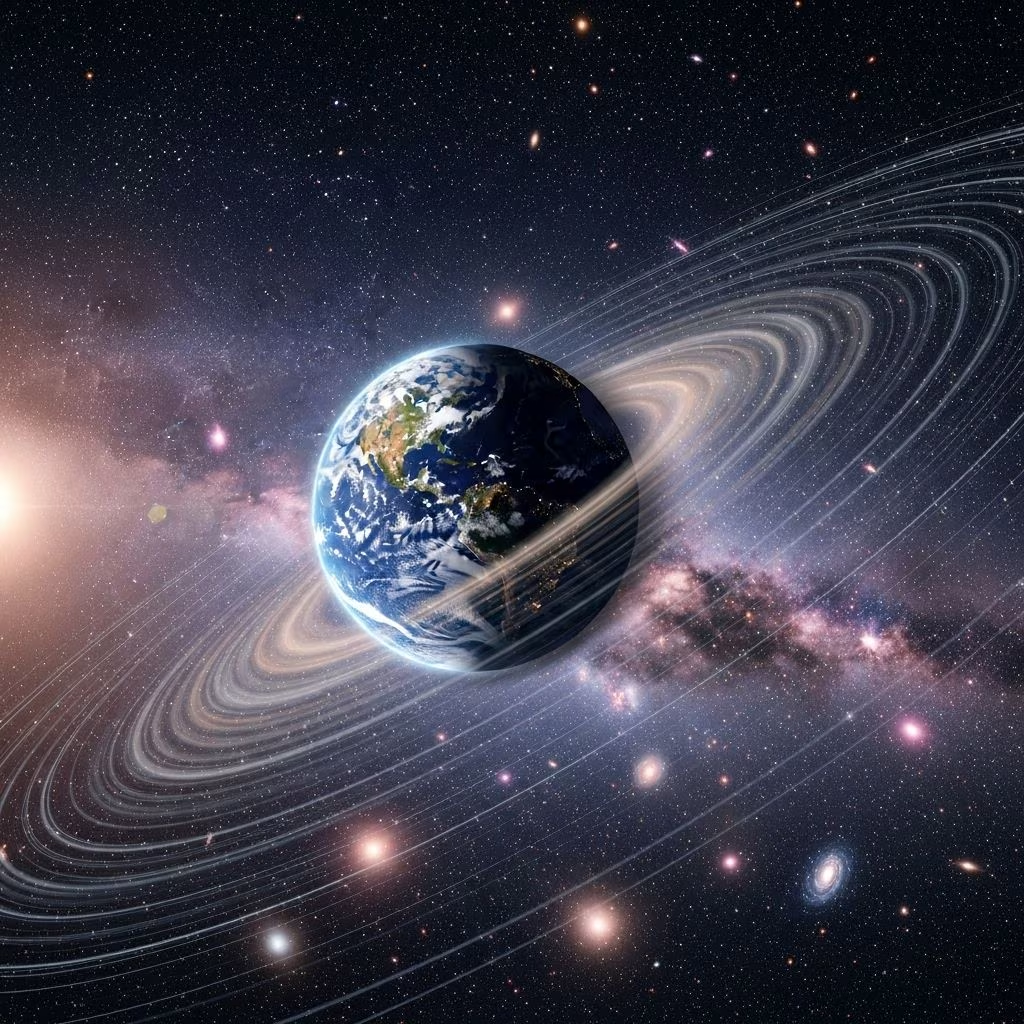
How Fast Is Earth Moving?
Each day, as we go about our routines, we’re traveling through space at incredible speeds—far faster than we might ever perceive. Earth itself is not stationary: it spins, orbits, and even travels with the Sun through the galaxy and universe. Understanding Earth’s motion offers new perspectives on our place in the cosmos and the forces shaping our planet’s environment.
Earth’s Rotation: The Daily Spin
Earth rotates around its own axis once every 24 hours. This rotation produces day and night and causes the familiar movement of the Sun, Moon, and stars across the sky. But how fast are we moving because of this rotation?
- Speed at the equator: The Earth’s surface moves at roughly 1,670 kilometers per hour (about 1,037 miles per hour) at the equator.
- The speed varies with latitude, decreasing steadily as you move towards the poles (where it becomes nearly zero).
- Despite such high speed, we don’t feel Earth’s rotation due to the uniformity and enormity of its scale—and because we rotate with it, only extreme changes (such as sudden stops) would be detectable to our bodies.
To visualize this, imagine standing on the equator as Earth spins beneath you; over the course of a day, you’d travel about 40,000 kilometers—roughly Earth’s circumference!
| Location | Rotational Speed (km/h) | Rotational Speed (mph) |
|---|---|---|
| Equator | 1,670 | 1,037 |
| Mid-Latitude (e.g., New York) | 1,275 | 792 |
| Poles | 0 | 0 |
Earth’s Orbit: Racing Around the Sun
While spinning on its axis, Earth also orbits the Sun—completing one revolution every 365.25 days. The orbital speed is much faster than rotation:
- Average orbital speed: 29.78 kilometers per second (about 107,000 kilometers per hour, or 66,600 miles per hour)[12].
- This speed varies slightly due to Earth’s elliptical orbit: from about 29.29 km/s at aphelion (farthest from the Sun) to 30.29 km/s at perihelion (closest to the Sun)—a difference of roughly 3%.
- Earth’s orbital journey covers nearly 940 million kilometers (584 million miles) every year.
- Compared to other planets:
- Mercury: 47 km/s
- Venus: 35 km/s
- Mars: 24 km/s
- Neptune: 5.4 km/s
| Planet | Orbital Speed (km/s) |
|---|---|
| Mercury | 47 |
| Venus | 35 |
| Earth | 29.78 |
| Mars | 24 |
| Neptune | 5.4 |
Our orbital velocity around the Sun is mostly responsible for the formation of our calendar year and the cycles of seasons. This speed is so great that were it to stop, Earth would plunge directly into the Sun.
The Solar System’s Journey Through the Milky Way
Earth’s motion doesn’t stop with its rotation and orbit; together with the Sun and the entire solar system, we move through the Milky Way galaxy.
- The solar system orbits the center of the Milky Way at a speed of about 828,000 kilometers per hour (514,000 miles per hour)[12].
- This immense journey takes our solar system about 225 to 250 million years to complete one galactic orbit, a period known as a cosmic year or galactic year.
- As we traverse this path, the Sun and its planets oscillate above and below the galactic plane, creating a more complex motion.
Visualize the Sun—in turn, Earth—orbiting a point located about 26,000 light-years from us, at the heart of our galaxy. All stars visible to the naked eye are traveling with us across this vast expanse.
The Milky Way’s Flight in the Universe
On an even larger scale, the Milky Way galaxy itself is moving through space. Its motion is determined by the gravitational tugs of other galaxies, the overall expansion of the universe, and mysterious attractors.
- The Milky Way moves at an estimated speed of about 2.1 million kilometers per hour (1.3 million miles per hour) relative to distant cosmic structures.
- This movement is measured against the Cosmic Microwave Background (CMB), the remnant radiation from the Big Bang that serves as the universe’s reference frame.
- Our galaxy, along with the nearby Andromeda galaxy and others within the Local Group, is heading generally toward the Great Attractor, a gravitational anomaly in intergalactic space.
Summary Table: Earth’s Multilayered Motion
| Type of Motion | Speed | Reference Point |
|---|---|---|
| Rotation (Equator) | 1,670 km/h | Earth’s axis |
| Orbit around Sun | 107,000 km/h | Sun |
| Solar System in Milky Way | 828,000 km/h | Galactic center |
| Milky Way in Universe | 2,100,000 km/h | Cosmic Microwave Background |
Comparing Cosmic Speeds
- The speed of light, at 299,792 kilometers per second (186,282 miles per second), dwarfs all of Earth’s movements: it is roughly 350 times faster than the sum of all these cosmic velocities combined.
- Despite these dizzying speeds, gravity keeps Earth, the solar system, and our galaxy’s stars bound together in coherent motion.
- All of these velocities are essentially imperceptible in daily life. The stability and scale of these motions prevent us from feeling them directly.
Our Cosmic Motion: What Does All This Mean?
Understanding how fast Earth is moving answers more than just a curiosity—it underpins scientific knowledge about seasons, climate, navigation, and the very stability of life on our planet.
- Earth’s rotation shapes day and night, affecting everything from sleep rhythms to weather systems.
- Earth’s orbit sets the length of our year and the progression of seasons; slight variations influence climate over eons.
- Solar system’s galactic orbit is implicated in long-term geological and evolutionary cycles, such as the movement of cometary bodies and cosmic radiation exposure.
- Our galaxy’s course through space is a puzzle for cosmologists, helping to map the structure and future of the universe.
These layered, immense movements put our daily experience in humbling context. While you may feel stationary, you are actually part of a planet spinning, orbiting, and journeying through an unimaginably vast universe.
Frequently Asked Questions (FAQs)
Q: Why don’t we feel Earth moving?
A: Earth’s movements—be it rotation, orbit, or galactic drift—are extremely smooth and constant. Because we’re enclosed in Earth’s atmosphere and moving at the same velocity as everything around us, there’s no perceptible sensation of speed, just as passengers in a smoothly moving train don’t feel motion until it stops or accelerates abruptly.
Q: What keeps Earth in its orbit?
A: Earth is kept in orbit by the gravitational pull of the Sun, balanced perfectly by our planet’s own inertia (its tendency to move in a straight line). This interplay forms a stable, nearly circular trajectory around the Sun[12].
Q: Does the speed of Earth ever change?
A: Earth’s orbital speed varies slightly over the year due to the elliptical shape of its orbit. At perihelion (closest approach to the Sun, in January), Earth moves fastest. At aphelion (farthest point, in July), it moves slower[10].
Q: Could Earth’s speed increase?
A: Theoretically, yes—if a massive object like another planet or asteroid were to affect Earth’s momentum, or if the Sun’s mass changed significantly. In practice, these possibilities are extremely remote. Minute changes do occur from interactions with the Moon and other planets, but Earth’s motion is remarkably stable[12].
Q: What is the fastest movement Earth experiences?
A: Among the motions described, the motion of our galaxy relative to the universe itself is the fastest, at over 2 million kilometers per hour. However, relative to our everyday lives, the rotation at the equator and orbital motion around the Sun are the most relevant[11].
The Big Picture: Our Place in the Cosmos
Earth’s motion is a symphony of interacting speeds, from the slow grace of its axial rotation to the breathtaking galactic dash through the universe. Each layer of movement ties us closer to the unfolding story of the cosmos—a story still being written as science continues to reveal ever more about the nature and destiny of our ever-moving world.
- Every object we see—from stars and distant galaxies to comets and space dust—is in constant, dynamic motion.
- Earth’s motions have shaped everything from the length of our day to the existence of seasons, from timekeeping methods to the very possibility of life.
- Ultimately, understanding these speeds gives us awe and appreciation for our planet’s journey—a cosmic voyage that each of us shares, every moment, as passengers on a spaceship called Earth.
References
- https://en.wikipedia.org/wiki/Earth’s_rotation
- https://bigthink.com/starts-with-a-bang/fast-earth-move/
- https://www.youtube.com/watch?v=oW2GT48ZLwA
- https://www.youtube.com/watch?v=wRbdZTlEsYU
- https://en.wikipedia.org/wiki/Earth’s_orbit
- https://www.worldatlas.com/space/how-fast-is-the-earth-moving.html
- https://www.edge-of-knowledge.com/edge-blog/2025/7/30/how-fast-is-earth-really-moving-through-space
- https://ourplnt.com/speed-of-earth-in-space/
- https://learn.sci-nature.com/2024/11/how-exactly-does-planet-earth-move.html
- https://bigthink.com/hard-science/how-fast-is-earth-moving-through-space/
- https://www.futura-sciences.com/en/how-fast-does-the-earth-move-through-space_9258/
- https://travelpander.com/how-fast-does-the-earth-travel/
- https://scienceshot.com/post/how-fast-is-earth-moving-discover-its-astonishing-speed
- https://www.sciencefocus.com/planet-earth/earth-rotation-speed
- https://ilovetheuniverse.com/how-fast-does-the-earth-move
- https://time.com/7301379/earth-rotation-speeding-up-science/


