


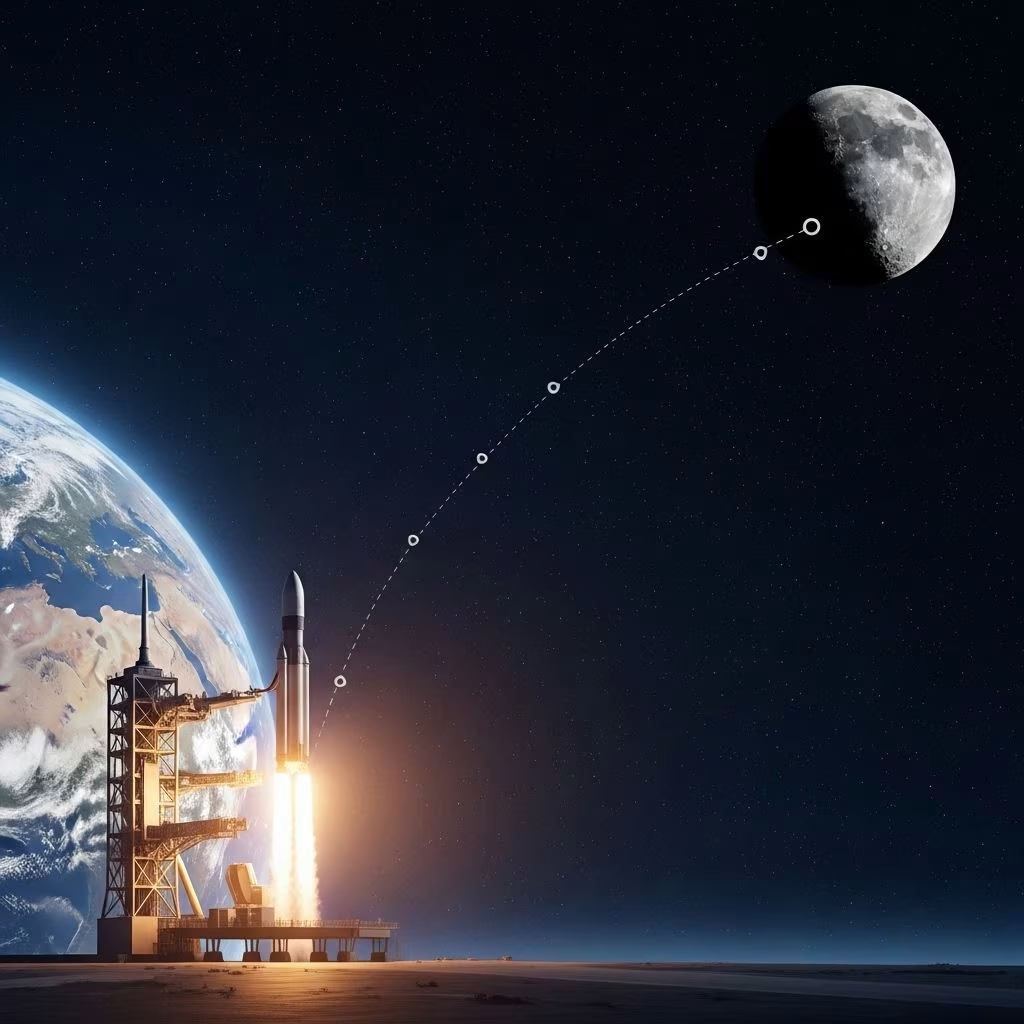
The question of how long it takes to get to the moon has fascinated generations, from the engineers of the Apollo era to the visionaries steering future lunar expeditions. The journey may seem straightforward, but a host of engineering, orbital, and logistical decisions can affect the answer—ranging from mere hours on speedy robotic flybys to multi-month odysseys for low-fuel probes.
Why the Moon’s Distance Is Not Fixed
The moon orbits Earth at an average distance of 238,855 miles (384,400 kilometers), but this is not a static figure. The moon’s orbit is elliptical, so the distance between Earth and the moon changes as both bodies move through space.
- Closest point (perigee): ~225,623 miles (363,104 km)
- Farthest point (apogee): ~252,088 miles (405,696 km)
This distance variation matters, especially when calculating the travel time for different missions—and it’s one of several reasons why there is no single answer to the question of ‘how long it takes to get to the moon.’
What Factors Affect Lunar Travel Time?
A mission’s duration from Earth to the moon is largely shaped by the following elements:
- Type of trajectory chosen (direct, free-return, or looping orbits)
- Amount of fuel used vs. mass carried
- Purpose of the mission (crewed landing, uncrewed flyby, orbit insertion, or lander rendezvous)
- Spacecraft technology and propulsion system
Each of these variables can change the journey’s length by hours, days, or even months.
For example, using more fuel allows for a more direct, faster trip, but may be costly or technically constrained. Conversely, using the gravitational pull of other bodies or slowly widening orbits saves fuel at the cost of time.
Record-Setting Journeys: The Fastest Flights to the Moon
Not all moon missions are alike—some simply fly past, while others need to slow down and enter lunar orbit or land. Here are a few notable records:
- Fastest flyby: NASA’s New Horizons probe, en route to Pluto, passed the moon in just 8 hours and 35 minutes after launch—though it did not attempt lunar orbit or landing.
- First lunar mission: The Soviet Luna 1 (1959) reached the moon’s vicinity in 34 hours, though it missed the target and continued into deep space.
- Typical robotic probe: Lunar Orbiter missions of the 1960s and current uncrewed landers frequently take between 2.5 and 5 days.
Table: Notable Journeys to the Moon
| Mission | Year | Duration (Earth to Moon) | Type | Notes |
|---|---|---|---|---|
| New Horizons | 2006 | 8 hours 35 minutes | Flyby | Fastest to the moon, but did not stop |
| Luna 1 | 1959 | 34 hours | Flyby (missed) | First lunar mission, deviated from trajectory |
| Apollo 11 | 1969 | 109 hours 42 minutes (~4.5 days) | Crewed landing | First humans on the moon |
| Beresheet (SpaceIL) | 2019 | Approx. 6 weeks | Uncrewed lander | Fuel-efficient, complex orbit. Crash landing. |
How Long Did It Take Apollo 11 to Reach the Moon?
The Apollo 11 mission, which saw humans step on another world for the first time, remains a benchmark for lunar travel:
- Launch to lunar orbit: Apollo 11 lifted off from Kennedy Space Center on July 16, 1969.
- Travel time: 109 hours and 42 minutes (about 4.5 days) from Earth to lunar orbit.
- Landing: Neil Armstrong and Buzz Aldrin descended via the Lunar Module and set foot on the surface on July 20, 1969.
This time included trans-lunar injection, coast through space, and orbital maneuvers to position the spacecraft for landing.
Other Apollo missions reported similar durations, usually three to five days in transit.
Why Some Lunar Missions Take Weeks or Months
For uncrewed missions or those with budget or payload constraints, longer, more fuel-efficient journeys are sometimes preferable. Instead of a direct, high-energy course, a probe can loop around Earth several times, gradually increasing speed until it is flung toward the moon.
- Beresheet (2019): This Israeli lander took about six weeks to reach lunar orbit after a series of elliptical orbits around Earth, sacrificing time for reduced fuel requirements.
- Similar missions: Some Chinese and Indian lunar probes have used comparable trajectories to maximize payload mass with existing rockets.
Such approaches illustrate the trade-off between time and fuel in modern space travel.
Average Travel Time to the Moon
For most crewed missions and direct robotic flights, the average travel time hovers around three days (72 hours). Advances in propulsion technology and mission design could lead to faster trips in the future, but, for now, the three-day figure remains the rule of thumb for lunar expeditions with astronauts or sensitive cargo.
How Fast Do Spacecraft Travel on the Way to the Moon?
- Typical speed: Apollo spacecraft traveled at roughly 24,000 miles per hour (39,000 km/h) as they departed Earth’s atmosphere toward the moon.
- Context: This is about 30 times faster than a commercial airliner, but tiny compared to the speed of light (which takes just over a second to reach the moon from Earth).
Spacecraft accelerate during launch and then “coast” through space, adjusting speed as needed for orbital insertion or descent to the lunar surface.
How Future Lunar Missions Could Change Travel Times
With renewed interest in the moon—including plans for sustainable lunar bases and frequent human landings—future missions may see:
- More direct trajectories, reducing trip times for crew and critical supplies.
- Re-usable vehicles and advanced propulsion could lower travel duration while increasing mission cadence.
- Greater flexibility in route and launch windows, as more advanced computers and guidance systems allow for complex maneuvering.
However, fuel economy, cost, and mission goals will likely keep the three-day benchmark in place for the near future for most human expeditions.
Unusual Lunar Journeys: Accidents, Surprises, and Odd Records
- Luna 1 (1959): Missed the moon, continuing into solar orbit—the first artificial object to do so.
- Beresheet (2019): Crash-landed, accidentally delivering a cargo of microscopic tardigrades (tiny water bears) to the lunar surface.
- New Horizons (2006): Unparalleled for speed, but didn’t stop at or orbit the moon.
Such episodes highlight the inherent challenges of lunar travel and the evolving ways people and robots may visit our nearest neighbor.
Frequently Asked Questions (FAQs)
Q: Can we travel faster to the moon with current technology?
A: Yes, it’s possible to send a spacecraft past the moon much faster (less than a day in some cases), but landing or orbiting usually requires a slower, more controlled approach to avoid missing the target or overshooting due to the lack of aerodynamic braking in space.
Q: Why didn’t the Apollo missions go even faster?
A: Apollo spacecraft carried humans, which meant balancing speed with safety. Slower, more controlled burns limited G-forces on astronauts and allowed for accurate trajectory corrections.
Q: What’s the longest it has taken to reach the moon?
A: Some missions have taken several months, especially those using low-energy trajectories or orbital assists. For instance, the Japanese Hiten probe took about three months with a complex looping path.
Q: What would a one-way ticket to the moon look like for a future tourist?
A: Space tourism is still a developing field, but future lunar travelers can likely expect a 3- to 5-day journey each way—much like Apollo missions, unless rapid transit advancements become economically practical.
Q: How long would it take using the fastest probe ever made?
A: The Parker Solar Probe (while not aimed at the moon) has reached over 100 miles per second. If a craft maintained that speed, it could reach the moon’s closest point in roughly 37 minutes. However, engineering a crewed vehicle or a lander to survive and stop would be highly impractical with current tech.
Key Takeaways
- The average time to travel from Earth to the moon is around three days.
- Fastest flyby: 8 hours and 35 minutes (New Horizons probe, 2006).
- Apollo crews: About 4 days to lunar orbit and landing.
- Longer journeys (weeks or months) optimize fuel use, mainly for uncrewed or small craft.
- Mission duration is ultimately a balance between speed, fuel constraints, and mission goals.
Conclusion: The Moon—Always Within Reach, Yet Challenging
While the moon sits just a few days’ rocket ride away, the route is never routine. Every mission is a statement about our engineering prowess and priorities, whether it’s Apollo’s sprint in the 1960s, fuel-thrifty probes of the 21st century, or tomorrow’s reusable lunar shuttles. The time it takes to get to the moon continues to be a story of evolving ambition, technology, and creativity in spaceflight.
References
- https://www.livescience.com/space/space-exploration/how-long-does-it-take-to-travel-to-the-moon
- https://en.wikipedia.org/wiki/Apollo_11
- https://www.britannica.com/science/How-Long-Does-It-Take-to-Get-to-the-Moon
- https://www.iflscience.com/how-long-does-it-take-to-travel-to-the-moon-78253
- https://science.howstuffworks.com/how-long-to-moon.htm
- https://www.livescience.com/space/space-exploration/how-long-does-it-take-to-travel-to-the-moon&rut=768fa29ed9d24a2295df59ea3ff56e64f42f0681de05207cf7cabb530071ecc2
- https://spacem12.com/how-long-does-it-take-to-get-to-the-moon/
- https://www.sciencefocus.com/space/how-long-does-it-take-to-get-to-the-moon
- https://www.nasa.gov/directorates/smd/how-long-does-it-take-to-get-to-the-moon-mars-jupiter-we-asked-a-nasa-expert-episode-51/
- https://orbitaltoday.com/2022/07/04/how-long-does-it-take-to-travel-to-the-moon/
- https://www.measuringknowhow.com/discover-how-long-it-takes-to-get-to-the-moon-journey-details/
- https://spaceiusa.com/how-long-does-it-take-to-get-to-the-moon/
- https://www.skyatnightmagazine.com/space-missions/how-long-walk-around-moon
- https://travelpander.com/how-long-does-it-take-to-travel-to-the-moon/
- https://en.wikipedia.org/wiki/Moon
- https://www.youtube.com/watch?v=4gDntIl2JSc


