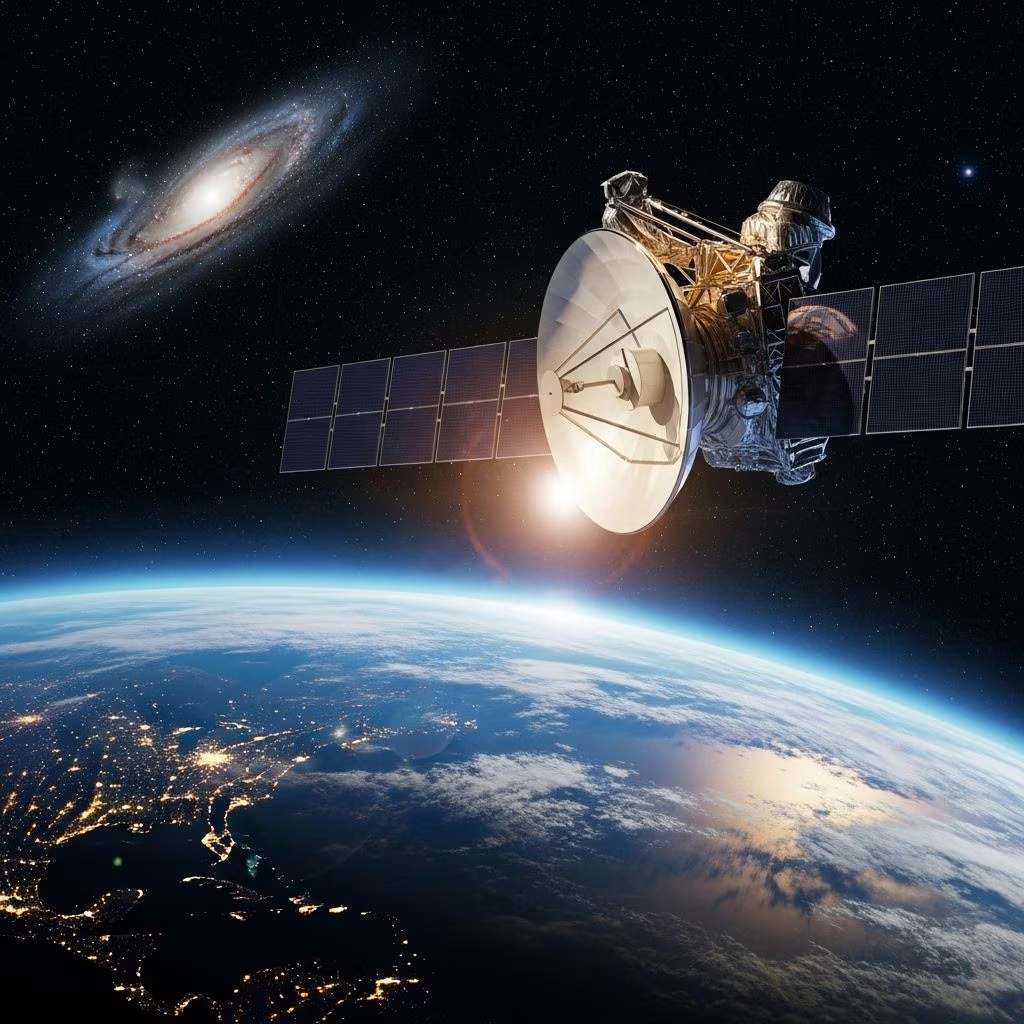
Since the dawn of the Space Age, satellites have become fundamental to life on Earth and our ongoing exploration of space. These engineered objects circling our planet carry out a huge range of tasks—enabling communication, guiding navigation, forecasting weather, monitoring the environment, and deepening our scientific understanding of the universe. This article explores what satellites are, how they work, the various types in orbit, their pivotal roles, and their influence on our world and future.
What is a Satellite?
Satellites are objects that orbit a planet or other celestial body. While natural satellites like the Moon occur naturally, most references to satellites today mean artificial satellites: human-made machines launched into space to perform specific functions while circling Earth or other bodies.
Satellites remain in orbit by balancing two forces: their forward motion (momentum) and the pull of gravity. Together, these create a constant “fall” around the planet rather than straight down toward it.
How Satellites Stay in Orbit
- Satellites must reach a speed that counteracts Earth’s gravity at their altitude.
- For example, at about 200 kilometers up, the required speed is over 27,400 km/h (17,000 mph)—fast enough to circle the planet every 90 minutes.
- Different orbits suit different mission types, such as low Earth orbit (LEO), medium Earth orbit (MEO), or geosynchronous/geostationary orbits (GEO).
Types of Satellites and Their Functions
There are thousands of active satellites serving a host of functions. Here are the major categories:
| Type | Primary Purpose |
|---|---|
| Communication | Relaying television, radio, phone, and internet signals worldwide |
| Navigation | Providing GPS and global positioning for ships, planes, cars, and smartphones |
| Earth Observation | Monitoring weather, tracking environmental changes, disaster management, and resource mapping |
| Scientific | Studying space physics, cosmic phenomena, distant galaxies, and planetary atmospheres |
| Military/Intelligence | Reconnaissance, surveillance, communication, and navigation for defense purposes |
| Technological Demonstration | Testing and proving new technologies in space environments |
Communication Satellites
These satellites form the backbone of global media and data transmission. By orbiting high above Earth—often in geostationary orbits—they can transmit signals to vast areas, making instantaneous connections possible almost everywhere.
- Enable live international broadcasts and internet access
- Link remote, rural, or disaster-affected regions to communications networks
Navigation and Positioning Satellites
Navigation satellites, such as those making up the Global Positioning System (GPS), provide continuous location and timing information globally. Modern life and commerce rely on accurate GPS signals for everything from mapping and logistics to aviation, maritime, and even banking systems.
- Enable precise navigation for vehicles, ships, and aircraft
- Provide timing signals critical to financial and data networks
Earth Observation and Weather Satellites
These satellites play a crucial role in monitoring our planet’s changing environment. They sense land, atmosphere, and ocean conditions, gathering data for weather forecasting, climate studies, disaster response, and agriculture.
- Track hurricanes, monitor droughts and fires, detect oil spills
- Inform climate science and emergency planning
- Monitor crop health and land use changes
Scientific and Astronomical Satellites
Specialized satellites—such as the Hubble Space Telescope—observe outer space, peer deeper into the universe, and look for phenomena invisible from Earth’s surface.
- Study distant galaxies, black holes, and cosmic microwave background
- Help search for exoplanets and investigate planetary atmospheres in the solar system and beyond
Military and Intelligence Satellites
Many satellites are dedicated to defense and security. They provide real-time reconnaissance, early warning of missile launches, secure communication, and electronic intelligence gathering vital to national security operations.
- High-resolution imaging of strategic regions
- Global surveillance and signal interception
History of Satellites: From Sputnik to Today
The modern era of satellites began with the Soviet Union’s launch of Sputnik 1 in 1957, the first artificial object to successfully orbit the Earth. This milestone set off the Space Race and catalyzed a revolution in science, technology, and geopolitics.
- 1957: Sputnik 1 orbits Earth, sending a radio signal detected worldwide
- 1960: NASA launches TIROS 1, the first weather satellite
- 1962: Telstar 1 enables live transatlantic television broadcasts
- 1972: Landsat 1 begins imaging Earth’s surface for science and resource management
- 1990: Hubble Space Telescope launches, transforming astronomy
- 2000s: Constellations of small satellites (CubeSats) emerge for science and industry
- 2020s: Mega-constellations like Starlink bring high-speed internet to remote areas
Satellite Orbits: Types, Altitudes, and Purposes
The choice of orbit dramatically affects a satellite’s function, coverage, and lifetime.
| Orbit Type | Altitude | Main Uses |
|---|---|---|
| Low Earth Orbit (LEO) | Approx. 160–2,000 km above Earth | Earth observation, science, ISS, some telecom, CubeSats |
| Medium Earth Orbit (MEO) | Approx. 2,000–35,786 km above Earth | Navigation satellites (GPS, GLONASS), some communications |
| Geostationary Orbit (GEO) | 35,786 km above the equator | Weather and most communication satellites; appear stationary from the ground |
| Highly Elliptical Orbit (HEO) | Variable altitude; elongated path | Special telecom and observation for high-latitude regions |
The Impact of Satellites on Everyday Life
Satellites exert profound influence across global society—often in ways we do not notice. Their effects include:
- Global communications: Uninterrupted phone, video, and internet connections across oceans and continents
- Navigation and logistics: Real-time GPS for mapping, navigation, shipping, and location-based services
- Environmental monitoring: Early warnings for hurricanes, earthquakes, and hazards; long-term climate surveillance
- Science and exploration: Unlocking the mysteries of space, shaping cosmology, and paving the way for space missions
- Defense and security: Surveillance, reconnaissance, and emergency response coordination
Challenges Facing Satellites: Space Debris and Congestion
With tens of thousands of satellites and millions of pieces of debris now encircling Earth, space congestion and space junk pose mounting threats to satellite health, safety, and the space environment.
- Debris ranges from spent rocket stages and old satellites to fragments from collisions
- Speeds in low orbit can reach up to 34,000 mph, making even small debris a hazard
- The risk of collisions grows with the expanding number of commercial mega-constellations
Mitigating these hazards requires international coordination, debris tracking, and strategies ranging from end-of-life disposal to anticipated “space traffic management” in the coming decades.
The Future of Satellites: Expanding Frontiers
- CubeSats and SmallSats: Miniaturized satellites are lowering costs and enabling rapid innovation in academia, business, and government.
- Mega-constellations: Hundreds to thousands of satellites, such as SpaceX’s Starlink, are now blanketing the globe to provide universal internet.
- Scientific missions: Advanced telescopes and probes—including the James Webb Space Telescope—are transforming space observation and exoplanet research.
- International collaboration: Joint satellite missions and data-sharing improve disaster response, environmental protection, and scientific discovery.
- Autonomy and AI: Future satellites will leverage artificial intelligence to manage operations and analyze huge data flows onboard.
- Debris removal and sustainability: Techniques such as robotic arms, targeted deorbiting, and even space “clean-up” missions aim to keep orbital paths safe.
Satellite FAQs
What is the difference between natural and artificial satellites?
Natural satellites, like the Moon, occur naturally and orbit planets due to gravitational attraction. Artificial satellites are human-made machines sent into space to orbit planets or celestial bodies for specific purposes.
How many artificial satellites are currently in orbit?
As of the mid-2020s, over 7,000 active satellites orbit the Earth, with many thousands more inactive or defunct. The number is rapidly growing due to new mega-constellations.
What is a geostationary satellite?
A geostationary satellite orbits Earth at roughly 35,786 kilometers (22,236 miles) above the equator, appearing stationary over a fixed spot. This allows for uninterrupted communications with designated areas on Earth.
What are CubeSats?
CubeSats are miniature satellites, usually standardized as 10 cm cubes, enabling affordable and accessible space missions for research, technology, and education.
How do satellites impact climate and environmental science?
Earth observation satellites collect vital climate data, track hurricane formation, monitor ice caps, forests, and oceans, and provide early warning for natural disasters.
Further Reading and Resources
- NASA’s Eyes on the Solar System: Explore live data on active missions and satellites.
- International Satellite Catalogues: Track the history and current status of satellites worldwide.
- Interactive Satellite Trackers: See real-time satellite positions above your location.
Satellites have woven themselves into the fabric of everyday life and global discovery. Their continued evolution not only promises new realms of knowledge and connectivity but also demands collaborative stewardship of the orbital environment we now share.
References
- https://www.space.com
- https://www.space.com/astronomer-megasatellite-concerns-about-space-junk.html
- https://www.britannica.com/topic/list-of-satellites-2024625
- https://www.cbsnews.com/space/
- https://www.britannica.com/science/satellite
- https://news.satnews.com/2021/08/24/the-space-report-2021-36th-annual-space-symposium-special-edition-executive-summary/
- https://spaceplace.nasa.gov/satellite/en/
- https://www.sciencedaily.com/news/space_time/satellites/
- https://en.wikipedia.org/wiki/Satellite
- https://www.n2yo.com
- https://spacemesmerise.com/en-nz/blogs/space-technology/the-crucial-role-of-satellites-in-space-exploration-enhancing-our-understanding-of-the-universe
- https://x2n.com/blog/the-past-and-future-of-satellites-in-space-exploration/
- https://www.youtube.com/watch?v=MV1hNtkTYQE
- https://sateliot.space/2025/03/11/satellite-iot-is-unlocking-new-growth-and-revenue-opportunities-for-global-business/
- https://www.astro.princeton.edu/~gbakos/satellites/index.html
- https://www.datacenterfrontier.com/cloud/article/11428076/bigdata-from-space-how-satellite-launches-power-cloud-growth
- https://www.neuco-group.com/wp-content/uploads/2024/10/Satellite-NewSpace-Insight-Report-September-2024.pdf