


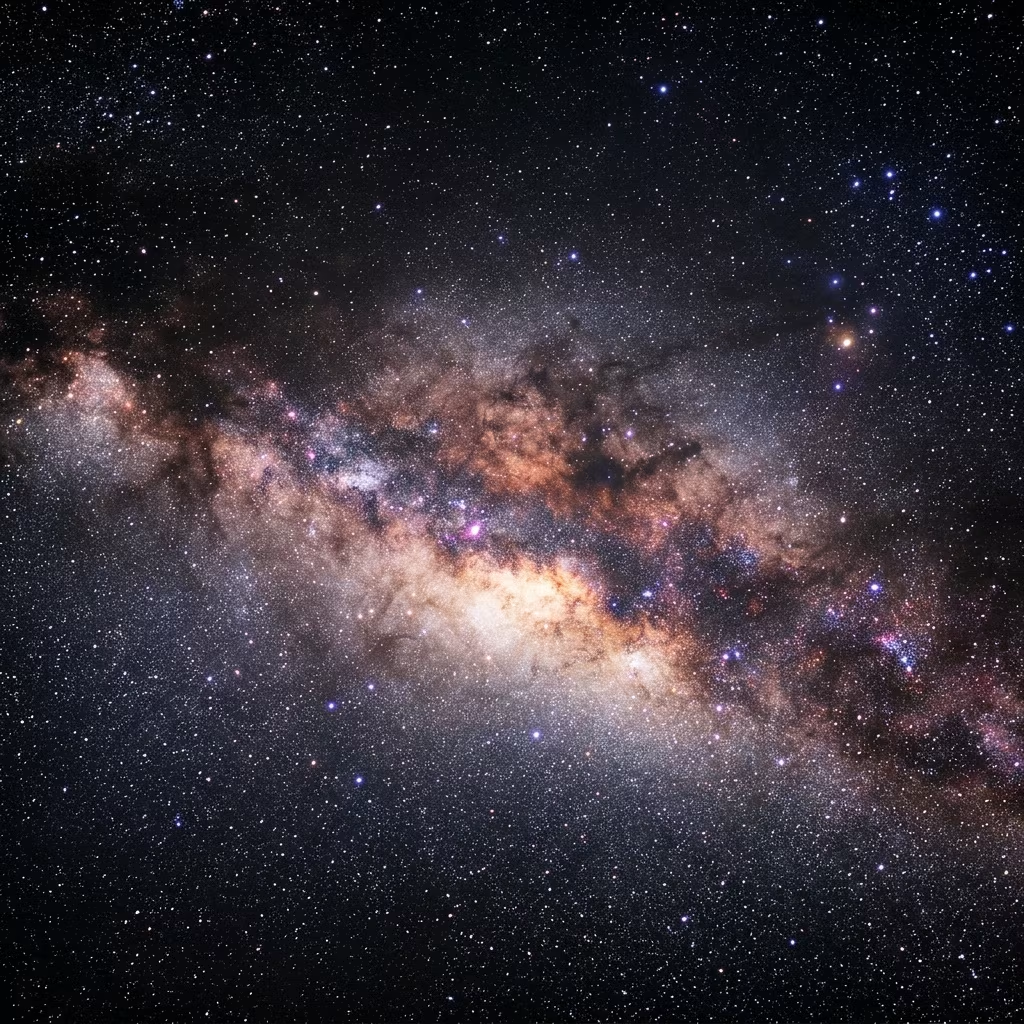
How Many Stars Are In the Milky Way Galaxy?
Gazing up on a clear night, you may see thousands of stars twinkling overhead. Yet even the most impressive night sky only hints at the vast multitude hidden from view in our home galaxy: the Milky Way. For centuries, astronomers have asked a seemingly simple question: How many stars are there in the Milky Way? The answer, as it turns out, is surprisingly complex—and continues to evolve as astronomical techniques improve.
Understanding the Milky Way: A Galactic Overview
The Milky Way is a spiral galaxy that comprises billions of stars, planets, gas clouds, and immense volumes of dark matter. Earth, our solar system, and nearly every star visible to the naked eye belong to this grand structure, which measures about 100,000 light-years across and contains distinctive spiral arms swirling around its dense central bulge.
- Diameter: ~100,000 light-years
- Thickness: ~1,000 light-years in the disk
- Key structures: central bulge, spiral arms, disk, halo
Our location inside the galaxy poses several challenges for astronomers, making it impossible to directly ‘count’ every star or even see much beyond our immediate cosmic neighborhood.
Can Astronomers Count All the Stars?
Unlike counting objects on a shelf, counting stars within the Milky Way is far more complicated. The difficulty stems from:
- Obscured Views: Interstellar dust and gas cloud much of the galaxy, hiding many stars—even from advanced telescopes.
- Distance Limits: The farther a star is from Earth, the dimmer and harder it becomes to detect, especially if it’s small or cool.
- Star Types: High-mass, bright stars are easy to spot, but low-mass red dwarfs are faint and dominate the count.
- Galactic Perspective: As we reside within one of the galaxy’s spiral arms, we only see a partial slice of the Milky Way’s full structure.
The challenge is thus not simply one of technology, but fundamental cosmic perspective.
Measuring the Milky Way’s Stellar Mass
To estimate the total number of stars, astronomers rely on indirect methods. A key strategy is measuring the stellar mass of the entire Milky Way, often using data from powerful telescopes and space missions.
- Stellar Mass: The combined mass of all observable stars, calculated in terms of our Sun’s mass (‘solar masses’).
- Current Estimate: About 50 billion solar masses of stars with an uncertainty of 9-10%.
- Main Missions: The European Space Agency’s Gaia satellite has produced the most refined estimate to date.
This mass, however, includes all types of stars—bright, faint, massive, and tiny—and even remnants like white dwarfs and neutron stars. Since most galactic mass is actually dark matter (about 85-90%), only a small portion is associated with regular stars.
Estimating Star Counts from Mass
From the above mass, astronomers apply models of stellar populations and their distribution to estimate actual star numbers. Key factors include:
- Mass-to-Light Ratio: Determines how much observable light (luminosity) comes from various star types.
- Stellar Population Models: ‘Initial mass functions’ predict proportions of large, bright stars vs. small, dim ones.
- Doppler Effect and Spectroscopy: Used to study the movement of stars, infer galaxy mass, and correct for ‘hidden’ matter.
Through such methods, astronomers derive a range rather than a definitive count.
So, How Many Stars Are There?
Although the exact number remains elusive, the current scientific consensus is that the Milky Way contains between 200 billion and 400 billion stars. This wide range reflects ongoing uncertainties about the lowest-mass stars and the galaxy’s dark, hidden regions.
| Estimation Method | Estimated Number of Stars | Key Uncertainties |
|---|---|---|
| Mass Measurement & Population Modelling | 200–400 billion | Red dwarfs, faint stars, galactic obscuration |
| Direct Observation (with telescopes) | ~10,000 (visible from Earth) | Limited by human eyesight and telescopic range |
| Mid-20th Century (Older estimates) | ~100 billion | Less accurate models, fewer data on faint stars |
Why Is There So Much Uncertainty?
Several key factors drive the uncertainty in star counts:
- Low-Mass Red Dwarf Stars: These stars are numerous but so faint that even the best telescopes struggle to detect them.
- Interstellar Dust: Acts like a veil across large portions of our sky, hiding vast numbers of stars.
- Galaxy’s Rotation and Mass Distribution: Much of the Milky Way’s mass is in dark matter, complicating estimates based on rotational velocity.
- White Dwarfs, Neutron Stars, and Black Holes: Stellar remnants that don’t emit visible light still contribute to the total mass calculations.
As a result, astronomers can only estimate—not determine—the total star count, with red dwarfs posing the greatest challenge.
The Role of Massive Stars and Supergiants
While dim red dwarfs dominate by number, the luminous output of the Milky Way is overwhelmingly driven by massive, hot, blue stars. Giants like:
- Pistol Star
- Wolf-Rayet star WR 89
- Eta Carinae’s central star
- Westerhout 49-2
—all only a few dozen to a couple of hundred times the Sun’s mass, but millions of times brighter—dominate the galaxy’s total light despite being rare. In contrast, the myriad red dwarfs, small and cool, are nearly invisible even in powerful surveys, yet vastly outnumber their gleaming cousins.
What About Our Own Sun?
The Sun is an average-sized, G-type main-sequence star, more massive and luminous than most (since red dwarfs are smaller and cooler), but far from the galactic extremes. Compared to the full stellar population:
- It is relatively young (~4.6 billion years old).
- It belongs to the disk population, about halfway from the galactic center to the edge.
- Its brightness places it among the minority of stars visible from far away.
Most stars in the Milky Way are far dimmer and smaller, meaning the Sun enjoys a special visibility from our vantage point.
Future Observations and Refined Counts
Next-generation telescopes and space missions promise to sharpen our understanding. Projects like the James Webb Space Telescope and future upgrades to Gaia will scan deeper, revealing:
- More faint red dwarfs and hard-to-see brown dwarfs.
- Hidden stars behind thick dust and in the galactic bulge.
- More accurate mass measurements for modeling populations.
With time, technological progress is gradually closing the gap, and astronomers may soon narrow the range—but fundamental limits due to obscure and ultra-faint star types may always leave room for uncertainty.
Frequently Asked Questions (FAQs)
Q: Why don’t astronomers know the exact number of stars in the Milky Way?
A: Because of limited observational perspective from inside the galaxy, faint stars that evade detection, and uncertainty from interstellar dust and dark matter, astronomers can only estimate star counts using indirect methods.
Q: What kind of stars dominate the Milky Way by number?
A: Red dwarfs—small, cool, and faint—make up the largest proportion of stars in the Milky Way. Though numerous, they are hard to detect and contribute little to the overall light of the galaxy.
Q: Are all stars in the Milky Way the same size and brightness?
A: No. The galaxy contains a vast variety, from massive, blue supergiants millions of times as luminous as the Sun, to dim red dwarfs and even stellar remnants such as white dwarfs and neutron stars.
Q: How does dark matter affect star counts?
A: Dark matter makes up most of the Milky Way’s total mass. Because it does not emit light, it must be accounted for when estimating how much mass belongs to stars versus ‘invisible’ dark matter.
Q: Will we ever know the exact number of stars in the Milky Way?
A: New technologies may improve estimates, but due to the abundance of faint, hidden stars and observational limits from inside the galaxy, a precise count is unlikely. Scientific models will continue refining the range.
Key Takeaways
- The Milky Way likely contains between 200 billion and 400 billion stars.
- This uncertainty is driven mainly by the unknown population of faint, low-mass red dwarfs.
- Astronomers estimate star counts using indirect methods based on mass, light output, and population models.
- Future missions and telescopes may sharpen—but not completely erase—the margin of error.
Conclusion: The Mystery Continues
Our cosmic home is vast, complicated, and still partly shrouded in mystery. Counting the stars in the Milky Way is far from simple, and represents the frontier of astronomical research. As technology advances, so too will our understanding—but some mysteries may always resist precise answers, inviting new generations of astronomers to keep searching.
References
- https://en.wikipedia.org/wiki/Milky_Way
- https://imagine.gsfc.nasa.gov/science/objects/milkyway1.html
- https://science.nasa.gov/universe/stars/
- https://bigthink.com/starts-with-a-bang/how-many-stars-milky-way/
- https://www.youtube.com/watch?v=hiWacnGH5II
- https://stardate.org/faq/how-many-stars-are-in-the-milky-way
- https://en.wikipedia.org/wiki/Galaxy
- https://www.worldatlas.com/space/how-many-stars-are-in-the-milky-way.html
- https://sten.astronomycafe.net/exactly-how-many-stars-are-in-the-milky-way/
- https://www.britannica.com/place/Milky-Way-Galaxy
- https://scitechdaily.com/how-many-stars-are-there-in-the-milky-way-in-the-universe/
- https://consensus.app/questions/how-many-stars-are-in-the-milky-way/
- https://www.spacesciences.org/post/how-many-stars-are-in-the-milky-way
- https://bigthink.com/starts-with-a-bang/overestimated-stars-in-universe/
- https://www.astronomy.com/science/astro-for-kids-how-many-stars-are-there-in-space/


