Sirius: The Brightest Star in the Night Sky
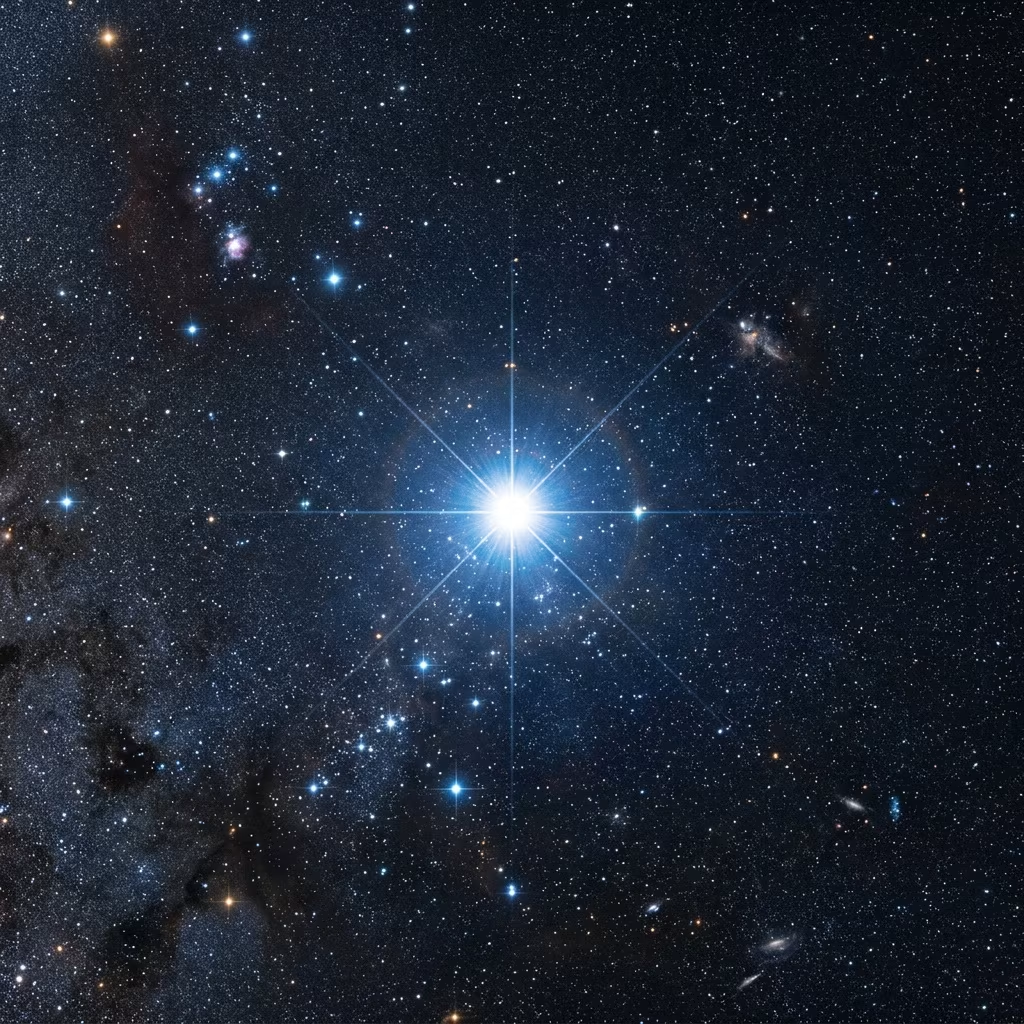
Across the vast expanse of the night sky, one celestial object stands out above all others in luminous brilliance: Sirius. Known as the ‘Dog Star,’ Sirius anchors the constellation Canis Major, captivating observers for millennia with its dazzling glow, rich history, and intriguing physical properties. This article explores Sirius’s location, characteristics, cultural significance, and tips for observing the star, unraveling the myths and science of this cosmic beacon.
Sirius Star System Facts
| Property | Details |
|---|---|
| Visual Magnitude | -1.46 (twice as bright as Canopus) |
| Distance from Earth | 8.6 light-years (2.64 parsecs) |
| Stellar System | Binary (Sirius A and Sirius B) |
| Spectral Type | A0 or A1 (Sirius A), DA2 (Sirius B) |
| Constellation | Canis Major (The Greater Dog) |
| Surface Temperature | ~9,940 K (Sirius A) |
| Radius | 1.19 million km (Sirius A) |
| Orbital Period (Binary) | ~50 years |
| Apparent Color | White to blue-white (Sirius A) |
Sirius is recognized as Alpha Canis Majoris (α CMa) and is nearly twice as bright as the next most luminous star, Canopus. Its name derives from the Greek ‘Seirios,’ meaning ‘glowing’ or ‘scorching,’ befitting its brilliant shine and status as the most prominent star in the night sky.
How to Find Sirius in the Sky
Locating Sirius is an essential skill for both novice stargazers and seasoned astronomers. Here’s how to spot this cosmological gem:
- Locate Orion: Find the three closely spaced stars forming Orion’s ‘belt’ in the night sky.
- Trace a Line: Draw an imaginary line downward (southeast) from the belt stars—this points almost directly to Sirius.
- Look for Exceptional Luminosity: Sirius shines distinctively brighter than all other stars; its brilliance is unmistakable.
- Check Timing: Sirius is most visible during winter in the Northern Hemisphere (December to March) and summer in the Southern Hemisphere.
Digital stargazing apps, such as Sky Tonight, offer quick guides to Sirius’s location relative to your geocoordinates, enhancing your observing experience.
Where Sirius Is Tonight
Every evening, Sirius ascends in the southeastern skies and reaches its highest point by midnight. Since it’s a southern star, it appears lower for northern observers, culminating higher overhead for those in the southern hemisphere.
- Coordinates: Right Ascension: 06h 45m 08.9173s; Declination: −16° 42′ 58.017″
- Seasonality: Visible from both hemispheres, with best visibility during winter for the North and summer for the South.
- Proximity: Sirius is one of Earth’s closest neighbors outside the Solar System.
Why Is Sirius So Bright?
Sirius owes its stunning brightness to a combination of high intrinsic luminosity and proximity to Earth:
- Distance: At just 8.6 light-years away, Sirius is among our celestial neighbors.
- Luminosity: Sirius A radiates roughly 25 times more energy than the Sun.
- Binary Nature: The system’s companion, Sirius B, is a faint, dense white dwarf, but the bulk of the visible light comes from Sirius A.
- Apparent Magnitude: The brightness observed from Earth depends not only on actual energy output, but distance—no star closer matches this brilliance.
Only the Sun, Moon, Venus, Jupiter, Mars, and occasionally Mercury outshine Sirius in the terrestrial sky. Among stars, Sirius reigns supreme.
Why Does Sirius Twinkle?
Sirius is famous for its intense ‘twinkling’—often appearing to flash with different colors. This dynamic display is caused by atmospheric refraction:
- Atmospheric Turbulence: When Sirius is low on the horizon, its light travels through more of Earth’s atmosphere, amplifying scattering.
- Color Flashes: Pockets of turbulent air act as tiny prisms, splitting and refracting Sirius’s white-blue light into rapid, random flashes across the spectrum—sometimes called the ‘rainbow star.’
- Star vs. Planet: Stars, including Sirius, twinkle because they’re distant points of light; planets shine more steadily due to their larger apparent size.
This phenomenon is most pronounced for Sirius due to its extreme brilliance and position in the sky.
The Color of Sirius
- Sirius A: The main star glows with a white to blue-white hue.
- Twinkling Colors: On Earth, Sirius often appears to ‘twinkle’ in multicolored flashes, earning it the nickname ‘rainbow star.’
- Sirius B: As a white dwarf, Sirius B is extremely faint by comparison and is hard to see without specialized equipment.
Despite the glittering spectacle seen from Earth, Sirius’s true color, observed from space, is a pure blue-white, characteristic of hot, young, mid-sized stars.
Sirius and the Constellation Canis Major
Sirius anchors Canis Major—Latin for ‘the Greater Dog.’ Within this southern constellation, Sirius acts as the ‘nose’ of the dog and is often accompanied by myth and symbolism.
- Constellation Details: Canis Major sits below Orion and is home to several brilliant stars, but none rival Sirius.
- Dog Star: The moniker ‘Dog Star’ arises from Sirius’s prominence in Canis Major, cementing its role in popular and scientific lore.
The star’s location within Canis Major makes it an easy reference point for sky navigation and constellation identification.
Mythology and Cultural Significance
Human cultures across the globe have venerated Sirius for centuries, intertwining its annual movements with seasonal events, mythic stories, and religious beliefs:
- Ancient Egypt: The annual heliacal rising of Sirius before sunrise heralded the Nile River’s flood. This event marked the Egyptian New Year and symbolized rebirth and renewal.
- Greek and Roman Influence: Named ‘Seirios’ (‘scorching’), Sirius was referenced by Homer and Hesiod, often representing heat and drought.
- Dog Days of Summer: The period of late July to August, when Sirius rises with the Sun, became known as the ‘dog days,’ associated with intensified heat.
- Navigation: Sirius’s brightness made it a significant marker in Polynesian and other navigational traditions.
- Cultural Lore: Numerous indigenous peoples attributed mystical powers or omens to Sirius’s annual reappearance.
Today, Sirius continues to inspire skywatchers, poets, and scientists alike, maintaining its mystical aura.
Astronomical Studies and Future Changes
Sirius is not only remarkable for its brilliance but also for its dynamic behavior and astronomical significance:
- Binary System: Sirius A (main sequence star) and Sirius B (white dwarf companion) orbit each other every 50 years, with their distance shifting from 8.2 to 31.5 astronomical units.
- Proper Motion: Sirius is gradually moving closer to the Solar System, increasing its brightness over the next 60,000 years.
- Pole Star Future: Around 66,270 AD, Sirius will come within 1.6 degrees of the south celestial pole due to Earth’s axial precession, becoming the southern Pole Star.
- Long-term Fate: It will remain our brightest star for around 210,000 years, when Vega will take over the role as brightest star.
The study of Sirius, especially its white dwarf, has illuminated the later stages of stellar evolution, influencing our understanding of cosmic cycles, binary systems, and stellar physics.
Frequently Asked Questions (FAQs)
Q: Why is Sirius called the Dog Star?
A: Sirius is named the Dog Star because it is the brightest star in the constellation Canis Major, which means ‘the greater dog’ in Latin.
Q: Can Sirius be seen all year round?
A: No, Sirius is most visible in the winter months in the Northern Hemisphere and summer in the Southern Hemisphere, with the best view between December and March for northern observers.
Q: Is Sirius part of a binary star system?
A: Yes, Sirius is a binary system. Sirius A is a main sequence star; Sirius B is a faint, dense white dwarf. They orbit each other every 50 years.
Q: Does Sirius have planets?
A: No planets have been confirmed orbiting Sirius. The presence of a stellar companion complicates stable planetary formation within the system.
Q: Why does Sirius twinkle more than other stars?
A: Its twinkling is especially pronounced because Sirius is so bright and is seen lower in the sky from many northern locations. Atmospheric turbulence splits its light into color flashes.
Q: What is the future of Sirius’s brightness?
A: Sirius will gradually become brighter as it approaches Earth, peaking at about -1.68 magnitude in 60,000 years before slowly fading as it moves away.
Summary: The Dazzling Beacon of the Night
Sirius is far more than just a bright dot in the sky—it’s a window into stellar physics, a linchpin of cultural traditions, and a versatile navigational aid. Whether marveled for its sparkling rainbow colors on frosty winter nights, or revered in ancient Egyptian ceremonies, Sirius’s enduring light continues to inspire astronomical curiosity and cultural reverence, proving that even the oldest of stars can still offer new mysteries to uncover.
References
- https://www.space.com/19922-sirius-brightest-star-night-sky.html
- https://en.wikipedia.org/wiki/Sirius
- https://www.britannica.com/place/Sirius-star
- https://www.space.com/3479-doorstep-astronomy-sirius.html
- https://starwalk.space/en/news/sirius-the-brightest-star
- https://astrobackyard.com/sirius-star/
- https://www.youtube.com/watch?v=PU5CgWsAPqM
- https://www.farmersalmanac.com/sirius-the-dog-star
- https://skyandtelescope.org/astronomy-news/meet-sirius-brightest-star/
- https://explainingscience.org/2024/06/09/sirius/
- https://www.youtube.com/watch?v=Zd5qGaj8YTA
- https://science.nasa.gov/asset/hubble/the-dog-star-sirius-and-its-tiny-companion/
- https://www.astronomy.com/science/sirius-our-brightest-star-is-orbited-by-a-white-dwarf-a-dead-stars-core-where-is-the-planetary-nebula-that-would-have-formed-when-it-shed-its-skin/
- https://aminoapps.com/c/space/page/blog/sirius/n5kJ_wxzFLu5Pk18PL327aePJeLQGWrXjm
- https://scisimple.com/en/articles/2025-05-28-sirius-the-brightest-stars-secrets–a9moj00
- https://starvium.com/stars/sirius-a