


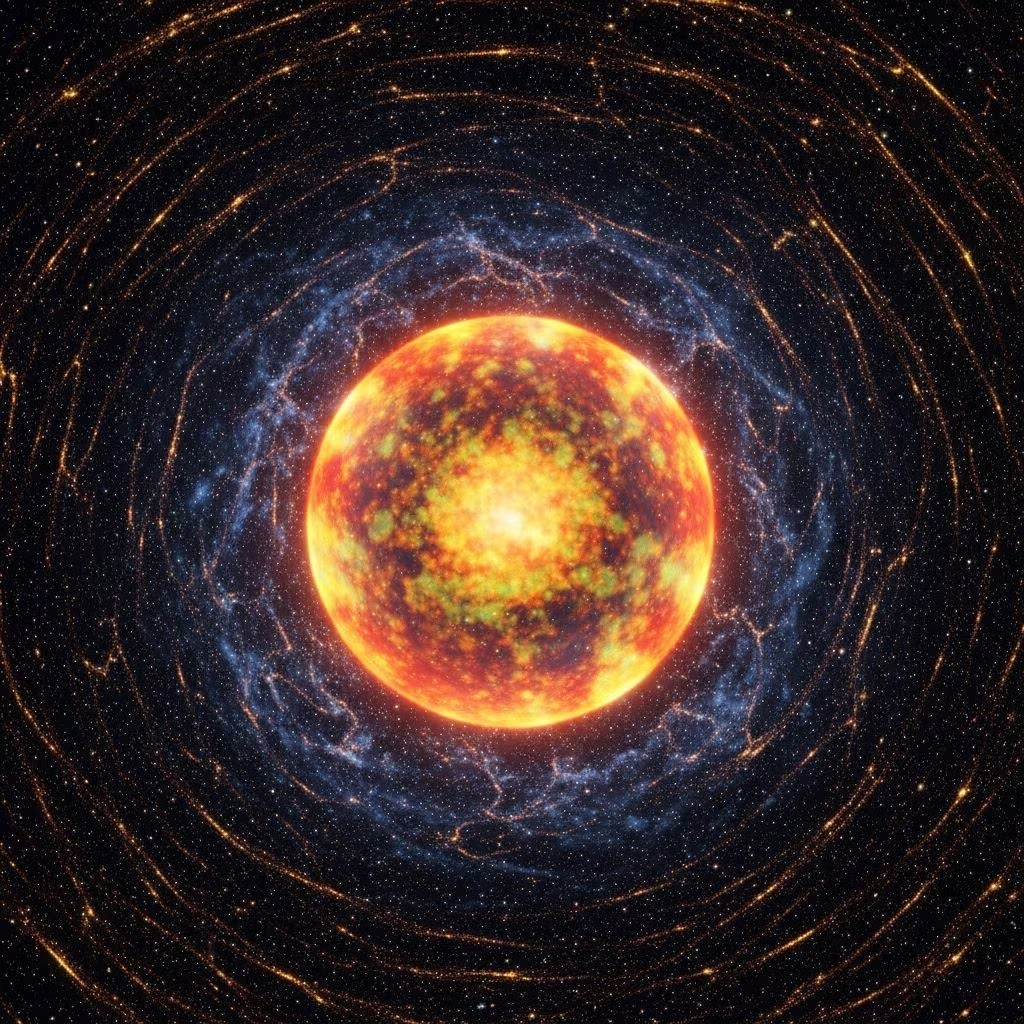
The Cosmic Microwave Background: Relic Light from the Big Bang
The Cosmic Microwave Background (CMB) is the faint, uniform glow of microwave radiation that permeates the entire universe. Invisible to the naked eye and only detectable with sensitive radio telescopes, this ancient light has traveled across space and time since soon after the universe’s birth. The CMB stands as one of the strongest pillars of evidence for the Big Bang theory and serves as a cosmic “baby picture,” revealing fundamental secrets about the universe’s origins and evolution.
What Is the Cosmic Microwave Background?
The CMB is often described as the afterglow of the Big Bang. Formed in the early universe, it represents the earliest electromagnetic radiation that we can observe. No matter where you look in the sky with a sufficiently sensitive instrument, a nearly uniform microwave signal can be detected. Its temperature is just 2.7 degrees above absolute zero (−270.45°C), but its faint, persistent presence dominates the sky when viewed in the microwave part of the spectrum.
- The CMB fills every direction in the universe.
- It is the cooled remnant of an incredibly hot, dense early state.
- Its discovery confirmed that the universe began with a hot, dense event—what we know as the Big Bang.
Origins: How the CMB Was Born
In the first moments after the Big Bang, about 13.8 billion years ago, the universe was a hot plasma of free electrons, protons, and photons (light particles). In this state, electrons and protons had not yet combined to form atoms, so photons scattered freely in all directions, unable to travel far without hitting a particle. This stage is often described as a ‘foggy’ or ‘opaque’ universe because light could not pass freely through space.
About 378,000 years after the Big Bang, as the universe expanded and cooled to around 2,700°C (5,000°F), electrons and protons finally combined to form neutral hydrogen atoms—a process known as recombination. At this moment:
- Photons were at last able to travel great distances without constant collisions.
- Light broke free from matter, and the universe became “transparent” for the first time.
- The CMB we observe today was released, carrying a direct imprint of the universe at that epoch.
This fundamental transition is called decoupling. The light from this era forms the CMB, which—due to cosmic expansion—has cooled from orange-hot to microwave-cold over billions of years.
Discovery: A Serendipitous Signal
The existence of the CMB was first predicted in 1948 by physicists Ralph Alpher and Robert Herman, who reasoned that if the universe began hot and dense, some residual heat should remain detectable.
- In 1965, radio astronomers Arno Penzias and Robert Wilson accidentally discovered the CMB at Bell Labs while investigating unexpected noise in a microwave antenna.
- Initially thinking the signal was a technical issue or perhaps caused by pigeons nesting in their equipment, they soon confirmed its universal origin.
- This discovery provided powerful, direct evidence supporting the Big Bang model and dramatically shaped modern cosmology.
The Surface of Last Scattering
The concept of the surface of last scattering is central to understanding the CMB. Before decoupling, the universe was opaque; light could not travel far. After neutral atoms formed, photons were free to travel unimpeded. The “surface” is not a physical boundary, but represents the spherical shell from which the earliest photons we see today were emitted.
- Photons from this time have been traveling for 13.8 billion years, reaching us from a shell about 45 billion light-years away due to cosmic expansion.
- The CMB photons have since been stretched (redshifted) by the expansion, placing them in the microwave part of the spectrum.
Seeing the CMB: How It Appears
Though its signal is faint, the CMB can be mapped with specialized technology. When displayed as a full-sky map, it forms a near-uniform glow, with tiny fluctuations in temperature and density. These minute anisotropies are critical—tiny differences in the CMB represent the seeds of all later cosmic structure.
- A typical full-sky CMB map, as rendered by missions like COBE, WMAP, and Planck, shows hot and cold spots (by a fraction of a degree), reflecting the primordial density variations of the early universe.
- These variations would eventually grow under gravitational attraction to form galaxies, clusters, and the cosmic web we see today.
The Science: What the CMB Tells Us
Detailed measurements and analysis of the CMB have revolutionized our understanding of cosmology, allowing scientists to derive some of the universe’s most fundamental properties.
| Property Derived | What the CMB Reveals |
|---|---|
| Age of the Universe | The CMB provides the most precise measurement: about 13.8 billion years. |
| Composition | Breakdown of ordinary matter (4.9%), dark matter (26.8%), and dark energy (68.3%). |
| Geometry | The CMB shows the universe is flat to high precision, not curved. |
| Seed Fluctuations | The tiny temperature variations in the CMB are the seeds of all cosmic structure. |
| Expansion Rate | Helps establish the Hubble constant, or how fast the universe is expanding. |
Through detailed mapping of the CMB, cosmologists have constructed a “cosmic recipe” describing the main ingredients and dynamics of the universe.
Major Missions Mapping the CMB
Several landmark scientific missions have mapped the CMB with increasing sensitivity and resolution, each contributing major advances:
- COBE (Cosmic Background Explorer): Launched in 1989, first detected tiny temperature fluctuations and confirmed the CMB’s blackbody spectrum.
- WMAP (Wilkinson Microwave Anisotropy Probe): 2001–2010, produced a full-sky map with much greater detail, refining our knowledge of the universe’s age and composition.
- Planck Observatory: Launched in 2009 by ESA, provided the most detailed full-sky temperature and polarization maps of the CMB to date.
Why the CMB Matters
The CMB is the ultimate origin story: a direct snapshot of the universe billions of years before the first stars or galaxies existed. Its study enables scientists to:
- Probe the universe’s origin and early evolution.
- Test theories of physics under extreme conditions.
- Provide critical evidence for dark matter and hints about dark energy.
- Understand the physics of inflation, an era of ultra-rapid expansion thought to precede the CMB.
Visualizing the CMB: Sunlight on a Cloudy Day
A useful analogy is comparing the CMB to sunlight shining through an overcast sky. On a cloudy day, you cannot see the Sun directly; instead, sunlight bounces and scatters through countless water droplets until it escapes and reaches your eyes as a diffuse glow. Similarly, the CMB is the earliest light we can see, escaping the universal fog when atoms first formed, giving us a diffuse yet profound “backlight” revealing the early cosmos.
Cosmic Timeline: CMB in Context
- Big Bang (0): Universe is born, incredibly hot and dense.
- First second: Protons, neutrons, electrons form; universe is opaque.
- 3–20 minutes: Nucleosynthesis, creating simple nuclei (helium, deuterium).
- 378,000 years: Atoms form, light is released, and the CMB begins its journey.
- Hundreds of millions of years: First stars, galaxies appear, further shaping the cosmos.
Frequently Asked Questions (FAQs)
Q: Why can’t we see the CMB with our eyes?
A: The CMB is microwave radiation, which lies far outside the visible spectrum detectable by the human eye. It requires highly sensitive radio and microwave telescopes for observation.
Q: How uniform is the CMB?
A: The CMB is extremely uniform, varying only by about one part in 100,000 across the sky. These tiny fluctuations reflect the seeds of future cosmic structure.
Q: How does the CMB support the Big Bang theory?
A: The presence, spectrum, and uniformity of the CMB directly match predictions made by the Big Bang model. Alternative hypotheses cannot explain the CMB’s blackbody spectrum and pervasive presence.
Q: What would the universe be like without the CMB?
A: Without the CMB, there would be no direct evidence of a hot, dense beginning, making it difficult to validate the Big Bang theory and study the early universe’s initial conditions.
Q: What is next in CMB research?
A: Future research focuses on detecting even fainter patterns, especially in polarization, to uncover details about cosmic inflation and primordial gravitational waves—potentially unraveling deeper layers of the universe’s first moments.
References
- Wikipedia: Cosmic microwave background
- Space.com: Cosmic Microwave Background explained
- Space.com: Cosmic Microwave Background Infographic
References
- https://en.wikipedia.org/wiki/Cosmic_microwave_background
- https://www.space.com/20330-cosmic-microwave-background-explained-infographic.html
- https://www.space.com/20330-cosmic-microwave-background-explained-infographic.html&rut=42ddaf13385f358ec48ae4aa35c19345019f78d91e0e827aa7a9725a87a6f470
- https://www.youtube.com/watch?v=AYFDN2DSVgc
- https://www.youtube.com/watch?v=3tCMd1ytvWg
- https://www.cfa.harvard.edu/research/topic/cosmic-microwave-background
- https://www.britannica.com/science/cosmic-microwave-background
- https://www.amnh.org/learn-teach/curriculum-collections/cosmic-horizons-book/cosmic-microwave-background-radiation
- https://en.wikipedia.org/wiki/Discovery_of_cosmic_microwave_background_radiation
- https://wmap.gsfc.nasa.gov/universe/bb_tests_cmb.html
- https://www.astronomy.com/science/decoding-the-cosmic-microwave-background/
- https://www.spaceandmotion.com/cosmic-microwave-background-radiation.htm
- https://www.aps.org/apsnews/2002/07/discovery-cosmic-microwave-background
- https://pmc.ncbi.nlm.nih.gov/articles/PMC5253920/
- https://www.port.ac.uk/news-events-and-blogs/blogs/space-cosmology-and-the-universe/curious-kids-what-is-cosmic-microwave-background-radiation
- https://www.jameswebbdiscovery.com/astronomy-news/microwave-cosmic-background-radiation-and-james-webb-telescope
- https://astronomy.swin.edu.au/cosmos/C/Cosmic+microwave+background


