


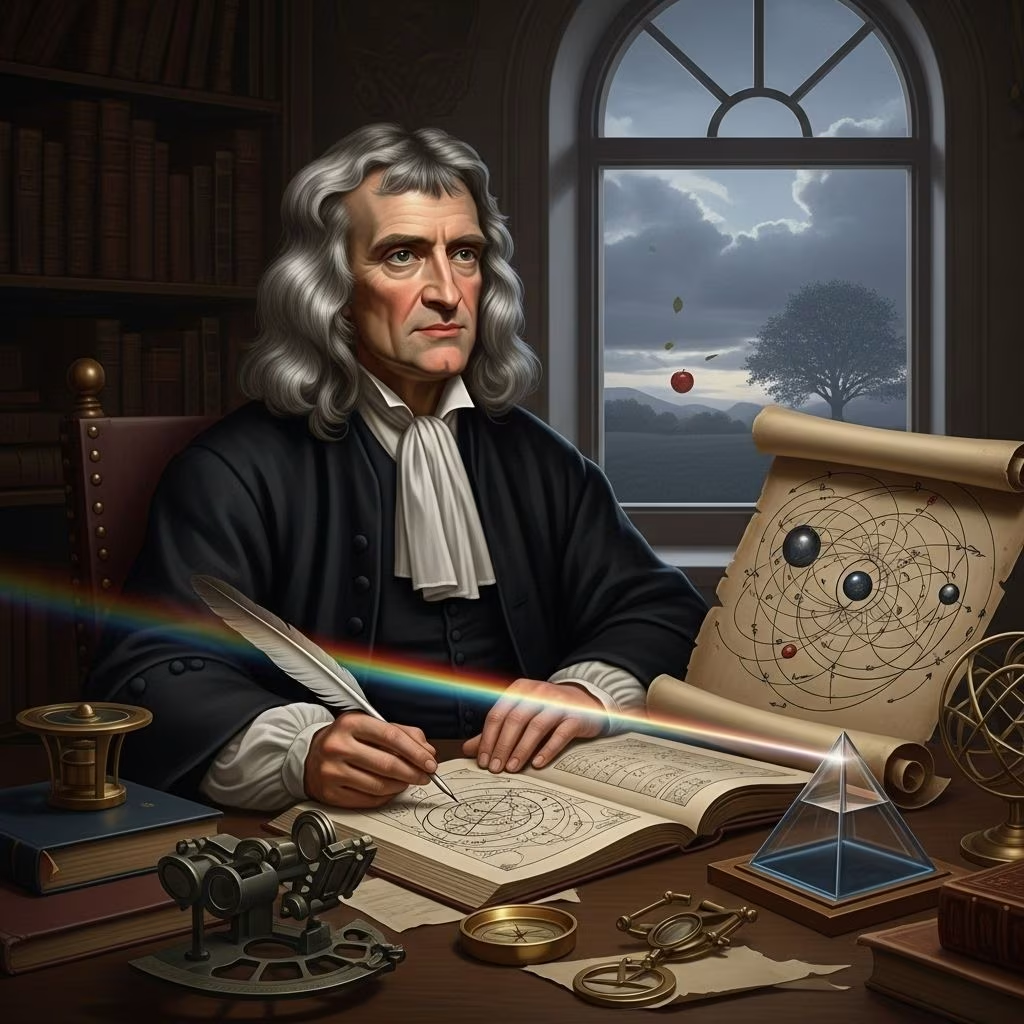
Isaac Newton: The Architect of Modern Science
Sir Isaac Newton stands as one of history’s greatest scientific minds, his work underpinning much of classical physics and mathematics. Born in seventeenth-century England, Newton fundamentally transformed our understanding of the natural world by formulating the laws of motion and universal gravitation, advancing the science of optics, and developing calculus independently. His insights ushered in a new era—the Scientific Revolution—and set the stage for centuries of technological and philosophical breakthroughs.
This article explores Newton’s early life, his key discoveries, intellectual contributions, and legacy in shaping scientific thought.
Early Life and Education
- Birth: Isaac Newton was born on January 4, 1643 (or December 25, 1642, according to the Julian calendar) in Woolsthorpe, Lincolnshire, England.
- Family Background: Newton’s father died before he was born, and his mother remarried when he was three, leaving him to be raised by his grandmother.
- School Days: He attended grammar school in Grantham, where he exhibited a keen interest in mechanics and science, and was expected to manage his family’s farm, but proved unsuited to agricultural life.
- University Education: In 1661, Newton entered Trinity College at the University of Cambridge, earning his BA in 1665 just as plague swept through London, prompting the closure of the university.
- Time in Isolation: During the hiatus from Cambridge (1665–1667), Newton developed several foundational ideas in mathematics and physics while living at his family’s farm.
Newton’s Scientific Revolution
Newton’s contributions spanned several disciplines: physics, mathematics, optics, and astronomy. His discoveries remain as pillars of classical science.
1. The Laws of Motion and Universal Gravitation
- Principia Mathematica: In 1687, Newton published Philosophiæ Naturalis Principia Mathematica, establishing the laws of motion and universal gravitation.
- Laws of Motion:
- First Law (Inertia): An object at rest stays at rest and an object in motion stays in motion unless acted upon by an external force.
- Second Law (Force and Acceleration): The force on an object is equal to its mass multiplied by its acceleration.
- Third Law (Action–Reaction): For every action, there is an equal and opposite reaction.
- Law of Universal Gravitation: Every mass attracts every other mass in the universe according to a force proportional to their product and inversely proportional to the square of the distance between them.
- Applications: Used in predicting the motion of planets, moons, the trajectory of comets, tides, and in confirming heliocentric models of the solar system.
2. Mathematical Achievements: Calculus
- Independent Discovery: Newton developed calculus—methods for calculating slopes of curves and areas under them—independently of Gottfried Wilhelm Leibniz, although their work led to a famous priority dispute.
- Binomial Theorem: He advanced mathematical series and the binomial theorem, laying groundwork for modern analysis and computation.
3. Breakthroughs in Optics
- The Science of Light: Newton discovered that white light is composed of various colors, which can be separated into a spectrum using a prism—a revolutionary advance in optics.
- First Reflecting Telescope: In 1668, he constructed the first practical reflecting telescope, using mirrors instead of lenses, which eliminated chromatic aberration.
- Key Experiment: His prism experiments showed that colors of the spectrum are intrinsic properties of light, not artefacts introduced by the glass.
4. Impact on Astronomy and Physics
- Unification of Celestial and Terrestrial Physics: Newton demonstrated that the same laws govern motion both on Earth and in the heavens.
- Kepler’s Laws Explained: Newton’s equations provided the theoretical foundation for Kepler’s laws of planetary motion, eliminating doubts about heliocentrism.
- Earth’s Shape: He inferred that the Earth is an oblate spheroid—a hypothesis confirmed by later geodetic measurements.
- Age of the Earth: Newton was among the first to estimate the planet’s age experimentally.
5. Additional Scientific Contributions
- Scientific Method: Newton refined approaches to systematic observation and empirical experimentation, helping to shape the modern scientific method.
- Other Fields: Newton contributed to alchemy, theology, and authored philosophical treatises, reflecting his polymathic range.
Newton’s Professional Life
- Cambridge Years: Newton remained at Cambridge after receiving his master’s degree in 1668, teaching and researching for nearly two decades.
- Recognition and Influence:
- Elected a fellow of the Royal Society, England’s leading scientific body.
- Served as Warden and Master of the Royal Mint, applying his talents to reform currency and combat counterfeiting.
- Personal Characteristics: Newton was known for his intense focus, a solitary disposition, and occasional disputes with contemporaries (notably Robert Hooke and Gottfried Leibniz).
Selected Table: Newton’s Key Discoveries and Impact
| Discovery/Contribution | Year | Field | Impact |
|---|---|---|---|
| Laws of Motion | 1687 | Physics | Foundation for classical mechanics; essential for engineering, physics, and astronomy |
| Law of Universal Gravitation | 1687 | Physics/Astronomy | Explained planetary motion and tides; unified terrestrial and celestial phenomena |
| Calculus | Mid-1660s | Mathematics | Paved the way for advancements in mathematics, physics, and engineering |
| Optics (Spectrum of Light) | 1666 | Physics/Optics | Revealed the intrinsic properties of light; led to new instrumentation |
| Reflecting Telescope | 1668 | Astronomy/Physics | Revolutionized astronomical observation; reduced chromatic aberration |
Philosophical and Historical Significance
- Newton’s Principia is considered one of the most influential works in the history of science, ushering in an era of rational analysis and empirical modeling.
- He was central to the Enlightenment, promoting scientific reasoning and the pursuit of knowledge.
- His synthesis of observation, mathematics, and natural philosophy established frameworks that endure in the physical sciences today.
Later Years and Legacy
- Retirement and Honors: Newton retired from active academia, spending much of his later life in London as president of the Royal Society and overseeing Britain’s currency reform.
- Death: Isaac Newton passed away on March 31, 1727, leaving an intellectual legacy whose impact has transcended centuries.
- Enduring Influence: His laws remain central to physics and engineering, while his methods of inquiry and synthesis continue to inform scientific practice.
Frequently Asked Questions (FAQs)
Q: What are Isaac Newton’s three laws of motion?
A: Newton’s laws of motion describe inertia, force and acceleration, and action–reaction, forming the bedrock for classical mechanics.
Q: How did Newton discover gravity?
A: Inspired by the falling of an apple and the motion of the moon, Newton theorized that a universal force acts between all matter, which he called gravitation.
Q: Did Newton invent calculus?
A: Newton independently developed calculus in the mid-1660s, around the same time as Leibniz. Both contributed to its foundations, but Newton’s work predates Leibniz’s publications.
Q: What was Newton’s reflecting telescope?
A: Newton’s 1668 invention replaced a lens with a mirror, greatly improving telescopic observations and reducing color distortions in astronomical images.
Q: Why is Newton considered the father of modern science?
A: Newton unified mathematical rigor, experimental evidence, and natural philosophy, establishing frameworks that underpin modern physics and scientific methodology.
Conclusion: Newton’s Transformative Genius
Isaac Newton redefined humanity’s understanding of nature. His tireless inquiry fused mathematics and observation into a coherent model that continues to guide exploration and innovation across countless disciplines. From the law of gravitation to the theory of light, Newton’s discoveries mark him as an architect of modern science, and his enduring legacy is felt everywhere from everyday engineering to frontier physics.
References
- https://nmspacemuseum.org/inductee/sir-isaac-newton/
- https://en.wikipedia.org/wiki/Isaac_Newton
- https://www.britannica.com/biography/Isaac-Newton
- https://en.wikipedia.org/wiki/Sir_Isaac_Newton
- https://www.britannica.com/biography/Isaac-Newton/The-Principia
- https://starchild.gsfc.nasa.gov/docs/StarChild/whos_who_level2/newton.html
- https://www.sparknotes.com/biography/newton/summary/
- https://www.schoolsobservatory.org/learn/history/biographies/newton
- https://www.eia.gov/kids/history-of-energy/famous-people/newton.php
- https://www.skyatnightmagazine.com/space-science/isaac-newton
- https://byjus.com/physics/isaac-newton/
- https://www.scholieren.com/verslag/biografie-geschiedenis-biography-isaac-newton
- https://mathshistory.st-andrews.ac.uk/Biographies/Newton/
- https://www.biography.com/scientists/how-isaac-newton-changed-our-world
- https://www.aakash.ac.in/blog/isaac-newton-biography-laws-inventions-facts-discoveries/
- https://sirisaacnewton.info/sir-isaac-newton-biography/


