Stars: The Powerhouses of the Universe
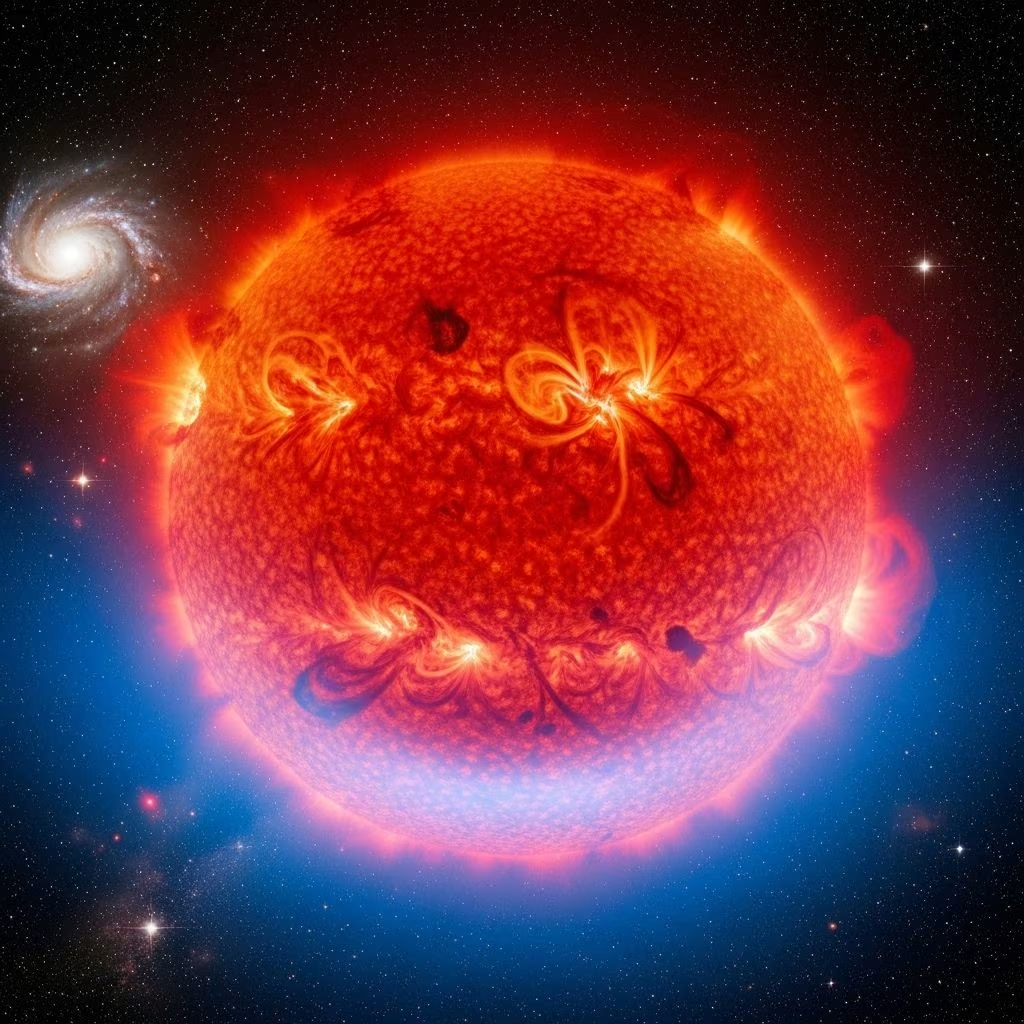
Stars are colossal spheres of glowing plasma that illuminate galaxies, forge heavy elements, and shape the very fabric of the cosmos. Throughout history, they have guided explorers, inspired myths, and sparked scientific discoveries. Our own Sun is just one of an uncountable multitude, most of which are light-years away and yet crucial for sustaining life and revealing the universe’s past and present.
What Are Stars?
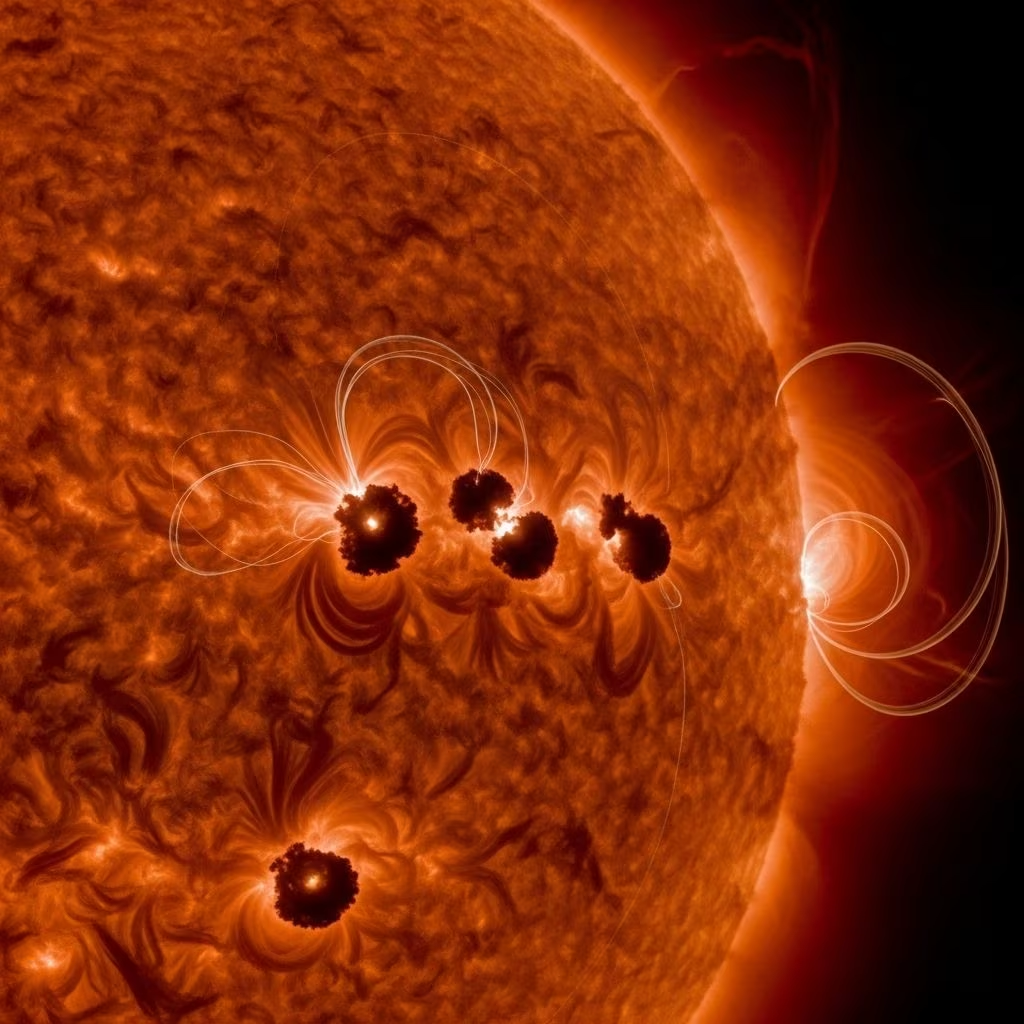
At their most fundamental, stars are self-luminous celestial bodies composed primarily of hydrogen and helium. The immense gravity at their cores initiates nuclear fusion, converting hydrogen into helium, releasing vast amounts of light and energy. This process balances the crushing force of gravity, keeping the star stable for millions to billions of years.
- Closest star: The Sun (approximately 93 million miles or 150 million kilometers from Earth)
- Number of stars in the Milky Way: Estimated 100–400 billion
- Stars visible to the naked eye from Earth: About 6,000 (in ideal conditions)
How Do Stars Form?
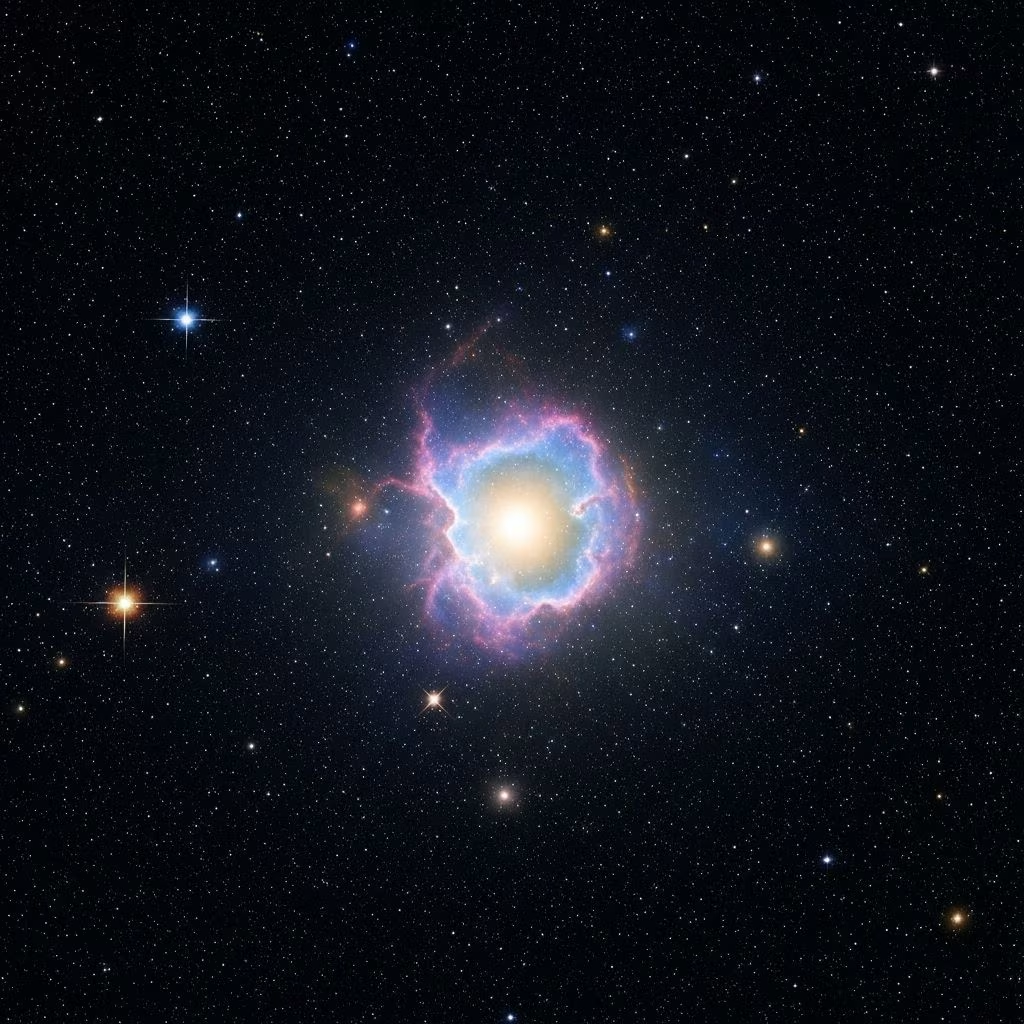
The creation of a star is an epic tale unfolding over millions of years, beginning in the dark, dense nebulae—giant clouds of cold gas and dust peppered throughout galaxies. Astronomers sometimes call these regions stellar nurseries or molecular clouds. Disturbances, like shockwaves from supernovae or collisions between clouds, can trigger the collapse of these dense regions, compressing them until gravity takes over.
Step-by-Step: Star Formation Process
- Cloud Collapse: Regions within a nebula contract under gravity, forming dense cores.
- Protostars: As material falls inward, the temperature rises, and a protostar forms at the center—essentially a “star in waiting.”
- Nuclear Fusion Ignites: When the core temperature hits about 10 million Kelvin, hydrogen fusion begins, and the protostar becomes a main sequence star.
- Stellar Clusters: Often, multiple stars form together, creating clusters or associations rather than single stars in isolation.
In some cases, the collapsing cloud splits, producing binary or multiple star systems—a common outcome in the universe.
Star Populations: Generations of the Cosmos
- Population III Stars: The oldest generation, composed almost entirely of hydrogen and helium, formed soon after the Big Bang. Their existence is largely theoretical today, as none have yet been directly observed.
- Population II Stars: Slightly younger and containing small amounts of heavier elements, these stars formed from the material ejected by earlier generations.
- Population I Stars: “Metal-rich” young stars like our Sun, containing elements heavier than helium, crucial for planet formation and life as we know it.
Life Cycle of a Star
A star’s lifetime is a story written by its mass. The most massive stars blaze through their fuel quickly, dying young and spectacularly, while smaller stars can glow quietly for billions of years.
Main Stages of Stellar Evolution
| Stage | Description | Duration | Key Features |
|---|---|---|---|
| Protostar | Collapsing dense core in a nebula | 105–106 years | Not yet fusing hydrogen |
| Main Sequence | Hydrogen fusion in the core | Millions to billions of years (depends on mass) | Stable; 90% of a star’s life |
| Red Giant / Supergiant | Core contracts, outer layers expand | ~108 years (less for massive stars) | Helium and heavier element fusion |
| Late Stages | Depends on mass: planetary nebula, supernova | Short; thousands to millions of years | Dramatic changes; mass ejection |
| Remnants | White dwarf, neutron star, or black hole | Trillions of years (white dwarfs); unknown for black holes | No further nuclear fusion |
End States of Stars
- White Dwarf: The fate of sun-like stars; a hot, dense stellar core that cools over time.
- Neutron Star: Left behind after a massive star explodes in a supernova; consists almost entirely of neutrons.
- Black Hole: Formed by the collapse of extremely massive stars; gravity is so intense that not even light can escape.
Classifying Stars: The Spectral Types and Brightness
Stars come in a dazzling array of sizes, temperatures, colors, and compositions. To bring order to this diversity, astronomers classify them by their spectral characteristics, surface temperatures, and luminosity.
Spectral Classification System
The Harvard Spectral Classification employs the letters O, B, A, F, G, K, and M—each further divided by number (0–9)—to sort stars by their temperature and color.
| Class | Color | Surface Temperature (K) | Typical Example |
|---|---|---|---|
| O | Blue | 30,000–50,000 | Rare, very massive, short-lived |
| B | Blue-white | 10,000–30,000 | Bright, massive |
| A | White | 7,500–10,000 | Sirius |
| F | Yellow-white | 6,000–7,500 | Procyon |
| G | Yellow | 5,200–6,000 | The Sun |
| K | Orange | 3,700–5,200 | Arcturus |
| M | Red | 2,400–3,700 | Betelgeuse |
O and B type stars are incredibly hot and bright but rare and short-lived. M-type stars, called red dwarfs, are far cooler and fainter. However, they are by far the most common stars in our galaxy.
Luminosity Classes and the Hertzsprung-Russell Diagram
In addition to the spectral type, stars are grouped by luminosity class, represented by Roman numerals I (supergiants) to V (main sequence or dwarfs), and plotted on the Hertzsprung-Russell (H-R) diagram. This crucial astronomical tool shows the relationship between stellar luminosity and temperature, revealing the main branches and stages of stellar evolution.
Other Types of Stars and Peculiar Stellar Objects
- Variable Stars: Their brightness fluctuates due to internal or external effects. This group includes Cepheid variables and eclipsing binary stars.
- Pulsating Stars: Stars expand and contract, causing changes in luminosity.
- Explosive Variables: Stars that suddenly brighten, such as novae and supernovae.
- Peculiar Stars: Have unusual chemical compositions or physical behaviors.
Star Groups: Clusters and Stellar Associations
Stars often form and travel together. These groupings play significant roles in galactic evolution and the enrichment of interstellar material.
- Open Clusters: Loose groupings of hundreds to thousands of young stars, generally found in spiral arms of galaxies. Example: The Pleiades.
- Globular Clusters: Spherical assemblies of tens of thousands to millions of ancient stars, residing in a galaxy’s halo. Example: Omega Centauri.
- Stellar Associations (OB Associations): Unbound groups of massive, hot O and B type stars.
Constellations: Patterns in the Night Sky
Since ancient times, humans have grouped the stars in the sky into constellations—patterns often named after mythological figures, animals, or objects. These do not reflect physical closeness or interaction between the stars but are a way for observers to map the sky and transmit stories across generations.
Major Constellations
- Orion: One of the most distinctive, recognizable by the “belt” of three bright stars.
- Ursa Major: Includes the asterism popularly known as the Big Dipper.
- Scorpius: Marked by a bright, curving tail.
- Leo: Named after the lion for its characteristic shape in the sky.
There are 88 officially recognized constellations that divide the entire sky, as defined by the International Astronomical Union (IAU).
Asterisms
Within or across constellations, observers often pick out smaller star patterns known as asterisms, such as the Summer Triangle or the Southern Cross.
Why Are Stars Important?
- Sources of Elements: Stars forge all chemical elements heavier than hydrogen and helium through nuclear fusion, scattering them into space as they die.
- Light and Energy: Stars provide the heat and energy that make planets habitable. The Sun’s light is essential for all life on Earth.
- Cosmic Beacons: Their positions, variations, and movements allow astronomers to measure vast astronomical distances and probe the universe’s structure and evolution.
Frequently Asked Questions (FAQs)
Q: Why do stars twinkle?
A: Stars appear to twinkle (a phenomenon called scintillation) because their light passes through the turbulent layers of Earth’s atmosphere, which refracts and scatters the starlight.
Q: Are all stars in a constellation physically close to each other?
A: No, constellations are line-of-sight groupings from our vantage point on Earth. The stars in a constellation can be at vastly different distances from us.
Q: What determines how long a star lives?
A: A star’s life span is mostly determined by its initial mass—more massive stars burn hotter, brighter, and faster, living only millions of years, while small red dwarfs can last for trillions of years.
Q: Can stars be different colors?
A: Yes. Stars emit different colors based on their surface temperatures: hottest stars are blue or white, intermediate stars are yellow (like the Sun), and cooler stars are orange and red.
Q: What will happen to the Sun when it dies?
A: The Sun will swell into a red giant, shed its outer layers as a planetary nebula, and leave behind a white dwarf—a hot, dense core that will slowly cool over billions of years.
Conclusion
Stars are not only luminous beacons dotting the night sky—they are engines of creation, forces of destruction, and time capsules holding clues to our universe’s origin and fate. By studying their birth, classification, evolution, and the constellations they form, we continue to deepen our understanding of both the cosmos and our place within it.
References
- https://en.wikipedia.org/wiki/Star_formation
- https://en.wikipedia.org/wiki/Stellar_classification
- https://www.britannica.com/science/star-astronomy/Star-formation-and-evolution
- https://www.slideshare.net/slideshow/stars-33885471/33885471
- https://www.britannica.com/summary/star-astronomy
- https://science.nasa.gov/universe/stars/
- https://byjus.com/physics/classification-of-stars/
- https://spaceplace.nasa.gov/constellations/en/
- https://www.geeksforgeeks.org/physics/what-is-a-star-formation-life-span-constellations/
- https://www.cfa.harvard.edu/research/topic/star-formation
- https://www.lpi.usra.edu/education/skytellers/constellations/
- https://courses.lumenlearning.com/suny-astronomy/chapter/star-formation/
- https://www.schoolsobservatory.org/learn/space/stars/classification
- https://www.skyatnightmagazine.com/advice/a-guide-to-stellar-spectral-classifications
- https://study.com/academy/lesson/star-formation-main-sequence-dwarf-giant-stars.html
- https://study.com/academy/lesson/what-is-a-constellation-definition-facts-formation-examples.html
- https://www.americanscientist.org/article/the-formation-of-star-clusters
- https://edukemy.com/blog/formation-of-galaxies-stars-planets-cosmic-marvels-geography-notes/
- https://www.astroleague.org/stellar-classifications/
- https://testbook.com/physics/classification-of-stars