Kuiper Belt Objects: Ancient Icy Worlds Beyond Neptune
The Kuiper Belt is a remote, intriguing region beyond Neptune filled with icy bodies that offer a window into the early solar system. The icy worlds—known collectively as Kuiper Belt Objects (KBOs)—range from small, unexplored fragments to recognized dwarf planets like Pluto and Eris. This article explores their history, characteristics, scientific importance, and the latest research, providing an in-depth look at one of the solar system’s most mysterious frontiers.
What Is the Kuiper Belt?
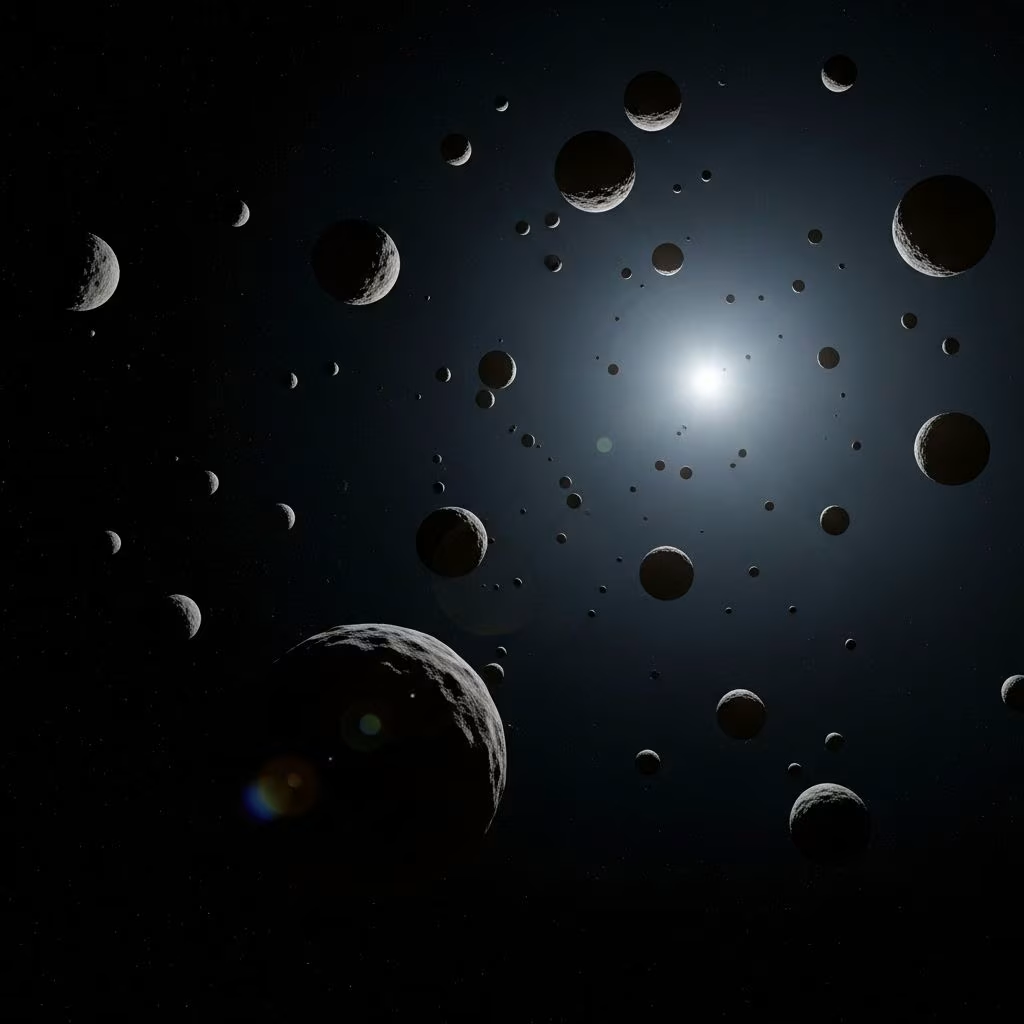
The Kuiper Belt is a vast, doughnut-shaped region encircling the solar system from approximately 30 to over 50 astronomical units (AU) from the Sun (1 AU equals the distance from Earth to the Sun). Located just beyond Neptune, it is sometimes called the ‘third zone’ of the solar system—after the inner rocky planets and the outer gas giants. It is estimated to contain hundreds of thousands to potentially trillions of icy worlds and fragments, representing leftover material from the formation of the solar system nearly 4.6 billion years ago.
- Range: Extends from 30 AU (Neptune’s orbit) to 50 AU and beyond
- Shape: Thick disk or ‘doughnut,’ unlike the thinner asteroid belt
- Main Constituents: Icy bodies including dwarf planets, comets, and minor planets
- Notable Objects: Pluto, Eris, Haumea, Makemake, and many others
- Scientific Significance: Relics of solar system formation, possible source of comets
How Was the Kuiper Belt Discovered?
Although theorists speculated about a region of icy material beyond Neptune for decades, the Kuiper Belt’s existence was confirmed only in the late 20th century. While predictions from astronomers such as Kenneth Edgeworth and Gerard Kuiper in the mid-1900s suggested this region might exist, direct observational evidence arrived in 1992 with the discovery of (15760) 1992 QB1, the first officially recognized Kuiper Belt Object after Pluto and Charon.
- Early hypotheses were based on the need to account for comet origins and possible planetary migration.
- The existence of Pluto and its unusual orbit provided further hints of a larger, yet-unseen population of trans-Neptunian bodies.
- 1992: The first clear detection of a KBO other than Pluto or Charon confirmed the Kuiper Belt was real.
- To date, astronomers have cataloged thousands of KBOs, with estimates suggesting vast numbers remain undiscovered.
Types and Classification of Kuiper Belt Objects
KBOs display a remarkable diversity in size, shape, orbital behavior, and composition. Astronomers categorize them primarily by their orbital dynamics, which provides clues to their history and interactions, particularly with Neptune.
- Classical KBOs (Cubewanos):
- Have relatively stable, near-circular orbits not strongly affected by Neptune.
- Subdivided into cold classicals (low inclinations) and hot classicals (higher inclinations and more eccentricity).
- Resonant KBOs:
- Locked in gravitational resonance with Neptune.
- Most famous are the Plutinos—like Pluto—which orbit the Sun twice for every three Neptune orbits (2:3 resonance).
- Scattered Disk Objects:
- Have highly eccentric, inclined orbits, sometimes stretching hundreds of AU from the Sun.
- Believed to have been ejected or disturbed by Neptune’s gravity, representing the transition between the Kuiper Belt and the even more distant Oort Cloud.
| Type | Orbital Properties | Examples |
|---|---|---|
| Cold Classical | Stable, circular, low inclination | Many small KBOs |
| Hot Classical | More eccentric, higher inclination | Variety of larger KBOs |
| Resonant (Plutinos) | Resonant with Neptune (e.g., 2:3) | Pluto, Orcus |
| Scattered Disk | Highly eccentric, distant | Eris, 2003 UB313 (Eris) |
Physical Characteristics and Composition
KBOs are mostly composed of ices—such as water, ammonia, and methane—mixed with rocky material. These objects have never coalesced into larger planets, meaning they likely preserve the original composition of the solar system’s early building blocks.
- Most KBOs are dark, reddish, or gray, reflecting their varied composition and surface processing.
- Some KBOs, like Pluto, show real atmospheres, complex surface features, and even seasonal changes.
- KBO sizes range from tiny fragments to planet-sized worlds: Pluto (2,376 km diameter), Eris (~2,326 km), and smaller objects several hundred kilometers wide.
Major Kuiper Belt Objects
While thousands of KBOs have been observed, a handful stand out due to their size, brightness, and the unique features revealed by both observations and spacecraft missions.
- Pluto: Once considered the ninth planet, Pluto is a dwarf planet with five known moons, heart-shaped plains of nitrogen ice, and ongoing geological activity.
- Eris: Slightly smaller than Pluto but more massive, Eris has a large moon, Dysnomia, and helped trigger the debate redefining planets in 2006.
- Haumea: An elongated, spinning object with two moons and a ring system, known for its rapid rotation and distinctive shape.
- Makemake: Slightly smaller than Haumea and Pluto, with a single moon and a bright, methane-frosted surface.
- Quaoar, Sedna, Orcus, Varuna: Other significant KBOs with unique characteristics, though less studied.
Pluto: Dwarf Planet of the Kuiper Belt
Pluto, discovered in 1930, was the first KBO to be known and is the best-studied member of this remote group. It was designated a planet for much of the 20th century, but after the discovery of Eris and other large KBOs, Pluto was reclassified as a “dwarf planet” by the International Astronomical Union in 2006.
- Diameter: 2,376 km
- Orbit: 39.5 AU average distance, 2:3 resonance with Neptune
- Moons: Charon (largest), Styx, Nix, Kerberos, Hydra
- Surface: Nitrogen, methane, and carbon monoxide ices
- Exploration: NASA’s New Horizons mission provided the first close-up images and surface data in 2015
The Importance of Studying the Kuiper Belt
Kuiper Belt Objects provide vital clues about the early history of the solar system, planetary migration, and the processes that shaped planets.
- Solar System Formation: KBOs are believed to be relatively unchanged since the solar nebula era, offering a “fossil record” of solar system materials.
- Comet Origins: Many short-period comets originate in the Kuiper Belt, linking these icy bodies to the influx of water and organics to early Earth.
- Planetary Migration: Orbital resonances reveal Neptune’s past movements and help explain the current architecture of the outer solar system.
- Refining Planet Definitions: The sheer number and diversity of KBOs forced astronomers to reconsider what defines a planet.
The Kuiper Belt vs. The Oort Cloud
The Kuiper Belt should not be confused with the Oort Cloud, though both are reservoirs of icy objects surrounding the solar system.
| Feature | Kuiper Belt | Oort Cloud |
|---|---|---|
| Location | 30 – 50+ AU from Sun | ~2,000 – 100,000+ AU from Sun |
| Shape | Donut-shaped disk | Spherical shell |
| Main Contents | Dwarf planets, KBOs, comets | Long-period comets |
| Discovery | Direct observation | Theoretical—no confirmed direct observation |
Spacecraft Missions and Kuiper Belt Exploration
Because of its distance and the small size of most KBOs, exploration of the Kuiper Belt is challenging. Ground and space-based telescopes have discovered thousands of objects, but only one spacecraft—NASA’s New Horizons—has crossed this region, transforming our understanding.
- New Horizons
- Launched in 2006 to study Pluto and beyond
- Flew past Pluto and Charon in July 2015, providing unprecedented images and data
- Continued into the Kuiper Belt to encounter KBO Arrokoth (2014 MU69) in 2019—revealing bi-lobed shape and evidence of gentle planetary accretion
- Future Missions: Proposed spacecraft and the James Webb Space Telescope aim to further study KBOs and their atmospheres, surfaces, and surroundings
Formation and Evolution: How Did the Kuiper Belt Arise?
The Kuiper Belt likely represents debris left behind when the solar system took shape, but its current architecture was heavily influenced by the migration of giant planets—especially Neptune.
- Initial models predicted a denser, more massive belt; most material has since been ejected or incorporated into planets.
- Neptune’s outward migration scattered many bodies, producing the resonant and scattered populations seen today.
- Ongoing collisions among KBOs may create dust and refresh surface properties, although the region is far less crowded now.
Studying KBOs: Scientific Methods and Techniques
Because KBOs are so distant and dim, astronomers rely on several advanced methods to study them:
- Telescope Surveys: Large-scale astronomical surveys track KBOs’ movement and brightness over time, revealing their orbits and population statistics.
- Direct Imaging: The largest and brightest KBOs can be photographed with advanced telescopes on Earth or in space.
- Stellar Occultations: When a KBO passes in front of a star, brief dimming allows scientists to deduce size, shape, and sometimes atmospheres.
- Spacecraft Visits: Only New Horizons has visited a KBO so far; future missions may fly by or orbit these distant worlds.
Frequently Asked Questions (FAQs) About the Kuiper Belt
Q: What qualifies an object as a Kuiper Belt Object?
A: Any object orbiting the Sun beyond Neptune, typically between 30 and 50 AU, that is composed primarily of ices and rock is considered a KBO. Their specific classification depends on their orbital characteristics, such as resonance with Neptune or orbit stability.
Q: What is the difference between a KBO and a comet?
A: Comets often originate from the Kuiper Belt or Oort Cloud. When a KBO is perturbed inward and develops a visible coma and tail due to solar heating, it becomes classified as a comet. Many comets are thus Kuiper Belt objects in origin, but not all KBOs become comets.
Q: Why was Pluto reclassified as a dwarf planet?
A: Pluto was reclassified in 2006 because its orbit is shared with many other KBOs, and it does not “clear the neighborhood” around its orbit—the defining criterion for full planetary status.
Q: Are there more objects in the Kuiper Belt than in the asteroid belt?
A: Yes, the Kuiper Belt is believed to be much more populous and massive than the main asteroid belt, though individual KBOs are often smaller and farther apart.
Q: What does the study of KBOs tell us about Earth’s history?
A: KBOs preserve the primitive material from the solar system’s formation, shedding light on the processes that led to planetary creation. Some theories suggest comets from the Kuiper Belt may have delivered water and organics to early Earth.
Q: How many Kuiper Belt Objects have been discovered?
A: Thousands of KBOs have been cataloged, and estimates suggest there could be hundreds of thousands larger than 100 km across and potentially millions of smaller bodies awaiting discovery.
More to Explore
- The Orion Nebula as a star-forming region
- The evolution and formation of planetary systems
- NASA’s New Horizons and future missions to the outer solar system
- The role of trans-Neptunian objects in redefining what it means to be a planet
- The quest to identify Planet Nine and its connection to distant KBO orbits
The ongoing exploration of the Kuiper Belt is one of the frontiers of planetary science. Each discovery brings us closer to answering profound questions about our solar system’s diversity, origins, and the dynamic processes that shape planetary systems throughout the universe.
References
- https://en.wikipedia.org/wiki/Kuiper_belt
- https://science.nasa.gov/solar-system/kuiper-belt/facts/
- https://science.nasa.gov/solar-system/kuiper-belt/
- https://www.space.com/james-webb-space-telescope-kuiper-belt-objects
- https://www.space.com/solar-system-map-kuiper-belt-extended-new-horizons-nasa
- https://www.ebsco.com/research-starters/astronomy-and-astrophysics/kuiper-belt-objects-kbos
- https://en.wikipedia.org/wiki/List_of_the_brightest_Kuiper_belt_objects
- https://www.sciencenews.org/article/kuiper-belt-discovery-solar-system-planets-space
- https://www.ebsco.com/research-starters/astronomy-and-astrophysics/kuiper-belt
- https://www.britannica.com/place/Kuiper-belt
- https://pluto.jhuapl.edu/Arrokoth/About-the-Kuiper-Belt.php
- https://astroengine.com/2008/11/09/strangest-kuiper-belt-objects-the-top-five/
- https://cosmosmagazine.com/space/astronomy/kuiper-belt-unexpected-objects-solar-system/
- https://spacecenter.org/what-is-the-kuiper-belt/
- https://astronomy.swin.edu.au/cosmos/k/Kuiper+Belt+Objects
- https://www.youtube.com/watch?v=QqSl7TVoCUQ
- https://www.adastraspace.com/p/kuiper-belt-oort-cloud
- https://study.com/learn/lesson/kuiper-belt-overview-location-facts.html
- https://myspacemuseum.com/what-can-be-found-in-the-kuiper-belt