Main Sequence Stars: The Heartbeat of the Universe
The cosmos is illuminated by countless stars, but the vast majority belong to a single, powerful group: main sequence stars. Understanding these stellar objects unlocks insight into the universe’s structure, the origin of elements, and the stability of life here on Earth. This article explores the essence of main sequence stars, tracing their journey from birth to eventual transformation and explaining why they are the linchpin of modern astrophysics.
What Is a Main Sequence Star?
At its core, a main sequence star is a star fusing hydrogen into helium in its core, balancing two immense forces:
- The outward pressure generated by nuclear fusion reactions
- The gravitational pull drawing the star’s mass inward
When these two forces reach equilibrium, the star settles into the most prolonged and stable phase of its existence: its time on the main sequence.
The Hertzsprung-Russell Diagram: Locating Main Sequence Stars
The Hertzsprung-Russell (H-R) diagram is a crucial tool in stellar astronomy. By plotting a star’s luminosity (intrinsic brightness) against its surface temperature (color), astronomers discovered that most stars fall along a distinctive, continuous band running diagonally from the upper left (hot, luminous stars) to the lower right (cool, dim stars) of the diagram.
- This band is the main sequence. More than 90% of stars, including our Sun, reside here during the majority of their lives.
- Main sequence stars span a range of masses, temperatures, and luminosities, but are all bound by the core process of hydrogen fusion.
| Star Type | Mass (solar masses) | Surface Temperature (K) | Color | Luminosity (vs. Sun) | Main Sequence Lifespan |
|---|---|---|---|---|---|
| O-type (massive) | >16 | ~30,000–50,000 | Blue | 30,000–1,000,000 | ~1 million years |
| B-type | 2.1–16 | ~10,000–30,000 | Blue-white | 25–30,000 | 10–500 million years |
| G-type (like the Sun) | 0.8–1.2 | ~5,300–6,000 | Yellow | ~1 | ~10 billion years |
| K-type | 0.45–0.8 | ~3,700–5,300 | Orange | 0.08–0.6 | 15–30 billion years |
| M-type (red dwarfs) | 0.08–0.45 | ~2,400–3,700 | Red | 0.0001–0.08 | 100–1,000+ billion years |
How Do Main Sequence Stars Form?
Main sequence stars arise from vast, dense clouds of gas and dust called nebulae. The process includes:
- Gravitational Collapse: Regions within the nebula condense under their own gravity, forming a protostar.
- Ignition of Fusion: As the core temperature rises to millions of kelvin, hydrogen nuclei begin fusing into helium, unleashing enormous energy.
- Hydrostatic Equilibrium: Once fusion pressure counters gravity, the new star stabilizes as a main sequence star.
The Structure of a Main Sequence Star
Despite their diversity, all main sequence stars share a key internal structure:
- Core: Where hydrogen is fused into helium, releasing vast amounts of light and heat.
- Radiative and Convective Zones: Layers outside the core transport energy outward—either by radiation, convection, or a combination—depending on the star’s mass.
- Photosphere: The visible surface from which most light escapes into space.
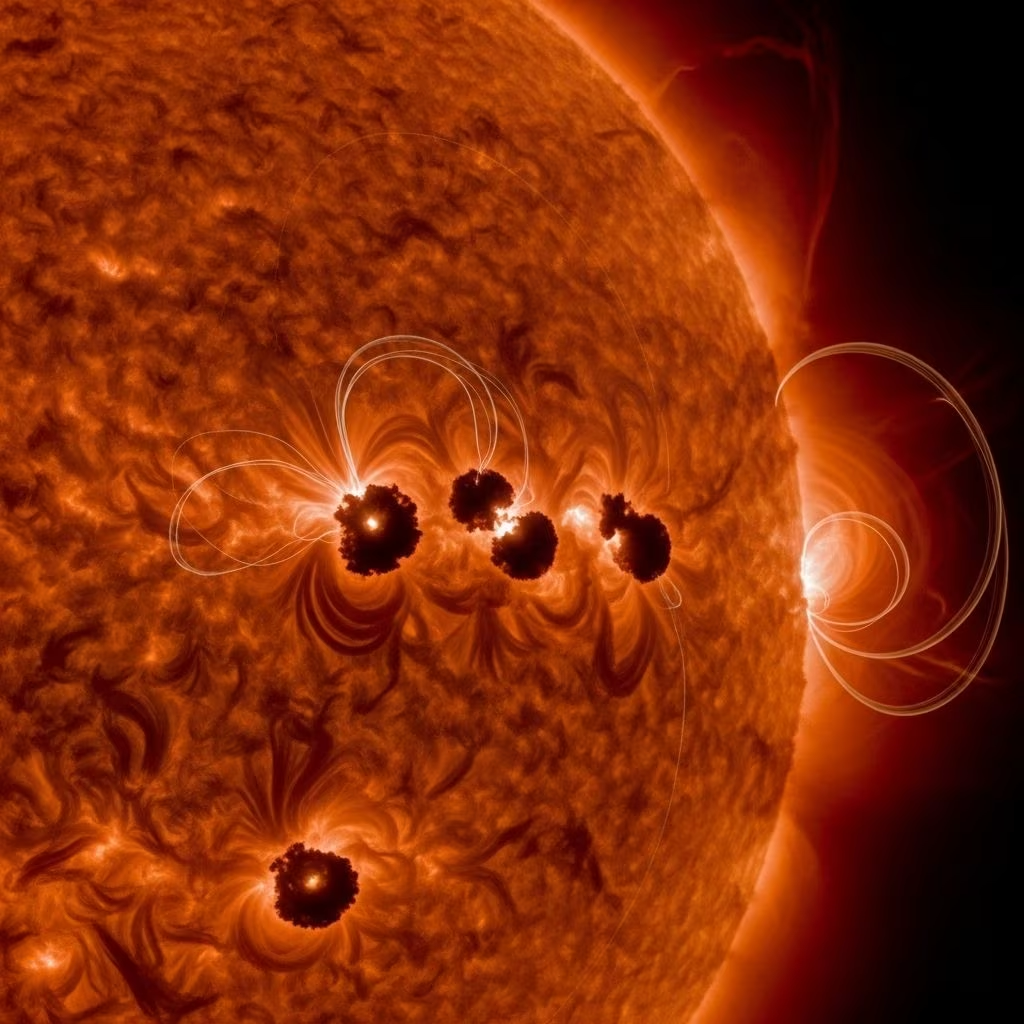
- Atmosphere: Beyond the photosphere lies the chromosphere and corona, typically seen only during eclipses or by X-ray imaging.
The balance of outward radiation from fusion and inward gravitational force is called hydrostatic equilibrium, making main sequence stars incredibly stable for the bulk of their lives.
The Fusion Engine: Hydrogen to Helium
The defining characteristic of a main sequence star is hydrogen fusion in its core, which takes place via two main processes:
- Proton-Proton (pp) Chain: Predominates in lower-mass stars (like the Sun). Four hydrogen nuclei (protons) fuse to form one helium nucleus, releasing energy as gamma rays, neutrinos, and positrons.
- CNO Cycle: More important in hotter, massive stars, this process uses carbon, nitrogen, and oxygen as catalysts for hydrogen fusion.
This nuclear fusion not only generates light and heat but also prevents the star from collapsing under its own gravity.
Mass: The Master Variable
Mass is the single most important factor in a main sequence star’s characteristics:
- High-Mass Stars are hot, blue or white in color, and extremely luminous. However, they burn through their hydrogen rapidly and have short lives (millions of years).
- Low-Mass Stars are cool, red, and faint, but can endure for tens to hundreds of billions of years.
- Stars like our Sun occupy a middle ground, with lifespans of about 10 billion years.
This strong mass-luminosity relationship means the more massive the star, the brighter it shines—but also the more quickly it evolves.
Our Sun: A Typical Main Sequence Star
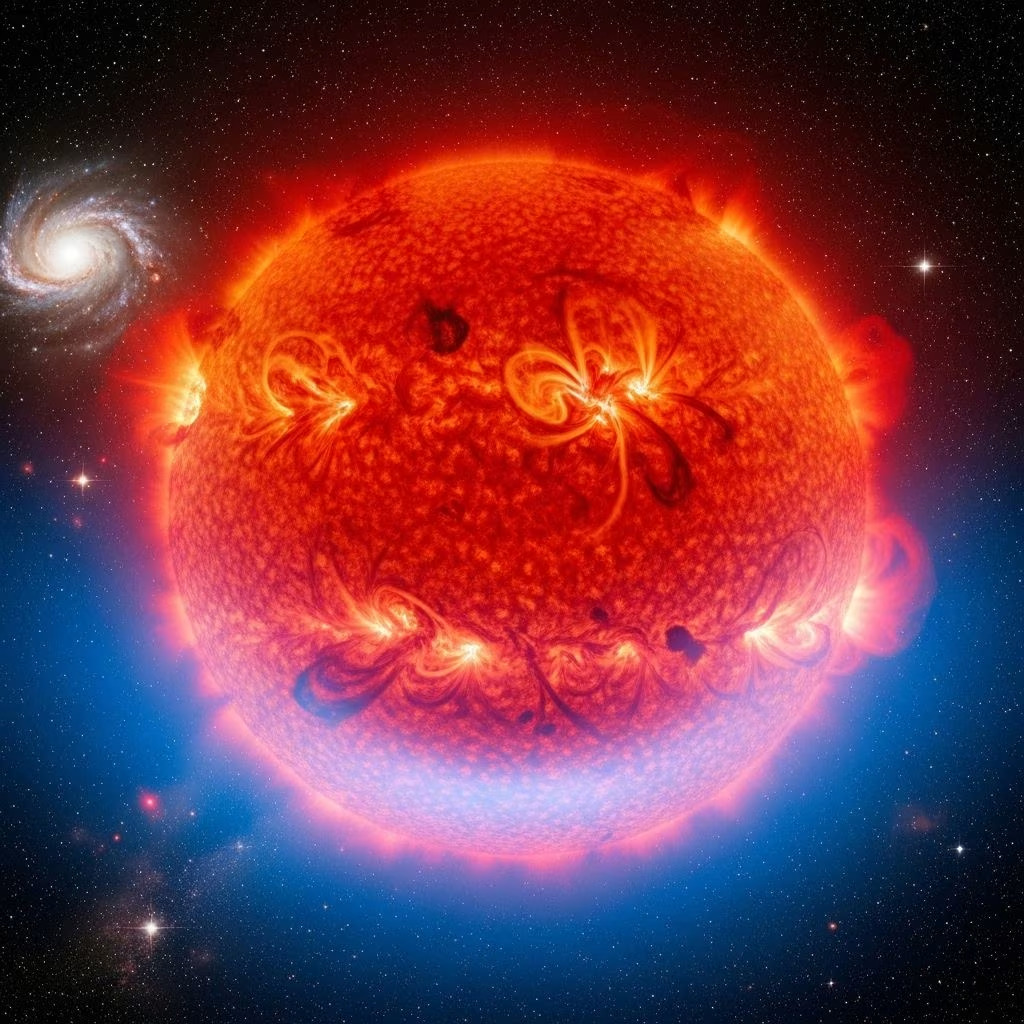
The Sun is a type G main sequence star (sometimes called a yellow dwarf) and has been in this stable phase for approximately 4.6 billion years. It is expected to remain a main sequence star for another 5 billion years, during which it will continue to power the solar system and support life on Earth.
- Mass: 1 solar mass (1 M☉)
- Surface temperature: ~5,778 K
- Luminosity: 1 solar luminosity (1 L☉)
Our Sun is the standard against which other main sequence stars are often compared.
Main Sequence Stars and the Universe
Main sequence stars are critical for several reasons:
- They are cosmic engines that create all elements heavier than hydrogen and helium (although most heavy elements are formed in later evolutionary stages and supernovae).
- Their stability ensures the persistent emission of light and heat—crucial for planetary habitability.
- They account for over 90% of all stars observed and are the ‘default’ life stage for nearly every star in the sky at any given time.
When Does a Star Leave the Main Sequence?
A star remains on the main sequence as long as it has enough hydrogen to sustain fusion in its core. When this fuel depletes:
- The core contracts and heats up, while the outer layers expand and cool.
- The star leaves the main sequence and transitions to the next phase—typically becoming a red giant if it is of low to intermediate mass, or evolving into more dramatic fates like supergiants, neutron stars, or black holes for the most massive stars.
Stellar Evolution Post-Main Sequence
| Initial Mass (solar masses) | Post-Main Sequence Fate |
|---|---|
| < 0.5 | Becomes a cool, long-lived red dwarf; eventual fate may be a white dwarf, but time exceeds the Universe’s current age |
| ~0.5 – 8 | Swells into a red giant, sheds outer layers, core becomes a white dwarf |
| >8 | Expands into a supergiant, explodes as a supernova, leaving behind a neutron star or black hole |
The Importance of Main Sequence Stars
- Help astronomers measure galactic structures and star formation histories.
- Play a major role in the chemical enrichment of the universe.
- Guide the search for habitable planets—long-lived main sequence stars are prime targets in the search for extraterrestrial life.
Main Sequence Stars in the Bigger Picture
The study of main sequence stars illuminates broad themes in science:
- Cosmology: Their lifespans anchor the age and evolution of galaxies.
- Astrobiology: Their steady energy output underpins planetary habitability and the search for life in the universe.
- Elemental Origins: They produce the building blocks for planets, life, and even the chemical elements found in our bodies.
Frequently Asked Questions (FAQs) on Main Sequence Stars
Q: What defines a main sequence star?
A main sequence star is defined by the steady balance of hydrogen fusion in its core and the equilibrium between gravitational contraction and outward pressure from fusion reactions.
Q: How long do stars typically stay on the main sequence?
The main sequence phase varies by mass: massive stars may remain for only a few million years, while low-mass stars can persist for hundreds of billions of years. Sun-like stars last about 10 billion years in this phase.
Q: Why is the Sun a main sequence star?
Our Sun continually fuses hydrogen to helium in its core and maintains a perfect balance between gravity and fusion pressure—making it a classic main sequence star.
Q: What happens when a star leaves the main sequence?
After hydrogen fuel runs out in its core, the star evolves based on its mass, becoming a red giant, white dwarf, neutron star, or black hole.
Q: Are all main sequence stars the same?
No; main sequence stars differ widely in mass, temperature, brightness, color, and lifespan. Their underlying fusion process is the essential commonality.
Key Takeaways: Why Main Sequence Stars Matter
- Main sequence stars are the most prevalent and critical stars in the universe.
- The Sun, our life-giving star, is a typical main sequence example.
- Studying main sequence stars unlocks core knowledge of stellar and planetary evolution, including the history and future of our solar system.
References
- https://en.wikipedia.org/wiki/Main_sequence
- https://study.com/academy/lesson/main-sequence-star-definition-facts-quiz.html
- https://theplanets.org/types-of-stars/main-sequence-star-life-cycle-and-other-facts/
- https://www.ebsco.com/research-starters/astronomy-and-astrophysics/main-sequence-stars-0
- https://science.nasa.gov/universe/stars/types/
- https://study.com/academy/lesson/video/main-sequence-star-definition-facts-quiz.html
- https://science.nasa.gov/universe/stars/
- https://www.merriam-webster.com/dictionary/main%20sequence
- https://www.teachastronomy.com/textbook/Properties-of-Stars/Understanding-the-Main-Sequence/
- https://www.skyatnightmagazine.com/space-science/main-sequence-stars
- https://astro4edu.org/resources/glossary/term/186/
- https://www.storyboardthat.com/space-words/main-sequence-star
- https://boyce-astro.org/the-main-sequence/
- https://cronodon.com/SpaceTech/Main_Sequence.html
- https://library.fiveable.me/key-terms/astrobiology/main-sequence-stars
- https://sentinelmission.org/astrophysics-glossary/main-sequence-star/