


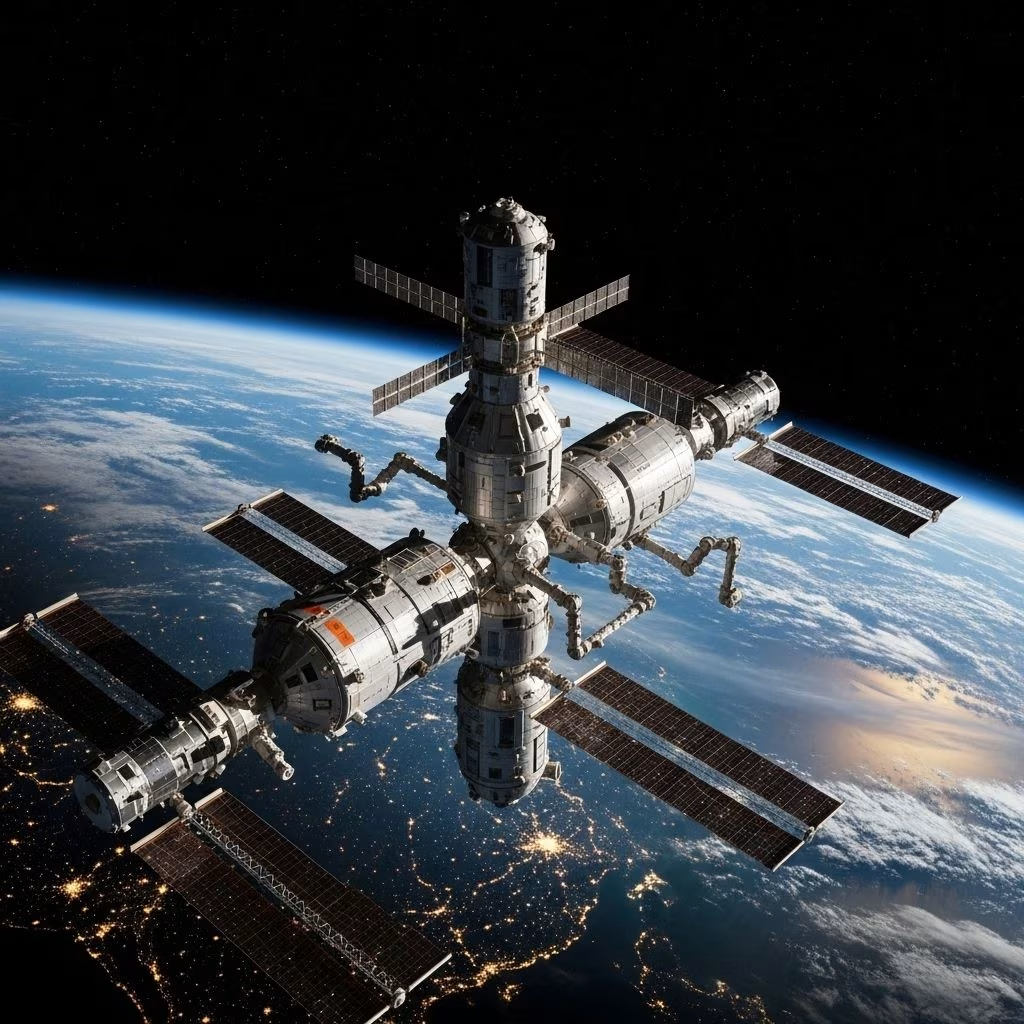
Tiangong: China’s Shining ‘Heavenly Palace’ in Space
Tiangong—which means ‘Heavenly Palace’ in Mandarin—is China’s permanently crewed modular space station, heralding a new era for Chinese and international space science. Comparable in ambition (if not yet in size) to the International Space Station (ISS), Tiangong demonstrates China’s long-term commitment to scientific research and technological advancement in low Earth orbit (LEO).
Design & Features of Tiangong
Tiangong is a modular space station positioned in low Earth orbit at altitudes between 340 km and 450 km above Earth’s surface. Its core design concepts include:
- Modular structure: The station uses a “T” shaped configuration, with a central core and two laboratory modules on either side.
- Total pressurized volume: Approximately 340 m3, just over a third the size of the ISS.
- Mass: About 66 metric tonnes when fully assembled.
- Crew capacity: Sustains three astronauts for extended missions, expandable to six during crew rotations.
- Operational life: Designed for at least 10 years, with extensibility options.
The station showcases advances in environmental control, monitoring, robotic technology, and docking mechanisms.
Assembly Timeline and Development
Tiangong’s construction is a capstone achievement for the China Manned Space Agency (CMSA):
- April 29, 2021: Launch of the Tianhe (‘Harmony of the Heavens’) core module.
- July 24, 2022: Addition of Wentian (‘Quest for the Heavens’) laboratory module.
- October 31, 2022: Installation of Mengtian (‘Dreaming of the Heavens’) laboratory module.
- Multiple crewed and uncrewed missions: Supported construction, resupply, and scientific commissioning.
Precursor modules (Tiangong-1 and Tiangong-2) served as vital testbeds for rendezvous, docking, and life support technologies now operational on Tiangong.
Core Modules: Tianhe, Wentian, and Mengtian
| Module | Translation | Launch Date | Main Function | Key Specs |
|---|---|---|---|---|
| Tianhe | Harmony of the Heavens | 29 Apr 2021 | Core command, crew quarters | Length: 16.6 m, Diameter: 4.2 m, Mass: 22.5 t, Pressurized volume: ~50 m3 |
| Wentian | Quest for the Heavens | 24 Jul 2022 | Science lab, backup life support, EVA airlock | Length: ~17.9 m, Mass: ~22 t |
| Mengtian | Dreaming of the Heavens | 31 Oct 2022 | Science lab, payload deployment | Length: ~17.9 m, Mass: ~22 t |
The Tianhe core module houses the primary living and control spaces, while Wentian and Mengtian offer additional laboratory environments and technological support. When fully assembled, total habitable space is up to 110 m³.
Living and Working in Space: Crew and Experiments
Tiangong boasts significant advancements for comfort and experimentation:
- Crew environment: Facilities mirror terrestrial comfort, including sleeping quarters, hygiene stations, and communal spaces.
- Extravehicular Activity (EVA): Dedicated airlocks support spacewalks, vital for assembly and external maintenance.
- Docking ports: Five in total, used for visiting crew vehicles, cargo supply ships, and science payloads.
- Life support: Both Tianhe and Wentian modules maintain redundant life support systems.
Scientific experiments span a wide range:
- Biological growth in microgravity
- Materials science & crystalline growth
- Space medicine and physiology
- Earth observation and atmospheric research
- Space technology validation
Science, Technology, and International Collaboration
Tiangong is not just a national project—it is an orbital laboratory open to selected international partners.
- Science platform: Tiangong enables long-term microgravity research unavailable on Earth, yielding advances in fluid dynamics, combustion, space medicine, and more.
- Technological innovation: The station advances automated rendezvous/docking, robotic manipulation, deep-space communication, and closed-loop life support.
- International projects: The China Manned Space Agency has opened select joint experiments to international participants, expanding scientific collaboration.
In the near future, the orbital platform will host the Xuntian space telescope, designed to co-orbit with the station for regular service and refueling visits. Xuntian’s powerful optics will extend China’s reach in astrophysical research and exoplanet studies.
Tiangong in the Context of Global Spaceflight
Unlike earlier Chinese space laboratories that provided proof of concept for systems engineering and human spaceflight, Tiangong marks China’s full entry into long-term human occupation and research in space.
| Feature | Tiangong | International Space Station (ISS) |
|---|---|---|
| Operational Since | 2021 | 2000 |
| Pressurized Volume | ~340 m³ | ~915 m³ |
| Crew Capacity | 3 (up to 6 during rotation) | 6–7 |
| Primary Operating Altitude | 340–450 km | approx. 400 km |
| Ownership | China | International Partnership |
| Design Life | ≥10 years | ≥20 years (2028+ extension planned) |
With prospects for expanded international cooperation and the planned de-orbiting of the ISS in the coming decade, Tiangong may soon be the only permanently crewed outpost in Earth orbit.
Frequently Asked Questions (FAQs)
Q: What does ‘Tiangong’ mean and why is it significant?
A: ‘Tiangong’ literally means ‘Heavenly Palace’, reflecting the Chinese vision of constructing a home for humanity in space and advancing peaceful exploration.
Q: How is Tiangong different from the earlier Tiangong-1 and Tiangong-2?
A: Tiangong-1 and Tiangong-2 were experimental modules, while the current Tiangong station is China’s first long-term, multifunctional laboratory and living space in orbit.
Q: How does Tiangong support scientific research?
A: Tiangong offers facilities for cutting-edge experiments in biology, medicine, materials science, and Earth observation.
Q: Can international astronauts visit Tiangong?
A: As of 2025, the station is primarily crewed by Chinese taikonauts, but international collaboration is developing, especially on scientific experiments.
Q: How long do crews stay aboard Tiangong?
A: Typical missions last between 3 and 6 months, with regular rotations to ensure continuous human presence in orbit.
Q: What is next for Tiangong?
A: Future plans include the addition of large payloads like the Xuntian space telescope and ongoing enhancements to science capabilities, life support, and robotics.
Further Reading
- Official China Manned Space Agency press releases
- International peer-reviewed journals on space exploration
- Comparison studies of Tiangong, ISS, and historical space stations
- Updates from the China Academy of Space Technology (CAST)
References
- https://en.wikipedia.org/wiki/Tiangong_space_station
- https://www.planetary.org/space-missions/chinese-space-station
- https://en.wikipedia.org/wiki/Tiangong-1
- https://www.youtube.com/watch?v=BwAj396v0iw
- https://spaceref.com/space-stations/overview-of-chinas-tiangong-space-station/
- https://www.cnsa.gov.cn/english/n6465652/n6465653/c6809605/content.html
- https://www.eoportal.org/satellite-missions/tiangong-space-station
- https://science.howstuffworks.com/chinese-space-station-news.htm
- https://spj.science.org/doi/10.34133/space.0035
- https://www.space.com/china-tiangong-space-station
- https://www.britannica.com/technology/space-station/Tiangong
- https://www.youtube.com/watch?v=lPpdOZRh2ks
- https://www.space.com/space-exploration/launches-spacecraft/satellite-spies-both-iss-and-chinas-tiangong-space-station-space-photo-of-the-day-for-july-4-2025
- https://www.rocketstem.org/2023/08/22/tiangong-station-gives-china-continuous-presence-in-orbit/
- https://www.drishtiias.com/daily-news-analysis/china-s-tiangong-space-station
- https://www.skyatnightmagazine.com/space-missions/tiangong-china-space-station
- https://www.shymkent.info/space/chinese-spaceflight/chinese-space-station-tiangong-and-its-activities/


