


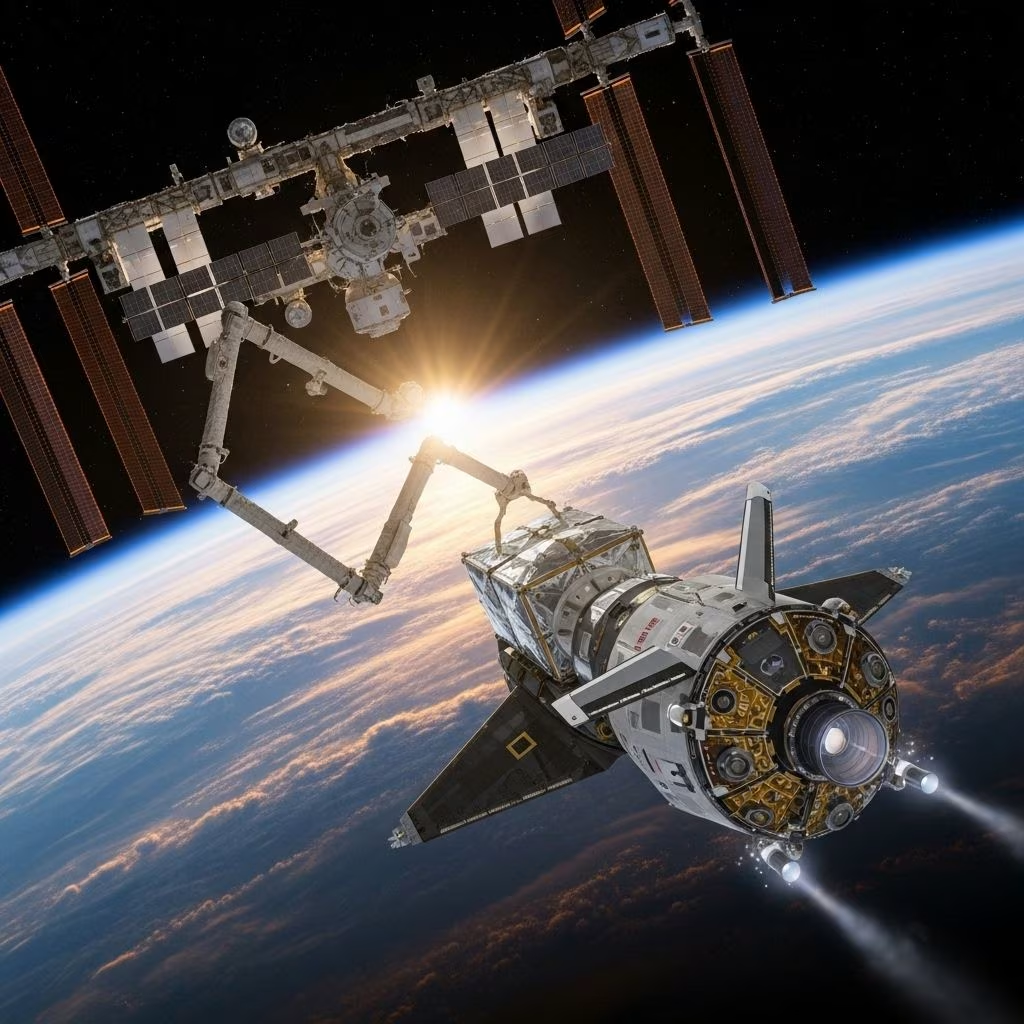
How NASA and Sierra Space Are Preparing for Dream Chaser’s First ISS Flight
The Dream Chaser spaceplane, built by Sierra Space in collaboration with NASA, is gearing up for its historic debut flight to the International Space Station (ISS). This mission represents a leap in commercial spacecraft capability, combining the versatility of traditional reusable spaceplanes with cutting-edge cargo technology. Here’s a comprehensive look at the preparations, testing, and innovations behind Dream Chaser’s long-awaited first flight.
What Is Dream Chaser?
Dream Chaser is a winged commercial spaceplane developed by Sierra Space (formerly Sierra Nevada Corporation’s Space Systems) designed for missions to low Earth orbit, including cargo and potential crew flights to the ISS. Distinct among modern orbital vehicles, Dream Chaser’s design is reminiscent of the space shuttle but scaled down, emphasizing high reusability, runway landings, and versatile mission parameters.
- Reuse: Designed for rapid turnaround and multiple flights, reducing long-term operational costs.
- Versatility: Capable of carrying pressurized and unpressurized cargo, with conceptual crewed variants in development.
- Gentle Earth Return: Glides to a horizontal runway landing, subjecting hardware and science experiments to significantly lower reentry forces (typically less than 1.5g).
Background and Development Timeline
Dream Chaser’s development traces back more than a decade. Motivated by NASA’s push for low-cost orbital cargo and crew delivery, Sierra Space set out to revive the spaceplane concept with modern technology. While early plans included a crewed version, NASA’s Commercial Resupply Services 2 (CRS-2) contract focused development on an autonomous cargo variant for the ISS.
- CRS-2 Contract: Awarded in 2016; Sierra Nevada (now Sierra Space) received NASA funding for at least six Dream Chaser resupply missions to the ISS.
- Name: The first orbital vehicle is named Tenacity, reflecting the years of perseverance and teamwork required to reach first flight.
- Timeline: Although the maiden flight was postponed multiple times (initially expected in 2021), rigorous development and testing have now set the first mission for the third quarter of 2025.
Key Features and Technical Specifications
| Feature | Details |
|---|---|
| Length | ~9 m (30 feet) |
| Wingspan | ~5 m (16.5 feet) |
| Height | ~3 m (9.8 feet) |
| Maximum Cargo Capacity | ~5,000 kg internally; +4,500 kg with Shooting Star (~9,500 kg total) |
| Engine | Orbitec Vortex |
| Propellant | Hydrogen peroxide & optional kerosene RP-1 |
| Power | Solar cells and onboard batteries (with additional panels on Shooting Star) |
| Maximum Crew | Up to 7 (crew version, not CURRENT variant) |
| Launch Vehicle | ULA Vulcan Centaur (4 boosters, large fairing) |
| Landing | Runway glider (horizontal) |
Dream Chaser stands out as the only current commercial system to combine vertical rocket launch with horizontal, airport-style landings. Its thermal protection system, employing silica tiles and TUFROC composite on leading edges, helps ensure robust reuse and safe return of sensitive cargo and experiments.
- Wing Design: The cargo version features folding wings to fit within standard launch fairings, maximizing compatibility with multiple rockets.
- Thermal Protection: Advanced ceramics and tile technologies inspired by but distinct from those used on the Space Shuttle.
- Downmass Capability: Can return up to 1,750 kg (3,860 lb) of cargo to Earth — an important capability for scientific payloads and station hardware.
The Dream Chaser Cargo System & Shooting Star Module
One of the most innovative aspects of the Dream Chaser system is its modular Shooting Star cargo container. Developed as an expendable pressurized module, Shooting Star drastically increases overall cargo uplift and adds several technical features central to mission success.
| Shooting Star: | |
|---|---|
| Length | ~4.6 m (15 feet) |
| Payload | 10,000 lbs (4,536 kg) additional cargo |
| Power | Up to 6kW solar panels |
| Thermal Management | Active and passive |
| Berthing/Docking | Supports docking with ISS, allows crew access via internal hatches |
| Disposal | Burns up on re-entry, facilitating removal of up to 3,250 kg (7,170 lb) of trash from the ISS |
| Navigation | Six thrusters for translation/rotation |
- Access: ISS astronauts access Dream Chaser cargo via Shooting Star, moving through a pressurized passageway.
- Trash Disposal: The ability to incinerate large volumes of ISS refuse improves station logistics and safety.
- Free-flying Variant: Sierra Space has developed a Shooting Star variant for standalone or other missions in low Earth orbit or cis-lunar space.
NASA and Sierra Space: Collaboration and Testing
Extensive collaboration between NASA and Sierra Space is essential to assure Dream Chaser’s safety and mission readiness. Both organizations have conducted a broad series of tests on the spacecraft, cargo module, and ground operations at key NASA centers.
- Structural Tests: Tenacity underwent rigorous vibration and acoustics tests at NASA’s Neil Armstrong Test Facility to simulate launch and ascent conditions.
- Integrated Stacking: Dream Chaser and its Shooting Star were stacked and tested together as a system, ensuring they withstand stresses as a cohesive unit.
- Earthbound Readiness: Subsystems for power, guidance, and life support were validated well ahead of shipping Dream Chaser to Kennedy Space Center;
- Cargo Integration: Coordination with ISS managers ensured seamless loading and transfer of science payloads and station supplies.
After successful vibration testing, Dream Chaser Tenacity is scheduled to move to Kennedy Space Center, where final preparations—ranging from software validations to cargo loadout—will occur ahead of flight.
Flight Readiness and Launch Schedule
Dream Chaser’s journey to the pad incorporates years of engineering iteration. The operational schedule for Tenacity’s debut illustrates the thorough steps taken for safety and mission assurance:
- Launch Date: Currently projected for the third quarter of 2025, following numerous reschedulings due to development milestones and external factors (e.g., Vulcan Centaur rocket readiness).
- Launch Vehicle: ULA’s Vulcan Centaur, using large payload fairing and four solid boosters to deliver Dream Chaser to orbit.
- Flight Duration: Each cargo supply mission is planned to last about 45 days.
- Landing Site: Dream Chaser will return autonomously and glide to a runway at NASA’s Kennedy Space Center, demonstrating the reusable, airplane-like approach absent from other ISS cargo systems.
Expected Impact and Future Missions
Dream Chaser’s debut is expected to inaugurate a new phase in ISS resupply, expand commercial partnerships in space, and open new opportunities for science and industry:
- ISS Logistics: With large cargo delivery and rapid downmass return, Dream Chaser supports critical station operations, from food and water to advanced experiments and hardware replacements.
- Commercial Science: The reduced reentry G-forces and fast cargo access after landing allow sensitive experiments (such as biological or technological prototypes) to be returned to Earth and analyzed within hours.
- Cost Efficiency: Dream Chaser’s reusable design aims to drive down costs, paving the way for more frequent, flexible missions to LEO and beyond.
- Broader Applications: Potential expansions include lunar logistics and free-flying science platforms, leveraging Dream Chaser and Shooting Star’s modularity.
- Follow-On Craft: Sierra Space’s next spaceplane Reverence (DC102) is in the pipeline, with contracts in place for at least six CRS-2 cargo missions and ongoing assembly progress.
Comparing Dream Chaser to Other Spaceplanes and Cargo Vehicles
| Vehicle | Key Attribute | Resupply Downmass | Reusable? | Landing Type |
|---|---|---|---|---|
| Dream Chaser | Runway landings, folding wings | 1,750 kg | Yes | Horizontal (runway) |
| SpaceX Dragon | Vertical splashdown in ocean | 3,000-6,000 kg (varied configs) | Yes | Vertical (parachute) |
| Northrop Grumman Cygnus | Large cargo up, no return cargo | 0 kg | No (expendable) | Burns up (destructive reentry) |
Frequently Asked Questions (FAQs)
Q: Why did Dream Chaser’s first flight take so long to materialize?
A: Technical challenges, rigorous NASA safety certification, integration with new launch vehicles, and the COVID-19 pandemic collectively led to Dream Chaser’s maiden mission being postponed from early 2020s to the latter half of 2025.
Q: What happens to the Shooting Star module after completion of its mission?
A: Shooting Star burns up harmlessly upon atmospheric reentry, acting as a trash disposal unit for the ISS and minimizing orbital debris risk.
Q: Can Dream Chaser carry astronauts?
A: While the current version is cargo-only, the original Dream Chaser design includes a variant capable of carrying up to seven crew members. Future missions may use the crewed version if contracts and development permit.
Q: How does Dream Chaser’s runway landing benefit scientific research?
A: The gentle 1.5g maximum reentry stress and fast recovery time allow delicate experiments to be returned to researchers quickly, preserving data quality and biological integrity.
Q: What makes Dream Chaser unique versus other ISS cargo vehicles?
A: Dream Chaser’s airplane-like horizontal runway landing is unique among ISS cargo vehicles, and its modular system allows for flexible delivery, disposal, and reusability options not present in many other current systems.
Related Topics
- The history of spaceplane technology
- NASA’s Commercial Resupply Services program (CRS)
- Comparison: Dream Chaser vs. SpaceX Dragon vs. Cygnus
- Future of low Earth orbit logistics and industry
With Dream Chaser’s inaugural flight drawing closer, the future of commercial spaceplane operations is set for a new era of innovation, rapid turnaround, and global runway landings. Watch this space for the next phase in orbital logistics and scientific access.
References
- https://www.space.com/19552-dream-chaser.html
- https://mezha.media/en/articles/povernennya-kosmichnih-shatliv-dream-chaser-ta-inshi-302765/
- https://en.wikipedia.org/wiki/Dream_Chaser_Tenacity
- https://en.wikipedia.org/wiki/Dream_Chaser
- https://www.sierraspace.com/dream-chaser-spaceplane/uncrewed-cargo-spacecraft/
- https://www.sierraspace.com/dream-chaser-spaceplane/
- https://www.nasa.gov/missions/station/commercial-resupply/sierra-spaces-dream-chaser-new-station-resupply-spacecraft-for-nasa/
- http://www.astronautix.com/d/dreamchaser.html
- https://www.nasa.gov/centers-and-facilities/glenn/first-look-spaceplane-stacked-and-shaken-at-nasa-test-facility/


