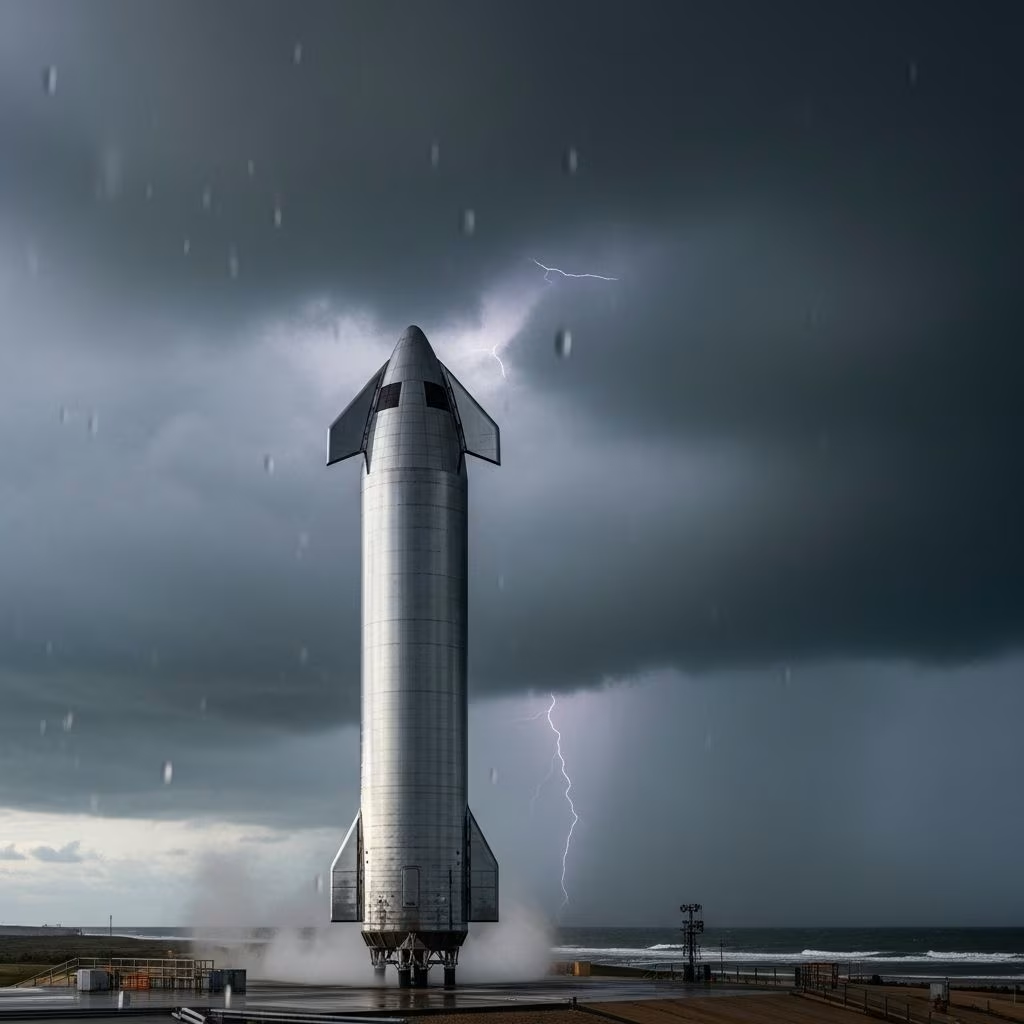
SpaceX Starship Flight 10 Delay: Weather and Technical Hurdles Stall Crucial Launch
SpaceX’s ambitious plans to launch the 10th test flight of its Starship megarocket have encountered a series of setbacks, with poor weather conditions and technical issues forcing repeated postponements. As the world’s most powerful rocket awaits liftoff from the Starbase facility in south Texas, the stakes remain high for both SpaceX and NASA, whose lunar and Mars programs hinge on the success of this critical test.
Key Takeaways
- Starship Flight 10 delayed due to a combination of ground system issues and severe weather risks, including thunderstorms and lightning.
- Multiple launch attempts postponed, first for technical troubleshooting, then due to ‘anvil clouds’ and persistent bad weather.
- This test is pivotal for NASA’s Artemis 3 Moon landing (targeted for 2027) and SpaceX’s long-term Mars objectives.
- Backup launch opportunities are scheduled, but the timeline is increasingly pressured by operational and environmental challenges.
Background: Why Starship Flight 10 Matters
SpaceX’s Starship program aims to revolutionize space travel with fully reusable, super-heavy lift vehicles capable of delivering massive payloads to orbit and beyond. Each test flight iterates on hardware improvements and mission profiles. Flight 10 is especially significant because:
- It is the fourth Starship launch of 2025 and the 10th overall full-stack test, after the previous three test flights this year (Flights 7, 8, and 9) ended in failure.
- The test’s goals include demonstrating atmospheric reentry, controlled descent, and a targeted splashdown in the Indian Ocean about 1 hour and 6 minutes after liftoff.
- Crucially, NASA has selected Starship as the lander for the Artemis 3 mission, making the timing and outcome of each test essential for the broader lunar exploration schedule.
Chronology of Recent Delays
Originally, Starship Flight 10 was scheduled to launch on Sunday evening, August 24, 2025, at 7:30 p.m. EDT (6:30 p.m. CDT) from SpaceX’s Starbase in Boca Chica, Texas. However, a succession of issues has repeatedly delayed the mission:
- Sunday, August 24: Launch was scrubbed roughly 30 minutes before liftoff.
- Initial Cause: SpaceX cited the need to “troubleshoot an issue with ground systems.” These systems, known as “Stage 0,” are unique to Starship launches and can automatically halt operations if any of their thousands of elements malfunction.
- Though weather on Sunday was less than ideal, the initial stoppage was not caused by environmental conditions.
- CEO Elon Musk later specified: “Ground side liquid oxygen leak needs to be fixed. Aiming for another launch attempt tomorrow.”
Monday: Weather Becomes the Culprit
- The launch was rescheduled for Monday night, targeting a similar launch window around 7:30 p.m. EDT.
- Despite hopes for improved conditions, thunderstorms, rain, and especially lightning—referred to as “anvil clouds”—forced SpaceX to stand down yet again about 20 minutes before the launch window ended.
Elon Musk stated on social media:
“Launch called off for tonight due to anvil clouds over launch site (lightning risk)”
- These hazards echo common caution in aerospace, as lightning strikes have caused catastrophic failures in the past (such as the Apollo 12 launch in 1969).
- SpaceX indicated another launch opportunity might arise as early as Tuesday night, depending on improving conditions and full system readiness.
Operational Pressures: Backup Windows and Local Impacts
Given the repeated postponements, SpaceX and local officials have made contingency plans to provide maximum flexibility:
- Backup launch dates are officially scheduled for August 25 and August 26, matching the original time window. All attempts are subject to closure of Boca Chica Beach and Highway 4 for public safety.
- Beach and road closures highlight the significant local impact of Starship operations. Cameron County Judge Eddie Treviño Jr. ordered, “Beach and Highway 4 [will be] closed for protection of public health and safety during SpaceX flight testing.”
- Additional delays beyond these dates may require new authorizations and could interfere with ongoing SpaceX and community activities.
Starbase and the Ground Game: Why ‘Stage 0’ Is Critical
Unlike traditional rockets, Starship’s ground systems are central to the launch sequence. “Stage 0” includes a maze of hardware for propellant delivery, environmental conditioning, and structural support. The intricacy means:
- Even minor leaks or sensor discrepancies can trigger automatic scrubs to safeguard the rocket, personnel, and facility.
- SpaceX’s robust approach to troubleshooting, including fast turnarounds and overnight operations, reflects both the complexity and ambition of the program.
As highlighted by recent events, even after hardware fixes, environmental hazards (like anvil clouds) can easily ground a launch—demonstrating that full-stack Starship launches require precise alignment of technology and nature.
Implications for NASA’s Artemis Mission and the Mars Dream
Delays in the Starship program don’t just impact SpaceX’s timelines—they directly affect lunar landing and Mars exploration plans:
- NASA’s Artemis 3 mission—targeted for 2027—counts on a fully tested and reliable Starship vehicle as its lunar lander. The agency’s ability to meet this deadline hinges on successful high-altitude and landing demonstrations in Starship’s 2025 flights.
- International collaboration: The Artemis program involves global partners and requires tight scheduling between launches, in-space rendezvous, and landings.
- Mars ambitions: Starship is designed to be fully reusable with huge payload mass—enabling deep space missions and establishing permanent outposts on the Red Planet. Every delay in flight testing reverberates across SpaceX’s vision for multi-planetary humanity.
Starship Flight 10 Mission Profile: Goals and Milestones
The Flight 10 test is engineered to push Starship’s capabilities further than before. Key mission parameters include:
| Parameter | Details |
|---|---|
| Height at Launch | ~400 feet (122 meters) |
| Planned Duration | Approximately 1 hour and 6 minutes |
| Reentry Phase | Begins 47 minutes after launch |
| Landing Target | Splashdown in the Indian Ocean |
| Launch Location | Starbase, Boca Chica, Texas |
| Primary Objective | Demonstrate reentry, descent, and a safe ocean landing |
| Backup Dates | August 25 & 26, 2025 |
Recent Setbacks and Learnings
Every Starship flight yields critical data, even (and especially) after failure:
- The three earlier launches in 2025 (Flights 7, 8, and 9) all failed after liftoff due to a variety of technical problems, including engine anomalies and structural issues.
- An additional Starship prototype exploded on a test stand in June, intensifying urgency for robust ground infrastructure and hardware reliability.
- Each incident prompts detailed investigation and rapid iteration—one of SpaceX’s hallmarks in advancing reusability and rocket design.
Despite delays and setbacks, SpaceX’s rapid prototyping ethos accelerates learning and improvements in both hardware and launch operations. Continuous testing is fundamental to achieving the program’s audacious goals.
Community and Environmental Considerations
Starbase’s location brings both benefits and challenges for local communities and wildlife:
- Frequent road and beach closures disrupt local access but are essential to public safety during launches.
- Environmental groups and regulatory bodies carefully monitor launch activities and their impacts on sensitive habitats, notably during pad construction and test flights.
- Community engagement and regulatory compliance remain as crucial as engineering readiness in the campaign to send Starship into orbit safely and sustainably.
What’s Next for Starship Flight 10?
- If ground system repairs and weather conditions align, SpaceX will attempt another launch soon, possibly as early as the next available window.
- Each postponement paints a vivid picture of the challenges and unpredictabilities inherent in developing the most complex spacecraft ever built.
- NASA, the world space community, and the aerospace-hungry public await the next attempt with anticipation, watching closely as SpaceX works to overcome technical and meteorological obstacles.
Frequently Asked Questions (FAQs)
Q: Why was Starship Flight 10 delayed?
A: The initial delay was caused by a ground systems issue—a liquid oxygen leak on the ground-side hardware. Subsequent attempts were postponed due to severe weather, particularly lightning threats from anvil clouds near the launch site.
Q: When will SpaceX attempt to launch Flight 10 again?
A: SpaceX has designated backup launch dates on August 25 and 26, 2025, with similar launch windows. Weather and technical readiness will determine the actual launch date.
Q: What is the objective of Starship Flight 10?
A: The test aims to launch Super Heavy and Starship fully stacked, fly a suborbital trajectory, and attempt a reentry and splashdown in the Indian Ocean. This will validate improvements in reentry, vehicle control, and landing procedures.
Q: Why does Starship matter for NASA’s Artemis program and Mars?
A: NASA has selected Starship as the Moon lander for Artemis 3. The platform’s eventual reusability and mass capacity are also key to future Mars travel. Delays in Starship readiness could impact these programs’ timelines.
Q: Has Starship successfully launched and returned yet?
A: As of Flight 10, SpaceX has not yet achieved a fully successful, controlled ocean splashdown. Flights 7–9 in 2025 all ended in failure after liftoff, underlining the difficulty of the test campaign.
Looking Ahead: SpaceX’s Challenge and Promise
SpaceX’s Starship program embodies the spirit of risk, iteration, and technological daring at the heart of modern space exploration. Every launch attempt, whether scrubbed for a fleeting thunderstorm or paused for valve replacements, brings invaluable lessons that draw humanity closer to the Moon, Mars, and beyond.
- The next attempt at Starship Flight 10 will serve not only as a technical achievement, but as a bellwether for the future of global spaceflight.
- The world will be watching—not just for a rocket launching, but for a new era in deep space exploration to finally get off the ground.
References
- https://www.space.com/space-exploration/launches-spacecraft/spacex-delays-critical-starship-flight-10-test-launch-due-ground-systems-issue
- https://www.space.com/space-exploration/launches-spacecraft/spacex-starship-flight-10-launch-what-time
- https://en.wikipedia.org/wiki/Starship_flight_test_10
- https://spaceexplored.com/2025/08/24/starship-flight-10-delayed-heres-why-and-when-it-could-launch-next/
- https://www.rocketlaunch.live/launch/starship-flight-10
- https://spaceflightnow.com/2025/08/16/spacex-schedules-starship-flight-10-details-recent-setbacks/
- https://www.usatoday.com/story/news/nation/2025/08/22/starship-rocket-launch-spacex-when/85758301007/
- https://www.teslarati.com/spacex-calls-off-starship-10-flight-attempt-once-again-weather/
- https://www.youtube.com/watch?v=QrJwUmaExso
- https://www.youtube.com/watch?v=M8JrVsRL6Aw
- https://www.usatoday.com/story/news/nation/2025/08/25/starship-rocket-launch-scrub-spacex-when/85812991007/
- https://www.teslaoracle.com/2025/08/25/spacex-called-off-todays-starship-flight-10-test-due-to-weather-conditions/
- https://www.teslarati.com/spacex-starship-flight-10-what-to-expect/
- https://teslanorth.com/2025/06/18/spacex-starship-flight-10-late-june-launch/