NASA Raises the Odds that an Asteroid Could Hit the Moon in 2032
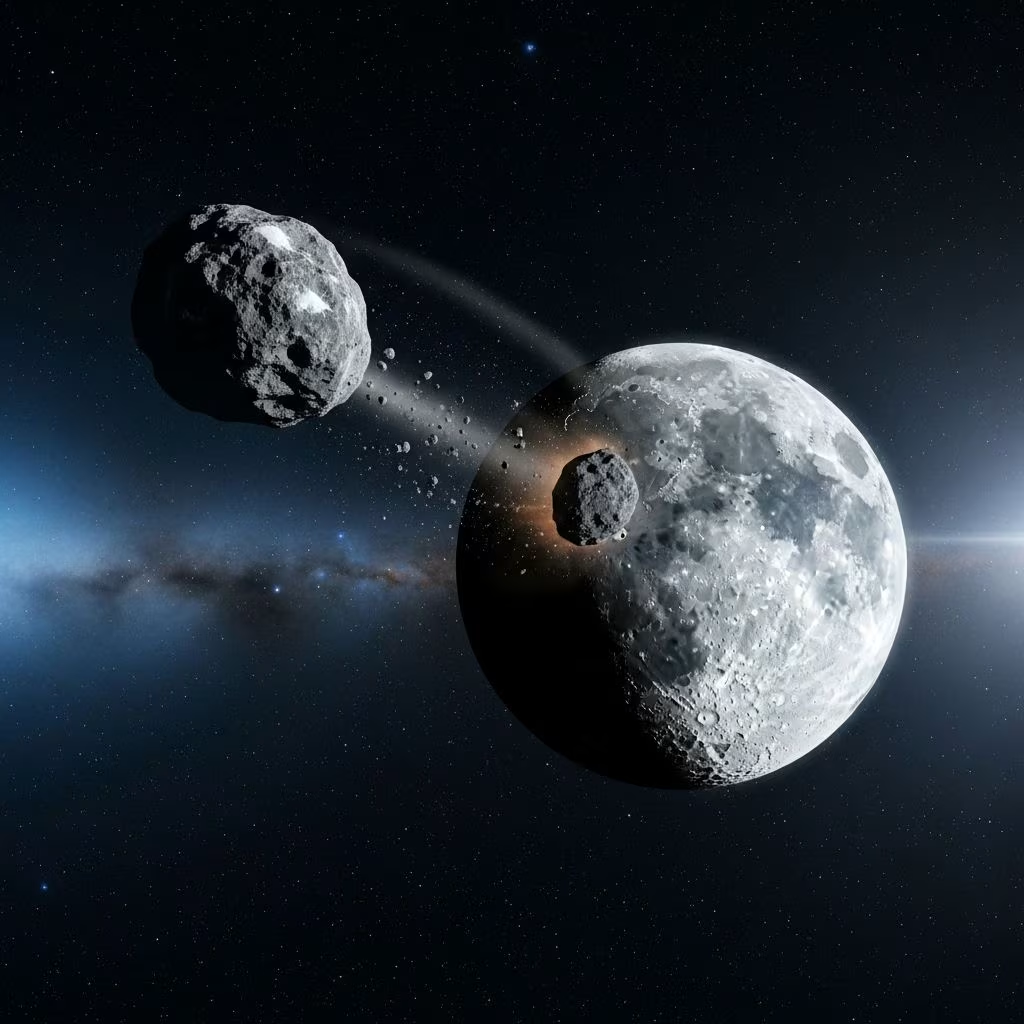
In an unprecedented development, NASA has updated the impact probability for asteroid 2024 YR4, indicating a 4.3% chance that this city-sized space rock could collide with the Moon on December 22, 2032. While Earth has been cleared of imminent danger, the Moon now faces a heightened risk, sparking significant scientific interest and concern regarding the aftermath of such an impact.
Overview: The Threat of Asteroid 2024 YR4
Discovered in December 2024, asteroid 2024 YR4 initially unsettled astronomers due to early calculations that showed as much as a 3.1% chance it could strike Earth, the highest risk ever measured for a large near-Earth object of its kind. Successive observations using advanced telescopes, including the James Webb Space Telescope (JWST), have since eliminated the threat to Earth, but refined its trajectory to reveal a distinct risk for our lunar neighbor.
- Diameter: Approximately 60 meters (about 200 feet)—comparable to the size of a city-destroying asteroid.
- Mass: Estimated to weigh millions of kilograms.
- Orbit: Close pass in astronomical terms—about 0.00007 AU from the Moon.
How the Odds Changed: From Earth to the Moon
Initial concerns revolved around an Earth impact, but improved orbital data swiftly reduced those odds to near zero. As the calculations have become more robust, the Moon’s risk window expanded. Today, NASA and international agencies estimate the following:
| Celestial Body | Impact Probability (Initial) | Updated Probability |
|---|---|---|
| Earth | 3.1% | 0.004% |
| Moon | Below 1% | 4.3% |
According to Dr. Andrew Rivkin, a planetary scientist at Johns Hopkins University, the shift toward lunar risk is a natural artifact of tighter orbital constraints: “The way that the orbit improved made the position move away from the Earth, but it moved toward the Moon.”
Asteroid 2024 YR4: What We Know
2024 YR4 is a near-Earth object (NEO) whose size and kinetic energy have piqued the interest of planetary defense researchers. Described as a ‘city killer,’ its mass and velocity mean that an impact would produce an explosive energy output on par with a large nuclear detonation—potentially the largest lunar impact in around 5,000 years.
- Discovery date: December 27, 2024
- Classification: Apollo-type NEO
- Closest lunar approach: Projected for December 22, 2032
Lead author Paul Wiegert and his team at the University of Western Ontario performed simulations indicating that between 100 million kilograms and more could be ejected from the Moon’s surface by the impact, with effects comparable to a significant nuclear explosion[11].
Potential Consequences of a Lunar Impact
Debris Ejection: What Happens Next?
If 2024 YR4 strikes the Moon, simulations predict an extraordinary ejecta event. Lunar material would be blasted outward, with some fragments possessing enough velocity to escape the Moon’s gravity altogether.
- Meteor Shower: Some of these lunar fragments could intersect Earth’s atmosphere, resulting in a spectacular “lunar meteor shower” visible from the surface.
- Satellite Hazards: Orbits above Earth could be threatened. High-velocity debris would pose risks to Earth-orbiting satellites and assets fundamental to communication and navigation[10].
- New Lunar Crater: The impact would create a fresh, observable lunar crater. Researchers from ESA’s Planetary Defence Office confirm this event would be visible from Earth-based telescopes.
Richard Moissl, head of ESA’s Planetary Defence Office, stated, “Definitely, a new observable Moon crater would be the outcome!” The study estimates that nothing dangerous would reach the Earth’s surface, but the meteor activity could be significant for scientific observation and for the safety of orbital infrastructure[10].
Scientific and Technological Interest
The potential for a real-time, energetically significant asteroid impact on the Moon is sparking enthusiasm in the planetary science community. It presents a once-in-millennia opportunity to study:
- Crater Formation: Direct observation of lunar impact crater genesis and ejecta dispersal dynamics
- Lunar Meteorites: Tracking the journey of lunar-origin meteors hitting Earth, offering fresh insight into lunar geology
- Satellite Defense: Refined modeling of high-velocity debris hazards for artificial satellites, informing future risk mitigation strategies[10].
Why Was Earth Ruled Out?
Early headlines prompted significant concern regarding Earth’s safety. However, the combination of newly tracked orbital data points and continual telescopic surveillance allowed analysts at NASA’s Near-Earth Object Studies Center to precisely calculate a negligible collision chance. By the time JWST and other global observatories secured additional data in mid-2025, Earth’s risk had fallen below 0.004%, removing the threat of global calamity while focusing monitoring efforts on the Moon[11].
Challenges Ahead: Should We Intervene?
While astronomers anticipate a rare scientific event, some experts and commentators have called for proactive mitigation, including controversial proposals to alter or even destroy the asteroid before a lunar impact. Ideas such as nuclear deflection have surfaced, prompting lively ethical and technical debates in international forums and among the planetary defense community.
- Nuclear Deflection: Proposals involve launching explosive devices to alter the asteroid’s path or fragment it before collision.
- Technical Feasibility: Such interventions are logistically complex and come with geopolitical and environmental risks.
- Scientific Value: Many planetary scientists discourage intervention, arguing that the event offers an invaluable opportunity to study a rare natural process in the solar system.
The Global Conversation: Excitement and Anxiety
The prospect of a city-sized asteroid striking our celestial companion has split public and scientific opinion between anxiety over possible satellite fallout and excitement about witnessing a natural lunar event unprecedented in modern times.
- For Scientists: The impact could provide direct data on crater morphology, lunar material exchange, and NEO dynamics.
- For the Public: There is interest in the potential meteor shower spectacle and concerns about the implications for satellite networks and communication systems.
- For Space Agencies: Continuous monitoring will intensify, with agencies updating risk assessments as data improves and considering diplomatic and legal implications of mitigation plans.
Satellite Networks: Vulnerabilities and Protective Measures
Researchers warn that up to 100 million kilograms of debris may be ejected from the Moon’s surface, with some reaching Earth’s vicinity in 2033. Most fragments are expected to burn up harmlessly in the atmosphere, but high-speed ejecta could potentially damage commercial, scientific, or military satellites. Industry leaders are consulting with NASA and ESA to model debris trajectories and, if necessary, adjust satellite orbits temporally during the highest-risk period[10].
Looking Ahead: What to Expect in 2032
The asteroid’s approach and potential impact on December 22, 2032 will be watched closely by observatories, agencies, and amateur astronomers worldwide. If 2024 YR4 does strike the Moon, observers on Earth will likely witness:
- A visible lunar flash; telescopes could catch the immediate aftermath
- The emergence of a new, large crater; later images will reveal the scale of devastation
- Heightened meteor activity; possible ‘lunar meteor showers’ over the following months
Beyond the spectacle, new data and increased public attention may galvanize global support for enhanced NEO tracking, lunar exploration, and innovation in space asset protection.
Frequently Asked Questions (FAQs)
Q: What is the size and significance of asteroid 2024 YR4?
A: 2024 YR4 is approximately 60 meters in diameter—a size capable of causing a city-level catastrophe on Earth or generating a massive lunar crater. Its 4.3% lunar impact probability makes it a rare, closely monitored threat.
Q: Will any debris from a lunar impact reach Earth’s surface?
A: Simulations suggest that while most ejecta will either remain in lunar orbit or burn up in Earth’s atmosphere, some material may survive and create an observable meteor shower, with negligible risk for ground-level damage.
Q: How certain are scientists about the impact?
A: The current estimate, based on refined JWST observations, indicates a 4.3% chance, but this figure may change with continued monitoring as 2032 approaches.
Q: Could a lunar impact threaten satellites or other assets?
A: High-speed debris from the lunar surface could, in theory, threaten satellites, particularly those in medium to high Earth orbits. Steps may be taken to reposition satellites temporarily during the high-risk interval.
Q: Will the impact be visible from Earth?
A: Yes, astronomers expect the flash and crater formation to be detectable from Earth with professional or amateur telescopes. A surge in meteor activity may also be visible to the unaided eye if debris reaches Earth’s skies.
Q: Why don’t scientists plan to deflect the asteroid?
A: Many in the scientific community see greater value in studying the impact rather than intervening. However, there is ongoing debate about planetary defense priorities and the risks versus benefits of any such attempt.
Conclusion: A Rare Celestial Event and Its Implications
NASA’s revised trajectory for asteroid 2024 YR4 marks a crucial test for global asteroid-tracking infrastructure and planetary defense strategies. While Earth faces no immediate threat, the Moon’s fate in 2032 could give the world a front-row seat to a planetary process millions of years in the making—reminding humankind of our shared cosmic environment and the ongoing need for robust space situational awareness and contingency planning.
References
- https://science.nasa.gov/solar-system/asteroids/2024-yr4/
- https://www.space.com/astronomy/asteroids/nasa-raises-the-odds-that-an-asteroid-could-hit-the-moon-in-2032
- https://science.nasa.gov/blogs/planetary-defense/2025/06/05/nasas-webb-observations-update-asteroid-2024-yr4s-lunar-impact-odds/
- https://timesofindia.indiatimes.com/science/nasa-warns-city-killer-asteroid-2024-yr4-may-impact-moon-in-2032-earth-stays-safe-for-now/articleshow/121745397.cms
- https://phys.org/news/2025-06-earth-satellites-asteroid-moon.html
- https://www.livescience.com/space/asteroids/city-killer-asteroid-2024-yr4-could-shower-earth-with-bullet-like-meteors-if-it-hits-the-moon-in-2032
- https://www.ndtv.com/science/scientists-consider-blowing-up-asteroid-2024-yr4-to-prevent-moon-impact-9331411
- https://www.iflscience.com/nasa-observations-suggest-asteroid-2024-yr4-now-has-1-in-23-chance-to-hit-the-moon-in-2032-79547
- https://www.the-independent.com/space/asteroid-2024-yr4-moon-impact-nuclear-explosion-b2831872.html
- https://www.foxweather.com/earth-space/potential-asteroid-2024-yr4-moon-meteor-shower
- https://www.iflscience.com/in-2032-earth-may-witness-a-once-in-5000-year-event-on-the-moon-79853
- https://www.sciencealert.com/2032-city-killer-impact-threatens-earths-satellites-study-finds
- https://www.youtube.com/watch?v=6RH3DbrLkTY
- https://opentools.ai/news/nasa-raises-alarm-asteroid-might-hit-the-moon-in-2032
- https://www.universetoday.com/articles/the-potential-danger-to-satellites-due-to-ejecta-from-a-2032-lunar-impact-by-asteroid-2024-yr4