


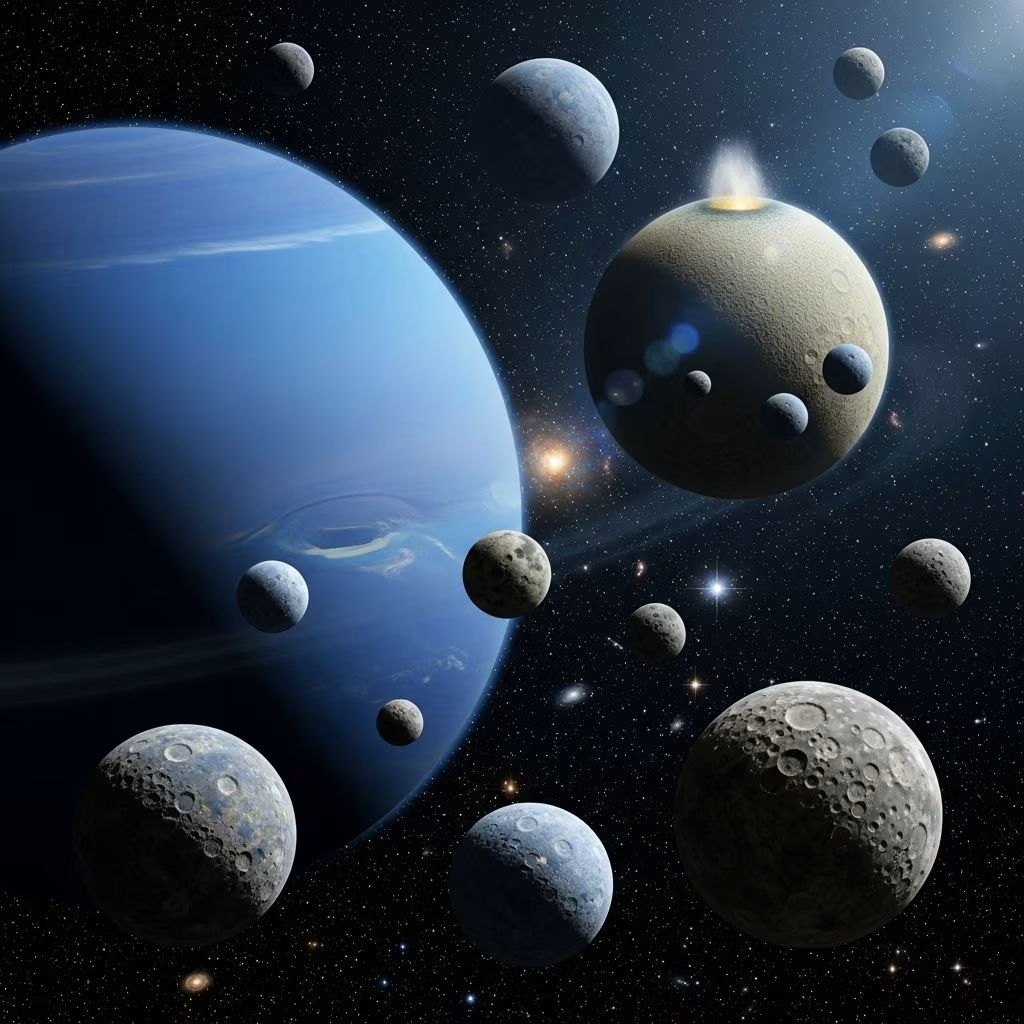
Neptune’s Moons: A Solar System Enigma
Neptune, the enigmatic blue planet at the edge of our solar system, commands a miniature solar system of its own, graced by a diverse host of moons. Since Neptune’s discovery in 1846, astronomers have uncovered a remarkable family of natural satellites revealing clues to the planet’s history, the dynamics of planetary systems, and the tumultuous early solar system. This article explores the moons of Neptune, their discovery, characteristics, and the scientific mysteries they continue to inspire.
Discovery and Early History
The story of Neptune’s moons begins just days after the planet itself was sighted. Triton, Neptune’s largest moon, was discovered on October 10, 1846, merely 17 days after Johann Galle and Heinrich d’Arrest identified Neptune using calculations by Urbain Le Verrier. William Lassell, a British astronomer, observed the new moon through his telescope, marking the start of Neptune’s satellite saga. For more than a century, Triton stood alone, until Gerard Kuiper’s discovery of Nereid in 1949, the moon that remains Neptune’s most eccentric and one of the most distant regularly-orbiting moons in the solar system. The next wave of discoveries would not come until Voyager 2’s flyby in 1989, which revealed Neptune’s complex inner satellite system.
How Many Moons Does Neptune Have?
To date, 16 confirmed moons orbit Neptune, although numbers have fluctuated with new discoveries and observational limitations. As of the 2020s, 16 are generally recognized, with potential for further additions as telescope technology improves. Each is named after various minor sea deities and nymphs from Greek mythology, in keeping with Neptune’s mythological association as the god of the sea.
Classification: Regular vs. Irregular Moons
Neptune’s moons are classified into two major groups:
- Regular moons: Seven inner moons with relatively small, circular, prograde orbits close to Neptune’s equatorial plane.
- Irregular moons: Nine distant moons—including Triton and Nereid—with eccentric, often retrograde, and highly inclined orbits.
This stark division reflects a dramatic and violent past—particularly the capture of Triton, which disrupted any primordial moon system and led to the re-formation of inner moons from the collision debris.
Meet Neptune’s Major Moons
Each of Neptune’s moons holds unique characteristics, but the following are the most significant and best studied.
Triton: The Captured Giant
Triton is, by far, the dominant member of Neptune’s satellite system. It is the only large moon in the solar system to revolve in a retrograde orbit: it moves in the opposite direction to Neptune’s rotation. This strongly suggests that Triton did not form alongside Neptune, but was instead captured from the Kuiper Belt during the early solar system.
- Diameter: 2,704 km (1,680 mi)
- Orbital distance from Neptune: ~354,760 km
- Orbit period: Synchronous with Neptune’s rotation (always shows the same face)
- Surface temperature: ~ -235°C (-391°F), among the coldest in the solar system
Triton’s atmosphere is thin and composed mainly of nitrogen, with trace amounts of methane. Its icy surface features a polar ice cap at the south, rugged “cantaloupe terrain,” geysers of nitrogen gas, and signs of past geologic activity. Triton is slowly spiraling inward and is predicted to eventually be torn apart by Neptune’s gravity, possibly forming a ring.
Nereid: The Distant Eccentric
Nereid is Neptune’s third-largest moon and has the most eccentric orbit of any known moon in the solar system. Its distance from Neptune can range dramatically, thought by many to be the result of Triton’s capture violently altering its original orbit.
- Diameter: ~340 km
- Discovered: 1949 by Gerard Kuiper
- Orbital period: ~360 Earth days
- Distance from Neptune: ranges from 1.3 to 9.7 million km
Nereid’s irregular shape, uncertain origin, and extreme orbit make it an object of ongoing interest, possibly a captured object or surviving remnant of Neptune’s original satellite system.
Proteus: The Large Inner Moon
Proteus is Neptune’s second-largest moon, yet far smaller than Triton. It has an irregular, heavily cratered surface and orbits closer to Neptune. Proteus was largely unknown until Voyager 2’s flyby.
- Dimensions: 418 x 390 x 396 km (irregular shape)
- Distance from Neptune: ~117,650 km
- Orbital period: 1.1 Earth days
The moon is dark and non-reflective, suggesting a composition of ice mixed with rock, and is pockmarked by impact craters.
The Small Inner Moons: Naiad, Thalassa, Despina, Galatea, Larissa
The Voyager 2 mission discovered an array of small inner moons clustered close to Neptune. These moons possess prograde, near-circular orbits and are thought to be fragments from past collisions. They include:
- Naiad: The innermost Neptunian moon (discovered 1989; diameter ~58 km; orbital period 0.294 days)
- Thalassa: (discovered 1989; diameter ~80 km; orbital period 0.311 days)
- Despina: (discovered 1989; diameter ~148 km; orbital period 0.335 days)
- Galatea: (discovered 1989; diameter ~158 km; orbital period 0.428 days)
- Larissa: (discovered 1989, but first seen in 1981 via stellar occultation; diameter ~194 km; orbital period 0.555 days)
These small, less-reflective satellites are closely associated with Neptune’s faint ring system—some even help maintain ring arcs through their gravitational influence.
Other Notable Moons: Halimede, Sao, Laomedeia, Psamathe, Neso, S/2004 N1
Beyond the major moons are a growing collection of irregular, distant satellites. Highlights include:
- Neso: Neptune’s most remote known moon, orbiting farther from its planet than any other moon in the solar system (approximately 48 million km away; period: ~26.7 years).
- Psamathe: Slightly closer than Neso, but also extremely far-flung and with a retrograde orbit.
- S/2004 N1: The most recently discovered moon (identified in 2013), only about 16 to 20 km across, orbiting between Larissa and Proteus.
Most of these outer satellites are less than 100 km across, often discovered via lengthy exposure by large ground-based telescopes.
All Neptune’s Moons at a Glance
| Moon | Discovery Year | Approx. Diameter (km) | Orbital Distance (km) | Orbital Period (Earth days) | Orbit Type |
|---|---|---|---|---|---|
| Naiad | 1989 | 58 | 48,230 | 0.29 | Prograde |
| Thalassa | 1989 | 80 | 50,070 | 0.31 | Prograde |
| Despina | 1989 | 148 | 52,530 | 0.33 | Prograde |
| Galatea | 1989 | 158 | 61,950 | 0.43 | Prograde |
| Larissa | 1989 | 194 | 73,550 | 0.55 | Prograde |
| Proteus | 1989 | 418 x 390 x 396 | 117,650 | 1.1 | Prograde |
| Triton | 1846 | 2,704 | 354,760 | Synchronous | Retrograde |
| Nereid | 1949 | 340 | 5,513,400 | 360.1 | Prograde/Highly Eccentric |
| Halimede | 2002 | 62 | 16,611,000 | 1,877.5 | Retrograde |
| Sao | 2002 | 44 | 22,228,000 | 2,914.1 | Prograde |
| Laomedeia | 2002 | 42 | 23,571,000 | 3,169.5 | Prograde |
| Psamathe | 2003 | 40 | 46,695,000 | 9,433 | Retrograde |
| Neso | 2002 | 60 | 48,387,000 | 9,747.2 | Retrograde |
| S/2004 N1 | 2013 | ~20 | 104,000 | 0.936 | Prograde |
The Violent Past: Triton’s Capture and Its Impact
Triton’s retrograde orbit is the telltale sign of a cataclysmic past when it was drawn in and captured by Neptune’s gravity—likely a captured Kuiper Belt object. This process would have disrupted and destroyed the original system of moons, causing intense tidal forces, collisions, and the creation of a disk of debris from which the current inner moons later accreted. Scientists believe that Triton’s eventual descent toward Neptune will end in its total destruction, possibly producing another ring system for Neptune far in the future.
Ring-Moon Connections
Several of Neptune’s inner moons interact with its system of faint, dusty rings. Galatea, in particular, acts as a shepherd moon, keeping the narrow Adams ring stable through its gravitational influence. This makes Neptune’s rings and moons an important laboratory for studying disk dynamics, orbit-moon interactions, and the broader evolutionary processes shaping planetary ring systems.
Spacecraft Exploration and Observations
Our knowledge of Neptune’s moons expanded dramatically with the Voyager 2 flyby in August 1989. The spacecraft provided detailed images and data on the previously unseen inner moons, confirmed the oddities of Triton’s geology, and opened new chapters in the stories of these distant worlds. Since Voyager 2, additional moons have been discovered using powerful ground-based telescopes and the Hubble Space Telescope, confirming that Neptune’s realm is still largely unexplored.
Fascinating Facts About Neptune’s Moons
- Triton is the only large moon in the solar system with a retrograde, circular, and highly inclined orbit relative to its planet’s equator.
- Nereid has the most eccentric (oval-shaped) orbit among all known moons.
- The inner moons orbit extremely close to Neptune, some within the planet’s faint dust rings, and are among the darkest objects observed in the solar system.
- Most of Neptune’s moons were discovered in a single year—1989—due to Voyager 2’s unique imaging campaign.
- Triton’s surface hosts nitrogen geysers, making it geologically active even in the solar system’s distant reaches.
Frequently Asked Questions (FAQs)
Q: How was Neptune’s largest moon, Triton, discovered?
A: Triton was identified by William Lassell on October 10, 1846, less than a month after Neptune itself was discovered. Lassell used a powerful telescope to spot Triton’s movement against the background stars.
Q: Why does Triton have a retrograde orbit?
A: Triton’s retrograde path indicates it was once an independent object—probably a Kuiper Belt object—captured by Neptune’s gravity long after the planet formed. Its capture was a violent event that reshaped Neptune’s satellite system.
Q: How are Neptune’s moons named?
A: Neptune’s moons are named after minor sea deities and nymphs from Greek mythology, corresponding to the planet’s mythological namesake—the Roman god of the sea.
Q: How far from Neptune does its farthest moon orbit?
A: Neso, Neptune’s most distant known moon, orbits approximately 48 million km (about 30 million miles) from the planet, taking more than 25 years to complete a single orbit.
Q: Will Triton eventually collide with Neptune?
A: Yes. Tidal forces are causing Triton to spiral gradually toward Neptune, and it is expected—over billions of years—to break apart and possibly form a new ring system around the planet.
Conclusion: A Solar System of Surprises
Neptune’s moons are among the most intriguing and dynamic in our solar system. From the icy, active surface of Triton to the hidden stories of tiny, distant satellites, these worlds continue to challenge and inspire astronomers. As technology advances, the next encounters with Neptune’s moons will no doubt uncover further surprises, deepening our understanding of planetary formation and evolution far beyond Earth.
References
- https://en.wikipedia.org/wiki/Moons_of_Neptune
- https://www.britannica.com/topic/moons-of-Neptune-2237322
- https://www.britannica.com/place/Neptune-planet/Neptunes-moons-and-rings
- https://science.nasa.gov/neptune/moons/
- https://www.go-astronomy.com/moons-of-neptune.htm
- https://science.nasa.gov/neptune/
- https://en.wikipedia.org/wiki/Neptune’s_natural_satellites
- https://www.bobthealien.co.uk/neptune/moons.htm
- https://www.enchantedlearning.com/subjects/astronomy/planets/neptune/neptunemoons.shtml
- https://coolcosmos.ipac.caltech.edu/ask/140-How-many-moons-does-Neptune-have-
- https://skydeeaerospace.com/neptune-moons/
- https://www.allthescience.org/what-are-the-moons-of-neptune.htm
- https://orbitaltoday.com/2023/05/28/neptune-moons/
- https://myspacemuseum.com/facts-about-neptunes-moons
- https://www.worldatlas.com/articles/the-moons-of-neptune.html
- https://wiki.kidzsearch.com/wiki/List_of_Neptune’s_moons
- https://planetfacts.org/moons-of-neptune/
- https://astronoo.com/en/moons-of-neptune.html


