Uranus: The Seventh Planet Discovered by Telescope
Uranus stands as a remarkable chapter in the story of astronomy. Not only is it the seventh planet from the Sun, but its discovery in 1781 was also revolutionary: the first time humanity identified a planet in the solar system using a telescope, fundamentally changing our view of the cosmos. Long mistaken for a faint star, Uranus was revealed as a true planet thanks to technological advancements and persistent observations, ushering in a new era of planetary science.
Planet Profile: Quick Uranus Facts
- Order from Sun: Seventh
- Distance from Sun: ~2.9 billion km (1.8 billion miles)
- Diameter: 50,724 km (31,518 miles)
- Mass: 14.5 times that of Earth
- Moons: At least 27 known
- Rings: 13 distinct rings
- Discoverer: William Herschel (1781)
The Discovery of Uranus
The story of Uranus begins on March 13, 1781, when William Herschel, a German-born British astronomer, spotted a curious object through his homemade telescope in his garden in Bath, England. Herschel initially believed he’d found a comet, but further observations overturned this notion, and the object was later confirmed as the seventh planet orbiting the Sun—twice the distance of Saturn and far beyond what ancient astronomers had ever cataloged[12].
Historical Context: Uranus Before Herschel
- Ancient and early modern astronomers, including the Greek Hipparchos (128 BC), catalogued Uranus as a star, given its faintness to the naked eye.
- John Flamsteed, the first Astronomer Royal, recorded it six times between 1690 and the early 18th century, listing it as ‘34 Tauri’ among fixed stars, not realizing it was a wandering planet[12].
- Pierre Charles Le Monnier, a French astronomer, observed Uranus twelve times across two decades in the mid-1700s, yet always considered it a star.
William Herschel’s Observations
Herschel observed Uranus as a small disc, which distinguished it from the point-like appearance of stars. He first reported his discovery as a comet to the Royal Society but presented hints it could be more, piquing the curiosity of the astronomical community[12].
- His telescope had a 6.2-inch diameter—superior to the equipment of his contemporaries and key to identifying Uranus as a planet.
- Subsequent observations by Herschel and other astronomers tracked the object’s movement, confirming its planetary nature.
Confirmation as a Planet
Soon after Herschel’s discovery, Finnish-Swedish astronomer Anders Johan Lexell calculated the object’s orbit, proving it nearly circular and far from elliptical like a comet. Johann Elert Bode of Germany further confirmed its identity as a planet and proposed the name “Uranus,” after the Greek god of the sky[12].
What Makes Uranus Unique?
- First planet discovered with a telescope: Earlier planets were observed since antiquity, but Uranus’s faintness required the resolving power of modern optics.
- Revolution in Astronomy: Uranus’s discovery proved that there were still unmapped planets in the solar system, raising hopes for further discoveries.
- Unusual Axis Tilt: Uranus’s axis is tipped over almost 98 degrees, so it orbits the Sun almost rolling on its side rather than spinning like a top. This results in extreme seasons lasting over 20 years each.
Physical Characteristics
| Feature | Uranus |
|---|---|
| Diameter | ~50,724 km |
| Mass | 14.5 Earth masses |
| Distance from Sun | 2.9 billion km |
| Orbital Period | 84 Earth years |
| Rotation Period | 17 hours, 14 minutes |
| Atmosphere Composition | Hydrogen, Helium, Methane |
| Color | Pale blue-green |
How Uranus Shaped Modern Astronomy
The discovery of Uranus immediately expanded the boundaries of the solar system and humanity’s astronomical horizon. It proved that scientific instrumentation could surpass the limits of naked-eye observation and catalyzed an era of vigilant sky surveying for new worlds. Before Uranus, the solar system was thought to end at Saturn; Herschel’s finding propelled scientists to consider a much broader, more varied planetary family.
- Spurred improvements in telescope design and survey techniques.
- Inspired more precise calculations of planetary orbits.
- Led to predictions and subsequent discovery of Neptune (and indirectly, Pluto).
The Naming of Uranus
Uranus was first called “Georgium Sidus” to honor King George III, but the name “Uranus”—after the ancient Sky god (father of Saturn)—was eventually adopted globally. The tradition of naming planets for mythological figures was continued for Neptune and Pluto.
Atmosphere and Appearance
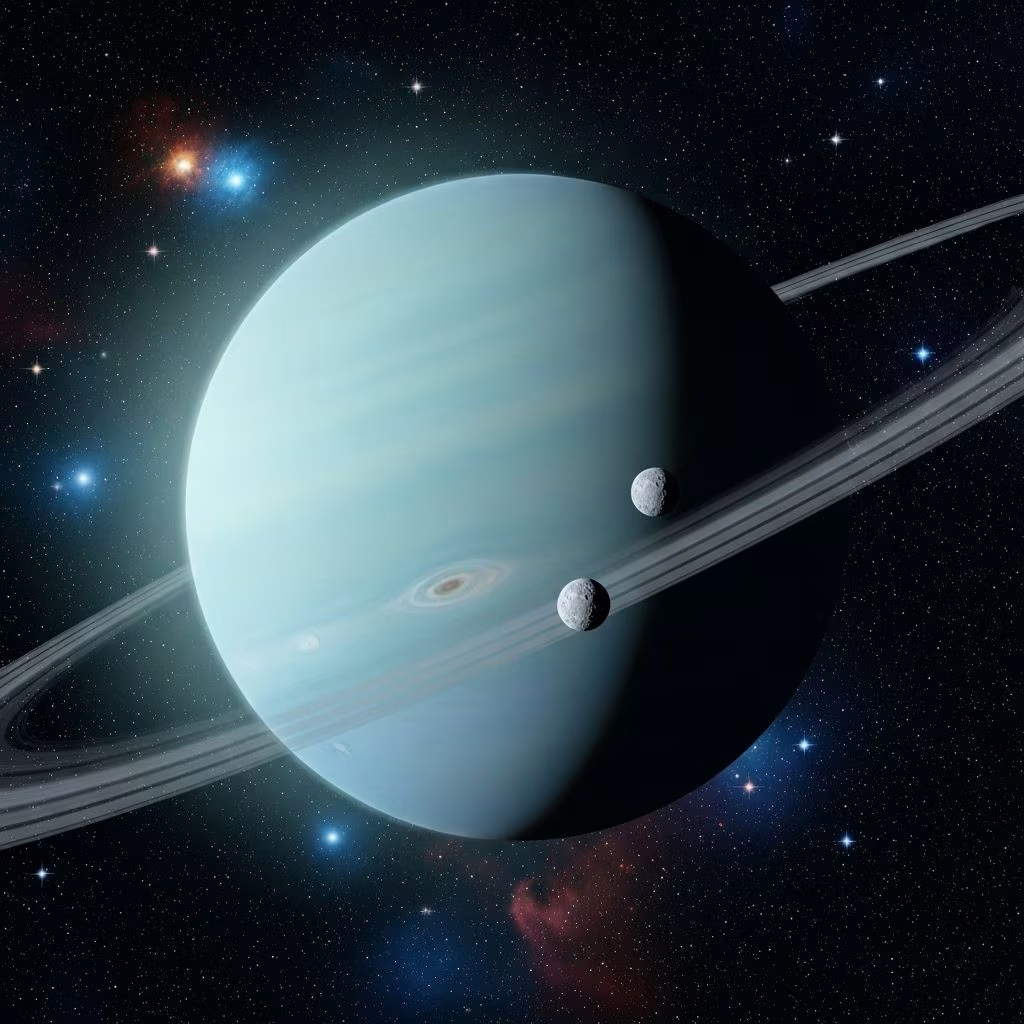
Uranus’s blue-green color comes from methane gas in its upper atmosphere, which absorbs red light and reflects blue-green wavelengths.
Its atmosphere is composed mainly of hydrogen (83%) and helium (15%), with small amounts of methane, water, and ammonia. Unlike Jupiter and Saturn, Uranus lacks a strong visible cloud structure, perhaps due to lower internal heat and the planet’s distance from the Sun[11].
Extreme Weather and Rotation
- Axis Tilt: Sitting nearly horizontal, the planet’s rotation causes one pole to face the Sun for decades, then the other.
- Seasons: Uranian seasons last 21-22 years each, given its 84-year orbit.
- Winds: Despite its cold, distant location, Uranus can experience winds up to 900 km/h (560 mph).
Moons and Rings
Uranus boasts an intriguing system of moons and rings
- Moons: At least 27 confirmed, with the largest being Titania, Oberon, Umbriel, Ariel, and Miranda. Herschel discovered the first two, Titania and Oberon, shortly after finding Uranus itself[10].
- Rings: Thirteen radiation-dark rings encircle Uranus, discovered in 1977. These narrow rings are made of small, dark particles and are less obvious than Saturn’s bright bands[10][11].
Exploration of Uranus
To date, our only close-up visit to Uranus was made by NASA’s Voyager 2 spacecraft in 1986, which captured images, studied the planet’s atmosphere, rings, and moons, and helped resolve mysteries about Uranus’s magnetic field and composition.
- Voyager 2 revealed that Uranus’s magnetic field is inclined by 59 degrees with respect to its axis—a peculiar orientation.
- It also confirmed the presence and characteristics of the rings and moons.
- Most knowledge of the planet’s surface and atmosphere is inferred from remote sensing since Uranus lacks a solid surface.
Uranus in the Night Sky
Uranus is typically visible only with binoculars or a small telescope, as it shines at magnitude 5.3 at its brightest. Although never visible to the naked eye from urban areas, dedicated observers can glimpse it as a faint greenish star from dark-sky sites. Its slow orbit means it moves gradually against the background stars of the Zodiac.
Key Milestones in Uranus Research
- 1690: Flamsteed catalogs Uranus as star ‘34 Tauri’.
- 1781: Herschel confirms Uranus as a planet.
- 1787: Titania and Oberon, Uranus’s largest moons, are discovered by Herschel.
- 1790s: Uranus is accepted worldwide as the seventh planet.
- 1977: Rings of Uranus are discovered during a stellar occultation.
- 1986: Voyager 2’s flyby brings back close-up images and data.
Comparison Table: Uranus vs Other Gas Giants
| Feature | Jupiter | Saturn | Uranus | Neptune |
|---|---|---|---|---|
| Diameter (km) | 142,984 | 120,536 | 50,724 | 49,244 |
| Mass (Earths) | 318 | 95 | 14.5 | 17.1 |
| Moons | 92 | 83 | 27 | 14 |
| Rings | Yes | Yes | Yes | Yes |
| Axis Tilt (deg) | 3.1 | 26.7 | 97.8 | 28.3 |
The Legacy of Uranus’s Discovery
The impact of Uranus’s confirmation as a planet rippled through science and culture. It validated the power of telescopic observation over naked-eye possibilities, inspired generations of astronomers, and led directly to further discoveries. Uranus’s discovery showed that our solar system was more complex and expansive than previously thought.
Frequently Asked Questions (FAQs)
Who discovered Uranus?
William Herschel discovered Uranus in 1781 using a telescope, making it the first planet found by this method.
Why was Uranus mistaken for a star?
Uranus is faint and moves slowly across the sky, making it appear as a fixed star in early observations. Only telescopic power could distinguish its planetary disk from a star’s point of light.
How many moons does Uranus have?
Uranus has at least 27 moons, with the largest being Titania, Oberon, Miranda, Ariel, and Umbriel.
Does Uranus have rings?
Yes; Uranus possesses a system of thirteen narrow, dark rings, discovered in 1977.
What is unusual about Uranus’s rotation?
Uranus rotates on its side, with its axis tilted about 98 degrees, causing extreme seasonal changes.
Was Uranus visited by any spacecraft?
Only Voyager 2 has flown by Uranus, in 1986, providing critical data on the planet, rings, and moons.
Why is Uranus blue-green?
Methane in the atmosphere absorbs red and reflects blue-green light, giving the planet its distinctive hue.
References
- Science Museum: Uranus—first planet discovered with a telescope
- NASA: Uranus Facts
- Royal Museums Greenwich: The Discovery of Uranus
- Cool Cosmos – Caltech: Who discovered Uranus?
- Wikipedia: Uranus
- BBC Sky at Night Magazine: How Uranus was discovered
- Air and Space Museum: Uranus
- Space Facts: Uranus Facts
- Encyclopedia Britannica: Uranus Facts, Moons, & Rings
References
- https://www.sciencemuseum.org.uk/objects-and-stories/uranus-first-planet-discovered-telescope
- https://science.nasa.gov/uranus/facts/
- https://www.nasa.gov/history/240-years-ago-astronomer-william-herschel-identifies-uranus-as-the-seventh-planet/
- https://www.rmg.co.uk/stories/space-astronomy/astronomy/discovery-uranus
- https://en.wikipedia.org/wiki/Uranus
- https://www.skyatnightmagazine.com/space-science/how-was-uranus-discovered
- https://airandspace.si.edu/explore/stories/uranus
- https://coolcosmos.ipac.caltech.edu/ask/134-Who-discovered-Uranus-
- https://www.youtube.com/watch?v=aGVFwNWu5c0
- https://space-facts.com/uranus/
- https://www.britannica.com/place/Uranus-planet
- https://paac.ppc.ac.in/2021/03/13/the-story-of-discovery-of-uranus/
- https://planetfacts.org/who-discovered-uranus/
- https://www.upr.org/science/2020-04-17/william-herschels-discovery-of-uranus
- https://spacecenter.org/meet-the-solar-system-uranus/
- https://www.universetoday.com/articles/discovery-of-uranus
- https://eduindex.org/2023/03/29/discovery-of-uranus/
- https://theplanets.org/uranus/