


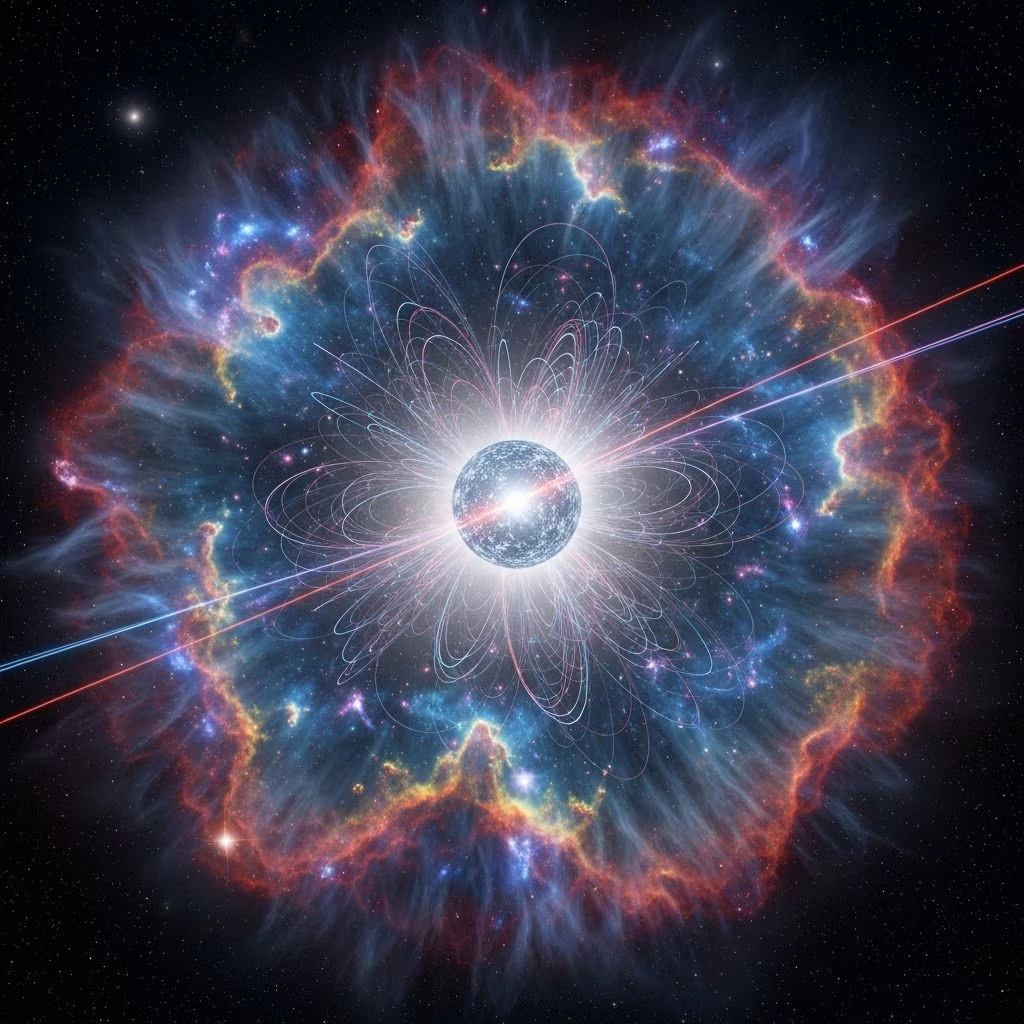
What Are Neutron Stars?
Neutron stars are among the densest objects in the known universe, second only to black holes. Formed from the collapsed cores of massive stars after a violent supernova, these compact stars pack masses greater than the sun into city-sized spheres only about 20 kilometers (roughly 12 miles) across. Their unique structure, extreme conditions, and exotic physical properties make them one of the most fascinating topics in astrophysics.
Formation: Birth in Catastrophe
Neutron stars originate in the death throes of massive stars, typically ones with 8 to 30 times the mass of the sun. After millions of years fusing elements in their cores, these stars ultimately exhaust their nuclear fuel. Unable to support themselves against gravity, they catastrophically collapse and explode as supernovae. The star’s core, suddenly unsupported, implodes until the atomic nuclei are packed together more tightly than anywhere else known in the universe.
- Supernova explosions blow off a star’s outer layers, leaving behind the ultra-dense core that becomes a neutron star.
- If the original star is too massive, even neutron degeneracy cannot halt collapse and the core will become a black hole instead.
Stellar Evolution & Core Collapse
During a massive star’s lifespan, it balances gravitational collapse with energy from nuclear fusion. When iron builds up in its core, fusion halts, the core collapses, and the remaining mass rebounds outward, resulting in a supernova. Post-explosion, the remaining material forms the neutron star.
Extreme Properties
Neutron stars are known for several remarkable physical traits:
- Density: A neutron star’s average density exceeds 4–8 × 10¹⁷ kg/m3. A sugar-cube-sized amount of neutron star material would weigh more than Mount Everest on Earth.
- Size and Mass: Typical diameters are between 20–24 kilometers (12–15 miles), with masses ranging between about 1.1–2.3 times that of our sun.
- Gravitational Field: Their surface gravity is extremely intense—billions of times that of Earth. Even light is strongly affected by their gravity, leading to significant gravitational redshifts.
- Rotation: Neutron stars often rotate rapidly, with periods down to milliseconds. As they conserve angular momentum upon collapse, they can spin up to hundreds of times every second.
- Magnetic Fields: They possess magnetic fields trillions of times stronger than Earth’s, especially in the subclass of magnetars.
What Makes Up Neutron Stars?
The composition of neutron stars is exotic, governed by physics under conditions that can’t be reproduced in terrestrial laboratories:
- The outermost layer is a thin crust of nuclei and electrons, crushed into a solid lattice.
- Beneath this crust, the pressure becomes so intense that electrons and protons merge to form neutrons. The result is a core consisting predominantly of neutrons—hence the name “neutron star.”
- Deeper within, matter may take on forms not found elsewhere, possibly including “hyperons” or even “quark matter,” where constituents of neutrons themselves are broken apart.
Exotic Physics and Matter States
Conditions within neutron stars test our understanding of quantum mechanics, relativity, and nuclear physics:
- Neutron degeneracy pressure and nuclear forces are all that stand against gravitational collapse.
- If mass exceeds about 2.2–2.9 solar masses (the Tolman–Oppenheimer–Volkoff limit), even these forces fail and the star collapses into a black hole.
- Theoretical predictions include possible “superfluid” or “superconducting” states, and the presence of particles such as kaons or other strange matter.
Types of Neutron Stars
Neutron stars exhibit diverse astronomical phenomena, largely dictated by their environments and physical properties:
- Pulsars: Neutron stars emitting beams of electromagnetic radiation from their poles, which sweep across Earth at regular intervals. They were discovered through their repeated radio “pulses.”
- Magnetars: Possessing ultra-strong magnetic fields, they can power dramatic bursts of X-ray and gamma-ray emission and display some of the most violent activity among compact objects.
- X-ray Binaries: Neutron stars in binary systems can accrete material from a companion star, heating up and emitting high-energy X-rays.
Observing Neutron Stars
Neutron stars are typically detected in the aftermath of supernovae, through X-ray, radio, optical, and even gamma-ray telescopes. Their emissions arise from a variety of physical processes:
- Their rapid rotations (as pulsars) generate highly regular pulsations detectable across billions of light-years.
- Some neutron stars cool more quickly than anticipated, providing clues about exotic physics at work in their interiors.
- Gravitational waves have been detected from mergers of neutron stars, marking a new era in multi-messenger astronomy.
Recent Discoveries
Advanced telescopes such as the James Webb Space Telescope and ground-based gravitational wave detectors (like LIGO and Virgo) have revealed new details about neutron stars, including the aftermath of their mergers and new candidates at the heart of supernova remnants.
Neutron Stars vs. Other Stellar Remnants
| Property | Neutron Star | White Dwarf | Black Hole |
|---|---|---|---|
| Typical Mass (Solar Masses) | 1.1 – 2.3 | 0.5 – 1.4 | > 2.5 |
| Typical Radius | 10–20 km | ~7,000–14,000 km | 0 (Singularity/ Event Horizon defined by mass) |
| Density | 1017 kg/m3 | 109 kg/m3 | Infinite at the singularity |
| Support Mechanism | Neutron degeneracy pressure/nuclear forces | Electron degeneracy pressure | Nothing—gravity wins |
| Surface | Solid crust, mainly neutrons | Crystalline lattice of nuclei/electrons | No surface; event horizon |
Life Cycle & Fate
Neutron stars may evolve further after formation:
- They slowly cool and rotate more slowly over millions of years.
- Neutron stars in binary systems may acquire additional mass, emit X-rays, or eventually merge with another neutron star, potentially forming a more massive neutron star or collapsing into a black hole.
- Some neutron stars may receive “kicks” at birth, accelerating them through space at hundreds of kilometers per second.
Neutron Stars and the Universe
Studying neutron stars helps illuminate fundamental questions about the universe:
- They act as cosmic laboratories for the study of matter under extreme densities and pressures, unattainable on Earth.
- Neutron stars provide crucial clues about the synthesis of heavy elements, magnetic field generation, and the behavior of matter under gravitational collapse.
- The detection of gravitational waves from neutron star collisions has opened new investigative windows on the cosmos and the origin of elements like gold and platinum.
Frequently Asked Questions (FAQs)
Q: How much would a teaspoon of neutron star material weigh on Earth?
A: A teaspoon of neutron star matter would weigh about a billion tons on Earth—approximately as much as a large mountain.
Q: Can anything survive touching the surface of a neutron star?
A: No ordinary matter could survive. The gravity, radiation, and forces at the surface would instantly destroy any known material or object.
Q: How are pulsars related to neutron stars?
A: Pulsars are rapidly spinning neutron stars emitting beams of radio waves and other electromagnetic radiation from their magnetic poles. As these beams sweep past Earth, they appear as regular pulses.
Q: What happens if a neutron star gets too massive?
A: If a neutron star accumulates enough mass (usually above 2.2–2.9 times the mass of the sun), even neutron degeneracy pressure can’t support it, and it will collapse into a black hole.
Q: How are neutron stars detected?
A: They’re detected via their emissions—radio, X-ray, optical, or gamma-ray—or, more recently, through gravitational waves resulting from collisions.
Summary
Neutron stars comprise one of the universe’s most remarkable endpoints, embodying extraordinary density, powerful magnetic fields, and serving as cosmic testbeds for physics under extreme conditions. Their study bridges gaps in our understanding between quantum mechanics and general relativity, continually challenging and expanding the frontier of astrophysical knowledge.
References
- https://www.space.com/neutron-stars-playing-it-cool-unlock-exotic-physics
- https://www.space.com/neutron-star-binary-systems-esa-gaia-discovery
- https://en.wikipedia.org/wiki/Neutron_star
- https://cosmosmagazine.com/space/astronomy/supernova-neutron-star-jwst/
- https://esawebb.org/news/weic2404/
- https://www.thespacereview.com/article/4042/1
- https://www.jpl.nasa.gov/news/webb-finds-evidence-for-neutron-star-at-heart-of-young-supernova-remnant/
- https://en.wikipedia.org/wiki/List_of_neutron_stars
- https://www.skyatnightmagazine.com/space-science/neutron-star
- https://science.slashdot.org/story/00/06/19/125204/how-neutron-stars-get-their-kicks
- https://newspaceeconomy.ca/2024/07/02/the-enigmatic-world-of-neutron-stars-cosmic-remnants-of-stellar-evolution/
- https://cosmosmagazine.com/space/neutron-star-more-numerous/
- https://www.youtube.com/watch?v=bQIHi-z_xZ4
- https://scisimple.com/en/articles/2025-04-21-unraveling-the-mysteries-of-neutron-stars–a31wvzr
- https://www.advancedsciencenews.com/neutron-stars-could-be-the-gateway-to-dark-matter/
- https://imagine.gsfc.nasa.gov/science/objects/neutron_stars2.html


