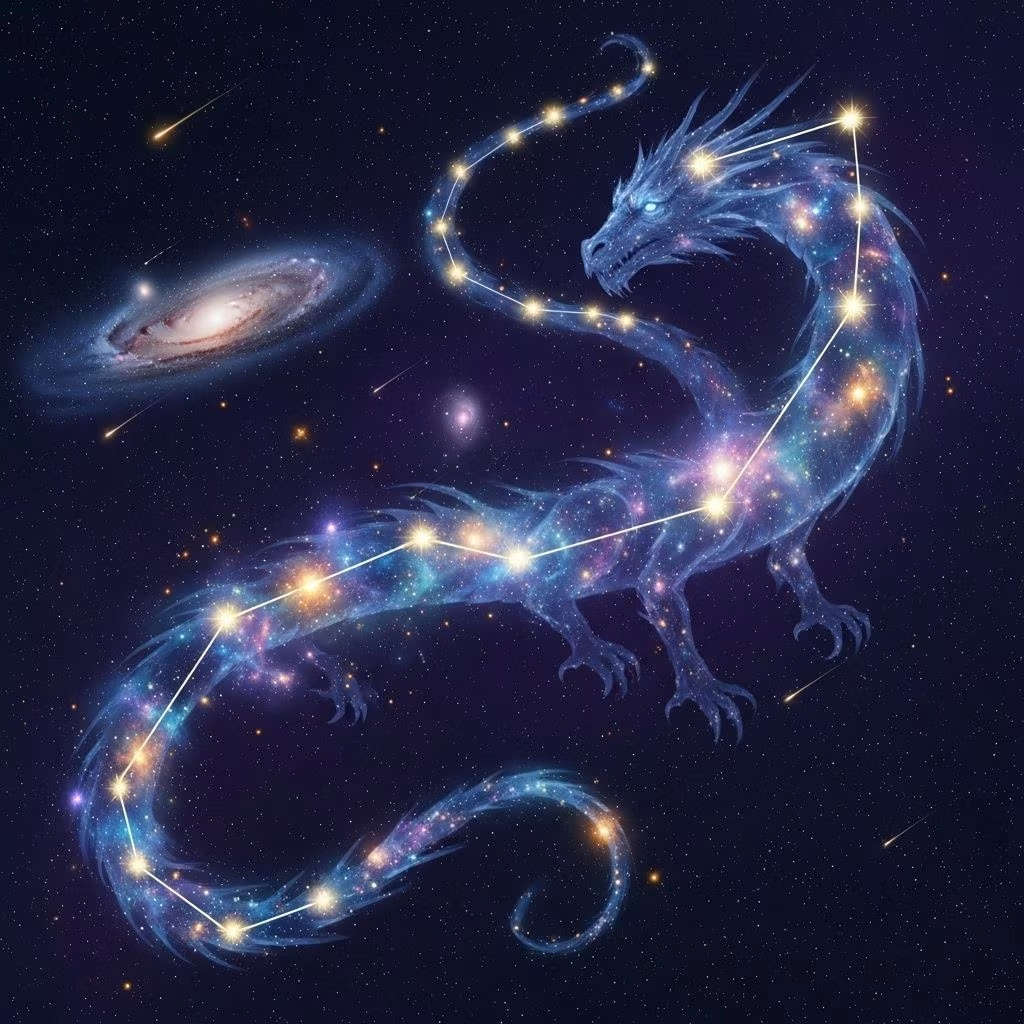
Draco is an ancient and enduring constellation of the northern sky, known for its striking serpentine shape and its legendary background in Greek mythology. Navigating the area between the recognizable Ursa Major and Ursa Minor, Draco has fascinated astronomers for centuries as a symbol of cosmic guardianship and mythic heroism. This guide provides an in-depth exploration of Draco, from its mythological origins to its modern astronomical significance.
Overview of Draco
- Name: Draco (Latin for “dragon”)
- Abbreviation: Dra
- Genitive: Draconis
- Location: Northern celestial hemisphere
- Size: Area of 1083 square degrees (8th largest)
- Visibility: Circumpolar for northern observers (never sets below the horizon)
- Brightest star: Eltanin (Gamma Draconis)
- Notable deep sky objects: Cat’s Eye Nebula, Tadpole Galaxy, Spindle Galaxy
- Meteor shower: Draconids
Draco in the Night Sky
Located among the northern constellations, Draco winds between Ursa Major and Ursa Minor, forming a distinctive ‘S’ shaped curve that resembles a dragon coiled around the sky. Its head is found just north of the constellation Hercules, while its tail snakes between the Big and Little Dippers. Due to its circumpolar position, Draco remains visible throughout the year for most observers in the northern hemisphere.
| Draco Facts | Details |
|---|---|
| Declination | +90° to -15° |
| Quadrant | NQ3 (third quadrant, northern hemisphere) |
| Neighboring Constellations | Boötes, Camelopardalis, Cepheus, Cygnus, Hercules, Lyra, Ursa Major, Ursa Minor |
| Number of main stars | 14 main stars, 17 formally named stars |
| Stars with planets | 9 |
| Messier objects | 1 (M102, also listed as NGC 5866) |
The Mythology and History of Draco
The origins of Draco are steeped in Greek mythology, primarily linked to the tale of the dragon Ladon. Ladon was a multi-headed beast set to guard the golden apples in the Gardens of the Hesperides—a task assigned by Hera, queen of the gods, to protect the tree from theft. The golden apples were said to bestow immortality upon those who consumed them.
- Ladon was placed in the garden both to guard the apples and to prevent Hesperides (the nymph daughters of Atlas) from sneaking any apples for themselves.
- The legendary hero Heracles (Hercules), during his 12 Labors, was tasked with retrieving these apples. He vanquished Ladon to complete his mission.
- In honor of Ladon, Hera memorialized the dragon in the stars, creating the constellation Draco.
- Various cultures have their own interpretations: to the Romans, Draco also symbolized a vanquished monster. Babylonian sources identified it as Tiamat, the primordial sea serpent.
Naming and Astronomical Significance
Draco was one of the original 48 constellations catalogued by Ptolemy in the 2nd century CE. Its name and lore have endured, and it remains among the official 88 recognized by the International Astronomical Union (IAU). The IAU abbreviation for Draco is Dra, and its genitive (used in star names) is Draconis.
Draco’s Place in Astronomical Families
Draco belongs to the Ursa Major constellation family, alongside constellations such as Coma Berenices, Boötes, Camelopardalis, Canes Venatici, Corona Borealis, Leo Minor, Lynx, Ursa Major, and Ursa Minor.
Key Stars in Draco
Although not among the most prominent constellations, Draco contains many noteworthy stars, several with stories or scientific interest.
- Eltanin (Gamma Draconis): The brightest star in Draco, situated in the dragon’s head. Eltanin has about 72 times the luminosity of the Sun and is 154 light-years from Earth.
- Rastaban (Beta Draconis): The second-brightest star, also in the dragon’s head. Sometimes referred to as the “right eye of the dragon.”
- Thuban (Alpha Draconis): Once the pole star around 2700 BCE, Thuban marks the dragon’s tail. Thuban is historically important for ancient civilizations due to its near-perfect alignment with the north celestial pole thousands of years ago.
- Aldhibah (Zeta Draconis): Part of the dragon’s body, 330 light-years away.
- Edasich (Iota Draconis): A giant orange star with an exoplanet in orbit—one of the first exoplanet host stars discovered.
- Altais (Delta Draconis), Grumium (Xi Draconis), Giausar (Lambda Draconis): Other stars named by the IAU representing various parts of the serpent’s body.
There are 17 officially named stars in Draco, including Aldhibah, Alrakis, Alruba, Alsafi, Altais, Athebyne, Dziban, Edasich, Eltanin, Fafnir, Funi, Giausar, Grumium, Rastaban, Taiyi, Thuban, and Tianyi.
| Star Name | Designation | Magnitude | Distance (light-years) |
|---|---|---|---|
| Eltanin | Gamma Draconis | 2.23 | 154 |
| Rastaban | Beta Draconis | 2.79 | 380 |
| Thuban | Alpha Draconis | 3.65 | 303 |
| Edasich | Iota Draconis | 3.29 | 101 |
Deep Sky Objects in Draco
Beyond its stars, Draco is renowned for hosting several deep sky wonders:
- Cat’s Eye Nebula (NGC 6543): A visually striking planetary nebula featuring intricate concentric shells around its bright core. It lies about 3,300 light-years away.
- Tadpole Galaxy (Arp 188): A peculiar galaxy with a dramatic tidal tail resembling a tadpole, formed by gravitational interactions; it is approximately 420 million light-years from Earth.
- Spindle Galaxy (Messier 102 / NGC 5866): A lenticular galaxy best seen edge-on, it is noted for its thin, spindle-like appearance and dust lane.
- Draco Dwarf Galaxy: A faint spheroidal satellite of the Milky Way, important in studies of dark matter due to its high mass-to-light ratio.
- Splinter Galaxy (NGC 5907): Another remarkable edge-on spiral galaxy, best observed with moderate to large telescopes.
Draconids Meteor Shower
Every October, Draco is the radiant for the Draconids meteor shower. This spectacle—most active around October 8–10—emerges when Earth passes through debris left by Comet 21P/Giacobini-Zinner. Some years, the Draconids surprise with outburst rates of hundreds of meteors per hour, while in most years, the shower remains modest.
Observation Tips
Draco is always visible for most northern observers due to its circumpolar status, but certain parts are best seen during spring and summer nights. While Draco’s stars aren’t especially bright, Eltanin and Rastaban are easy to locate:
- Find the tail of Ursa Minor to spot Thuban.
- The curve of the dragon’s body winds between the ladle shapes of Ursa Major and Ursa Minor.
- The dragon’s head—marked by Eltanin and Rastaban—lies near the constellation Hercules.
Fun Facts about Draco
- Draco was the northern pole star constellation around 4,000 years ago—Thuban’s role as pole star was vital to ancient navigators and pyramid builders.
- Draco is the eighth largest constellation but is not particularly bright, making star charts essential for its identification.
- The name Draco and the myth of Ladon continue to inspire fantasy literature and art.
- The International Astronomical Union officially recognizes “Draconis” as the genitive name used in naming conventions for Draco’s stars.
Draco’s Place in Culture and Science
Draco’s shape, mythology, and cosmological significance have made it a persistent figure in Western and world astronomy. Thuban’s ancient role as the pole star aligns with several historic monuments in Egypt and explains its importance in ancient timekeeping and navigation. Today, Draco’s stars and deep sky objects play a role in research—especially in oxygen-poor planetary nebulae and dark matter studies of the Draco Dwarf Galaxy.
Frequently Asked Questions (FAQs)
Q: Why is Draco called a circumpolar constellation?
A: Draco is called circumpolar because, for observers in the northern hemisphere, it never sets below the horizon and is visible year-round.
Q: What is the myth associated with Draco?
A: Draco is most often associated with Ladon, the dragon that guarded the golden apples in the Garden of the Hesperides, slain by Heracles in Greek mythology.
Q: Was a star in Draco once the pole star?
A: Yes, Thuban (Alpha Draconis) was the pole star about 2700 BCE and was crucial to ancient civilizations for navigation and alignment.
Q: Which are the brightest stars in Draco?
A: The brightest star is Eltanin, followed by Rastaban and Thuban.
Q: What interesting deep sky objects are found in Draco?
A: Draco contains the Cat’s Eye Nebula, Tadpole Galaxy, Spindle Galaxy, Splinter Galaxy, and the Draco Dwarf Galaxy.
Q: When is the Draconids meteor shower visible?
A: The Draconids meteor shower peaks in early October each year, with activity centered around October 8–10.
References
- https://en.wikipedia.org/wiki/Draco_(constellation)
- https://www.constellation-guide.com/constellation-list/draco-constellation/
- https://theplanets.org/constellations/draco-constellation/
- https://starregister.org/draco.php
- https://www.go-astronomy.com/constellations.php?Name=Draco
- https://theskylive.com/sky/constellations/draco-constellation
- https://lovethenightsky.com/draco-constellation-guide/
- https://kids.britannica.com/students/article/Draco/341192
- https://www.solarsystemquick.com/universe/draco-constellation
- https://kids.kiddle.co/Draco_(constellation)
- https://interstellarium.com/en/constellations/draco/
- https://skyandtelescope.org/astronomy-news/meet-the-draco-constellation-the-dragon-between-the-dippers/
- https://chandra.harvard.edu/photo/constellations/draco.html
- https://arabiannightsrum.com/stars/circumpolar-constellations/draco/
- https://usvao.org/draco-constellation-facts/
- https://www.space.com/draco-constellation-stargazing-guide.html
- https://www.astronomytrek.com/constellations/draco/
- https://www.centreofexcellence.com/the-draco-constellation/
- https://www.aquilae.space/draco-constellation/
- https://www.planetguide.net/draco-constellation/