Planet Nibiru: Unraveling the Myth of the ‘Doomsday Planet’
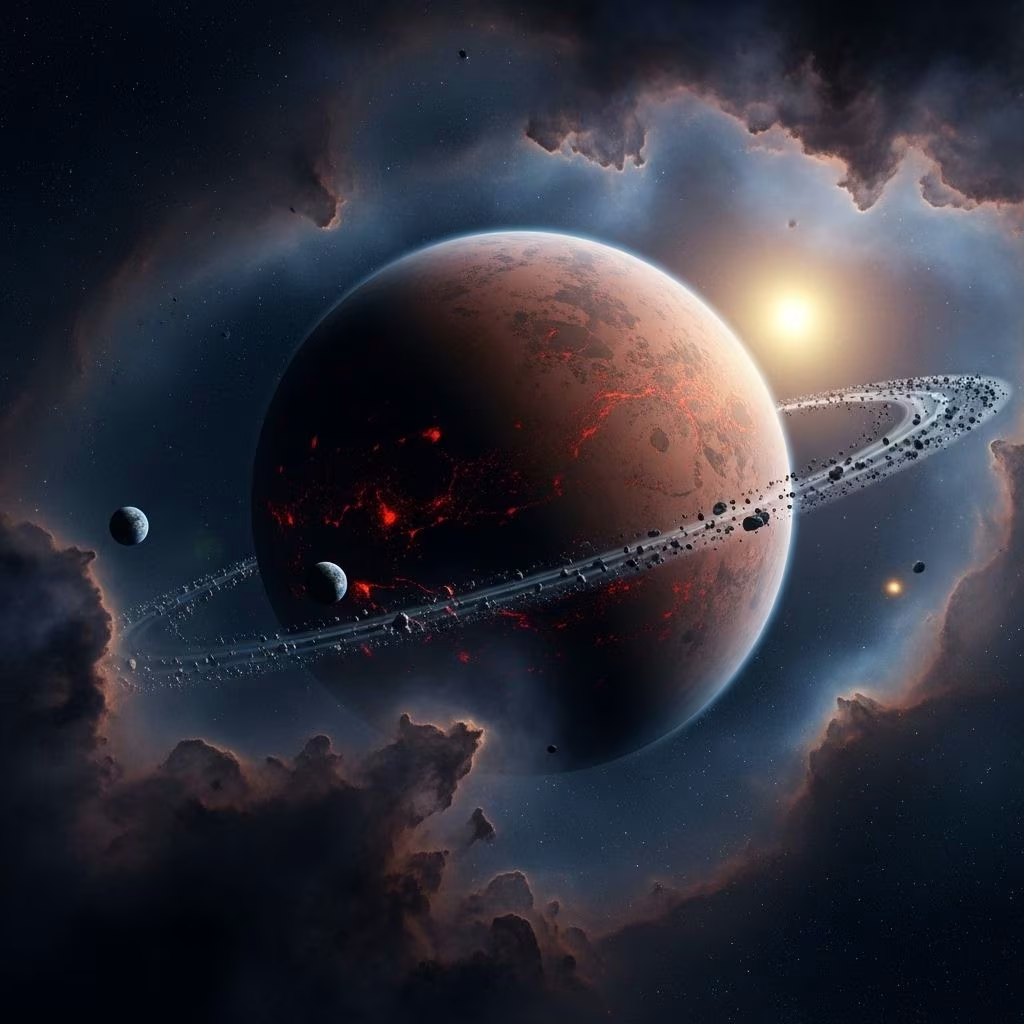
For decades, Nibiru—alternately known as Planet X—has captivated the imaginations of conspiracy theorists, ancient astronaut enthusiasts, and curious stargazers worldwide. Claiming the potential to wreak havoc on Earth, the legend of this supposed rogue planet has stirred global concern through repeated doomsday predictions and viral internet rumors.
But what is Nibiru, where did the story originate, and how does the scientific community respond to these alarming claims?
Contents
- The Origins of the Nibiru Myth
- Ancient Connections and Zecharia Sitchin
- The Nibiru Cataclysm Theory
- What Scientists Say About Nibiru
- Rise of Internet Doomsday Groups
- NASA and Expert Debunking
- Frequently Asked Questions (FAQs)
The Origins of the Nibiru Myth
The idea of Nibiru as a mysterious planet beyond Neptune first took shape in popular culture during the late 20th century. Its roots lie in interpretations of Babylonian and Sumerian mythologies, where the word ‘Nibiru’ signified a crossing or point of transition, particularly in relation to the path of the gods and celestial bodies.
Modern references to Nibiru as a physical planet, however, are mainly linked to the writings of Zecharia Sitchin and later amplified by self-described contactees like Nancy Lieder in the mid-1990s.
Ancient Connections and Zecharia Sitchin
Zecharia Sitchin, an independent researcher and author, spent decades interpreting cuneiform tablets from ancient Mesopotamia. Sitchin proposed that the texts referenced a 12th planet called Nibiru, allegedly home to a technologically advanced alien race known as the Anunnaki, who once visited Earth.
- Sitchin’s Theory claims Nibiru has an elongated, elliptical orbit that brings it into the inner solar system every several thousand years.
- Mainstream Academia has overwhelmingly rejected Sitchin’s translations and interpretations, questioning both his linguistic accuracy and astronomical claims.
Despite Sitchin’s denial of any apocalyptic connection, his ideas seeded the belief that Nibiru was not only real but potentially catastrophic if it reappeared near Earth.
What Ancient Texts Actually Say
- Nikbiru in Sumerian astronomy referred to a crossing point, likely denoting the movement of Jupiter or Mercury—not a hidden planet.
- No direct ancient record describes a planet whose orbit endangers Earth.
The Nibiru Cataclysm Theory
The most sensational aspect of Nibiru lore is the so-called Nibiru Cataclysm—a predicted disastrous encounter between Earth and a massive planetary object, either by collision or near-miss. This scenario first gained viral attention in 1995, when Nancy Lieder, founder of the website ZetaTalk, claimed to receive extraterrestrial warnings about Nibiru’s trajectory.
| Cataclysm Claim | Originator | Predicted Timing |
|---|---|---|
| Physical Pole Shift Decimating Humanity | Nancy Lieder (ZetaTalk) | May 2003 (postponed repeatedly) |
| Later Associated with 2012 Phenomenon | Various Doomsday Groups | December 2012 |
| Cataclysm on September 23, 2017 | David Meade (numerologist) | September 2017 |
Despite repeated changes to the predicted date, the essential warning remained the same: a mysterious unseen planet was due to suddenly appear, upending Earth’s orbit and ending civilization.
Claims and Evidence Presented by Believers
- Nibiru alleged to be on an inclined orbit, crossing the solar system every few thousand years.
- Some say it causes periodic mass extinctions or geological upheavals on Earth.
- Linked to supposed sightings, misunderstood astronomical phenomena, and viral social media content.
What Scientists Say About Nibiru
To date, no credible scientific evidence supports the existence of Nibiru or any large, undiscovered planet on an Earth-threatening orbit in our solar system.
According to professional astronomers and planetary scientists:
- All known large bodies in the solar system have tracked orbits that do not endanger Earth.
- Supposed photographic evidence is attributed to lens flares, image artifacts, or misidentified astronomical objects.
- If a planet as large as Nibiru were approaching the inner solar system, it would be visible to professionals and amateur astronomers alike, and its gravitational effects would have been observed decades earlier.
Alternative Astronomical Mysteries Often Confused with Nibiru
- Planet Nine, a theoretical object much farther out than Neptune, is hypothesized based on the clustering of trans-Neptunian objects. This theory is unrelated to Nibiru’s catastrophic claims and is subject to ongoing scientific investigation.
- KBOs (Kuiper Belt Objects) and odd orbital phenomena have sometimes fueled Nibiru speculations, but mainstream science attributes these to known gravitational influences from existing planets.
Rise of Internet Doomsday Groups
In the late 2000s, discussion of Nibiru proliferated through online forums, YouTube videos, and social media, often blending with apocalyptic prophecies linked to the 2012 Mayan calendar. Doomsday websites accumulated thousands of followers who continued to revise the predicted ‘arrival date’ each time it failed to manifest.
Media Coverage: Major media outlets have repeatedly covered the Nibiru myth—usually to debunk its claims and clarify scientific consensus.
Key Characteristics of Nibiru Internet Myths
- Viral spread through sensational videos, anonymous forums, and easily-manipulated images.
- Association with other cosmic phenomena (e.g., asteroids, comets, eclipses) to sustain interest.
- Persistent reinterpretation and re-dating as each apocalypse fails to arrive.
NASA and Expert Debunking
In response to heightened public anxiety around Nibiru cataclysm claims, NASA and other scientific institutions have issued multiple statements:
- No evidence exists for any rogue planet approaching Earth that can cause harm in the foreseeable future.
- The physics of orbital mechanics make sudden planetary appearances impossible in our solar system—any large object on an inbound trajectory would have been detected far in advance.
- The legend of Nibiru is a classic example of misinterpreted myth and pseudoscience, often amplified by online misinformation.
NASA astronomer David Morrison and others have explained that similar doomsday predictions have repeatedly failed and continue to be debunked by astronomical observation and data analysis.
Frequently Asked Questions (FAQs)
Q: Does Nibiru—or Planet X—exist?
A: No. Astronomers have found no evidence of a large unseen planet with an Earth-threatening orbit. All known solar system bodies are tracked, and such an object would have been detected by both professional and amateur astronomers.
Q: Is Planet Nine the same as Nibiru?
A: No. While some scientists investigate the possibility of a distant ‘Planet Nine’ based on gravitational effects among trans-Neptunian objects, this object would be far from Earth and poses no threat. It is not linked in any way to catastrophic Nibiru scenarios.
Q: Why do people believe in the Nibiru catastrophe?
A: The legend combines ancient myths, pseudo-scientific interpretations, viral internet culture, and human fascination with apocalyptic predictions. Claims are often based on misunderstood astronomical data and perpetuated by online communities.
Q: Have any experts or organizations confirmed the risk of Nibiru?
A: No credible scientist or scientific institution endorses the idea of a Nibiru-based catastrophe. NASA and several leading astronomers have specifically debunked all related claims.
Q: How did ancient people allegedly “know” about undiscovered planets?
A: Some interpretations claim that ancient texts contain references to planets like Neptune and Pluto, but these are speculative and not widely accepted by historians or astronomers. Most references are metaphorical or misread in modern pseudo-scientific literature.
Summary: Separating Cosmic Fact from Internet Fiction
Despite decades of speculation and viral scare stories, Nibiru remains a phenomenon of modern myth-making rather than astronomical reality. The scientific consensus is clear: our solar system harbors no hidden world on a catastrophic orbit, and Earth faces no imminent threat from rogue planets.
Instead, the enduring popularity of the Nibiru legend reveals much about the power of online conspiracy culture, the misuse of ancient myth, and the necessity of scientific literacy in the age of misinformation.
- Nibiru: A myth derived from a misinterpretation of history and pseudo-scientific speculation.
- Doomsday Claims: Repeatedly debunked and unsupported by any observational evidence.
- Science: The solar system is well-tracked; planetary threats would be visible far in advance.
- Lesson: Critical thinking and evidence-based inquiry are the best defense against viral fearmongering.
References
- https://www.space.com/12194-comet-elenin-planet-nibiru-doomsday-2012.html
- https://en.wikipedia.org/wiki/Nibiru_cataclysm
- https://www.youtube.com/watch?v=-ypxIzHAfEk
- https://starwalk.space/en/news/planet-nibiru
- https://en.wikipedia.org/wiki/Nibiru_collision
- https://science.howstuffworks.com/nibiru.htm
- https://sitchiniswrong.com/NibiruCuneiform.pdf
- https://starwalk.space/es/news/planet-nibiru
- https://enkispeaks.com/nibiru-planet-of-our-ancestors-geology-history-galactic-context/
- https://www.iflscience.com/nasa-responds-to-claims-that-the-world-is-going-to-end-tomorrow-43850
- https://earthchanges.ning.com/profiles/blogs/nibiru-does-exist-proof
- https://www.youtube.com/watch?v=iTQQTmvnQsY
- https://www.sciencefocus.com/space/what-evidence-is-there-for-the-existence-of-the-planet-nibiru
- https://www.indy100.com/news/conspiracy-theorist-planet-x-nibiru-spacex-elon-musk-falcon-9-heavy-rocket-apocalypse-us-government-8146266
- https://science.nasa.gov/solar-system/planet-x/
- https://creation.com/nibiru
- https://rationalwiki.org/wiki/Nibiru
- https://www.sciencetimes.com/articles/48255/20240119/nibiru-cataclysm-will-mysterious-shadow-planet-obliterate-earth-heres-what.htm