Protons are one of the universe’s essential building blocks, shaping the identity and structure of every atom in existence. Their discovery revolutionized our understanding of atomic science and continues to inspire research in physics, chemistry, and cosmology.
What Is a Proton?
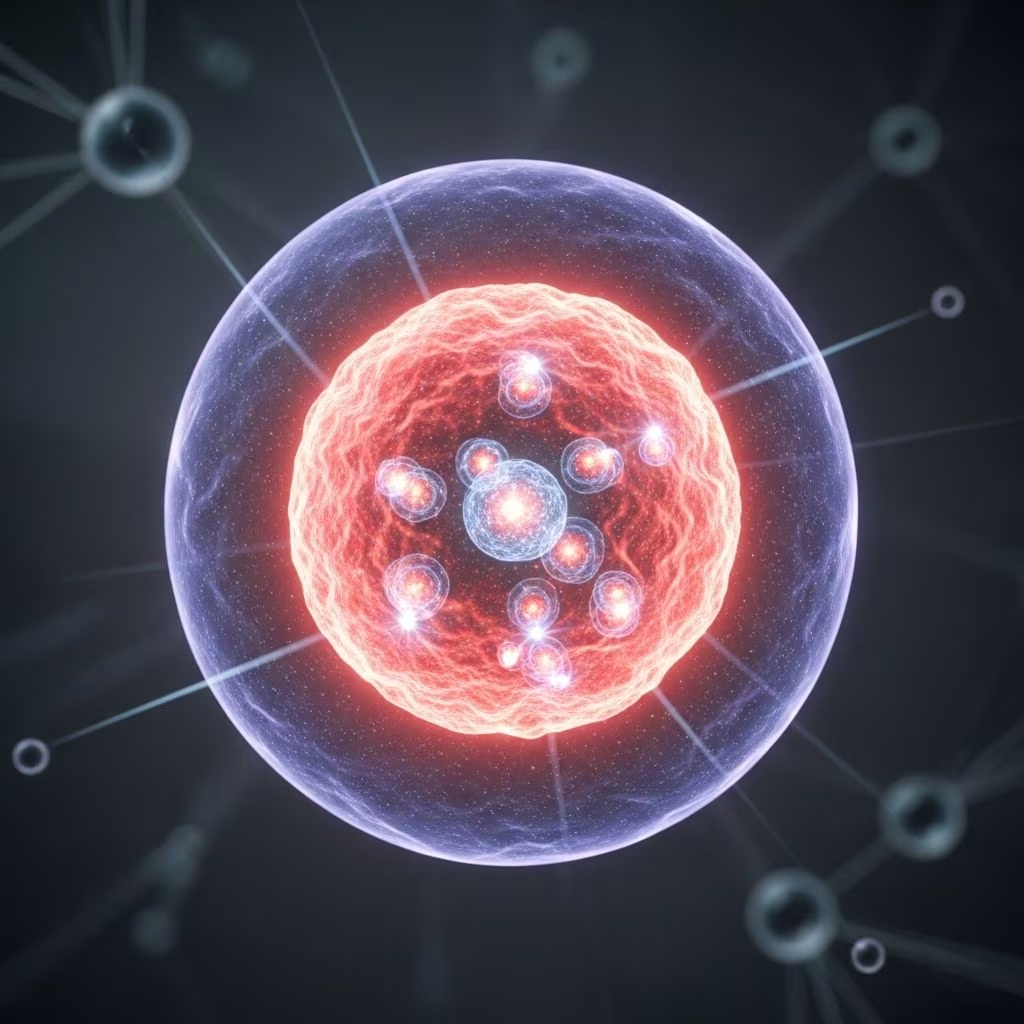
A proton is a stable, positively charged subatomic particle found in the nucleus (center) of every atom. It carries a charge of +1 elementary charge (1.602 x 10⁻¹⁹ coulombs) and is key to defining the identity of each chemical element on the periodic table. Protons, together with neutrons, make up atomic nuclei, while electrons orbit the nucleus and balance the electrical charge.
- Charge: +1 elementary charge
- Mass: Approx. 1.6726 x 10⁻²⁷ kilograms (1 atomic mass unit, amu)
- Location: Nucleus of the atom
- Symbol: p or p+
The number of protons in an atom’s nucleus is called the atomic number (Z) and determines the chemical element—for example, hydrogen has 1 proton, and carbon has 6.
History: The Discovery of the Proton
The story of the proton’s discovery is a milestone in the scientific exploration of matter. While early scientists suspected the existence of particles inside atoms, it was Ernest Rutherford, a New Zealand-born physicist, who made a decisive breakthrough in 1919. Rutherford’s famous gold foil experiment and subsequent research revealed the presence of small, positively charged particles within the atomic nucleus.
- 1919 – First Identification: Rutherford observed that when nitrogen atoms were bombarded with alpha particles, they emitted hydrogen nuclei. He concluded that these nuclei were fundamental particles and named them “protons” (from the Greek word for “first”).
- Nobel Prize: Rutherford received the Nobel Prize in Chemistry in 1908 for his previous research on atomic structure, setting the stage for his later work on protons.
- Legacy: Rutherford’s discovery initiated further advancements in atomic theory, paving the way to the understanding of nuclear reactions and modern particle physics.
The Structure and Role of Protons
Although protons are considered fundamental components of matter, modern physics reveals that protons themselves have internal structure: they are made up of even smaller particles called quarks, held together by the strong nuclear force via particles known as gluons.
- Quark Composition: 2 up quarks and 1 down quark
- Total Charge: The combination of quark charges results in the proton’s overall +1 charge.
- Size: Roughly 0.84–0.87 femtometers (fm) in radius (1 fm = 10-15 m)
- Stability: Protons are remarkably long-lived; under ordinary circumstances, they do not spontaneously decay.
Comparison of Protons, Neutrons, and Electrons
| Particle | Charge | Mass (kg) | Location | Role in Atom |
|---|---|---|---|---|
| Proton | +1 | ~1.67 × 10⁻²⁷ | Nucleus | Determines Atomic Number (Element) |
| Neutron | 0 | ~1.67 × 10⁻²⁷ | Nucleus | Stabilizes Nucleus |
| Electron | -1 | ~9.11 × 10⁻³¹ | Electron Cloud | Involved in Chemical Bonds |
Properties of Protons
- Positive charge: This attracts negatively charged electrons, helping to hold them in orbit around the nucleus.
- Larger than electrons (in mass): A proton is about 1836 times heavier than an electron.
- Stability: Protons are stable and do not decay under normal conditions.
- Defining atoms: The number of protons in the nucleus defines the chemical element (e.g., 1 for hydrogen, 6 for carbon).
- Participation in reactions: Protons are central in nuclear reactions—both fission and fusion processes—fueling stars and the sun.
Why Protons Matter: Their Role in Atoms and the Universe
Protons are fundamental to the existence and identity of every atom:
- They determine an atom’s elemental identity (via the atomic number).
- Their interactions with electrons allow for the formation of molecules, enabling the chemistry that supports life.
- The number of protons in the nucleus influences atomic mass and stability.
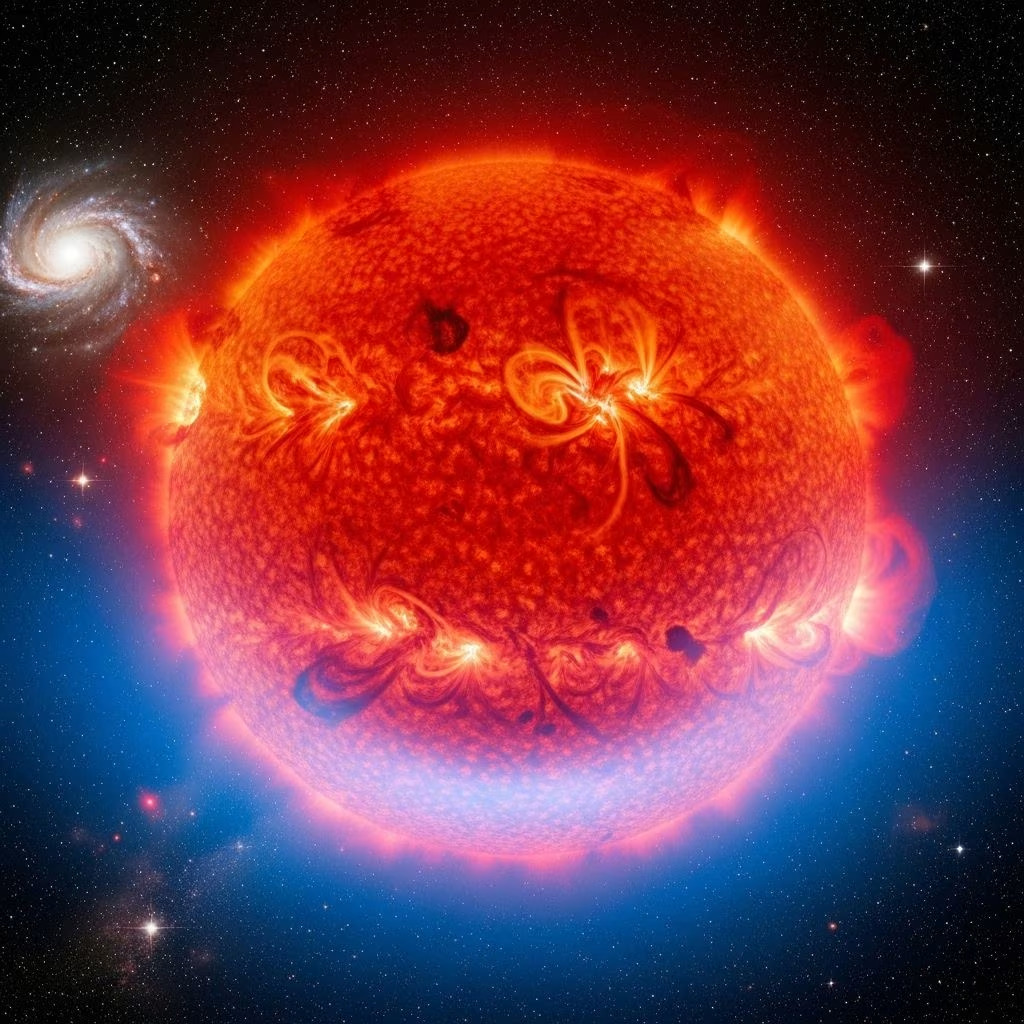
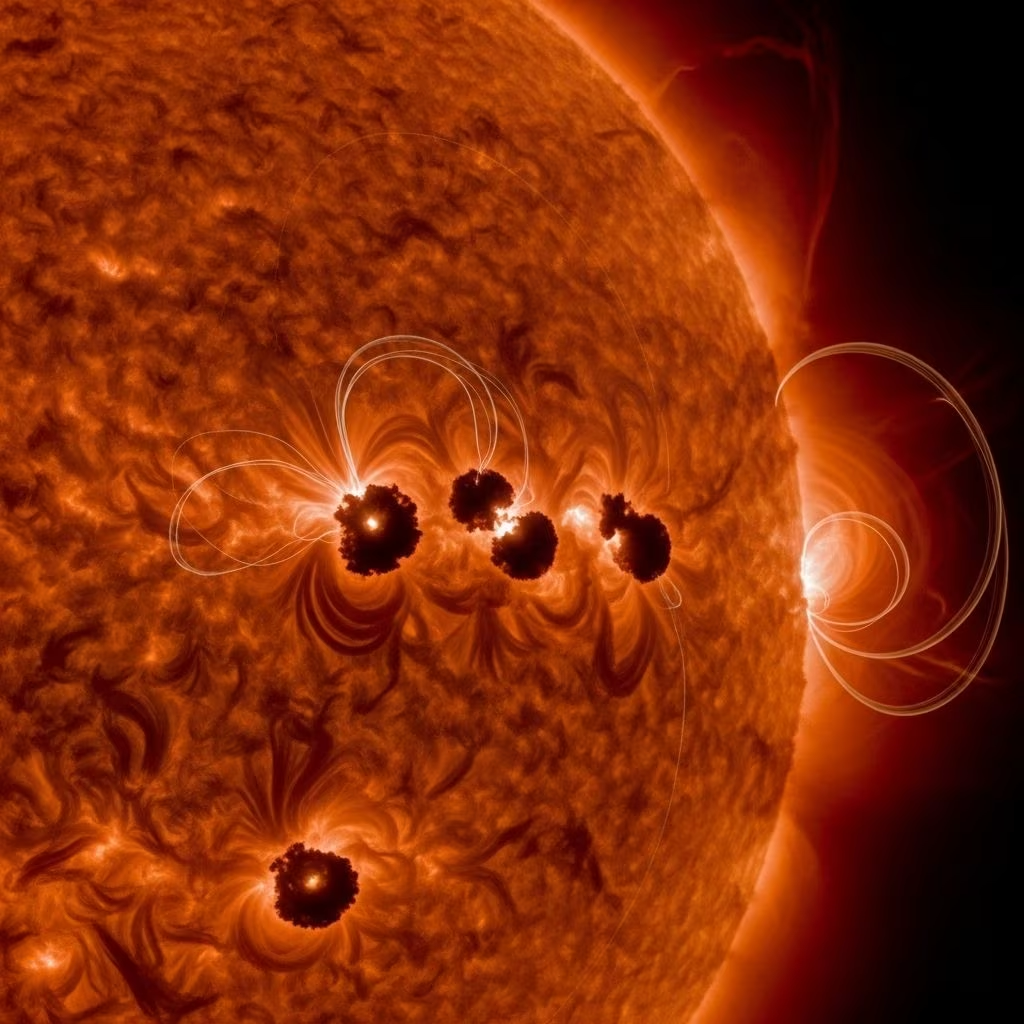
- Nuclear fusion in stars (the proton-proton chain) converts hydrogen into helium and generates the energy that ultimately powers the sun and other stars.
Protons and Atomic Number
The atomic number is defined as the number of protons in an atom’s nucleus and is unique to each element. For example, every hydrogen atom has one proton, while every helium atom has two.
| Element | Atomic Number | Number of Protons |
|---|---|---|
| Hydrogen | 1 | 1 |
| Helium | 2 | 2 |
| Carbon | 6 | 6 |
| Oxygen | 8 | 8 |
| Iron | 26 | 26 |
Protons in Chemistry and Physics
Because protons define which element an atom represents, any change (gain or loss) of a proton in a nucleus transforms one element into another—a process fundamental to nuclear reactions and radioactive decay. Protons are also crucial in chemical reactions as they participate in ionization and acid–base chemistry (where H+ ions are essentially single, free protons).
Nuclear Reactions
- Fusion: Multiple protons (as in hydrogen atoms) join to create heavier elements, releasing energy (as in stars).
- Fission: Heavy atomic nuclei split, producing smaller nuclei that may have different numbers of protons.
Chemical Reactions
- Protons can move between atoms and molecules, which is fundamental to acid-base reactions in chemistry.
Fun and Lesser-Known Facts About Protons
- There are about 1.67 sextillion protons in just a single drop of water!
- The term “proton” is derived from the Greek word for “first,” reflecting their fundamental role in nature and physics.
- Protons are not indivisible; they consist of three quarks held together by the strong nuclear force.
- The mass of a proton is approximately 1836 times that of an electron.
- A hydrogen atom—nature’s simplest atom—consists of just one proton and one electron.
Unsolved Mysteries: Are Protons Truly Permanent?
Protons are thought to be stable and do not decay in normal circumstances. Some advanced theoretical physics models predict that protons might eventually decay over extraordinarily long timeframes (proton decay), but no credible evidence for this decay has yet been found. Experiments continue to probe the longevity of the proton, a frontier in understanding matter’s stability.
Protons in the Universe: Cosmic Importance
Protons are abundant in the universe—they are the primary component of the sun and other stars (in the form of hydrogen nuclei) and make up much of the unseen mass of cosmic rays that bombard Earth from space. Their presence and activity fuel the energy output of stars, drive the chemistry of planetary atmospheres, and ultimately sustain life on Earth.
Frequently Asked Questions (FAQs) About Protons
Q: What is a proton, and where is it found?
A: A proton is a positively charged subatomic particle found in the nucleus of every atom. It defines the element and fundamentally shapes the structure of matter.
Q: Who discovered the proton, and when?
A: Ernest Rutherford discovered the proton in 1919 while working at the University of Cambridge, building on groundbreaking experiments into atomic structure.
Q: What makes a proton different from a neutron?
A: Protons carry a positive electric charge, whereas neutrons are electrically neutral. Both reside in the atomic nucleus and have nearly equal mass, but their differing charges are crucial for atomic behavior.
Q: How many protons are in an atom?
A: The number of protons in an atom defines its atomic number, which uniquely identifies the chemical element (e.g., 1 proton for hydrogen, 6 for carbon).
Q: Are protons fundamental particles?
A: Protons are considered composite particles, made up of three quarks bound by the strong force. They were once thought to be indivisible, but are now understood as collections of smaller constituents.
Q: Can protons exist outside of atoms?
A: Yes. Isolated protons exist in cosmic rays and as hydrogen ions (H+) in plasmas and chemical reactions.
Q: What happens if you change the number of protons in an atom?
A: Changing the proton count changes the element entirely, a process which can happen through nuclear reactions such as fission, fusion, or radioactive decay.
Conclusion: Protons—Nature’s Building Blocks
From defining the identity of elements to powering the stars, protons are at the heart of matter and energy in the universe. Their discovery, properties, and mysterious longevity continue to be a foundation for scientific inquiry and discovery, illuminating the deepest workings of nature.
References
- https://www.space.com/40397-proton-rocket.html
- https://www.space.com/41458-omg-particle-cosmic-ray-mystery.html
- https://www.britannica.com/technology/Proton-Russian-launch-vehicle
- https://theexplanation.com/on-atoms-protons-neutrons-electrons/
- https://profmattstrassler.com/articles-and-posts/largehadroncolliderfaq/whats-a-proton-anyway/
- https://profmattstrassler.com/articles-and-posts/particle-physics-basics/the-structure-of-matter/protons-and-neutrons/
- https://www.astrosafe.co/article/proton
- https://www.spaceanswers.com/solar-system/another-radiation-belt-has-been-discovered-around-saturn/
- https://www.britannica.com/science/proton-proton-cycle
- https://www.skyatnightmagazine.com/space-science/facts-about-astronomy-space
- https://www.youtube.com/watch?v=TbzZIMQC6vk
- https://www.saleh-theory.com/Article/a-new-explanation-for-the-structure-of-the-nuclei-of-atoms-from-smallest-to-the-largest-part-b
- https://en.wikipedia.org/wiki/Proton
- https://phys.org/news/2023-08-protons-insight-early-universe.html
- https://www.natgeokids.com/uk/discover/science/space/ten-facts-about-space/
- https://byjus.com/chemistry/proton-neutron-discovery/