A Cosmic Smiley: Moon and Stars Align for a Rare Night Sky Spectacle
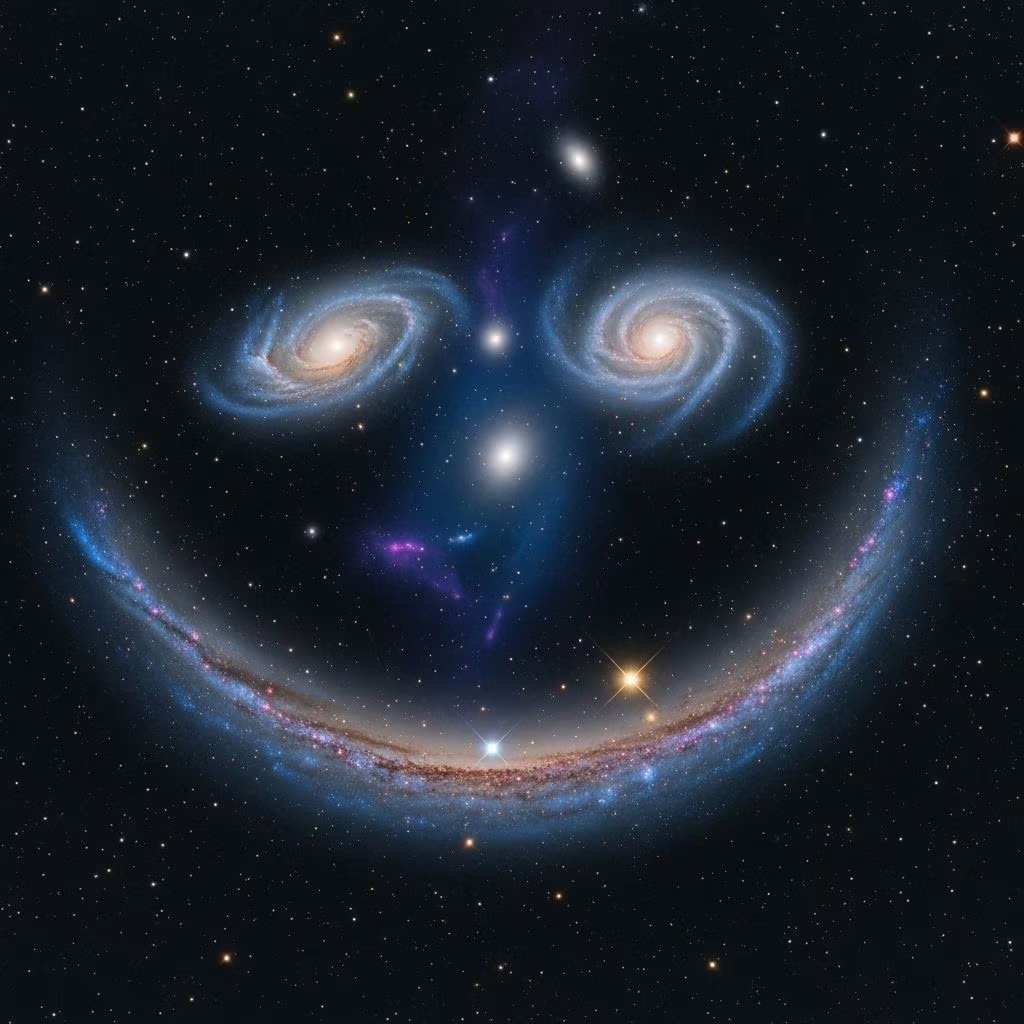
On the evening of May 29, 2025, skywatchers across much of the Northern Hemisphere will be treated to a playful and rare celestial event: a conspicuous smiley face will appear in the western sky. This striking cosmic “emoji” is produced by a perfect alignment of Earth’s crescent moon and the two brightest stars of the constellation Gemini—Castor and Pollux—creating the appearance of a smiling face looking down from the heavens. Here’s everything you need to know about seeing this uplifting sight, why it occurs, and how stargazers can make the most of the experience.
Celestial Smiley Face: What Is It?
The ‘smiley face’ is a visual arrangement in the night sky where the crescent moon forms a smile-like arc, while the twin stars Castor and Pollux appear above it, resembling glowing eyes. This geometric occurrence is the result of an unusual, but predictable, positioning of Earth’s natural satellite with the stars of Gemini.
While similar alignments happen from time to time, a configuration so reminiscent of a classic smiley face is rare—making the 2025 appearance a highly anticipated event for amateur astronomers, space enthusiasts, and anyone looking for a reason to celebrate the beauty of the night sky.
When and Where to See the Smiley Face
The celestial smiley face will be visible shortly after sunset on the evening of Thursday, May 29, 2025. The best viewing window is approximately:
- 45 minutes after sunset, when the sky is dark enough for the stars to stand out but before the moon sets.
- Until around midnight local time, after which the alignment will dip below the western horizon.
The event is best observed from:
- North America (especially the United States and Canada)
- Europe and parts of Asia
- Anywhere in the Northern Hemisphere with a clear western view free from obstructions, such as trees or buildings
Check local conditions, as weather and light pollution can significantly impact visibility. The timing will shift slightly depending on your specific location, so consult a reputable astronomy or stargazing app for personalized sky maps and reminders.
Step-by-Step: How to Spot the Night Sky Smiley
Follow these steps to ensure you don’t miss the whimsical cosmic face:
- As sunset approaches, find a location with a clear view of the western sky. An open field, park, or rooftop works best.
- Wait for about 45 minutes after sunset, when the sky darkens enough to reveal brighter celestial objects.
- Look roughly 20 degrees above the western horizon—about the height covered by your outstretched hand held at arm’s length, with your fingers spread wide apart.
- Spot the thin crescent moon, glowing with a distinctive curved shape. This forms the “smile.”
- Above the crescent, locate the two bright points of light—Castor (upper right) and Pollux (upper left)—positioned about 5 degrees above the moon. The span between them matches the width of three fingers at arm’s length.
- Admire the cosmic emoji: the moon’s arc as the “mouth,” and Castor and Pollux as “eyes” beaming gently across the sky.
Measuring Sky Distances
If you need help with judging distances between the moon and the stars:
- Make a fist, hold it at arm’s length, and place it against the sky. The width of your fist covers roughly 10 degrees of sky.
- A spread hand (thumb to pinky) covers a bit more—helpful for finding the 20-degree elevation of the crescent moon.
Why This Alignment Matters
This event’s rarity and cheerful pattern have drawn attention from professional astronomers and casual stargazers alike. Here’s why the smiley face alignment is notable:
- Rare Geometry: While the moon regularly passes near various stars and planets, an alignment that so closely matches a smiley face is unusual and occurs only once every several years in any given location.
- Accessibility: The formation will be visible without telescopes or binoculars, making it perfect for families, students, or anyone new to astronomy.
- Inspires Interest in Space: Playful events like this spark curiosity about the night sky, inviting people to learn more about astronomy, celestial navigation, and star lore.
- Link to Cultural History: Stories and mythologies worldwide reference the “twins” of Gemini and the moon, giving added resonance to the spectacle.
Fun Astronomy Facts: The Moon, Castor, and Pollux
| Celestial Body | Type | Key Features |
|---|---|---|
| Moon (Crescent) | Earth’s natural satellite | Only natural satellite of Earth; phases cycle every 29.5 days; crescent phase occurs as the Moon moves between new and first quarter or third quarter and new. |
| Pollux | Red Giant Star (Gemini) | Brightest star in Gemini; about 33.7 light-years from Earth; orange hue; actually a huge red giant about 8.8 times the Sun’s diameter. |
| Castor | Star System (Gemini) | Second-brightest star in Gemini; 51 light-years away; a six-star system consisting of three pairs of gravitationally bound stars. |
Why Castor and Pollux?
Castor and Pollux are known as the ‘heavenly twins’ in Greek and Roman mythology. Their proximity to each other and their brightness make them stand out, and their alignment above the moon on this night forms the perfect ‘eyes.’
Other Notable Smileys in History
- Similar alignments occurred in previous years, but local visibility and clarity of the crescent’s arc can vary greatly.
- The next comparable event may not occur for several years, making this a fleeting opportunity for stargazers.
Tips for Enjoying the Smiley Face Event
- Get There Early: Arriving at your viewing spot well before sunset ensures you have time to settle in and choose the clearest vantage point.
- Avoid Light Pollution: Pick rural or suburban areas away from city lights for the best view. Urban skyglow can mask faint stars.
- Bring a Stargazing App: Apps like Stellarium, SkySafari, or Star Walk can help you track celestial objects in real time and confirm the alignment as it appears.
- Pack Essentials: Consider bringing binoculars, a telescope for extra detail, warm clothing (if needed), snacks, and a red-light flashlight to preserve night vision.
- Make It a Group Activity: Stargazing is more fun with friends or family—share the moment and spark curiosity among children and adults alike.
- Take Photos: If you have a camera with manual settings, try long-exposure shots. Even smartphone cameras can capture the formation if you steady them on a tripod and use a timer.
- Check the Weather: Cloudy conditions or fog can obscure the view. Monitor local forecasts and be ready to adapt.
Frequently Asked Questions (FAQs)
Q: Is this smiley face a once-in-a-lifetime event?
A: While smiley face alignments happen occasionally, the next event of similar clarity and timing may be several years away for your location. It’s rare to have the crescent moon and Gemini’s twins so well aligned and visible at a convenient evening hour.
Q: What if I miss it? Will there be another?
A: Similar alignments do return in later years, but the exact arrangement and quality can vary based on lunar phases and star positions. Subscribe to astronomical calendars for alerts on upcoming fun celestial events.
Q: Can I see the smiley face from the Southern Hemisphere?
A: The event is best seen from the Northern Hemisphere since Gemini is more prominent there after sunset. Observers in southern latitudes may see the objects, but the “face” may not appear as upright or as distinct.
Q: Are any special tools needed for viewing?
A: No special instruments are required—the formation is clear to the naked eye, thanks to the moon’s brightness and the prominence of Castor and Pollux. Binoculars or a telescope can enhance the experience but aren’t necessary.
Q: What is the significance of Castor and Pollux in astronomy?
A: They are the two brightest stars in Gemini and are prominent in both Western and Eastern astronomy and mythology. Pollux is an easily identifiable red giant, and Castor is one of the few multiple-star systems visible to the naked eye.
Q: What causes the crescent phase of the moon?
A: The crescent phase occurs as the moon travels between the sun and Earth, with only a small portion of its sunlit side visible to us. This phase is perfect for smiley alignments, as the arc mimics a classic smile.
Summary: Celebrating the Sky’s Uplifting Emoji
The ‘smiley face’ of May 29, 2025, beautifully combines natural curiosity, the science of celestial mechanics, and a universal symbol of happiness—all visible with the unaided eye. Mark your calendars, plan your stargazing adventure, and share a smile with the cosmos as the moon, Castor, and Pollux light up the evening sky in a way that resonates across cultures and ages.
For up-to-date viewing tips, consult leading astronomy sites before the event date. Clear skies and happy stargazing!
References
- https://www.space.com/stargazing/a-smiley-face-will-appear-in-the-night-sky-on-may-29-heres-how-to-see-it
- https://www.youtube.com/watch?v=7CNE5gBds5M
- https://dailygalaxy.com/2025/05/tonight-giant-smiley-face-light-up-the-sky/
- https://economictimes.indiatimes.com/news/international/us/smiley-face-in-us-sky-what-is-this-rare-celestial-event-when-will-it-appear-and-what-is-best-time-and-place-to-watch/articleshow/121498839.cms
- https://bestlifeonline.com/smiley-face-night-sky/
- https://economictimes.indiatimes.com/topic/night-sky-smile
- https://gulfnews.com/world/moon-venus-and-saturn-coming-together-in-celestial-smiley-when-and-where-to-watch-1.500166667
- https://www.youtube.com/watch?v=QG4YsK0KKRQ
- https://www.thescarboroughnews.co.uk/news/people/astro-dog-astronomy-column-heres-what-yorkshire-coast-stargazers-can-see-in-the-sky-in-may-5104449
- https://wbuf.com/smiley-face-sky-new-york/
- https://opentools.ai/news/skys-the-limit-rare-celestial-smiley-face-to-grace-canadas-skies
- https://horoscopeview.com/rare-smiley-face-2025.html
- https://astrologyview.com/article/rare-smiley-face-in-the-sky-check-date-time-april-2025/
- https://1440wrok.com/rare-smiley-face-in-the-sky/
- https://www.skyatnightmagazine.com/news/photograph-smiley-face-moon-venus-saturn-april-2025
- https://www.skyatnightmagazine.com/news/smiley-face-moon-venus-saturn-april-2025