Darkened Cities: Imagining Night Skies Above the World’s Metropolises
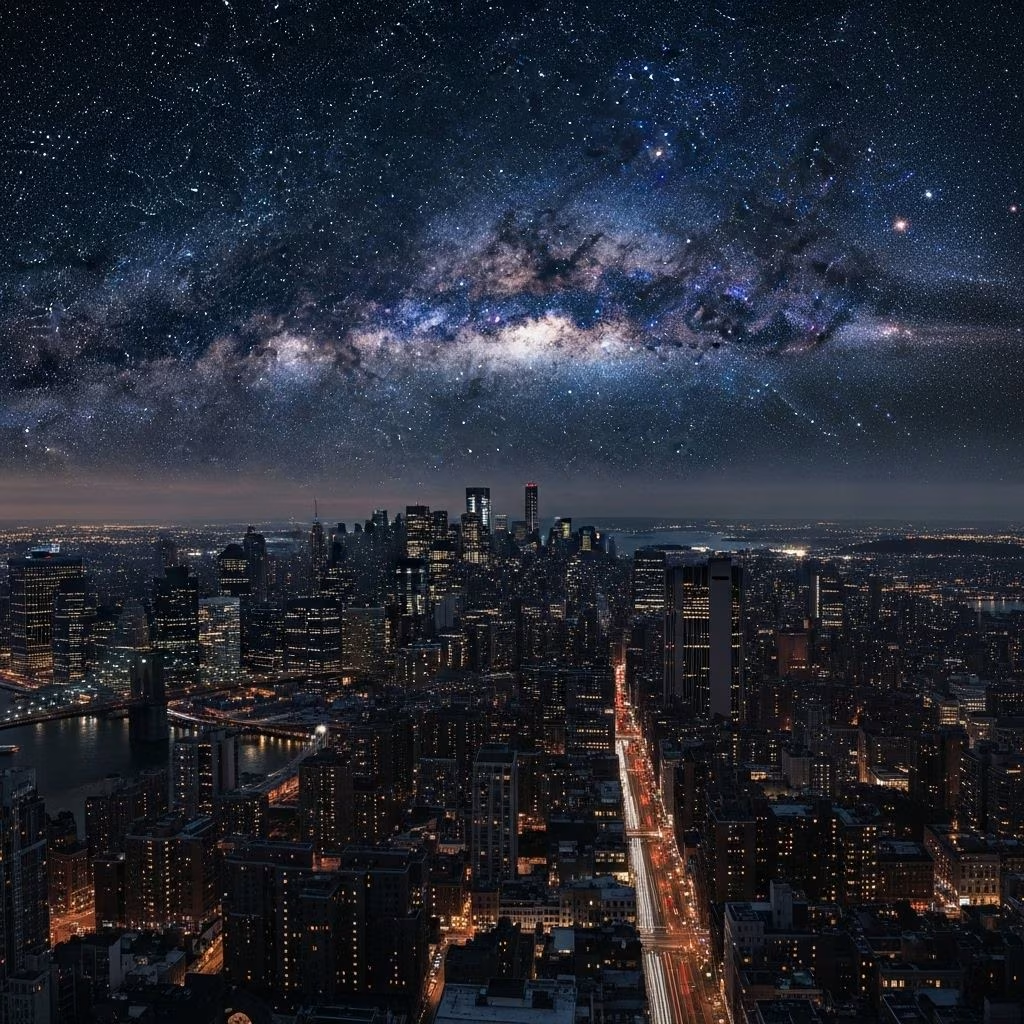
For most city dwellers, the spectacle of a truly dark night sky—filled with countless stars and swirling galaxies—is an elusive experience. Modern urban environments are drenched in artificial light, a phenomenon known as light pollution, which washes out all but the brightest celestial objects. In his groundbreaking photo series Darkened Cities, French artist and photographer Thierry Cohen renders the unseen cosmic splendor over city skylines, blending scientific precision and artistic vision to highlight what’s lost to urban lighting.
About Thierry Cohen and His Vision
Thierry Cohen began his photographic career in 1985 and soon established himself as a pioneer in digital photography. Since 2010, Cohen has focused his creative energy exclusively on the Villes Eteintes (French for ‘Darkened Cities’) project, which has been exhibited widely, including prestigious venues like the Palais de Tokyo and the Musee de l’Homme in Paris. Driven by a passion for both technical perfection and environmental advocacy, Cohen set out to answer a profound question: What would the night sky over a city look like if every electric light was switched off?
The Science and Method Behind the Images
Cohen’s process is meticulous. He:
- Photographs major cities from carefully chosen vantage points, meticulously recording time, angle, and geographic coordinates.
- Travels to remote locations—including deserts like the Mojave, Atacama, and the Sahara—at matching latitudes and shoots the night sky at the exact angle, orientation, and astronomical timing as his city shots.
- Combines these images digitally, overlaying pristine starfields atop cityscape photographs taken (often during the day) when artificial lights are minimal, effectively removing the glare of urban illumination.
The result is astonishingly authentic: the skies depicted are not imaginative renderings but scientifically plausible—faithful to the cosmic view as it would appear above those precise urban coordinates.
The Artistic and Environmental Message
Photography writer Francis Hodgson insightfully described Cohen’s work as “an indictment and a lament.” The series doesn’t only illustrate what we’re missing—it offers a powerful reversal of urban mythology, confronting viewers with the cold, disconnected reality of city existence, severed from the infinite energies and wonders of the stars. By making visible what is invisible to modern urban eyes, Cohen invites reflection on both our place in the universe and the environmental consequences of human progress.
“In Thierry Cohen’s series, we think we see bright night skies over cities. Very traditional, very poetical. Actually, what we’re seeing is the opposite… cold, cold cities below, cut off from the seemingly infinite energies above. It’s a powerful reversal, and one very much in tune with a wave of environmental thinking of the moment.” — Francis Hodgson
Iconic Cities Reimagined Under Starry Skies
Cohen’s images cover many of the world’s most iconic urban landscapes. By presenting a selection of these locations, the impact of light pollution becomes global and personally relatable.
- New York City (including the Empire State Building and Brooklyn Bridge)
- Paris
- San Francisco
- Los Angeles
- Hong Kong
- Shanghai
- Tokyo
- Sao Paulo
- Rio de Janeiro
Table: Cohen’s City Skylines vs. Starfield Locations
| Urban Location | Corresponding Sky Captured At | Key Features |
|---|---|---|
| New York City | Mojave Desert, USA | Empire State, Brooklyn Bridge, dense cityscape |
| Paris | Sahara Desert, North Africa | Eiffel Tower, Haussmann architecture |
| San Francisco | Atacama Desert, Chile | Golden Gate Bridge, bay landscape |
| Hong Kong | Remote Asian highlands | Victoria Harbour skyline |
| Shanghai | Desert region at similar latitude | Pudong financial district |
| Tokyo | Japanese mountain ranges | Urban density, iconic neon |
| Rio de Janeiro | Brazilian highlands | Christ the Redeemer, mountainous terrain |
| Sao Paulo | South American outback | Sprawling high-rise cityscape |
| Los Angeles | California desert | Downtown skyline, hilly surrounds |
Understanding Light Pollution and Its Effects
One of the most notable byproducts of urbanization is light pollution—the excessive or misdirected artificial light that not only obscures the stars but also impacts ecological systems, wildlife navigation, and even human circadian rhythms.
- In cities, only the most prominent celestial bodies (e.g., the Moon, Venus, Jupiter) are typically visible.
- Outside urban centers, especially in designated dark-sky reserves, the number of visible stars can increase by hundreds or thousands.
- Light pollution interferes with both scientific astronomy and everyday appreciation of the universe.
Cohen’s work delivers a compelling visual argument for reducing unnecessary urban lighting—not just for science and nature, but for the preservation of human wonder.
The Technical Challenge: Merging Cityscapes and Starfields
The magic of the Darkened Cities series is as much about technical prowess as it is about concept. Cohen’s workflow involves:
- Pre-visualizing the final composition, including city features and anticipated star patterns.
- Scheduling shoots around astronomical events (moonless nights, particular starfields) to ensure accurate sky alignment.
- Using daylight city photos (to minimize artificial lighting) and matching these with nighttime sky photographs from remote locations.
- Layering images digitally; the starfields must match the city’s orientation, time, and position as precisely as possible.
The resulting images are not simply superimposed; they are calculated visual reconstructions of what would be visible if light pollution were magically removed—scientifically, they represent real-world astronomy as seen through the lens of urban architecture.
Reception, Exhibits, and Cultural Impact
The Darkened Cities project has attracted international attention, appearing in prominent exhibits such as New York’s Danziger Gallery, where viewers confronted the startling disparity between dream and reality. The series not only impresses with its surreal visuals but also serves as a catalyst for discussions on urban planning, sustainability, and the human experience of nature.
Global Dialogue on Urban Environments
- Art and science communities celebrate Cohen’s ability to connect environmental consciousness with aesthetic beauty.
- The images have been featured in major media outlets, lecture series, and public forums focused on light pollution awareness.
- Cohen’s approach inspires similar efforts in other disciplines—astronomy outreach, city planning, and ecological activism.
Frequently Asked Questions (FAQs)
Q: What is light pollution, and how does it affect our view of the night sky?
A: Light pollution refers to excessive or misdirected artificial lighting that overwhelms natural darkness. In urban areas, light pollution blocks residents from seeing most stars, reducing visible celestial objects to only the brightest.
Q: Are Cohen’s images scientifically accurate?
A: Yes. Cohen uses precise astronomical coordinates and timing to ensure that the skies in his composite images match exactly what would be visible at those urban locations, if not for light pollution.
Q: Which cities are featured in the Darkened Cities series?
A: Cities include New York, Paris, San Francisco, Los Angeles, Hong Kong, Tokyo, Shanghai, Sao Paulo, and Rio de Janeiro.
Q: How does Cohen create the images?
A: The process involves shooting cityscapes at carefully recorded coordinates and times, capturing matching starfields from remote dark-sky locations at the same latitude, then digitally blending both to reveal the obscured night sky.
Q: What message does the Darkened Cities series promote?
A: Cohen’s images highlight the profound loss of connection with the cosmos due to urban development, urging greater awareness of environmental impact and a collective reconsideration of the relationship between city life and nature.
Key Takeaways for Readers
- Thierry Cohen’s Darkened Cities visually restores the star-filled sky over our world’s cities, reminding us of the universe that light pollution erases.
- The series bridges science and art, demonstrating the rich possibilities of digital photographic technique in environmental storytelling.
- By reconnecting viewers with the cosmic scale, Cohen’s work encourages a sense of stewardship and awe for the natural world.
How Can You See More Stars in Real Life?
- Visit dark-sky reserves and parks, which actively control light pollution.
- Engage in local public advocacy for better urban lighting policies.
- Support astronomy outreach and education programs.
- Reduce outdoor lighting at night at home and in neighborhoods.
Further Reading & Inspiration
- Learn more about light pollution and its global impact.
- Explore additional works by Thierry Cohen and other environmental photographers.
- Discover initiatives such as International Dark Sky Association and local astronomy events.
Darkened Cities moves viewers to reflect: How much beauty has urban progress cost us—and how might we reclaim our ancient link to the stars, even in the heart of the world’s brightest cities?
References
- https://www.space.com/20542-darkened-cities-night-sky-photos.html
- https://www.bravethewoods.com/blog/darkened-cities-by-thierry-cohen
- http://thierrycohen.com/pages/texts/text.html
- https://abcnews.go.com/blogs/headlines/2013/03/darkened-cities-the-night-sky-you-dont-see
- https://www.space.com/20615-darkened-cities-night-sky-imagined.html
- https://loeildelaphotographie.com/en/thierry-cohen-darkened-cities/
- https://www.kenkoskela.com/blog/cities-at-night/
- https://weburbanist.com/2013/04/21/perfect-pitch-impossibly-starry-city-skies-in-blackest-night/
- https://www.youtube.com/watch?v=r05X-H2n5Dc
- https://petapixel.com/2012/12/28/photographer-imagines-what-world-cities-would-look-like-without-lights/
- https://www.smithsonianmag.com/science-nature/what-major-world-cities-look-like-at-night-minus-the-light-pollution-12087147/
- https://thesnappylens.com/best-techniques-night-city-skyline-photography/
- https://www.timeoutdubai.com/culture/art/57729-darkened-cities
- https://kristenryanphotography.com/blog/2020/6/18/night-photography-part-2-cityscapes
- https://www.istockphoto.com/photos/city-skyline-night
- https://jamesmaherphotography.com/night-city-street-photography/
- https://www.istockphoto.com/photos/aerial-view-city-night