


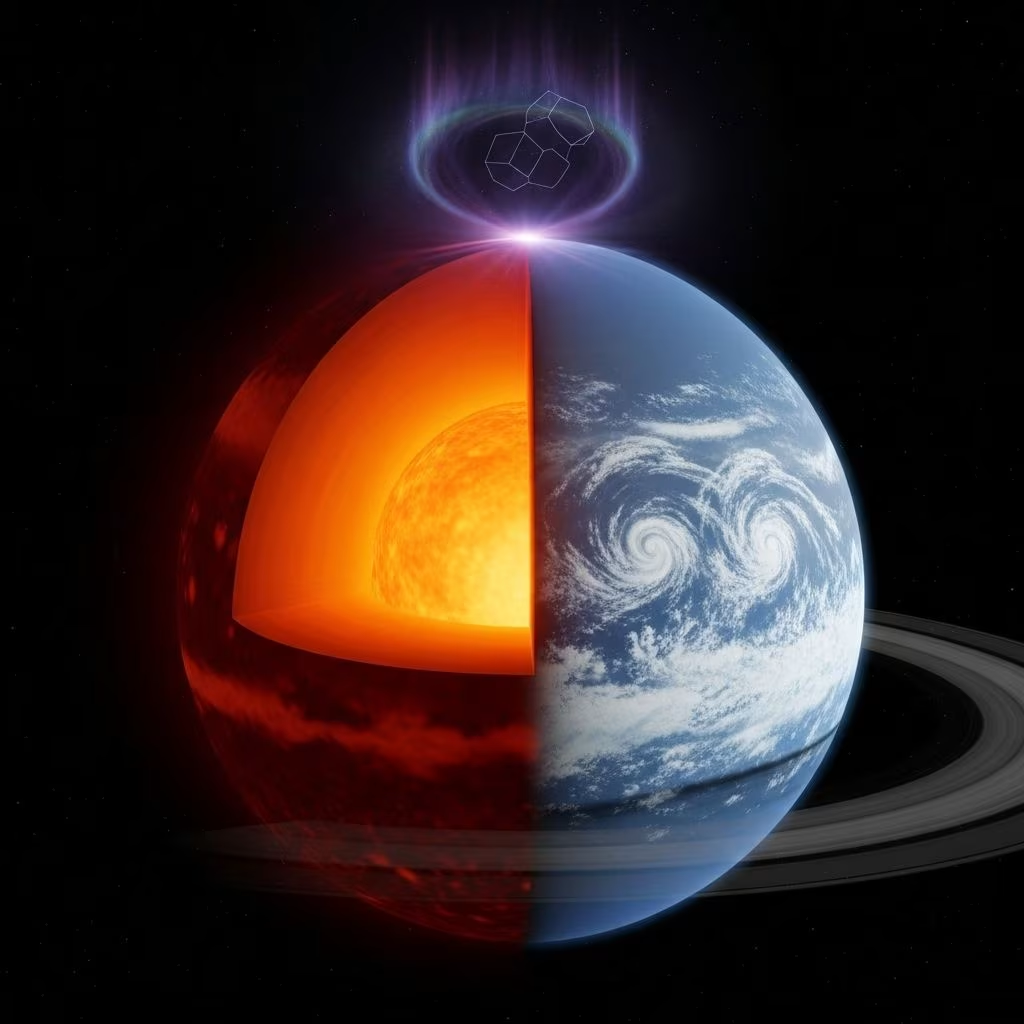
Saturn’s Extreme Temperatures: Hot Core, Frigid Clouds, and a Puzzle Above
Saturn, the sixth planet from the Sun and the second-largest in our solar system, is best known for its spectacular rings. But beyond its recognizable appearance lies a planet of extraordinary temperature contrasts, from a blistering hot core to icy clouds and an upper atmosphere that scientists still puzzle over. Understanding Saturn’s temperature not only reveals the planet’s exotic make-up but also offers insights into the workings of other gas giants and the broader mechanics of planetary atmospheres.
Introduction: The Challenge of Measuring Saturn’s Temperatures
Unlike rocky planets like Earth or Mars, Saturn lacks a solid surface. Its “surface” is defined by layers of gas and clouds, making its temperature highly variable depending on depth and position. Instruments on Earth, along with spacecraft like Cassini and Voyager, have pieced together a picture of Saturn’s wild thermodynamics—an environment vastly different from our home planet.
Saturn’s Temperature Layers: From Core to Cloud Tops
The temperature on Saturn isn’t uniform. Instead, it varies dramatically by altitude and location. The planet is essentially made up of the following main temperature zones:
| Region | Estimated Temperature | Main Heat Source |
|---|---|---|
| Core | ~11,700°C (21,000°F) | Internal generation via gravitational compression |
| Deep Atmosphere | Up to hundreds of °C | Internal and residual heat |
| Middle Atmosphere (Cloud Layer) | -185°C to -122°C (-300°F to -188°F) | Very weak solar radiation |
| Upper Atmosphere (Thermosphere near Poles) | ~300°C (570°F) | Auroras, electric currents |
| Cloud Tops | -178°C (-288°F) | Sunlight and atmospheric processes |
- Core: Saturn’s central region is thought to be extremely hot—estimated at 11,700°C (21,000°F)—hotter than the surface of the Sun. This intense heat is mainly due to planetary formation processes and the ongoing compression of hydrogen and helium deep inside the planet’s interior.
[10] - Middle Atmosphere and Cloud Layers: Temperatures drop sharply as you ascend through Saturn’s atmosphere. The bottom of the clouds, composed of water ice, average about -23°C. Rising through the clouds to layers dominated by ammonium hydrosulfide and ammonia ices, temperatures can plummet to -93°C and finally reach as cold as -150°C at the very edge of space. Overall, the top cloud layer averages around -185°C (-300°F) to -122°C (-188°F).[10]
- Upper Atmosphere: Paradoxically, the uppermost atmosphere, especially near the poles, is unexpectedly warm—reaching up to 570°F (300°C) according to some recent studies. Solar energy is too weak at Saturn’s distance to explain this heating; instead, scientists believe powerful auroras and electric currents play a role.
The Mystery: Why Is Saturn’s Upper Atmosphere So Hot?
For years, planetary scientists believed Saturn’s upper atmosphere should be frigid, given that the planet orbits about 886 million miles (1.4 billion km) from the Sun. Surprisingly, however, temperatures in these upper layers soar far above what sunlight alone can explain. This puzzling warmth is sometimes called the “energy crisis” of the outer planets.
- Auroral Heating: At Saturn’s poles, intense auroras—caused by charged particles from the solar wind—create strong electric currents. These currents can heat the upper atmosphere, especially near the polar regions, to hundreds of degrees above what is expected based solely on solar input.
- Atmospheric Waves: Some evidence shows that large-scale waves and winds within Saturn’s atmosphere may help transport heat upwards, contributing further to the temperature anomaly.
- Comparisons: This problem isn’t unique to Saturn; Jupiter also exhibits similarly hot upper atmospheric layers. Understanding Saturn’s energy budget is a priority for those seeking to solve the “planetary heating” mystery.
Internal Heat: Saturn as Its Own Furnace
Unlike Earth, whose surface is largely heated by sunlight, Saturn generates a significant portion of its own energy. In fact, it emits around 2.5 times as much energy as it receives from the Sun.[10]
- Gravitational Compression: Saturn is steadily contracting under its own gravity. As it does so, hydrogen and helium deep within the planet’s interior are compressed, generating heat—a process called Kelvin–Helmholtz contraction. This explains the searing heat at Saturn’s core and is a defining characteristic of gas giants.[10]
- Radiated Energy: Most of this internally generated heat escapes outwards, keeping Saturn much warmer than its distance from the Sun would otherwise allow, especially in the planet’s lower atmospheric layers.
- Helium Rain Theory: Some research suggests that as Saturn cools, helium separates from hydrogen and “rains” down through the planet, generating frictional heat and further boosting the planet’s energy output. This “helium rain” is thought to delay Saturn’s cooling process and add to its temperature complexity.
Seasons and Temperature Variations on Saturn
While Saturn has a comparable axial tilt to Earth—26.75 degrees versus Earth’s 23.4—seasonal temperature swings on Saturn are far less pronounced. The planet’s frigid distances from the Sun mean that solar energy has little impact overall.
- Weak Seasonal Effects: Saturn’s upper atmosphere does show subtle color changes that correspond with the planet’s seasons. When winter falls on one hemisphere, for example, that side develops a faint blue hue. These shifts are linked to ultraviolet sunlight interacting with methane in Saturn’s atmosphere, but actual temperature differences between hemispheres remain minimal.
- No Drastic Swings: The planet’s own internal workings dominate its climate, making temperature differences between seasons or hemispheres negligible compared to what we observe on Earth.
- Solar Distance: The farther a planet is from the Sun, the less influence the Sun’s seasonal changes have upon its weather. For Saturn, the Sun is a bright point in the sky, not the dominant source of heat that it is on Earth.
Saturn’s Rings and Their Temperature
Saturn’s rings are an integral part of the planet’s exotic appearance and have garnered scientific curiosity regarding their own temperature profiles.
- Composition and Heating: The rings are primarily composed of water ice, ranging in size from grains of dust to boulders several meters across. Their temperatures can fluctuate, typically falling between -200°C and -180°C (-328°F and -292°F), depending on Sun exposure and shadowing. They generally remain colder than Saturn’s top clouds.
- Thermal Mapping: Observations from NASA’s Cassini spacecraft allowed for thermal mapping, revealing cooler temperatures in the shadowed and more distant parts of the rings, and warmer temperatures in regions directly illuminated by the Sun.
- Implications: Studying the temperature of Saturn’s rings helps astronomers better understand the physical properties and age of the ring particles, as well as the formation history of Saturn’s planetary system.
Frequently Asked Questions (FAQs)
Q: Why is Saturn’s core so hot?
A: Saturn’s core is heated by the ongoing gravitational compression of hydrogen and helium deep inside the planet, a process known as Kelvin–Helmholtz contraction. This generates enough internal energy to keep the core temperature extraordinarily high—around 11,700°C—despite the coldness of space.[10]
Q: How cold does it get near Saturn’s cloud tops?
A: Temperatures at Saturn’s highest cloud layers typically average between -185°C (-300°F) and -122°C (-188°F). At these frigid temperatures, ammonia and other ices form the planet’s visible “surface.”[10]
Q: If Saturn is so far from the Sun, why is its upper atmosphere so hot?
A: The upper atmosphere’s warmth cannot be explained by sunlight alone. Scientists think energetic auroras, caused by Saturn’s magnetic field interacting with solar winds, play a major role in heating the upper layers—especially near the poles—well beyond what solar energy can achieve at Saturn’s distance.
Q: Does Saturn experience weather or storms related to temperature?
A: Yes. Saturn is home to powerful storms and jet streams, including the famous hexagonal storm at its north pole. These immense systems are driven by complex atmospheric circulation and internal heating rather than solar-driven weather like on Earth.
Q: Are there significant temperature differences between Saturn’s hemispheres due to seasonal changes?
A: No. While Saturn’s axial tilt does result in changing sunlight angles, the actual temperature variation from hemisphere to hemisphere is minimal. The Sun is simply too weak at Saturn’s distance to cause major seasonal shifts. However, subtle color changes occur, especially in the upper atmosphere, as UV sunlight interacts with methane during the planet’s seasons.
Summary: The Temperature Puzzle of Saturn
Saturn is a world of extremes—its core blazes with heat fit to melt most elements, while its outer atmosphere brushes the absolute cold limit of our solar system. Perhaps most mysterious is its upper atmosphere, as warm as a mild oven despite being nearly a billion miles from the Sun. As scientists continue to study Saturn, especially with the data provided by missions like Cassini, the knowledge gained not only demystifies the ringed planet itself but also improves our understanding of planetary processes across the cosmos.
- Saturn’s core exceeds 11,700°C, powered by internal processes.
- Cloud top temperatures can dip to below -180°C, extremely cold by Earth standards.
- Upper atmosphere is heated by auroras and currents, causing unexpectedly high temperatures for such a distant planet.
- No dramatic seasonal temperature swings—Saturn’s weather is dominated by internal and chemical processes, not solar heating.
- Rings are cold, with their own unique temperature patterns.
Key Takeaways
- Saturn remains a planet defined by contrasts—extreme cold and heat, visible calm and hidden turmoil.
- Its study continues to challenge and expand our understanding of planetary atmospheres and thermal physics in the solar system.
References
- https://science.nasa.gov/saturn/facts/
- https://study.com/learn/lesson/saturn-facts-rings-temperature-size.html
- https://www.britannica.com/place/Saturn-planet
- https://science.nasa.gov/resource/solar-system-temperatures/
- https://lovethenightsky.com/temperature-on-saturn/
- https://en.wikipedia.org/wiki/Saturn
- https://www.labmanager.com/what-makes-saturns-atmosphere-so-hot-22246
- https://en.wikipedia.org/wiki/Climate_of_Titan
- https://www.sciencing.com/saturns-temperature-ranges-7704/
- https://www.universetoday.com/articles/temperature-of-saturn
- https://education.seattlepi.com/saturns-temperature-ranges-3879.html
- https://www.space.com/18475-saturn-s-atmosphere-composition-climate-and-clouds.html
- https://myspacemuseum.com/is-saturn-cold-or-hot
- https://www.britannica.com/place/Saturn-planet/The-interior
- https://worldmetrics.org/average-surface-temperature-of-saturn-statistics/
- https://news.arizona.edu/news/what-makes-saturns-upper-atmosphere-so-hot
- https://universewatcher.com/unraveling-the-temperature-mystery-how-hot-or-cold-is-saturn-really/


