What is Perihelion?
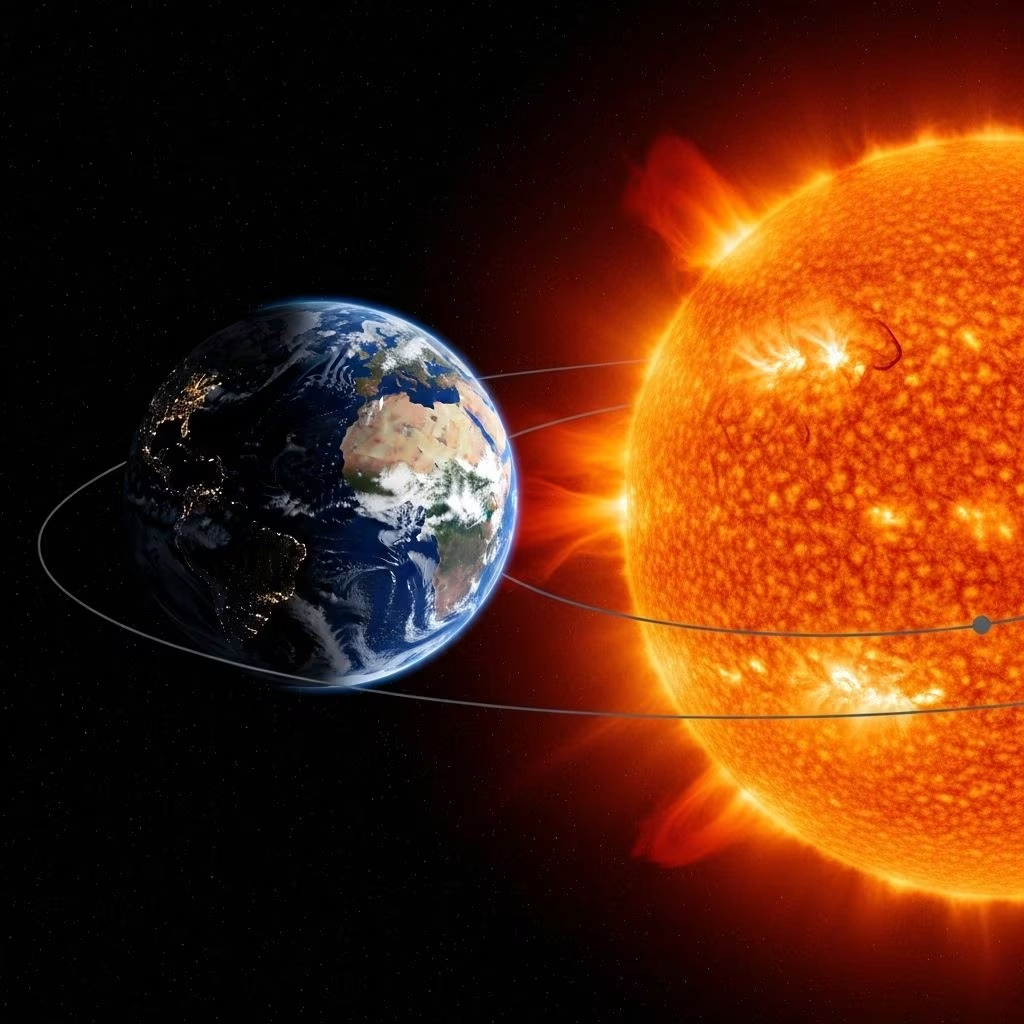
Perihelion is the moment in a celestial body’s orbit when it gets closest to the Sun. The term comes from the Greek words ‘peri’, meaning ‘near’, and ‘helios’, meaning ‘sun’. Every planet, comet, and asteroid orbiting the Sun has a perihelion, and for Earth, this event occurs once a year, typically in early January.
- Perihelion: Earth’s closest approach to the Sun in its orbital path.
- Aphelion: The point where a body is farthest from the Sun.
- Orbital Shape: Earth’s orbit is an ellipse, not a perfect circle, leading to varying distances throughout the year.
At perihelion, the distance between Earth and the Sun is about 147.1 million kilometers (91.4 million miles). At aphelion, this distance increases to roughly 152.1 million kilometers (94.5 million miles).
Why Does Earth Have a Perihelion?
The Earth orbits the Sun in an elliptic path instead of a perfect circle. According to Kepler’s Laws of planetary motion, this ellipsis means there are specific points along the path where the distance varies: perihelion (nearest) and aphelion (farthest).
Kepler’s Second Law (the Law of Areas) states that a planet moves faster in its orbit as it approaches perihelion due to the Sun’s gravitational pull.
- Average Earth-Sun distance: ~150 million kilometers
- Perihelion (closest): ~147.1 million kilometers
- Aphelion (farthest): ~152.1 million kilometers
- Orbital speed at perihelion: ~30 km/s (109,000 km/h)
When Does Perihelion Occur?
For Earth, perihelion typically happens in early January. In 2022, it occurred on January 4th. This timing might seem surprising, especially since the Northern Hemisphere is in the depth of winter, but the seasons are not determined by Earth’s proximity to the Sun. Instead:
- Seasons are due to Earth’s axial tilt, not orbital distance.
- When it’s perihelion, the Northern Hemisphere is tilted away from the Sun, resulting in winter, while the Southern Hemisphere enjoys summer.
How Does Perihelion Affect Climate and Seasons?
Although perihelion brings Earth about 5 million kilometers closer to the Sun than at aphelion, the temperature difference isn’t as dramatic as one might expect. This is because the tilt of Earth’s axis dominates seasonal changes. However, the difference in solar energy is measurable:
- During perihelion, Earth receives roughly 7% more solar energy than at aphelion.
- This can slightly amplify seasonal extremes in the Southern Hemisphere, which is tilted toward the Sun during perihelion.
- In the Northern Hemisphere, the effect is mitigated because perihelion coincides with winter.
Over long timescales, small shifts in perihelion (and Earth’s orbital shape, known as Milankovitch cycles) can influence Earth’s climate. These cycles contribute to the rhythmic patterns of ice ages and interglacial periods.
Perihelion vs. Aphelion: A Comparison
| Term | Definition | Earth’s Average Distance | Orbital Speed | Season in Northern Hemisphere |
|---|---|---|---|---|
| Perihelion | Closest point to Sun | 91.4 million mi (147.1 million km) | ~30 km/s (109,000 km/h) | Winter |
| Aphelion | Farthest point from Sun | 94.5 million mi (152.1 million km) | ~29 km/s (105,000 km/h) | Summer |
Why Is Perihelion Important?
- Orbital Stability: The speed and distance at perihelion help maintain Earth’s stable orbit. If Earth’s speed changed dramatically, it could jeopardize our planet’s delicate balance.
- Celestial Mechanics: The perihelion is a foundational concept in understanding orbits, including those of other planets, comets, and asteroids.
- Climate Science: Minute changes in Earth’s orbital characteristics, including the timing and distance of perihelion, can have long-term effects on climate.
- Astronomical Predictions: Knowing perihelion helps astronomers predict solar energy reaching Earth and enhances our understanding of planetary motion and navigation.
Perihelion for Other Bodies in the Solar System
Perihelion and aphelion are not exclusive to Earth. All planets, comets, and asteroids that orbit the Sun have these points. The degree of difference between perihelion and aphelion varies based on how elliptical the orbit is.
- Mercury: The most extreme difference (closest and farthest from the Sun) due to its highly oval-shaped orbit.
- Venus, Earth, Neptune: Nearly circular orbits, meaning less pronounced perihelion/aphelion effects.
- Comets: Some have dramatic differences, whipping close to the Sun at perihelion and retreating into deep space at aphelion.
These points, known collectively as apsides, have different names based on the body being orbited (e.g., perigee/apogee for Earth orbits, perihelion/aphelion for Sun).
The Science and History Behind Perihelion
The concept of perihelion is central to orbital mechanics and celestial mechanics. Humanity’s ability to predict, measure, and understand perihelion is foundational not just for astronomy but also for navigation, climate modeling, and even space exploration.
- Greek origins: “peri” (near), “helios” (sun).
- Kepler’s laws: Established the elliptical nature of orbits and explained the speed variation at perihelion/aphelion.
- Modern astronomy uses perihelion to fine-tune predictions about Earth’s climate, planetary dynamics, and potential close approaches from asteroids or comets.
Perihelion’s Surprising Facts
- Earth moves fastest in its orbit at perihelion: About 30 km/s or 109,000 km/h. Enough speed, hypothetically, to circle the Earth in under 15 minutes!
- We don’t feel the speed: Because Earth’s movement is extremely smooth and the atmosphere travels with the planet.
- Seasonal irony: Northern Hemisphere’s coldest time coincides with perihelion.
Frequently Asked Questions (FAQs)
Q: What exactly is perihelion?
A: Perihelion is the point in the orbit of a planet, comet, or other body where it is closest to the Sun. For Earth, this happens each year in early January.
Q: Does perihelion affect the seasons?
A: Not significantly. Seasons are caused primarily by Earth’s axial tilt, though perihelion can slightly amplify seasonal extremes, especially in the Southern Hemisphere.
Q: How much closer is Earth at perihelion than at aphelion?
A: Earth is about 5 million kilometers (3 million miles) closer to the Sun at perihelion compared to aphelion.
Q: Which planet has the most significant perihelion-aphelion difference?
A: Mercury has the largest difference due to its highly elliptical orbit.
Q: Is perihelion a factor in long-term climate change?
A: Yes, small shifts known as Milankovitch cycles, which include changes in when and how close perihelion occurs, can influence Earth’s long-term climate patterns.
Summary: Why Perihelion Matters
Understanding perihelion enriches our appreciation of Earth’s movement, celestial mechanics, and the intricate balance that sustains life. It plays a vital role in astronomy, navigation, and climate studies, illustrating the majestic and precise dance our planet performs through space every year.
- Perihelion marks Earth’s closest approach to the Sun each year.
- It occurs in early January, coinciding with the peak of Northern Hemisphere winter.
- It’s a key concept in understanding planetary motion, climate cycles, and celestial navigation.
- Other bodies in the solar system—planets, comets, asteroids—also experience perihelion.
References
- https://www.space.com/14142-earth-closest-approach-sun-perihelion.html
- https://www.space.com/earth-closest-to-sun-perihelion-2022
- https://www.timeanddate.com/astronomy/perihelion-aphelion-solstice.html
- https://www.skyatnightmagazine.com/space-science/aphelion-perihelion
- https://en.wikipedia.org/wiki/Apsis
- https://www.space.fm/astronomy/planetarysystems/aphelionperihelion.html
- https://www.freeastroscience.com/2025/01/surging-at-109000-kmh-earths-dazzling.html
- https://spaceyv.com/what-is-perihelion/
- https://www.britannica.com/science/perihelion
- https://www.sciencetimes.com/articles/35386/20220104/perihelion-day-2022-earth-makes-closest-yearly-approach-to-the-sun.htm
- https://telescopesplanet.com/en/blog/perihelion-and-aphelion-phenomenon-what-are-they-1693479129.html
- http://www.astropixels.com/ephemeris/perap2001.html
- https://www.astro22.com/what-are-the-aphelion-and-perihelion-points-of-the/
- https://space.fandom.com/wiki/Argument_of_the_perihelion
- http://www.issibj.ac.cn/os/outreach/202501/P020250104396931169252.pdf
- https://www.britannica.com/science/aphelion
- http://issibj.ac.cn/os/outreach/202501/P020250104396931169252.pdf