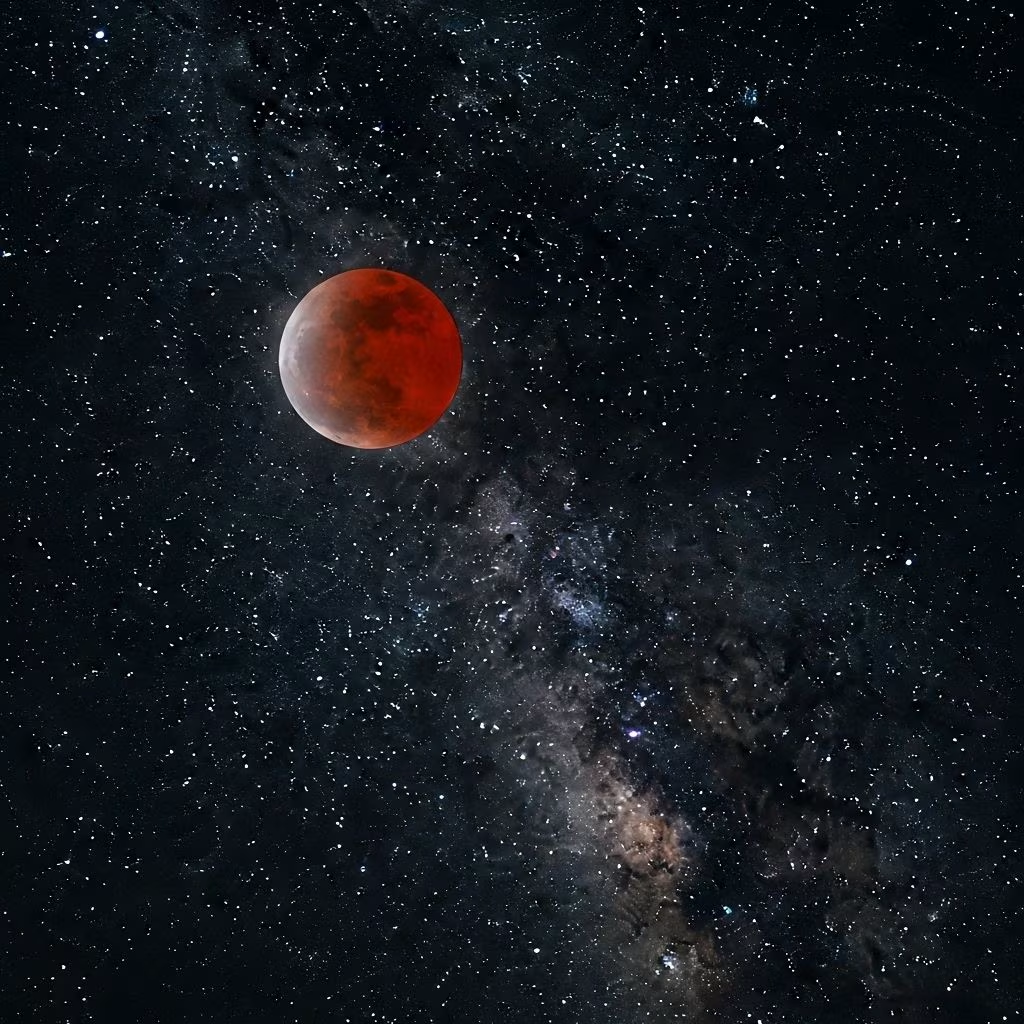
The night sky will host a remarkable astronomical event this September as a total lunar eclipse—the so-called Blood Moon—unfolds. On the evening of September 7–8, 2025, stargazers across parts of the globe will witness the Moon slip into Earth’s shadow, transforming into a haunting coppery-red orb. Whether you are a seasoned astronomer or a curious bystander, this guide will prepare you to experience this stunning lunar spectacle to the fullest.
What is a Total Lunar Eclipse?
A total lunar eclipse happens when the Earth passes directly between the Sun and the full Moon, casting its darkest shadow—the umbra—onto the lunar surface. Unlike a solar eclipse, lunar eclipses are safe to observe with the naked eye and can be seen by anyone under the right sky conditions, with no special equipment or eye protection required.
The notable reddish hue during totality leads to the nickname Blood Moon. This effect arises because sunlight filtering through Earth’s atmosphere is bent (or refracted) and scatters away the short blue wavelengths, allowing more of the longer red wavelengths to illuminate the Moon’s surface. The result is a dramatic transformation that can last over an hour, enthralling millions of viewers worldwide.
- Alignment: Sun, Earth, and Moon in a straight line
- Shadow: The Moon passes through Earth’s umbra, causing totality
- Color: Red to copper tones due to atmospheric scattering and refraction
- Visibility: Safe to observe with the naked eye, no filters needed
When is the Total Lunar Eclipse of September 2025?
The total lunar eclipse will take place overnight from September 7 to September 8, 2025. The entire event, from the initial penumbral stages to the final moments as the Moon exits Earth’s shadow, spans roughly five hours. However, the main attraction—the period of totality—lasts for a striking 82 minutes, making it one of the longer lunar eclipses of the decade.
| Phase | Time (EDT) | Time (GMT) |
|---|---|---|
| Penumbral Eclipse Begins | 11:28 AM | 15:28 |
| Partial Eclipse Begins | 12:26 PM | 16:26 |
| Total Eclipse Begins | 1:30 PM | 17:30 |
| Greatest Eclipse | 2:11 PM | 18:11 |
| Total Eclipse Ends | 2:52 PM | 18:52 |
| Partial Eclipse Ends | 3:56 PM | 19:56 |
| Penumbral Eclipse Ends | 4:55 PM | 20:55 |
Timing for the eclipse phases will shift based on your local time zone, so check regional forecasts and astronomical charts for precise timing in your area.
Where Will the Eclipse Be Visible?
The September 2025 Blood Moon will be visible to more than 7 billion people worldwide[10]. However, the view you experience will depend greatly on your location:
- Asia and Western Australia: Viewers here will see the entire eclipse from start to finish, including all phases of totality. This region is the prime vantage point for the event.
- Eastern and Central Europe, Africa: The eclipse will already be underway as the Moon rises; viewers will witness the Moon in total eclipse rising above the horizon, creating dramatic photo opportunities.
- Americas: Most of North and South America will miss out on the event, although the very western edge of Alaska may catch part of the partial phases.
- Rest of the World: Regions outside the main viewing areas (including the Pacific and parts of the Arctic) may see only a penumbral or partial eclipse, or none at all.
To confirm visibility for your location, consult interactive maps and local skywatching calendars.
Why Will This Eclipse Be So Spectacular?
This particular total lunar eclipse stands out for several reasons:
- Long Duration: The period of totality lasts an unusually long 82 minutes, longer than many recent lunar eclipses.
- Proximity to Perigee: Only 2.7 days before the Moon’s closest approach to Earth (perigee), the eclipse will occur when the Moon appears slightly larger and brighter than usual (sometimes referred to as a ‘supermoon effect’).
- Deep Umbra Passage: The Moon will plunge deep into Earth’s umbra, resulting in a particularly dark and saturated Blood Moon hue, assuming favorable atmospheric conditions.
- Widespread Visibility: Over 7 billion people reside within the area where at least part of this eclipse can be seen, making it one of the most globally accessible lunar eclipses of the decade.
What Causes the ‘Blood Moon’ Color?
During totality, sunlight passing through Earth’s atmosphere is refracted and filtered. Blue and green light are scattered more strongly than red and orange wavelengths, which are bent into Earth’s shadow and paint the Moon with a rusty or coppery glow. The specific brightness and shade of each Blood Moon is affected by:
- Atmospheric Dust: Following volcanic eruptions or dust storms, a lunar eclipse may take on a darker and more brownish tone.
- Air Clarity: Weather, pollution, and seasonal changes can make the Moon appear more vivid or faintly tinted.
- Depth in the Umbra: The deeper the Moon passes into the shadow, the darker and redder it appears.
This September’s eclipse is anticipated to be a particularly dark Blood Moon due to the Moon’s path through the heart of Earth’s shadow.
How to Watch the September 2025 Total Lunar Eclipse
Observing a lunar eclipse is simple, safe, and can even be done casually with the naked eye. Follow these tips to maximize your viewing experience:
- Check Local Times: Ensure you know when key phases (especially totality) occur in your time zone.
- Find a Clear Horizon: If the Moon is rising or setting during the eclipse in your region, a location with an unobstructed eastern or western horizon can provide dramatic views.
- Use Binoculars or a Telescope: These enhance the details and may reveal subtle color gradients across the lunar surface, but are not necessary for enjoyment.
- Bring a Camera: Photographing the eclipse can be rewarding. Use a tripod for sharp images, and experiment with exposure times to capture the red hues.
- Join Livestreams: If weather or daylight block your view, online broadcasts and live blogs will cover the event globally.
- Comfort: Bring a chair or blanket for comfortable skywatching, as totality lasts over an hour.
What Will Happen During the Eclipse?
The lunar eclipse will progress through a sequence of visually distinct stages:
- Penumbral Phase: The outer shadow of Earth subtly dims the Moon—usually hard to detect to the eye.
- Partial Eclipse: Earth’s inner shadow, the umbra, begins to bite into the Moon’s disc, producing a dramatic ‘missing piece’ effect.
- Totality: The entire lunar surface is within the umbra, transforming the Moon into a Blood Moon for 82 minutes. Expect the deepest color near mid-eclipse.
- Partial Eclipse Ends: The Moon gradually emerges from the umbra, and normal brightness returns.
- Penumbral Phase Ends: The faint shading slowly disappears as the Moon leaves Earth’s shadow completely.
Fun Facts About Lunar Eclipses
- Frequency: There are typically 0–3 lunar eclipses each year, but total eclipses are less common.
- Global Event: Unlike solar eclipses, which have narrow paths, everyone on the night side of Earth can witness a lunar eclipse.
- Safe to Observe: No need for special glasses or filters.
- Historic Interest: Ancient cultures often viewed eclipses as omens or signs, inspiring myths and legends.
Why Don’t We Have Lunar Eclipses Every Month?
Lunar eclipses occur only when the Moon is full and passes through Earth’s shadow. Due to the Moon’s slightly tilted orbit, it usually misses Earth’s shadow each month. Eclipses happen only when the Sun, Earth, and Moon align closely enough for a shadow to be cast during a full Moon. This alignment involves the nodes—the two points where the Moon’s orbit crosses the ecliptic plane.
Tips for Photographing the Blood Moon
- Use a tripod to stabilize your camera and avoid blurry images.
- Start with ISO 400–800, f/5.6, and a 1–2 second exposure; adjust settings as needed.
- Zoom lenses or small telescopes attached to cameras provide detailed lunar portraits.
- Capture the landscape for atmospheric shots, especially during moonrise or moonset phases.
- Edit your images in post-processing to enhance contrast and bring out the red hues.
Frequently Asked Questions (FAQs)
Q: What is a Blood Moon?
A: A Blood Moon refers to a total lunar eclipse during which the Moon appears red or copper-colored as it passes through the Earth’s shadow, caused by atmospheric filtering of sunlight.
Q: Will the September 2025 total lunar eclipse be visible in North America?
A: No, most of North America will miss the 2025 eclipse. Only extreme western parts of Alaska may glimpse a partial phase; the rest will not see the eclipse.
Q: Is it safe to look at a lunar eclipse without protection?
A: Yes. Lunar eclipses are completely safe to watch with the naked eye, binoculars, or a telescope—no filters or glasses are needed.
Q: Why does the Moon turn red during a total lunar eclipse?
A: The reddish hue happens because Earth’s atmosphere scatters blue light and bends the remaining red light into its shadow, illuminating the Moon in crimson and copper tones.
Q: When is the next total lunar eclipse after September 2025?
A: The next total lunar eclipse will occur on March 3, 2026, and will be visible from a different set of regions globally.
Share Your Experience
If you capture great photos of the September 2025 total lunar eclipse, share them with astronomy communities or send them to space portals eager to showcase global views of this remarkable Blood Moon!
Stay tuned to astronomy websites, live blogs, and local observatories for up-to-the-minute updates, livestreams, and skywatching tips as the eclipse unfolds. Let the wonder of the cosmos inspire you—clear skies and happy stargazing!
References
- https://www.timeanddate.com/eclipse/lunar/2025-september-7
- https://en.wikipedia.org/wiki/September_2025_lunar_eclipse
- https://www.space.com/stargazing/lunar-eclipses/blood-moon-1st-pictures-september-7-2025-total-lunar-eclipse
- https://www.space.com/stargazing/lunar-eclipses/dont-miss-total-lunar-eclipse-blood-moon-tonight-sept-7-2025
- https://www.youtube.com/watch?v=l1Sx0FG8EYE
- https://science.nasa.gov/eclipses/future-eclipses/
- https://www.syfy.com/syfy-wire/how-to-see-september-blood-moon-total-lunar-eclipse
- https://www.youtube.com/watch?v=ciCXPsxwtyQ
- https://www.farmersalmanac.com/lunar-and-solar-eclipses
- https://www.skyatnightmagazine.com/news/lunar-eclipse-september-7-2025
- https://www.livescience.com/space/the-moon/where-can-you-see-the-sept-7-blood-moon-total-lunar-eclipse
- https://timesofindia.indiatimes.com/astrology/planets-transits/blood-moon-september-2025-date-time-and-all-you-need-to-know-about-total-lunar-eclipse/articleshow/123693632.cms