String Theory: Unveiling the Universe’s Hidden Dimensions
For decades, physicists have sought a unified explanation of nature’s forces. String theory boldly proposes that everything in the universe—matter, energy, even space and time—originates from microscopic vibrating strings. This theory aims to bridge the gap between quantum mechanics and general relativity, offering a pathway toward a single ‘theory of everything’.
What Is String Theory?
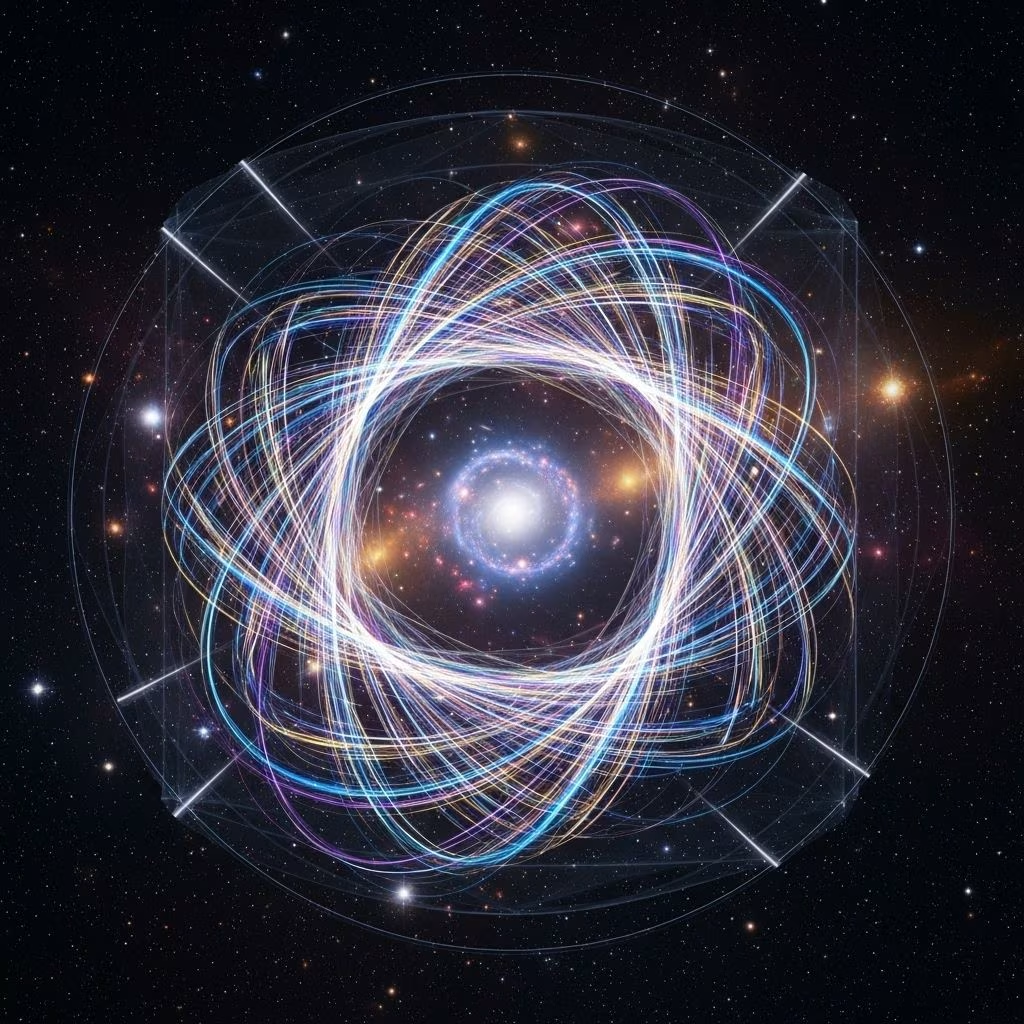
At its core, string theory is a theoretical framework postulating that the point-like particles in standard physics are actually one-dimensional “strings”. These objects, unimaginably small—even tinier than the smallest known subatomic particles—oscillate in distinct patterns. Each vibrational mode of a string corresponds to a fundamental particle, giving rise to all the building blocks of matter and energy observed in the universe.
- Strings can be open (with endpoints) or closed (forming loops).
- The properties of a particle—its mass, charge, and more—are determined by the way a string vibrates.
- On large scales, strings appear particle-like, but at the quantum scale, their vibrational nature emerges.
Among the many vibrational states, one matches the elusive graviton: the hypothetical quantum particle believed to mediate gravitational force. This insight positions string theory as a promising theory of quantum gravity—potentially reconciling the two dominant pillars of modern physics.
The Quest for Unification: From Quantum Mechanics to Relativity
Contemporary physics rests on two towering yet mutually incompatible theories:
- Quantum mechanics governs the subatomic world, dictating the behavior of particles at the smallest scales.
- General relativity, Einstein’s masterwork, describes the force of gravity and the structure of space-time at cosmic scales.
Despite their individual successes, these frameworks cannot be merged using conventional approaches. String theory offers a groundbreaking candidate for such unification, providing tools to describe all fundamental particles and forces, including gravity, within a single mathematical structure.
How Strings Construct the Universe
While traditional theories model particles as zero-dimensional points, string theory portrays them as tiny, one-dimensional filaments. As these strings twist, stretch, and vibrate, they spawn the rich diversity of particles and forces:
- Different vibrational modes produce different particles: electrons, quarks, photons, and even force-carrying particles.
- Interactions arise from strings splitting and recombining, in analogy to particle creation and annihilation.
- Gravity naturally emerges from one particular vibration mode—representing the graviton.
This elegant replacement of point-like particles with strings offers new avenues for calculating complex interactions, especially those involving quantum gravity where conventional field theories break down.
Extra Dimensions: Beyond the Familiar Three
Perhaps the most mind-bending implication of string theory is the need for extra spatial dimensions. While everyday experience is limited to three dimensions of space and one of time, string theory’s equations require more spatial dimensions for consistency:
- Original string theory proposed 10 total dimensions (nine space, one time).
- M-theory, an extension, suggests 11 dimensions.
Why don’t we perceive these extra dimensions? Most models argue they are compactified—curled up at scales so tiny they evade direct detection, much as a two-dimensional surface can seem one-dimensional from a distance.
The Five Versions of String Theory
Surprisingly, research revealed not a single string theory, but five consistent versions—each differing in technical details, symmetries, and types of strings:
- Type I: Involves both open and closed strings.
- Type IIA: Closed strings, non-chiral in ten dimensions.
- Type IIB: Closed strings, chiral in ten dimensions.
- Heterotic SO(32): Closed strings with unique symmetry.
- Heterotic E8 × E8: Closed strings with an even more complex symmetry structure.
Each theory accounts for the observed particles and forces in nature, but with key differences in symmetry, the role of supersymmetry, and the type of strings emphasized.
Supersymmetry: Bridging Fermions and Bosons
A central concept in many string theories is supersymmetry (SUSY), a proposed symmetry relating bosons (force carriers) and fermions (matter particles):
- Every boson has a fermionic partner, and vice versa.
- This symmetry is favored for mathematical consistency and could explain the mysterious mass patterns in the Standard Model.
Comparison of the Five String Theories
| Theory | String Types | Supersymmetry | Key Features |
|---|---|---|---|
| Type I | Open & Closed | Yes | SO(32) gauge symmetry |
| Type IIA | Closed | Yes | Non-chiral |
| Type IIB | Closed | Yes | Chiral |
| Heterotic SO(32) | Closed | Yes | SO(32) gauge group |
| Heterotic E8×E8 | Closed | Yes | E8×E8 gauge group |
M-Theory: The Unifying Framework
In 1995, physicist Edward Witten, building on the work of several researchers, proposed that all five superstring theories are merely different limits of an even deeper framework: M-theory. Unlike ordinary string theories, M-theory:
- Requires 11 dimensions for mathematical consistency.
- Includes not just one-dimensional strings, but higher-dimensional objects called branes (from “membranes”).
- Unifies the five superstring theories, linking them via dualities (mathematical connections demonstrating their equivalence under certain conditions).
M-theory remains incompletely defined, but its insights have transformed the field and inspired numerous advances in mathematics and physics.
Key Features and Predictions of String Theory
- Quantum Gravity: String theory naturally incorporates gravity alongside other forces, addressing a major gap in previous quantum field theories.
- No Free Parameters: The theory’s equations largely determine its structure; free choices (as seen in other models) are reduced.
- Prediction of New Particles: Supersymmetry requires the existence of superpartners for known particles—none yet observed, but the search is ongoing.
- Extra Dimensions: These provide potential new explanations for unresolved questions, like the strength of gravity and the variety of particle interactions observed.
- Unification of Forces: All four known fundamental interactions (gravity, electromagnetism, weak and strong nuclear forces) are accommodated.
Mathematics of String Theory: Dualities and Beyond
String theory’s mathematical landscape is extraordinarily rich, introducing the world to exotic concepts such as:
- S-duality: Relates strongly coupled and weakly coupled versions of the theory, providing new insights into non-perturbative physics.
- T-duality: Demonstrates that strings propagating on geometrically distinct spaces can nonetheless be physically equivalent.
- Branes: Higher-dimensional analogues of strings, these objects have expanded the theory’s focus far beyond simple strings.
- AdS/CFT Correspondence: A deep mathematical relationship linking gravity in anti-de Sitter space to a conformal field theory on its boundary, with applications from black holes to quantum computing.
Challenges, Criticisms, and Open Questions
Despite the brilliance and mathematical beauty of string theory, significant challenges remain on the path to experimental confirmation:
- Lack of Direct Evidence: No experimental test has yet definitively confirmed string theory’s predictions. The theory’s characteristic energy scales are vastly beyond reach of current particle accelerators.
- Landscape Problem: The theory admits a staggering number of vacuum solutions (sometimes said to be as high as 10500), making it difficult to predict why our universe has its observed properties.
- Supersymmetry Not Observed: Experiments at the Large Hadron Collider and elsewhere have not discovered the predicted supersymmetric partner particles.
- Conceptual Complexity: Its reliance on higher dimensions and complex mathematical constructs can be both a strength and a source of criticism.
Nonetheless, string theory continues to inspire theoretical advances. Even without direct detection, its framework has provided invaluable tools for understanding black holes, quantum field theory, and the mathematical structure underlying physical phenomena.
Reasons String Theory Attracts Physicists
- Unification: It offers a single, coherent framework encompassing all known particles and forces.
- Mathematical Beauty: Its equations have revealed deep connections between previously unrelated branches of mathematics and physics.
- Problem Solving: Insights from string theory shed light on puzzles ranging from the entropy of black holes to the nature of early cosmic inflation.
- Novel Predictions: The extra dimensions and new types of symmetry may point to new physical phenomena, even if indirect.
Looking Ahead: The Future of String Theory
As a framework under constant development, string theory is likely to remain a focus of fundamental research for decades. Even skeptics acknowledge its power as a generator of new mathematical ideas and as a testbed for exploring the deepest mysteries of space, time, and matter.
Researchers continue to search for indirect evidence—via cosmic signatures, properties of black holes, or hints of extra dimensions—while working to refine and clarify the theory’s predictions.
Frequently Asked Questions (FAQs)
Q: Is string theory proven?
A: No. While string theory is mathematically consistent and captivating, it remains an untested hypothesis due to the enormous energy scales required for experimental verification.
Q: How many dimensions does string theory propose?
A: Most string theories require 10 dimensions (9 space, 1 time), while M-theory calls for 11 dimensions. The extra dimensions are typically compactified and hidden from direct observation.
Q: What is the graviton, and why is it important?
A: The graviton is the hypothetical quantum particle that would mediate gravitational force. String theory naturally predicts its existence as a vibration mode of closed strings.
Q: Are there alternatives to string theory?
A: Yes, notable alternatives include loop quantum gravity and various quantum gravity proposals. However, string theory remains the most developed and ambitious framework for unification.
Q: Why do some physicists criticize string theory?
A: Critics cite the lack of testable predictions, reliance on unobserved extra dimensions, and the vast “landscape” of possible solutions, which complicates making unique predictions about our universe.
Key Points
- String theory proposes that everything is made from vibrating one-dimensional strings.
- It aims to unify all fundamental forces, including gravity, in a single framework.
- The theory requires extra dimensions of space, typically hidden at tiny scales.
- Multiple versions exist but can be unified under M-theory with 11 dimensions.
- Despite elegant mathematics, string theory remains experimentally unverified.
References
- https://www.space.com/string-theory-11-dimensions-universe.html
- https://www.space.com/is-string-theory-worth-it.html
- https://en.wikipedia.org/wiki/String_theory
- https://www.britannica.com/science/string-theory
- https://www.britannica.com/summary/string-theory
- https://byjus.com/physics/stringtheory/
- https://www.dummies.com/article/academics-the-arts/science/physics/string-theory-unifies-space-and-time-178678/
- https://en.wikipedia.org/wiki?curid=28305
- https://lifespaceandthelot.com/2023/12/21/string-theory-space-mysteries-explained/
- https://ndpr.nd.edu/reviews/the-emergence-of-spacetime-in-string-theory/
- https://www.advancedsciencenews.com/string-theory-provides-a-new-take-on-the-expansion-of-the-universe/
- https://www.dummies.com/article/academics-the-arts/science/physics/string-theory-moving-through-space-time-177837/
- https://www.youtube.com/watch?v=k6TWO-ESC6A
- https://profmattstrassler.com/2014/01/13/a-solar-system-test-of-string-theory/
- https://www.astronomy.com/science/string-theory-is-not-dead-yet/
- https://omeralpdanis.com/en/a-thorough-analysis-of-string-theory-basic-concepts-theory-versions-and-applications-2/