


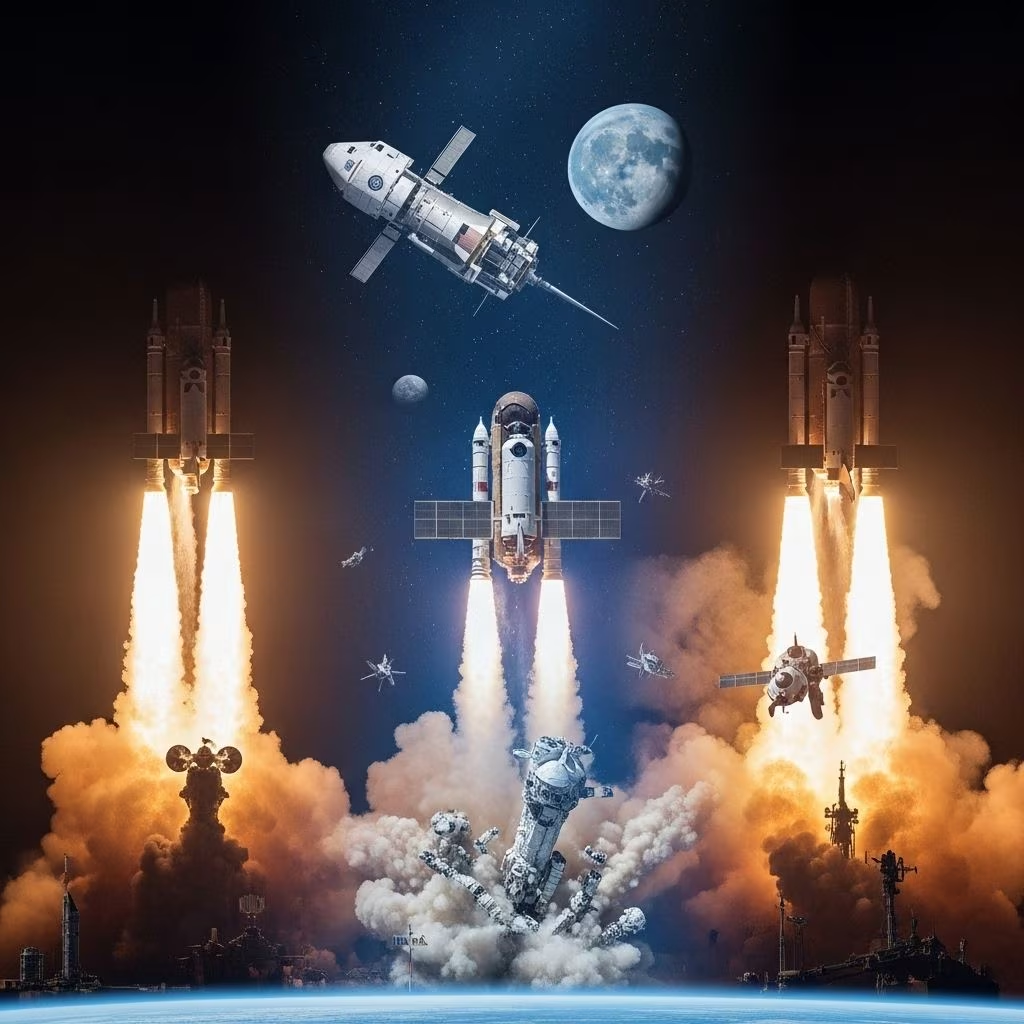
Space Exploration Launches and Spacecraft: Past, Present, and Future
Space exploration stands as one of humanity’s most extraordinary achievements. From the first flights beyond Earth’s atmosphere to the ambitious plans for sustainable exploration of the Moon and Mars, the story of space missions and spacecraft is a testament to human curiosity and technological innovation.
What Is Space Exploration?
Space exploration is the physical investigation of outer space using human astronauts and robotic spacecraft. It encompasses all launches, missions, and technological developments dedicated to venturing beyond our planet. Unlike astronomy, which observes space from Earth, space exploration is about traveling into and operating within the cosmos.
Why Explore Space?
- Scientific discovery: Understanding cosmic phenomena, the origins of the universe, and our own planet’s history.
- National prestige: Countries demonstrate their technological and scientific prowess through bold space initiatives.
- International collaboration: Major programs unite nations in peaceful, cooperative ventures.
- Human survival: Ensuring our long-term survival by exploring beyond Earth.
- Strategic and military advantages: Gaining an edge in communications, surveillance, and global influence.
The Early Era: Foundations and the Space Race
The roots of space exploration lie in a remarkable era defined by rivalry, visionary pioneers, and rapid technological progress. The mid-twentieth century marked the beginning of humanity’s journey into space, primarily driven by the Space Race—a Cold War contest between the Soviet Union and the United States.
Foundational Milestones
- Sputnik 1 (1957): The Soviet Union launches the world’s first artificial satellite. This historic event ushers in the Space Age.
- Explorer 1 (1958): The United States’ first successful satellite, carrying instruments that led to the discovery of the Van Allen radiation belts[11].
- Luna 2 (1959): First human-made object to reach the Moon, launched by the Soviets.
- Vostok 1 (1961): Yuri Gagarin becomes the first human in space, orbiting Earth.
- Apollo 11 (1969): Neil Armstrong and Buzz Aldrin are the first humans to walk on the Moon, marking the peak of the Space Race.
Landmark Firsts by the Soviet Union
- First living being in orbit (Laika, 1957)
- First human spaceflight (Yuri Gagarin, 1961)
- First spacewalk (Alexei Leonov, 1965)
- First automatic landing on another celestial body (Luna 9, 1966)
- First space station (Salyut 1, 1971)
These achievements established space exploration as a field of global competition and cooperation, setting the stage for an expanding universe of missions.
From Competition to Cooperation and Innovation
The 1970s and beyond saw a gradual transition. The competition between global powers gave way to more sustained programs, reusable spacecraft, and collaborative projects.
Major Programs and Technological Advances
- Space Shuttle Program (USA): Introduced reusable spacecraft, drastically changing launch economics and mission frequency.
- International Space Station (ISS): Built between 1998 and 2011 by the US, Russia, Europe, Canada, and Japan. The ISS is a symbol of global scientific collaboration and engineering prowess.
- Interplanetary Exploration: Expanding missions to Venus, Mars, and outer planets with robotic probes (e.g., Voyager, Viking, Pioneer)[12].
The Modern Era: Expanding Horizons
The 2000s to the present has witnessed an explosion of space activity generated by new entrants, private sector involvement, and renewed ambitions for lunar and planetary exploration.
New National Players
- China: Rapid expansion with crewed missions, lunar landers, and development of an independent space station.
- European Union, Japan, India: Significant contributions in launch vehicles, lunar and Mars probes, and robotics.
The Rise of the Private Space Industry
- Companies such as SpaceX, Blue Origin, and Rocket Lab now develop their own launch vehicles and spacecraft, competing globally for satellite launches, resupply missions, and future lunar projects.
- Commercial innovation is creating new possibilities for cost-effective, frequent access to space.
Return to the Moon and New Global Programs
Two preeminent lunar exploration initiatives are defining the 2020s:
- Chinese-led International Lunar Research Station
- US-led Artemis Program
Spacecraft: Types and Key Technologies
From tiny scientific payloads to massive orbital laboratories and deep-space vehicles, spacecraft designs have advanced dramatically.
Main Spacecraft Types
- Satellites: Orbiting Earth or other bodies; support communications, science, weather, and navigation.
- Probes: Uncrewed craft exploring the Moon, planets, asteroids, and beyond.
- Landers and Rovers: Touch down on planetary surfaces for scientific research (e.g., Curiosity on Mars).
- Manned Spacecraft: Vehicles supporting humans in low Earth orbit and beyond (e.g., Soyuz, SpaceX Dragon, Orion).
- Space Stations: Permanent or long-duration laboratories in space (e.g., ISS, China’s Tiangong).
Unmanned Spacecraft: A Journey Beyond Earth
Unmanned missions have revolutionized our understanding of the universe while reducing risks and costs compared to human spaceflight[11].
- Pioneering Missions: Sputnik 1 (first satellite), Pioneer 4 (flew past the Moon), and dozens of planetary probes.
- Scientific Achievements: Mapping planetary surfaces, studying atmospheres, and photographing distant worlds.
- Technological Innovations: Autonomous navigation, improved power sources, and advanced communications.
Landmark Launches and Missions: Chronological Highlights
| Year | Mission/Event | Significance |
|---|---|---|
| 1957 | Sputnik 1 | First artificial satellite (Soviet Union) |
| 1961 | Vostok 1 | First human in space (Yuri Gagarin) |
| 1965 | Voskhod 2 | First spacewalk (Alexei Leonov) |
| 1969 | Apollo 11 | First human landing on the Moon |
| 1971 | Salyut 1 | First space station deployed |
| 1981 | STS-1 (Space Shuttle Columbia) | First reusable crewed spacecraft |
| 1998–2011 | International Space Station | Multinational orbital laboratory |
| 2004–Present | Private commercial launches | Rise of SpaceX, Blue Origin, and others |
| 2022 | Artemis I | Uncrewed lunar orbit mission |
| 2024 | First CLPS lunar lander | First US lunar landing since Apollo 17 |
Spotlight on Current and Upcoming Missions
The 2020s are characterized by several ambitious spaceflight programs and upcoming launches.
Artemis Program (NASA and Partners)
- Goal: Land the “first woman and the next man” on the Moon and establish a sustainable lunar presence.
- Key elements:
- Orion crew vehicle
- Lunar Gateway station
- Commercial Lunar Payload Services (CLPS)
- Lunar landers and Artemis Base Camp
- Recent and planned milestones:
- Artemis I: Uncrewed lunar orbit (2022)
- Artemis II: Crewed lunar flyby (2025, planned)
- Gateway and Base Camp: Construction underway, with initial capabilities expected by 2025–2027
- CLPS: First US lunar lander since Apollo (2024)
Other Major Missions and Launches
- China Lunar and Mars Missions: Lunar landers, Mars rover missions, and construction of the Tiangong space station.
- Commercial Mars Missions: Proposals by SpaceX (Starship) and others to attempt future Mars exploration and habitation.
- Arabsat, OneWeb, and Starlink: Commercial communication satellite constellations.
- Planetary Science: Missions such as NASA’s Perseverance (Mars), ESA’s Juice (Jupiter Icy Moons Explorer), and India’s Chandrayaan and Mars Orbiter programs.
Innovations and Impacts of Spacecraft Technology
The evolution of spacecraft and launch vehicles continues to reshape exploration:
- Reusable Rockets: SpaceX’s Falcon 9 and similar vehicles slash costs and increase launch frequencies.
- Miniaturization: CubeSats and nanosatellites allow for rapid deployment of affordable payloads for science and communications.
- Deep Space Propulsion: Electric propulsion and innovative drives are enabling longer, farther missions.
- Autonomous Systems: Advances in onboard AI and robotics reduce the need for round-the-clock ground control.
Frequently Asked Questions (FAQs)
Q: What was the first human-made object in space?
A: Sputnik 1, launched by the Soviet Union in 1957, was the first artificial satellite and the first human-made object to orbit Earth.
Q: What is the purpose of the Artemis program?
A: NASA’s Artemis program aims to return humans to the Moon, land the first woman and next man on the lunar surface, establish a sustainable presence, and pave the way for eventual missions to Mars.
Q: How do robotic spacecraft differ from human missions?
A: Robotic spacecraft, such as probes and rovers, operate without a human crew. They are often sent on more hazardous or distant exploratory missions, reducing risk and cost but limiting real-time flexibility compared to crewed missions.
Q: What roles do commercial companies play in space launches?
A: Commercial companies design, build, and launch rockets and spacecraft for both private and government customers, providing services from satellite deployment to resupply missions. Companies like SpaceX, Blue Origin, and others have revolutionized launch frequency, cost, and technological innovation.
Q: What are the biggest challenges in space exploration?
A: The main challenges include the high cost of launches, the dangers of radiation and microgravity for humans, vast distances for deep space travel, long-duration life support, maintaining international collaboration, and ensuring sustainable technological advancement.
Conclusion: The Next Giant Leap
Space exploration’s history is one of crossing boundaries—of technology, ambition, and collaboration. Humanity’s next giant leaps, whether building lunar bases or reaching Mars, will rely on continued innovation, cooperation, and the tireless spirit that brought us from Sputnik to the International Space Station and beyond. Each new launch and spacecraft redefines what is possible, inviting new generations to reach for the stars.
References
- https://www.space.com
- https://www.space.com/space-exploration
- https://spaceexplored.com
- https://www.nasa.gov
- https://www.astronomy.com/space-exploration/space-missions-a-list-of-current-and-upcoming-voyages/
- https://www.jpl.nasa.gov
- https://spaceexplored.com/category/spaceflight/
- https://en.wikipedia.org/wiki/Space_exploration
- https://en.wikipedia.org/wiki/2024_in_spaceflight
- https://www.spacex.com
- https://spacemesmerise.com/en-de/blogs/space-exploration/unmanned-space-exploration-a-journey-beyond-earths-limits
- https://www.britannica.com/science/spaceflight
- https://www.planetary.org/space-missions
- https://www.britannica.com/science/space-exploration
- https://spacemesmerise.com/en-de/blogs/space-technology/exploring-the-unknown-a-comprehensive-history-of-space-probes
- https://spaceflightnow.com/news/index32.html
- https://phys.org/space-news/space-exploration/
- https://mycarmakesnoise.com/general/groundbreaking-spacecraft-that-revolutionized-space-exploration/


