Hubble Space Telescope: Revolutionizing Our View of the Cosmos
The Hubble Space Telescope (HST) stands as one of humanity’s most significant scientific instruments, transforming our understanding of the universe since its launch in 1990. Designed for high-precision astronomical observation, Hubble continues to inspire awe with its engineering, longevity, and unparalleled contributions to science.
Contents
- Origins and Mission
- Design and Engineering
- How Hubble Works
- Key Scientific Discoveries
- Servicing and Longevity
- Fast Facts & Specifications
- Legacy and Impact
- Frequently Asked Questions (FAQs)
Origins and Mission
The Hubble Space Telescope owes its name to Edwin Powell Hubble (1889–1953), a pioneering astronomer who fundamentally changed our understanding of the universe by demonstrating the existence of galaxies beyond our own and showing that the universe is expanding.
The notion of large, space-based observatories dates back decades. As early as the 1940s, scientists realized that placing telescopes above Earth’s turbulent and distorting atmosphere would unlock unprecedented clarity for astronomical observation. After decades of development by NASA, with instrumental contributions from the European Space Agency (ESA), Hubble was launched by Space Shuttle Discovery (STS-31 mission) on April 24, 1990.
- Mission Objective: Capture high-resolution images and spectra of the universe across ultraviolet, visible, and near-infrared wavelengths, unobscured by the Earth’s atmosphere.
- Unique Role: Hubble paved the way for advanced space-based astronomy, allowing access to wavelengths blocked or absorbed by the atmosphere.
- International Collaboration: Joint NASA and ESA project, reflecting global commitment to expanding our cosmic knowledge.
Design and Engineering
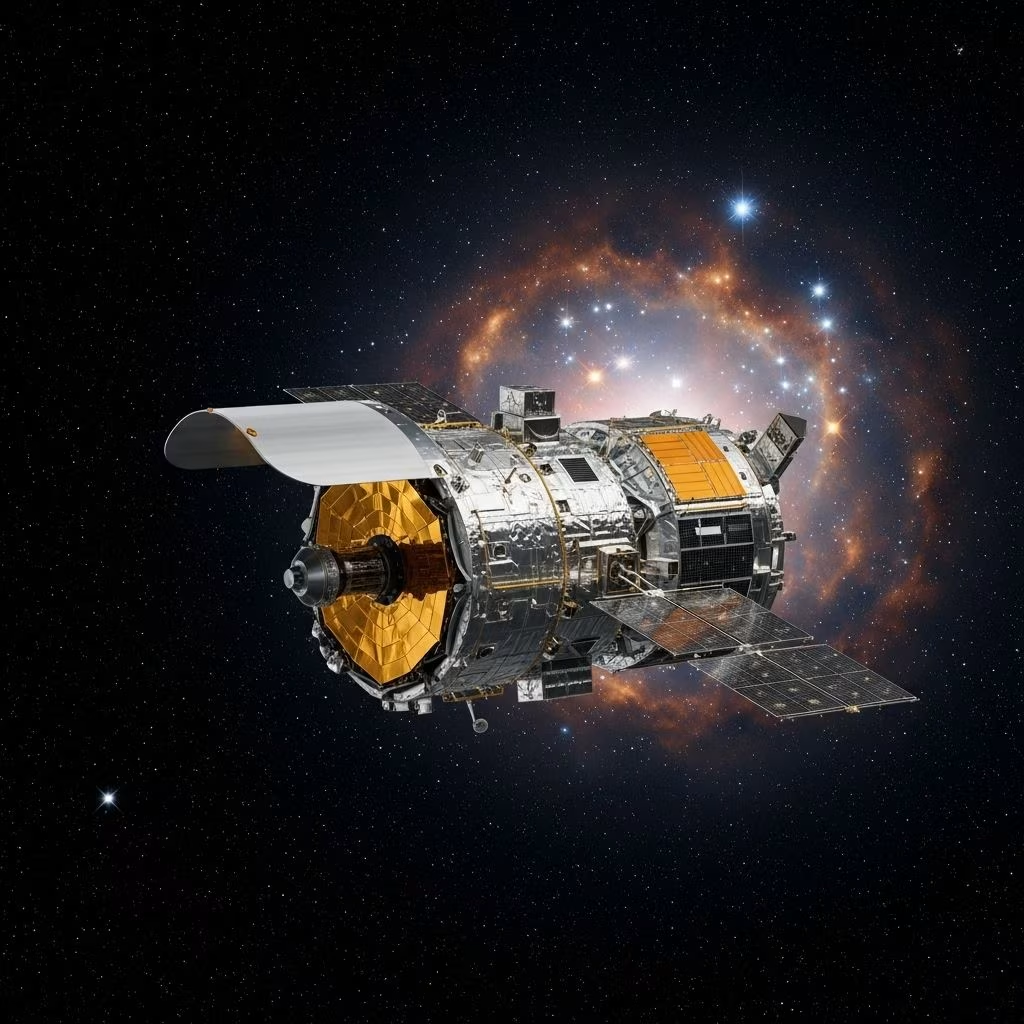
Hubble’s engineering embodies decades of optical, mechanical, and electronic innovation. The observatory is a masterpiece of modular, serviceable design, reflecting its planned long operational life.
Key Structural Features
- Primary Mirror: 2.4 meters (94.5 inches) in diameter, crafted from ultra-low expansion glass, and precisely figured to an exceptional degree of smoothness.
- Secondary Mirror: 0.3 meters (12.2 inches) diameter, directs light into the various scientific instruments.
- Length and Weight: 13.2 meters (43.5 feet) long, 4.2 meters (14 feet) at its widest point; weighs about 11,110 kg (24,490 lbs) at launch.
- Solar Panels: Two large deployable panels (each 2.45 x 7.56 meters) provide energy — generating about 2,800-5,500 watts for operation.
- Batteries: Six nickel-hydrogen batteries power Hubble during orbital night; these store energy equal to about 22 car batteries.
- Modular Components: Instruments and subsystems designed for replacement via astronaut-led servicing missions.
Scientific Instruments
Over the years, Hubble has carried a suite of interchangeable instruments, including:
- Imaging Cameras: Wide Field and Planetary Camera (WFPC and WFPC2), Advanced Camera for Surveys (ACS), Wide Field Camera 3 (WFC3).
- Spectrographs: Goddard High Resolution Spectrograph (GHRS), Space Telescope Imaging Spectrograph (STIS), Cosmic Origins Spectrograph (COS).
- Fine Guidance Sensors (FGS): Used for extreme precision in pointing and astrometry.
Hubble Space Telescope: Key Specifications
| Feature | Specification |
|---|---|
| Launch Date | April 24, 1990 |
| Orbit Altitude | Low-Earth orbit, approx. 569 km (about 353 miles) |
| Primary Mirror Diameter | 2.4 meters (94.5 in) |
| Total Length | 13.2 meters (43.5 ft) |
| Mass at Launch | 11,110 kg (24,490 lb) |
| Orbital Speed | ~27,000 km/h (~17,000 mph) |
| Orbit Period | ~95 minutes |
| Power Source | 2 x Solar Panels, 2.45 x 7.56 meters each |
| Batteries | 6 Nickel-hydrogen |
| Wavelength Range | Ultraviolet (115 nm) to near-infrared (2,500 nm) |
| Pointing Accuracy | 0.007 arcseconds (about the width of a human hair at one mile) |
How Hubble Works
Placed above the blur of Earth’s atmosphere, Hubble orbits our planet approximately every 95 minutes. In low-Earth orbit, its solar panels continuously recharge the batteries that power its sophisticated instruments and computers. Stability and accuracy are essential for the telescope’s scientific work, and Hubble incorporates several systems for pinpoint precision:
- Gyroscopes and Reaction Wheels: Maintain and adjust pointing direction without jets, ensuring ultra-steady images.
- Fine Guidance Sensors: Lock onto guide stars, ensuring image sharpness and stable data acquisition.
- Sun Sensors and Magnetometers: Assist orientation and protection, ensuring the telescope avoids unsafe sunlight angles.
Unlike traditional ground-based observatories, Hubble cannot change its orbit independently — adjustments and orbital boosts have only occurred during astronaut servicing missions using space shuttles.
Key Scientific Discoveries
Hubble’s legacy is defined by extraordinary discoveries and the stunning images it has provided. Since beginning operations, the telescope has made more than 1.7 million observations and fueled over 21,000 peer-reviewed scientific publications, fundamentally changing astronomy.
Major Hubble Science Highlights
- Measuring the Universe: Hubble’s accurate distance and age estimates refined the Hubble constant, bringing consensus on the age and expansion rate of the universe.
- Deep Field Imaging: The Hubble Deep Field, Ultra Deep Field, and other surveys captured galaxies billions of light-years away, revealing early cosmic history and galaxy evolution.
- Supernovae and Dark Energy: Hubble played a key role in discovering that the universe’s expansion is accelerating, implying the existence of mysterious dark energy.
- Black Holes: Observations have identified supermassive black holes at the centers of galaxies, including detailed studies of active galactic nuclei and jets.
- Exoplanets and Atmospheres: Hubble has probed the atmospheres of planets orbiting other stars, detecting elements like sodium and water vapor.
- Stellar Birth and Death: Iconic images of nebulae — such as the Eagle Nebula’s “Pillars of Creation” — show stars forming from gas and dust, while supernova remnants illuminate stellar deaths.
- Solar System Insights: Hubble has studied Jupiter’s storms, tracked comet collisions, monitored Pluto and its moons, and explored asteroids and Kuiper Belt objects.
Iconic Images
Hubble’s ability to capture high-resolution views across multiple wavelengths has produced some of the most breathtaking astronomical images ever seen. Its photography not only advances science but also inspires public imagination worldwide.
Servicing and Longevity
Unlike most spacecraft, Hubble was designed from the outset to be serviceable by astronauts — a decision that dramatically extended its life and utility. There have been five major servicing missions, each performed by space shuttle crews:
- Servicing Mission 1 (SM1), 1993: Installed new instruments and corrected the original mirror’s spherical aberration with COSTAR optics.
- Servicing Missions 2-4 (1997, 1999, 2002): Upgraded and replaced science instruments, computers, and batteries; improved data handling and solar arrays.
- Servicing Mission 4 (SM4), 2009: Final mission replaced the gyroscopes, batteries, and two key scientific instruments—all still critical today.
With these upgrades, Hubble has remained at the cutting edge for decades, far surpassing its planned 15-year lifetime. The most recent components and instruments promise years of continued operation, though as of 2025, the telescope is gradually ceding its role to new observatories like the James Webb Space Telescope (JWST).
Fast Facts & Specifications
- Operator: NASA, ESA, Space Telescope Science Institute
- Launch Vehicle: Space Shuttle Discovery (STS-31)
- Manufacturers: Lockheed Martin (spacecraft); Perkin-Elmer (optics)
- Current Status: Operational (since 1990); expected to remain active into late 2020s depending on system health
- Total Orbits Completed (as of mid-2020s): Over 180,000
- Publications Enabled: Over 21,000 peer-reviewed papers
- Gallery: Every current astronomy textbook contains Hubble images; its public image archives are among the most-used educational resources globally.
Legacy and Impact
The Hubble Space Telescope forever changed the field of astronomy and inspired the public. Its legacy includes:
- Scientific Breakthroughs: Confirming dark energy, resolving the age of the universe, and cataloging extraordinary phenomena in unprecedented detail.
- Education and Outreach: Making the wonders of the universe accessible to millions, fueling educational initiatives, textbooks, and public science.
- Engineering Feats: Demonstrating the value of servicing, and creating a model for future large space observatories.
Hubble’s ongoing discoveries will continue to inspire future generations long after new space telescopes take the lead in astronomical research.
Frequently Asked Questions (FAQs)
Q: Why was the Hubble Space Telescope placed in space?
A: Earth’s atmosphere distorts and absorbs light from space, limiting what ground-based telescopes can see. Hubble, in orbit above the atmosphere, captures clearer and higher-resolution images across ultraviolet, visible, and near-infrared wavelengths.
Q: How is Hubble powered?
A: Hubble uses two large solar panels to supply power to onboard systems and charge six nickel-hydrogen batteries, allowing continuous operation even when in Earth’s shadow.
Q: Can Hubble be repaired or upgraded?
A: Yes, Hubble was uniquely designed for service by astronauts. Five space shuttle missions replaced instruments, corrected optics, and extended its life—no other major telescope has been so extensively upgraded in space.
Q: Is Hubble still operating?
A: As of 2025, Hubble remains operational, though its systems are aging. Successor missions like JWST are now complementing its observations, but Hubble’s scientific contributions persist.
Q: What will happen to Hubble when its mission ends?
A: Eventually, Hubble will no longer be operational, and unless a controlled deorbit mission is mounted, it will re-enter Earth’s atmosphere and largely burn up. Plans exist to retire the telescope safely when required.
References
- https://en.wikipedia.org/wiki/Hubble_Space_Telescope
- https://science.nasa.gov/mission/hubble/overview/at-the-museum/specifications/
- https://science.nasa.gov/mission/hubble/overview/about-hubble/
- https://esahubble.org/about/general/fact_sheet/
- https://www.stsci.edu/hst
- https://research.arizona.edu/stories/hubble-space-telescope-facts
- https://www.britannica.com/topic/Hubble-Space-Telescope
- https://www.ebsco.com/research-starters/history/nasa-launches-hubble-space-telescope
- https://en.wikipedia.org/wiki/Hubble
- https://airandspace.si.edu/collection-objects/structural-dynamic-test-vehicle-hubble-space-telescope/nasm_A19870193000
- https://esahubble.org/about/
- https://www.thespacemystery.com/telescopes/hubble-space-telescope-features-and-discoveries/
- https://testbook.com/physics/hubble-space-telescope
- https://starizona.com/products/hubble-space-telescope
- https://www.stsci.edu/hst/about
- https://sci.esa.int/web/hubble/-/47358-fact-sheet
- https://space.fandom.com/wiki/Hubble_Space_Telescope
- https://www.studocu.com/en-us/document/harmony-science-academy-el-paso/ap-environmental-science/hubble-space-telescope-overview-and-key-developments-33hst/137677424
- https://www.discovermagazine.com/the-remarkable-hubble-space-telescope-35-years-observing-the-unknown-in-47591