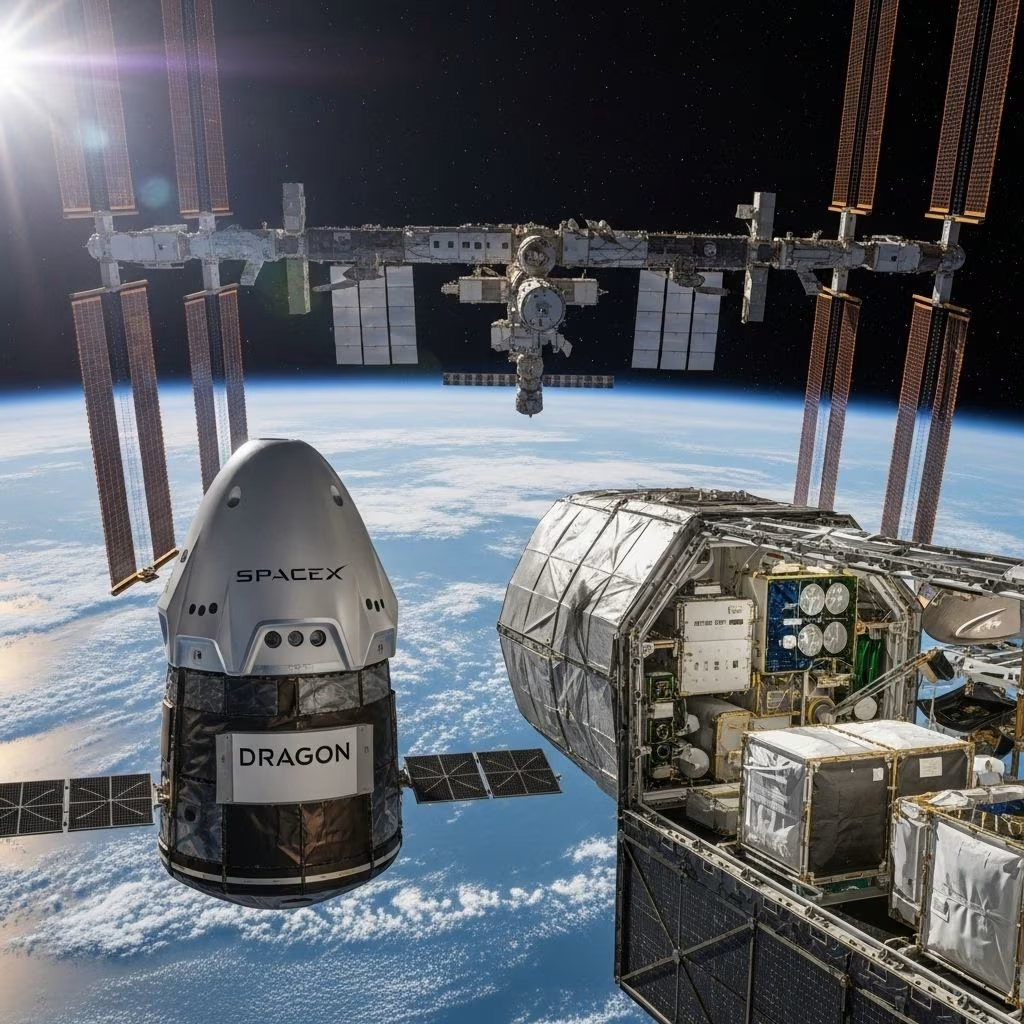
SpaceX CRS-33: Delivering Science and Innovation to the ISS
On August 24, 2025, SpaceX launched its 33rd Commercial Resupply Services (CRS) mission to the International Space Station (ISS), marking an important milestone in human spaceflight and scientific discovery. The mission, known as CRS-33 or SpX-33, supports ongoing advancements in microgravity research, sustainability, and preparations for future Artemis lunar and Mars expeditions.
Mission Overview
- Launch Date: August 24, 2025
- Docking Date: August 25, 2025, at ~7:30 a.m. EDT (1130 GMT)
- Launch Site: Space Launch Complex 40, Cape Canaveral Space Force Station
- Rocket: Falcon 9
- Capsule: SpaceX Dragon (Cargo configuration)
- Cargo Delivered: ~5,000 pounds (2,270 kg) of supplies and experiments
With its arrival, the Dragon capsule concluded a 29-hour orbital pursuit before docking with the ISS. Notably, this flight is SpaceX’s 50th Dragon mission to the station, spanning both cargo and crewed flights.
Key Mission Objectives
SpaceX CRS-33 was designed to further the ISS’s role as a laboratory for advancing technology vital for deep-space exploration. Major objectives included:
- Delivering critical science payloads and experimental hardware
- Testing new orbital boost technology to help maintain the station’s altitude
- Supporting the health and productivity of astronauts aboard the ISS
- Demonstrating technologies with applications for Artemis and future Mars missions
Statement from NASA on Mission Importance
“Commercial resupply missions to the International Space Station deliver science that helps prove technologies for Artemis lunar missions and beyond,” said acting NASA Administrator Sean Duffy. “This flight will test 3D printing metal parts and bioprinting tissue in microgravity — technology that could give astronauts tools and medical support on future moon and Mars missions.”
Scientific Experiments and Technology Demonstrations
The CRS-33 cargo manifest included a diverse array of experiments, each leveraging the unique conditions of microgravity aboard the ISS. Some highlights:
1. 3D Printing Metal in Space
- Experiment: Additive manufacturing of metal components within the station’s microgravity environment
- Goal: Enable astronauts to produce replacement parts on-demand, reducing dependence on Earth-based resupply
- Importance: This technology is critical for long-duration missions—such as those to the Moon and Mars—where launching spare parts from Earth is costly and time-prohibitive.
2. Advanced Bioprinting of Tissue
- Experiment: Bioprinting of liver tissue
- Goal: Investigate tissue assembly and survivability in microgravity
- Relevance: Potential applications for regenerative medicine and future in-situ medical solutions for deep-space astronauts.
3. Preventing Astronaut Bone Loss
- Experiment: Study into conserving bone health during long-duration spaceflight
- Goal: Develop countermeasures for bone-density loss—one of space travel’s greatest health challenges.
4. Sustainability: Water Recycling and Life Support
- Components: Hardware to upgrade the ISS’s water recycling and oxygen generation systems
- Objective: Support continuous crew habitation and reduce supply chain pressure from Earth.
5. Orbital Maintenance: The Dragon Boost Kit
- Hardware: Novel propulsion module installed in Dragon’s unpressurized trunk
- Purpose: Demonstrate autonomous ISS reboost capability
- Technology: Six propellant tanks (hydrazine/nitrogen tetroxide), a helium pressurant tank, and two Draco thrusters aligned with the station’s velocity vector.
- Impact: Adds about 9 m/s (20 mph) to the station’s orbital velocity—matching the total impulse of one-and-a-half Russian Progress cargo vehicles, which have traditionally handled reboost operations
- Support: Enough propellant to supply 25%–33% of the station’s annual reboost needs; demonstration scheduled throughout fall 2025.
How the ISS Benefits from CRS-33
- Enhancement of onboard science with new experiments
- Improved crew health and mission sustainability from advanced life-support hardware
- Increased station autonomy with the Dragon boost kit, reducing dependence on Russian Progress vehicles for orbit maintenance
- Direct support for Artemis and future Mars missions via demonstration of critical manufacturing and medical technologies in microgravity
The Launch and Docking Sequence
The launch of CRS-33 aboard Falcon 9 followed a carefully choreographed timeline:
- Falcon 9 lifted off at dawn (August 24, 2025), carrying Dragon CRS-33 towards the ISS.
- After orbital insertion, the Dragon capsule performed a series of rendezvous maneuvers over 29 hours.
- NASA TV and Space.com streamed live coverage of the docking, beginning at 6:00 a.m. EDT on August 25, with final docking expected at around 7:30 a.m. EDT.
- Upon arrival, station crew members prepared to unload the capsule’s cargo and initiate new scientific investigations and hardware installations.
Pioneering the Future of Artemis and Beyond
CRS-33’s science and technology payloads are directly tied to goals for NASA’s Artemis program and Mars planning:
- 3D printing in space paves the way for on-site resource utilization, which will be vital on the lunar surface and Mars.
- Bioprinting and bone-loss studies advance astronaut health for long-duration expeditions far from Earth’s immediate medical support.
- Orbital boost demonstrations lay the groundwork for future autonomous station maintenance, essential as operations extend beyond low Earth orbit.
Why Orbital Boost Capability Matters
The ISS loses altitude due to atmospheric drag, requiring periodic reboosts to maintain a stable orbit. Traditionally, Russian Progress cargo vehicles have performed most station boosts. The new Dragon boost kit introduces:
- Redundancy: An independent system ensures the ISS can resolve orbital adjustments even if other vehicles are unavailable.
- Efficiency: The kit’s impulse matches or exceeds the typical contribution from several Progress missions, supporting station operations even with fewer Russian cargo flights.
- Autonomy: Demonstrated US capability to maintain station altitude and reduce reliance on international partners for critical maintenance tasks.
| Feature | Description | Impact |
|---|---|---|
| 3D Printing Metal | On-orbit fabrication of parts | Reduces need for spares from Earth |
| Bioprinting Tissue | Microgravity assembly of liver tissue | Advances regenerative medicine in space |
| Bone Loss Studies | Mitigating astronaut health risks | Supports long-duration exploration |
| Boost Kit | ISS reboost hardware | Ensures orbit stability, reduces reliance on Russian vehicles |
| Life Support Hardware | Water recycling, oxygen systems | Long-term crew sustainability |
Supporting the Crew: Food and Essential Supplies
- The capsule brought nutrition packages, personal items, and backup medical supplies for the current station crew.
- Fresh supplies and equipment help maintain morale, safety, and mission productivity.
- Arrival of new hardware keeps ISS systems at peak operational readiness.
Next Steps: Ongoing Research and Demonstration
The coming months will see several critical activities:
- Initiation of metal 3D printing and bioprinting studies
- Integration and operation of the boost kit with periodic demonstration reboosts from September through fall 2025
- Analysis of bone-loss experiment data for development of improved countermeasures
- Assessment of the new water recycling and oxygen generation systems
Frequently Asked Questions (FAQs)
Q: What was the primary purpose of SpaceX CRS-33?
A: The mission aimed to deliver essential research experiments, crew supplies, and new engineering hardware—including a novel boost kit—to the ISS, supporting science, sustainability, and future Artemis and Mars objectives.
Q: How much cargo did the Dragon capsule deliver?
A: CRS-33 delivered about 5,000 pounds (2,270 kilograms) of food, crew supplies, scientific equipment, and experimental hardware to the station.
Q: What is the boost kit and why is it important?
A: The boost kit is a new engineering demonstration installed in Dragon’s trunk, designed to boost the ISS’s orbit autonomously. It helps maintain the station’s altitude, demonstrates US capability for orbital maintenance, and reduces reliance on Russian Progress vehicles.
Q: How does 3D printing metal parts in space benefit future missions?
A: On-orbit metal 3D printing enables astronauts to fabricate replacement components as needed, supporting self-sufficiency essential for missions to the Moon, Mars, and beyond where Earth resupply is limited.
Q: How does this mission relate to Artemis and Mars exploration?
A: Experiments in bioprinting, life support upgrades, and new manufacturing technologies help prove essential capabilities for lunar surface operations and eventual human expeditions to Mars.
Conclusion: Pushing Boundaries for Science and Exploration
SpaceX CRS-33 exemplifies the evolution of commercial cargo resupply services in enabling advanced science, crew support, and station sustainability. From pioneering manufacturing techniques to ensuring station autonomy, CRS-33 lays building blocks for the enduring future of human spaceflight and the extension of humanity beyond Earth.
References
- https://en.wikipedia.org/wiki/SpaceX_CRS-33
- https://www.nasa.gov/missions/station/commercial-resupply/spacex-crs/nasas-spacex-33rd-commercial-resupply-mission-overview/
- https://www.space.com/space-exploration/launches-spacecraft/spacex-dragon-cargo-capsule-crs-33-iss-docking
- https://www.nasa.gov/mission/nasas-spacex-crs-33/
- https://nextspaceflight.com/launches/details/6915
- https://spaceflightnow.com/2025/08/23/live-coverage-nasa-spacex-to-launch-falcon-9-rocket-dragon-spacecraft-on-crs-33-from-cape-canaveral/
- https://www.youtube.com/watch?v=LX_59e2Mm2E
- https://www.youtube.com/watch?v=H_9o2x6nVWg
- https://issnationallab.org/launch/nasas-spacex-crs-33/
- https://www.spacerealm.live/launch/falcon-9-block-5-dragon-crs-2-spx-33
- https://www.kennedyspacecenter.com/event/spacex-falcon-9-crs-33/
- https://www.spacelaunchschedule.com/launch/falcon-9-block-5-dragon-crs-2-spx-33/
- https://tlpnetwork.com/launches/dragon-crs-2-spx-33
- https://spaceflightnow.com/launch/falcon-9-crs-33/
- https://ground.news/article/crs-33-spacex-launches-50th-dragon-to-iss-on-resupply-mission-for-nasa-from-florida_d7f464
- https://www.spaceupclose.com/2025/08/nasa-spacex-crs-33-resupply-mission-thunders-to-orbit-overnight-with-science-and-reboost-kit-for-iss-photos/
- https://ground.news/article/crs-33-spacex-launches-50th-dragon-to-iss-on-resupply-mission-for-nasa-from-florida_ef0462
- https://www.nscfl.org/congratulations-nasa-spacex-for-the-crs-33-mission-cloned/