SpaceX’s Starlink Network Grows with Latest California Launch
On September 19, 2025, SpaceX achieved another milestone in its Starlink project by successfully launching 24 more Internet satellites from Vandenberg Space Force Base in California. The mission, part of SpaceX’s ongoing drive to create a high-speed, low-latency global broadband service, utilized the company’s signature reusable Falcon 9 rocket. This operation marks a significant stride forward for space-based connectivity, rocket reusability, and the commercialization of low Earth orbit.
Launch Overview
- Date and Time: September 19, 2025, 12:31 p.m. EDT (16:31 UTC; 9:31 a.m. local time)
- Location: Vandenberg Space Force Base, California
- Rocket: Falcon 9 (booster B1088)
- Satellites Deployed: 24 Starlink satellites
- Landing: Successful touchdown of the booster on “Of Course I Still Love You” droneship in the Pacific Ocean
Mission Details: Falcon 9’s Performance
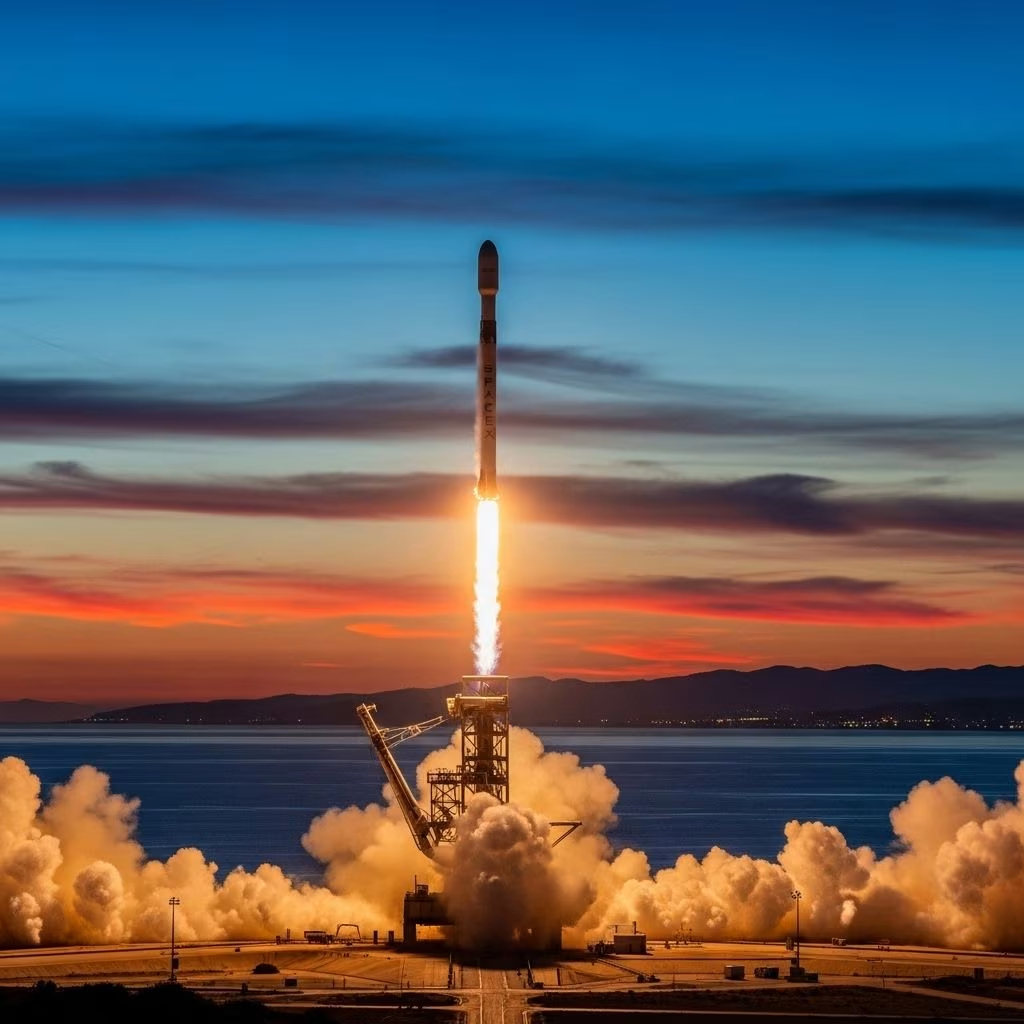
The Starlink batch was launched atop a Falcon 9 that braved typical Vandenberg coastal fog, lifting off smoothly and piercing the mist as it carried its payload toward orbit. The first stage, designated B1088, had previously completed nine flights, with this mission marking its 10th successful trip to space and back. About 8.5 minutes after liftoff, the booster made a precise landing on the droneship “Of Course I Still Love You,” stationed several hundred kilometers out in the Pacific. This achievement reinforces SpaceX’s leadership in booster reusability.
Meanwhile, the Falcon 9’s upper stage continued skyward, carrying the batch of 24 second-generation Starlink satellites. Deployment was planned to occur just over an hour (specifically about 62 minutes) after launch, once the rocket reached its assigned orbital plane in low Earth orbit.
Growth of the Starlink Constellation
With this mission, the Starlink constellation edges closer to an unprecedented scale:
- Active Satellites in Orbit: Nearly 8,400 globally (the largest ever assembled)
- 2025 Falcon 9 Launch Tally: This was the 118th Falcon 9 flight in the year
- Starlink Missions’ Share: Over 70% of 2025 Falcon 9 launches dedicated to Starlink
This rapid deployment underscores SpaceX’s ambition to provide worldwide Internet access, even in the most remote or underserved locations. Each successful deployment boosts throughput, improves latency, and increases service reliability for Starlink users in dozens of nations.
Starlink Constellation Growth Table
| Year | Active Starlink Satellites | Percentage of Falcon 9 Launches for Starlink |
|---|---|---|
| 2023 | ~5,000 | ~55% |
| 2024 | ~7,000 | 65% |
| 2025 | ~8,400 | 70%+ |
Rocket Reusability: Achieving Routine Recovery
SpaceX’s aggressive pursuit of reusable rocket technology has continued to pay dividends. The B1088 booster’s 10th launch and safe return demonstrate the maturity of SpaceX’s engineering. This capability substantially reduces the cost of spaceflight, ensures rapid cadence for launches, and makes ambitious projects like Starlink economically viable.
- 10 flights: Demonstrates booster robustness and cost-effectiveness
- Precision landing: Enabled by autonomous droneships
- Fast turnaround: Allows for dozens of launches per year from multiple sites
The success of Falcon 9’s reusable architecture is central to the Starlink project’s acceleration and cost control.
What Is Starlink and Why Does It Matter?
The Starlink network is SpaceX’s visionary answer to the global digital divide. By deploying thousands of satellites in low Earth orbit (LEO), Starlink aims to deliver high-speed Internet not just to cities, but to villages, ships, airplanes, and remote worksites:
- Fast Data: Latency and speeds comparable to terrestrial fiber Internet
- Coverage: Service reaches over 70 countries and counting
- Mobile Connectivity: Users on the move benefit, from ocean vessels to aviation customers
- Disaster Recovery: Starlink deployed rapidly in crisis and war zones for uninterrupted communications
Starlink’s infrastructure is already transforming the Internet landscape, with tangible impacts for education, healthcare, rural business, and emergency responders worldwide.
Behind the Scenes: The Launch Sequence
- Countdown: Final checks and fueling completed at SLC-4E.
- Iginition: Merlin engines roar to life, lifting off through Vandenberg’s fog.
- Max-Q: Rocket endures peak aerodynamic pressure early in flight.
- First Stage Separation: B1088 detaches and flips for controlled descent.
- Booster Landing: Executes automated burn and lands on droneship “Of Course I Still Love You.”
- Upper Stage Burn: Continues carrying payload, circularizing orbit.
- Satellite Deployment: Over an hour after launch, 24 Starlink satellites released into formation.
This sequence has become routine for SpaceX, yet each step is a remarkable feat of engineering and operational precision.
Implications for Global Connectivity
The continued build-out of Starlink makes Internet access a reality for areas previously left behind, with benefits including:
- Bridging the digital divide in rural and remote communities
- Enabling rapid disaster communication relief efforts
- Supporting global businesses and travel with in-motion broadband
- Providing redundancy and network stability for critical infrastructure
As Starlink coverage grows denser, the latency of signals drops and bandwidth per user increases, incentivizing more nations and enterprises to adopt the service.
The Road Ahead: Starlink and Future Missions
This latest launch fits into a rapid cadence for SpaceX, which in 2025 alone has averaged more than two Falcon 9 launches per week. Starlink missions account for the majority share but share the calendar with notable government and commercial satellite launches, including national security payloads (NROL), dedicated rideshare missions (such as Transporter-12), and cutting-edge science missions like SPHEREx.
Key missions enabled by Starlink’s progress:
- Enhanced end-user experience: More satellites generate lower latency and higher speeds
- Technology upgrades: Newer Starlink satellites feature improved lasers, bandwidth, and on-board processing
- Inter-satellite links: “Optical interlinks” allow faster, direct satellite-to-satellite communications, bypassing ground stations
- Operational agility: SpaceX now routinely turns Falcon 9 boosters around for new launches at a near-industrial pace
Historical Context: A Record-Breaking Constellation
With nearly 8,400 satellites in orbit as of September 2025, Starlink is by far the largest satellite constellation ever deployed. For comparison, all other active satellites—from both government and commercial operators—number only a fraction of Starlink’s fleet. This scale not only demonstrates SpaceX’s manufacturing and operational might, but also sets new standards for satellite Internet resiliency and capacity.
Spacecraft Design: Safety and Sustainability
Addressing concerns about orbital debris and space traffic, Starlink satellites are configured to deorbit safely at end of life, burning up in Earth’s atmosphere and minimizing long-term congestion. In addition:
- Automated collision avoidance: Onboard propulsion and tracking software steer satellites to safety
- Downlink flexibility: Ground stations are adaptable to optimize signals and avoid interference
- Sustainable deployment: New Starlink versions incorporate solar improvement and debris mitigations
SpaceX collaborates with other satellite operators and regulatory bodies to ensure its vast fleet enhances, not threatens, the safety and reliability of Earth orbital operations.
Frequently Asked Questions (FAQs)
Q: When and where did the most recent Starlink launch take place?
A: The launch occurred on September 19, 2025, at 12:31 p.m. EDT from Vandenberg Space Force Base, California.
Q: How many Starlink satellites are currently operational?
A: By September 2025, nearly 8,400 active Starlink satellites are in orbit, making it the world’s largest constellation.
Q: What is the significance of Falcon 9 booster B1088’s 10th flight?
A: This marks a major achievement for reusability and cost reduction. Each reused booster lowers launch costs and accelerates mission cadence.
Q: What are the main goals of Starlink’s growing network?
A: To provide fast, affordable Internet worldwide—especially in areas lacking conventional broadband—and to support global connectivity for both public and private sector needs.
Q: How does SpaceX recover and reuse rockets?
A: After stage separation, the Falcon 9 booster executes controlled burns and lands vertically on an autonomous droneship deployed in the ocean, allowing for refurbishment and rapid reuse.
Visual Summary of Mission Milestones
- Liftoff: Falcon 9 rises from Vandenberg through dense maritime cloud cover.
- Stage Separation: The booster completes a precise maneuver, returning to a pinpoint ocean landing.
- Orbital Insertion: The upper stage delivers 24 satellites to their target orbit, with planned deployment 62 minutes after launch.
- Constellation Impact: Each new batch strengthens Starlink’s global reach and network performance for end-users.
Looking Forward: SpaceX, Starlink, and the Future of Orbital Internet
With its relentless launch cadence, ever-improving hardware, and proven reusability, SpaceX solidifies its status as the world leader in commercial space operations. Starlink’s growth continues to transform digital access and business models, while each successful launch serves as a testament to the power of private innovation in space.
For more updates on rocket launches, satellite Internet breakthroughs, and major developments in the space industry, stay tuned to trusted space news sources.
References
- https://www.spacex.com/launches/
- https://spaceflightnow.com/2025/09/25/live-coverage-spacex-to-launch-28-starlink-satellites-on-falcon-9-rocket-from-cape-canaveral-13/
- https://www.youtube.com/watch?v=nXvaKkYwDPg
- https://nextspaceflight.com
- https://www.youtube.com/watch?v=KjlKSoRuYrc
- https://www.spacex.com/launches/mission/?missionId=sl-15-2
- https://www.space.com/space-exploration/launches-spacecraft/spacex-starlink-internet-satellite-launch-group-17-12
- https://spaceflightnow.com/2025/09/20/live-coverage-spacex-to-launch-28-starlink-satellites-on-falcon-9-rocket-from-cape-canaveral-12/
- https://www.space.com/space-exploration/launches-spacecraft/spacex-new-falcon-9-rocket-starlink-launch-group-17-8
- https://rocketlaunch.org/launch-schedule/spacex
- https://www.upi.com/Science_News/2025/09/13/spacex-starlink-launch-california-falcon-9-rocket/6791757779984/
- https://rocketlaunch.org/launch-schedule/vandenberg-sfb
- https://aiaa.org/2025/09/08/spacex-marks-2000-starlink-satellites-deployed-in-2025/
- https://www.rocketlaunch.live/?filter=california
- https://aiaa.org/2025/09/02/spacex-launches-1900th-starlink-satellite-to-orbit-in-2025/
- https://www.rocketlaunch.live/launch/starlink-17-12
- https://www.spacelaunchschedule.com/category/ca/
- https://news.ssbcrack.com/spacex-launches-24-more-starlink-satellites-from-california/
- https://news.satnews.com/2025/09/13/spacexs-saturday-starlink-smallsats-launch-group-17-10-in-californias-dense-fog/