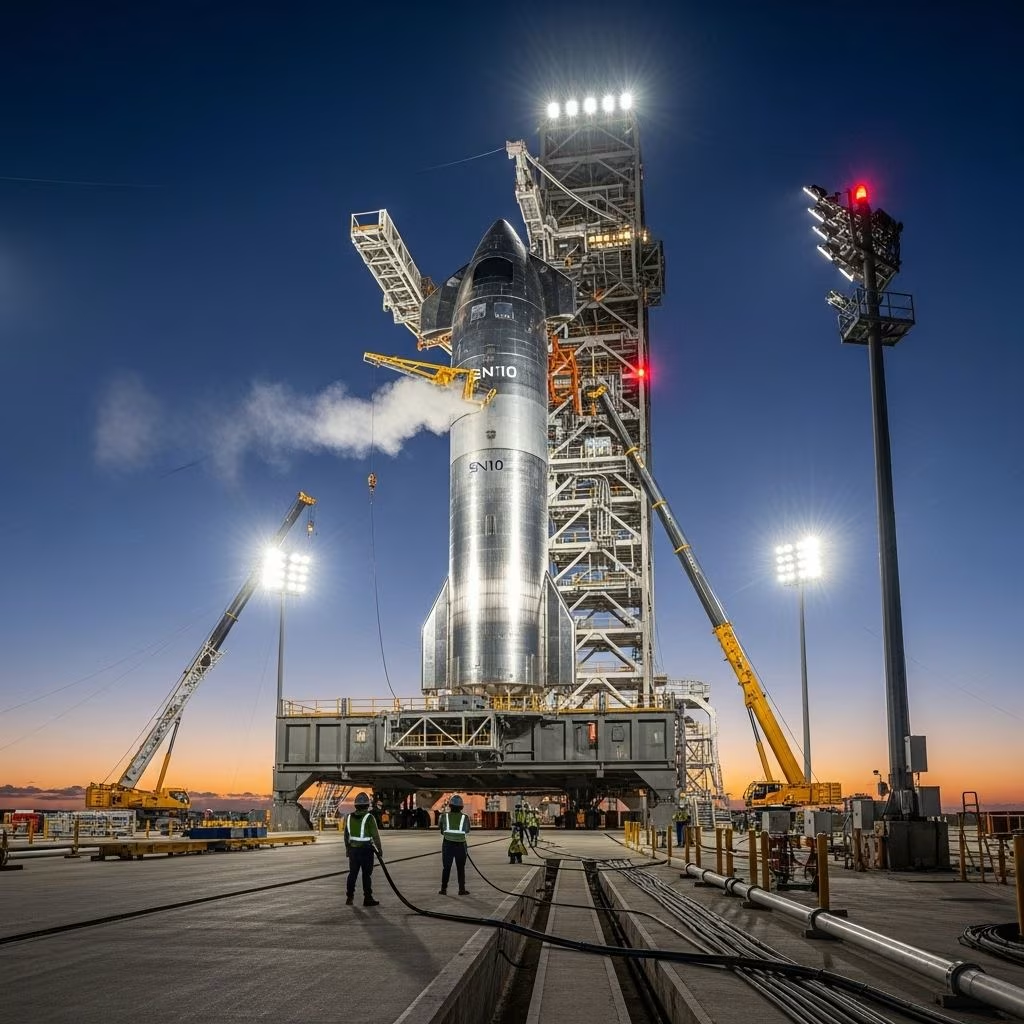
SpaceX Delays the Highly Anticipated 10th Starship Test Launch
SpaceX, renowned for rapidly pushing the frontier of launch vehicle development, recently announced a significant delay in the 10th integrated test flight of its colossal Starship vehicle. The postponement came mere minutes before the scheduled launch window at Starbase, Texas, on August 24, a disappointing turn that drew attention to the intricate complexities and interdependencies of ground systems in modern spaceflight.
Overview: Starship Flight 10 and Its Importance
Starship Flight 10 was slated to be a pivotal milestone in SpaceX’s ongoing campaign to qualify the massive Starship and its Super Heavy booster for future lunar and deep space missions, including the planned NASA Artemis 3 lunar landing in 2027. Each integrated flight brings forth incremental upgrades, critical tests, and valuable data, directly influencing the trajectory of both SpaceX and NASA’s timelines.
- Launch Site: Starbase, South Texas
- Launch Vehicle Configuration: Block 2 variants: Booster 16 and Ship 37
- Planned Launch Window: August 24, 7:30 p.m. EDT (2330 GMT), one hour window
- Mission Significance: Fourth Starship flight in 2025, vital for lunar lander readiness
Immediate Reason for the Delay
The launch was called off just 17 minutes before the scheduled liftoff as SpaceX cited ‘an issue with ground systems’—a phrase that underscores the critical role of support infrastructure in every launch attempt. Elon Musk’s company released a statement at 7:13 p.m. EDT (2313 GMT) via X (formerly Twitter), confirming that troubleshooting would be required before Flight 10 could proceed[10].
- Direct Cause: Ground systems anomaly detected
- Weather Considerations: Weather was not the primary factor for this scrub
- Backup Windows: August 26 at minimum, with potential extensions as needed
Ground Systems: What Are They and Why Do They Matter?
Ground systems, also known as “Stage 0” in SpaceX’s operational nomenclature, comprise the extensive array of support equipment, fueling lines, computer networks, hydraulics, safety shields, and timing mechanisms required to safely launch a rocket. These systems are so complex that a minor fault in any sub-component can prompt an automatic scrub to protect both hardware and personnel[10].
- Responsibility spans fueling, pressurization, countdown sequencing, telemetry, launch pad safety, and abort protocols.
- Recent upgrade efforts have further increased Stage 0’s complexity, given evolving test objectives.
- Starship’s immense power and intricacy amplify ground systems’ demands beyond those of previous launch vehicles.
Table: Comparison of Launch Abort Causes
| Cause of Scrub | Frequency | Impact |
|---|---|---|
| Ground system anomaly | Increasing with vehicle complexity | Can require multi-day troubleshooting, affects launch window scheduling |
| Hardware fault (e.g., engine sensor) | Occasional | Usually isolated; may allow rapid re-try |
| Weather | Common | May resolve same day; non-technical fix |
Unique Aspects of Starship’s Ground Systems
- The fully stacked Starship and Super Heavy tower over launch pads at 394 feet (120 meters), necessitating robust holding, fueling, and cryogenic management systems.
- Redundancy and autonomous abort triggers are built into nearly every subsystem.
- Ground infrastructure is actively upgraded between flights to address lessons learned and anticipated mission demands.
Timeline of Events Leading Up to the Scrub
The lead-up to the planned Flight 10 launch was marked by careful scheduling and coordination among regulatory bodies and operational teams. Approval from the Federal Aviation Administration (FAA) was granted about two weeks prior, following technical review and compliance checks. SpaceX had set backup days in anticipation of possible scrubs, reflective of best practices adopted during previous Starship flights and Falcon launches.
- Mid-July: Elon Musk predicts a launch in ‘about three weeks.’
- August 15: SpaceX publicly announces the target window for August 24.
- August 22: Revised launch forecasts as technical teams finalize checks.
- August 24: Official pause 17 minutes before window due to ground systems anomaly.
Implications for SpaceX and Lunar Objectives
This delay reverberates well beyond a single missed milestone. Starship’s 10th flight is vital to validating design upgrades required for NASA’s Artemis 3 lunar mission, scheduled for 2027. Each unsuccessful or delayed test compresses the time available for further launches, hardware refinements, and crewed lunar lander demonstrations.
- The Artemis 3 timeline relies on repeated, successful Starship flights demonstrating reliable orbital and landing capabilities.
- Failure to resolve ground systems anomalies expediently could push Artemis lander readiness into late 2027 or beyond.
- Upgrades tested in each launch (e.g., Block 2 improvements) are crucial for safety and operational success.
Starship Vehicle Configuration: What’s New for Flight 10?
For Flight 10, SpaceX rolled out major updates designed to address issues encountered in prior flights, such as upper stage losses and recovery malfunctions. Booster 16 and Ship 37 represent the latest Block 2 variants, incorporating lessons learned from earlier tests.
- Booster 16: Features refined Raptor engine systems for improved thrust and reliability.
- Ship 37: Upgraded avionics, heat shield design, and secondary redundancy layers.
- Software and telemetry improvements designed to capture more actionable data mid-flight.
Operational Flexibility: Backup Days and Rapid Turnarounds
SpaceX’s Starbase site is known for its 24/7 rapid turnaround operations. In anticipation of potential scrubs, the company maintains beach and road closures on backup dates (notably August 25 and 26 for this launch cycle), enabling teams to quickly address issues and reattempt launches—often within 48 hours of a halted window[10].
- Minimized downtime between attempts highlights the company’s adaptive operational philosophy.
- Coordinated closures minimize public disruption and enable safety for critical ground operations.
- This flexibility ensures high launch cadence, a core goal for Starship’s development roadmap.
Public Reaction and Commercial Interests
Starship’s growing public profile extends from direct viewers at Starbase to collectors and enthusiasts worldwide. SpaceX, as well as various retailers, marketed collectible models timed to launch events—exemplified by the release of a desktop die-cast Starship scaled at 13.77 inches (35 cm) to commemorate the program.
- Enthusiasts eagerly track each test flight for both technological progress and historic value.
- Merchandising further fuels interest, extending SpaceX’s brand reach beyond aerospace circles.
- Media coverage amplifies scrutiny on launch delays and technical challenges.
Looking Ahead: Next Steps for Starship Testing
Though no new target date for Flight 10 was immediately announced following the August 24 scrub, the presence of backup windows means that SpaceX could resume launch operations within days, pending resolution of the ground system issue. The company is expected to maintain its rapid iteration approach, employing newly gathered diagnostic information to refine system architecture and launch protocols[10].
- Possible quick turnaround for Flight 10, given past Starbase operational speed.
- Further delays could prompt reevaluation of 2025 flight schedule and Artemis lander development.
- NASA’s timelines may be impacted if repeated scrubs impede routine test launches.
Table: Projected Timeline for Upcoming Starship Milestones
| Milestone | Target Date | Status |
|---|---|---|
| Flight 10 Launch | August 24-26, 2025 | Delayed, pending ground system fix |
| Block 2 Replica Flight | Early Autumn 2025 | To be scheduled |
| NASA Artemis 3 Lander Demo | 2027 | Dependent on successful test launches |
Frequently Asked Questions (FAQs)
Why was Starship Flight 10 delayed?
SpaceX postponed the launch due to a detected ground systems issue that required troubleshooting. This means one or more critical infrastructure components did not meet launch criteria[10].
What are ground systems in rocket launches?
Ground systems refer to the support hardware and software at the launch site—fueling, safety, timing, telemetry, and abort systems—required for safe liftoff.
Will this delay affect NASA’s Artemis 3 mission?
Repeated delays in Starship tests may compress the timeline for lunar lander readiness and put additional pressure on meeting NASA’s Artemis 3 launch schedule for 2027.
When is the next possible launch attempt for Flight 10?
Backup days are scheduled for August 25 and 26, but SpaceX must first resolve the ground systems issue before rescheduling[10].
What improvements are incorporated in Starship Flight 10?
Flight 10 features Block 2 upgrades to both Booster 16 and Ship 37, advancing engine reliability, avionics, heat shields, and onboard telemetry systems.
Conclusion: Testing, Troubleshooting, and the Road to Lunar Landings
The delay of Starship Flight 10 serves as a high-profile reminder that in the world of orbital-class super heavy rocket launches, ground systems—often invisible to the public—can determine mission success. SpaceX’s intense schedule and rapid innovation are matched by a firm commitment to safety and learning, ensuring that even setbacks pave the path to sustainable space operations.
- Each flight delivers crucial data for both commercial and NASA-led missions.
- Ground system reliability is non-negotiable in high-stakes human and robotic launches.
- Ongoing public interest reflects the transformative potential of Starship for space exploration.
References
- https://en.wikipedia.org/wiki/Starship_flight_test_10
- https://spaceflightnow.com/2025/08/16/spacex-schedules-starship-flight-10-details-recent-setbacks/
- https://www.youtube.com/watch?v=_7mDKVHy6J8
- https://www.teslaoracle.com/2025/08/16/the-faa-gives-spacex-green-light-for-starship-flight-10-launch-test-in-august/
- https://www.space.com/space-exploration/launches-spacecraft/spacex-delays-critical-starship-flight-10-test-launch-due-ground-systems-issue
- https://www.youtube.com/watch?v=B4KxzIpCnOY
- https://www.rocketlaunch.live/launch/starship-flight-10
- https://www.space.com/space-exploration/launches-spacecraft/spacex-targeting-date-for-10th-starship-rocket-test-flight
- https://www.spacex.com/updates
- https://spaceexplored.com/2025/08/24/starship-flight-10-delayed-heres-why-and-when-it-could-launch-next/
- https://www.usatoday.com/story/news/nation/2025/08/22/starship-rocket-launch-spacex-when/85758301007/
- https://www.teslarati.com/spacex-calls-off-starship-10-flight-attempt-once-again-weather/
- https://spaceflightnow.com/2025/08/24/live-coverage-spacex-gets-ready-for-crucial-10th-test-flight-of-starship/
- https://www.usatoday.com/story/news/nation/2025/08/25/spacex-starship-launch-scrub-watch/85813031007/