Gemini Constellation: Facts, Myths, and Stargazing Highlights
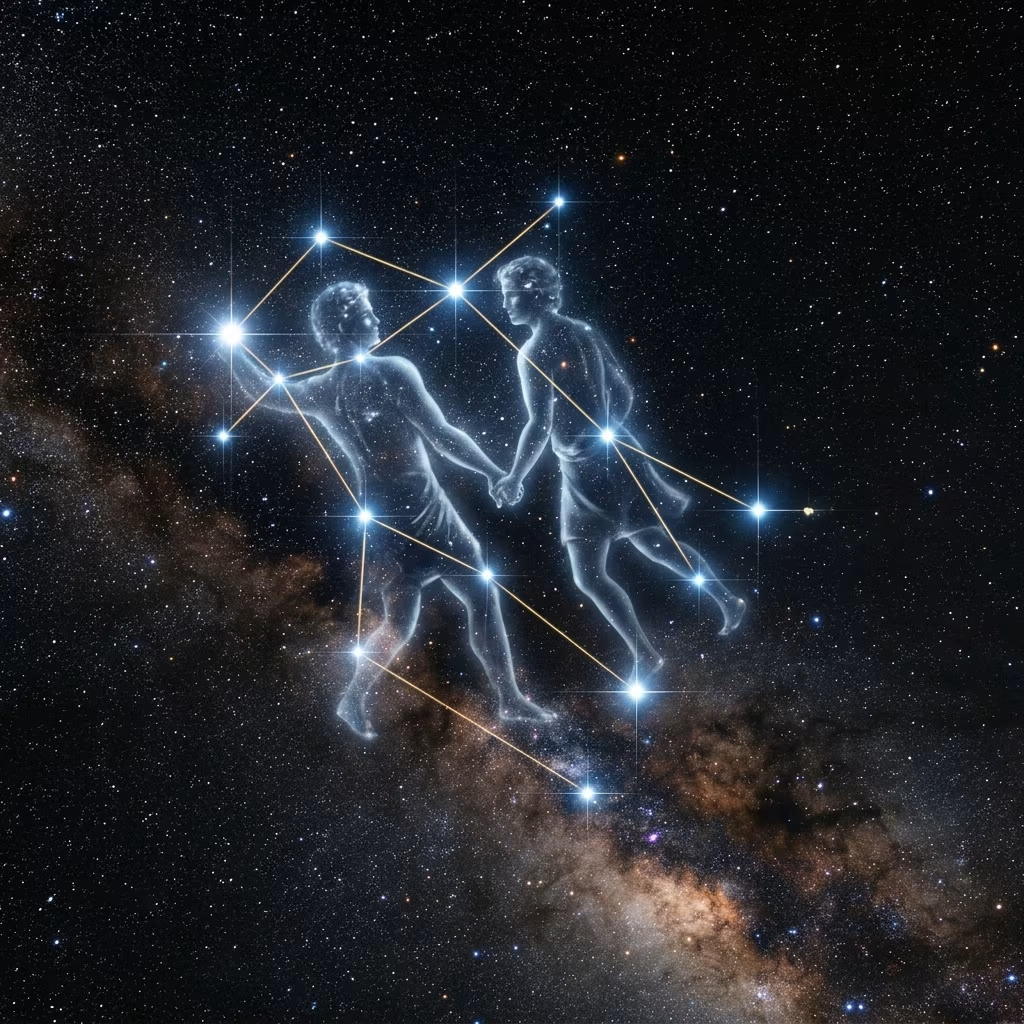
The Gemini constellation stands out in the night sky as both an astronomical marvel and a tapestry of mythology. Marked by its iconic twin stars, Castor and Pollux, Gemini is deeply interwoven with ancient stories, modern science, and annual skywatching events. This guide covers everything you need to know about Gemini: its location, history, mythology, notable stars, deep sky objects, and its continued fascination for astronomers and enthusiasts alike.
Gemini: The Zodiac Twin
Gemini is one of the 12 zodiac constellations and lies in the northern celestial hemisphere. Its name—Latin for “twins”—reflects its association with the legendary twin brothers, Castor and Pollux, from Greek mythology. Gemini is recognized for its visual appeal and its role in celestial navigation, sitting comfortably between Taurus and Cancer in the sky.
Key Facts About Gemini:
- Latin Name: Gemini (“The Twins”)
- Abbreviation: Gem
- Genitive Form: Geminorum
- Symbol: ♊︎
- Area: 514 square degrees (30th largest constellation)
- Family: Zodiac
- Quadrant: NQ2 (Northern Hemisphere, second quadrant)
- Visible between latitudes: +90° to -60°
History and Mythology of Gemini
Gemini’s origins reach well into antiquity. The constellation was cataloged by Ptolemy in the 2nd century AD and has featured in many ancient cultures’ star maps. Its mythological significance is especially rich in Greek and Roman tradition, where the twin brothers Castor and Pollux—known collectively as the Dioscuri—were revered for their brotherhood and heroism.
Classic Myths and Symbolism
- Greek Mythology: Castor and Pollux were sons of Leda, but only Pollux was immortal (sired by Zeus), while Castor was mortal. Their bond was so profound that when Castor died, Pollux begged Zeus to reunite them, resulting in their placement among the stars as the constellation Gemini.
- Other Traditions: In Egyptian astrology, the twins appeared as two goats; in Arabian tradition, as a pair of peacocks; and they have also been linked to legendary pairs like Horus (Egypt) or Romulus and Remus (Rome).
- Roman Connection: Called the Gemini, the twins were protectors of sailors and are referenced in classical literature and nautical culture.
Locating Gemini in the Night Sky
Gemini is a winter-spring constellation for the Northern Hemisphere, best visible during evenings from December to May. Its celestial neighbors are part of prominent constellations, making Gemini relatively easy to find.
| Neighboring Constellations | Direction in Sky |
|---|---|
| Taurus | West |
| Cancer | East |
| Auriga, Lynx | North |
| Monoceros, Canis Minor | South |
| Orion | Southwest |
Coordinates: Right ascension: approx. 7 hours | Declination: +22°
How to Spot Gemini
- Look for the V-shape of Taurus’s Hyades cluster and trace a line to the east until you see the two bright stars—Castor and Pollux.
- Alternatively, imagine a line from the Pleiades star cluster (in Taurus) to Regulus (Leo’s brightest star). Gemini lies about halfway along this line, just below Castor and Pollux.
- Gemini appears high in the sky during late winter evenings. From the Northern Hemisphere, it reaches its highest point around December and January.
Solstice Connection
Historically, the position of the Sun at the summer solstice has shifted due to axial precession. Once, the Sun was in Cancer, then Gemini, and currently, it’s entering Taurus during the June solstice—an illustration of how the constellations align with Earth’s changing orientation over millennia.
Notable Stars in Gemini
Gemini is easily recognized for its twin stars, Castor and Pollux. Together, they anchor the constellation. Yet Gemini hosts several other interesting stars, some of which are among the most intriguing for both amateur and professional astronomers.
| Star Name | Bayer Designation | Apparent Magnitude | Notable Features |
|---|---|---|---|
| Pollux | Beta Geminorum | ~1.14 | Brightest in Gemini; orange giant; 17th brightest in sky; has an exoplanet |
| Castor | Alpha Geminorum | ~1.58 | Six-star system (visual binary + spectroscopic pairs); white stars |
| Alhena | Gamma Geminorum | ~1.9 | Blue-white subgiant |
| Wasat | Delta Geminorum | ~3.5 | Eclipsing binary |
| Mebsuta | Epsilon Geminorum | ~3.1 | Giant star; forms the thigh of the southern twin |
| Propus (Tejat Prior) | Eta Geminorum | ~3.2 | Variable, marks one foot of Castor |
- Castor and Pollux serve as a landmark for identifying Gemini; while both appear as single points with the naked eye, telescopic observation reveals Castor’s multiple-star nature.
- Other named stars in Gemini include Alzirr, Geminga (an isolated pulsar), Mekbuda, Jishui, Tejat (Tejat Posterior), and Wasat.
Deep Sky Objects in Gemini
Beyond stars, Gemini is home to some of the sky’s most remarkable deep sky objects—from open clusters to unique nebulae and stellar remnants.
- Messier 35 (M35, NGC 2168): A bright open cluster with hundreds of stars, easily visible in binoculars near the foot of Castor. M35 is clustered with its neighbor, NGC 2158, a denser and older cluster, visible nearby with larger telescopes.
- Eskimo Nebula (NGC 2392): A planetary nebula dubbed “the Eskimo Nebula” for its appearance, visible with moderate telescopes as a shell of gas surrounding a dying star.
- Jellyfish Nebula (IC 443): A supernova remnant shaped like a jellyfish—faintly glowing, best seen in photographs or with large amateur telescopes.
- Medusa Nebula (Abell 21): Another planetary nebula, resembling writhing snakes of classical Greek myth, challenging for observers using modest equipment.
- Geminga: An isolated pulsar (neutron star) notable for its brightness in X-ray and gamma-ray wavelengths. The name is a contraction of “Gemini gamma-ray source.”
Meteor Showers Associated With Gemini
Gemini is the radiant source for two important meteor showers:
- Geminid Meteor Shower: One of the most prolific and reliable annual showers, peaking around December 13-14. The Geminids are especially notable for their bright, often colorful meteors; their parent body is an asteroid, 3200 Phaethon, rather than a typical comet.
- Rho Geminid Meteor Shower: Less prominent than the Geminids, this shower occurs in December and is more subtle for casual observers.
Gemini in Astrology
In Western astrology, Gemini marks the third sign of the zodiac, governing those born between roughly May 21 and June 21. Astrological Gemini is symbolized by twins, reflecting characteristics like duality, communication, and adaptability. Gemini is ruled by the planet Mercury, and its symbol is ♊︎.
- In astrology, Gemini’s influence is associated with intellect, curiosity, versatility, and sociability.
- In Egyptian astrological lore, Gemini appeared as goats; in Arabian astrology, as peacocks—illustrating the constellation’s adaptability across cultures.
Tips for Observing Gemini
Among the most visible constellations during Northern Hemisphere winter and early spring nights, Gemini offers celestial sights for astronomers of all levels.
- When to View: The constellation is highest at midnight during December and January. Early evening views are best from late November through early May.
- How to Identify: Look for the side-by-side bright stars—Castor and Pollux—near the ecliptic, aligned slightly northeast from Orion’s Belt.
- Observing Objects: Binoculars and small telescopes show off M35 and the stars of Gemini. More advanced observers can seek out theEskimo Nebula and other deep sky objects.
- Tracking the Moon: When the Moon passes through Gemini, its motion relative to Castor and Pollux can be tracked across a single night.
- Urban Viewing: The bright stars are visible even with moderate light pollution; deeper sky wonders will require darker skies.
Frequently Asked Questions (FAQs)
Q: What are the two brightest stars in Gemini?
A: Castor (Alpha Geminorum) and Pollux (Beta Geminorum) are the constellation’s brightest stars. Pollux is the brighter of the two and is an orange giant.
Q: What is the best time to view Gemini?
A: Gemini is best observed from December through May in the Northern Hemisphere, reaching its highest point in the sky during winter evenings.
Q: Does Gemini have any notable deep sky objects?
A: Yes. The open cluster Messier 35, the Eskimo Nebula, the Jellyfish Nebula, and the Medusa Nebula all reside within Gemini, offering impressive telescopic targets.
Q: What meteor shower is associated with Gemini?
A: The Geminid meteor shower, which peaks around December 13-14 each year, is one of the most active and reliable annual meteor displays, appearing to radiate from Gemini.
Q: Why is Gemini called the Twins?
A: The name Gemini is Latin for “twins,” reflecting its association with the mythological twin brothers Castor and Pollux, commemorated in the pattern of its brightest stars.
Q: Where is Gemini located relative to Orion and Taurus?
A: Gemini appears just northeast of Orion’s Belt and east of Taurus. Draw a line through Orion’s Belt toward the east, and you will reach the two stars Castor and Pollux in Gemini.
References and Further Reading
- “Gemini Constellation: Facts About the Twins” – Space.com
- Britannica, “Gemini | Constellation, Zodiac, Sign, Symbol, Dates, & Facts”
- Constellation Guide, “Gemini Constellation: Stars, Myth, Facts, Location”
- Wikipedia, “Gemini (constellation)”
References
- https://www.space.com/16816-gemini-constellation.html
- https://www.space.com/14482-constellation-gemini-twins-skywatching-tips.html
- https://theskylive.com/sky/constellations/gemini-constellation
- https://en.wikipedia.org/wiki/Gemini_(constellation)
- https://www.constellation-guide.com/constellation-list/gemini-constellation/
- https://www.britannica.com/place/Gemini-constellation-and-astrological-sign
- https://www.skyatnightmagazine.com/advice/constellation-gemini
- https://www.starregistry.com/constellation-name/gemini/
- https://blogs.missouristate.edu/physics/2023/08/09/get-to-know-the-gemini-constellation/
- https://www.go-astronomy.com/constellations.php?Name=Gemini
- https://www.youtube.com/watch?v=MY5SxpHT_3E
- https://www.unistellar.com/blog/gemini-constellation/
- https://totalgemini.com/gemini-through-space-and-time/
- https://freestarcharts.com/gemini
- https://news.missouristate.edu/2023/08/09/get-to-the-know-the-gemini-constellation/
- https://labelstars.com/en/constellations-list/gemini-constellation
- https://www.youtube.com/watch?v=r5lw6jZ-Ujo