Curiosity Rover: Charting a New Era of Mars Exploration
The arrival of NASA’s Curiosity rover on Mars marked a defining milestone in planetary exploration. Launched as part of the Mars Science Laboratory (MSL) mission, Curiosity’s ambitious objectives, advanced technology, and historic discoveries have profoundly advanced our understanding of Mars’ potential to support life and informed blueprints for humanity’s next steps among the stars.
Mission Overview
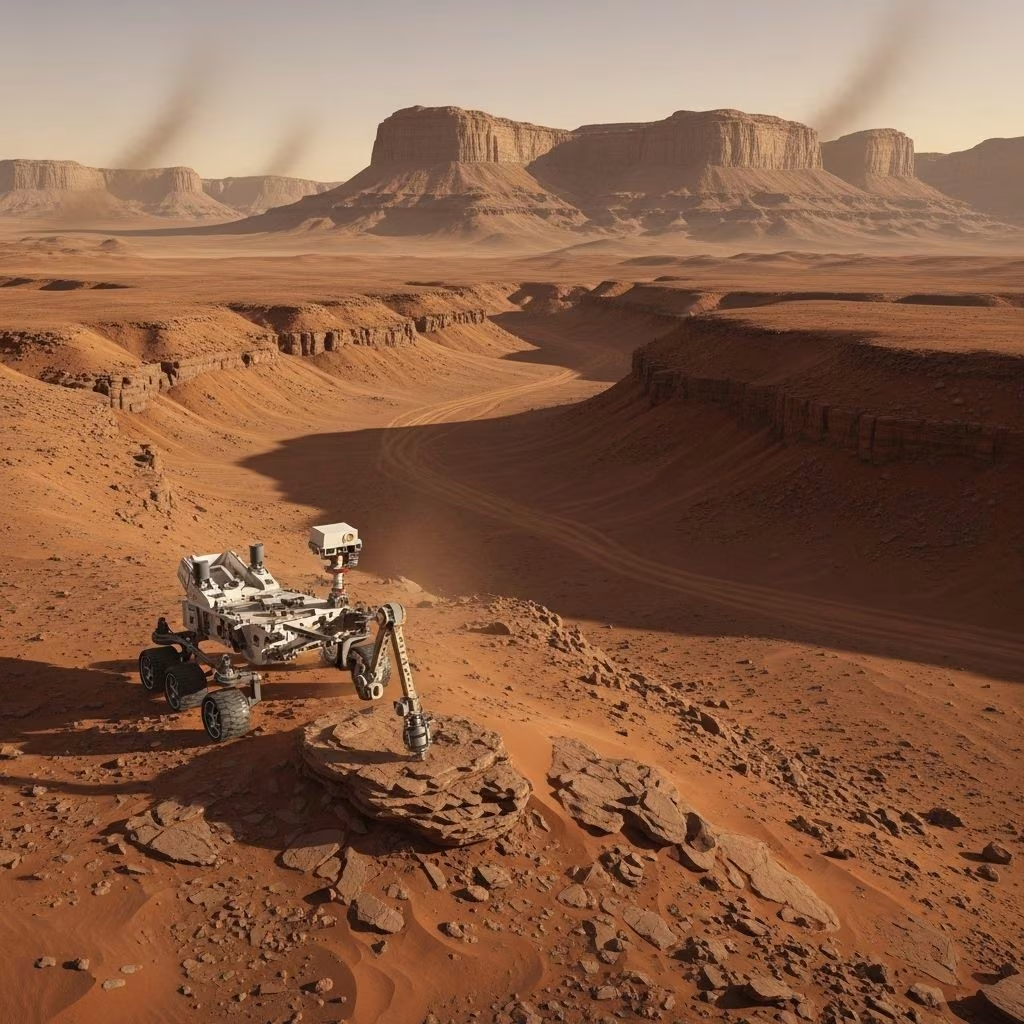
Curiosity is a car-sized rover operating on the surface of Mars within Gale Crater, and climbing the slopes of Mount Sharp. Developed under NASA’s Mars Science Laboratory (MSL) program, the rover was launched from Cape Canaveral on November 26, 2011, and landed on Martian soil on August 6, 2012, after a 560-million-kilometer journey through space. Originally planned as a two-year mission, Curiosity’s groundbreaking work has seen its mission extended indefinitely.
- Launch date: November 26, 2011
- Mars landing: August 6, 2012 (Bradbury Landing, Gale Crater)
- Operator: NASA Jet Propulsion Laboratory (JPL)
- Current status: Ongoing operations since 2012
The landing represented both a technological leap and a public spectacle—watched by millions worldwide. Thousands gathered in Times Square and at NASA’s Jet Propulsion Laboratory as the rover made its nail-biting descent, a moment famously branded the “seven minutes of terror.”
Goals and Scientific Objectives
Curiosity was built to answer a fundamental question: Could Mars ever have supported microbial life? To reach that answer, the MSL mission set out to conduct the most advanced and wide-ranging study of Martian climate, geology, and potential biosignatures ever attempted.
Primary Mission Goals
- Investigate the composition and history of the Martian atmosphere, surface, and geology.
- Determine whether the Martian surface ever offered environmental conditions favorable for life, especially the presence and role of water.
- Assess the planet’s habitability and gather data vital for the planning of future human missions.
Scientific Objectives
- Biological:
- Identify organic carbon compounds and chemical building blocks of life (carbon, hydrogen, nitrogen, oxygen, phosphorus, sulfur).
- Seek features that may represent evidence of past biological processes (biosignatures, biomolecules).
- Geological and Geochemical:
- Analyze mineralogical and isotopic composition of rocks and soils.
- Interpret the natural processes that have formed and transformed Martian rocks and terrain.
- Planetary Process:
- Reconstruct Mars’ climatic and atmospheric history spanning billions of years.
- Document the distribution and cycling of water and carbon dioxide.
- Surface Radiation:
- Characterize the types and amounts of radiation on the Martian surface, critical knowledge for future crewed missions.
As Curiosity’s journey continued, its objectives expanded to include the preservation and potential fossilization of organic compounds—a branch of science known as taphonomy.
An Engineering Marvel
Curiosity pushed the boundaries of robotic engineering as the largest and most capable rover sent to another world as of 2012. Its power, mobility, and scientific toolkit set new benchmarks for planetary exploration.
Key Features and Technologies
- Nuclear Power System: Unlike previous solar-powered Mars rovers, Curiosity utilizes a Multi-Mission Radioisotope Thermoelectric Generator (MMRTG), providing reliable energy day and night, in all seasons.
- Robust Mobility: Six-wheel rocker-bogie suspension enables it to traverse rugged, uneven terrain and climb steep slopes on Mount Sharp inside Gale Crater.
- Advanced Science Suite: Equipped with ten sophisticated science instruments, including:
- Sample Analysis at Mars (SAM): Analyzes soil and atmospheric samples for signs of organic molecules and gases tied to life processes.
- Chemistry and Camera complex (ChemCam): Uses laser pulses to study composition of rocks from a distance.
- Mast Camera (Mastcam): High-resolution imaging and video across visible and near-infrared wavelengths.
- Radiation Assessment Detector (RAD): Measures surface radiation levels, key for astronaut safety.
- Onboard Laboratory: Features a miniaturized laboratory, drill, scoop, and internal analysis chambers—making Curiosity the first true mobile science lab on Mars.
Landing: The ‘Seven Minutes of Terror’
Curiosity’s touchdown on Mars demanded a bold, unprecedented landing strategy. The Entry, Descent, and Landing (EDL) phase was dubbed the “seven minutes of terror” for its harrowing complexity and inherent risk.
- Atmospheric entry: The spacecraft hit the Martian atmosphere at over 21,000 km/h, protected by a heat shield.
- Supersonic parachute: Deployed to slow the descent, but still left the craft above a lethal speed for landing.
- SkyCrane maneuver: Retro-rockets fired, slowing the descent further, and then the SkyCrane system gently lowered Curiosity to the surface on a set of nylon cables—an engineering spectacle never before attempted.
This innovative sequence set new standards for planetary landings and paved the way for future missions like Perseverance.
Major Discoveries and Science Results
Curiosity confirmed that Gale Crater was once an ancient lake—an environment thought capable of supporting microbial life. This breakthrough, made within the first year, validated the mission’s core hypothesis and redirected the focus towards understanding how Mars became the cold, dry planet seen today.
Highlight Scientific Results
- Evidence of Ancient Water: Analysis of layered sediments at the landing site revealed a past environment with sustained fresh water—enabling the possibility for microbial life.
- Presence of Organic Molecules: Multiple organic molecules, crucial for life as we know it, were detected in Martian rock samples by the SAM instrument.
- Variable Methane Levels: Curiosity’s atmospheric studies detected fluctuating methane concentrations, sparking new questions about Mars’ chemistry and possible biological activity.
- Radiation Measurements: In-depth measurements of cosmic and solar radiation on the Martian surface have direct consequences for future human expedition planning, providing both risk data and mitigation pathways.
- Complex Geology: The rover’s exploration of sedimentary layers and mineralogical diversity has revealed a dynamic geological past, shaped by rivers, lakes, wind, and volcanic activity.
Gale Crater: Mars’ Window to the Past
Gale Crater’s central peak, Mount Sharp, exposes over three billion years of Martian geologic history. Curiosity’s trek up the lower slopes has enabled scientists to read the Red Planet’s changing environmental conditions in the very rocks it examines. The region is sometimes compared to the Four Corners of the American Southwest, sporting mesas, buttes, and layered outcrops that chronicle Mars’ transition from a wetter, warmer world to today’s arid desert.
Curiosity’s Legacy and Future Impact
Curiosity’s legacy is already etched in both scientific and engineering annals. The mission has:
- Revolutionized understanding of planetary habitability: Demonstrated that Mars was once home to habitable environments, advancing the central quest for life beyond Earth.
- Inspired future explorers: The mission’s landing and discoveries captivated the public and inspired budding scientists and engineers worldwide.
- Set new standards for planetary missions: The SkyCrane system, MMRTG power, and science suite design became models for subsequent missions like the Perseverance rover, which carries evolved instruments and operates on similar principles.
- Prepared humanity for Mars: By characterizing surface radiation and resources, Curiosity is informing planners on the hazards and practicalities of human Mars missions.
Notable Awards and Honors
- 2012 Robert J. Collier Trophy, National Aeronautic Association—recognizing extraordinary achievement in landing Curiosity on Mars and improving knowledge of ancient Martian environments.
- Design legacy: Curiosity directly influenced Mars 2020’s Perseverance rover mission planning and engineering, ensuring that its impact will resonate for generations.
Frequently Asked Questions (FAQs)
Q: What is Curiosity’s main scientific goal?
A: Curiosity aims to determine if Mars ever had the right conditions to support microbial life by analyzing rocks, soil, and atmosphere for biosignatures and environments conducive to life.
Q: How did Curiosity land on Mars?
A: The rover used a unique Entry, Descent, and Landing sequence involving a heat shield, supersonic parachute, and a rocket-powered SkyCrane, which gently lowered Curiosity to the Martian surface.
Q: Has Curiosity found evidence of life on Mars?
A: Curiosity has not found direct evidence of life, but it has discovered past environments that could have supported life and detected organic molecules, key ingredients for life as we know it.
Q: Why is Gale Crater important?
A: Gale Crater contains layered sediments that record over three billion years of Martian history, including evidence of ancient lakes and changing climates—making it one of the best places to search for signs of past habitability.
Q: Is Curiosity still active on Mars?
A: Yes, as of September 2025, Curiosity continues to operate and send back new data, far exceeding its original mission plan.
Further Reading & Resources
- NASA Mars Science Laboratory: Official mission information and latest updates.
- JPL: Engineering, mission metrics, and science highlights.
- The Planetary Society: Independent analysis and news on Mars exploration.
References
- https://en.wikipedia.org/wiki/Curiosity_(rover)
- https://science.nasa.gov/mission/msl-curiosity/
- https://study.com/academy/lesson/curiosity-overview-mission-facts-mars-rover.html
- https://www.jpl.nasa.gov/missions/mars-science-laboratory-curiosity-rover-msl/
- https://www.planetary.org/space-missions/curiosity
- https://www.space.com/17963-mars-curiosity.html
- https://www.britannica.com/topic/Curiosity-United-States-robotic-vehicle
- https://pmc.ncbi.nlm.nih.gov/articles/PMC8981195/
- https://en.wikipedia.org/wiki/Mars_Science_Laboratory
- https://pds-atmospheres.nmsu.edu/data_and_services/atmospheres_data/MARS/curiosity/mission_goals.html
- https://www.youtube.com/watch?v=P4boyXQuUIw
- https://robotsguide.com/robots/curiosity
- https://pubmed.ncbi.nlm.nih.gov/35399614/
- https://www.skyatnightmagazine.com/space-missions/curiosity-rover-mars
- https://www.pointsincase.com/articles/the-final-transmission-of-the-mars-rover
- https://www.space.com/37722-mars-rover-curiosity-five-years-anniversary.html
- https://www.youtube.com/watch?v=Gu9a-BvS-l4
- https://www.iflscience.com/the-haunting-last-message-from-nasas-opportunity-rover-sent-from-inside-a-planet-wide-storm-79921