Sundogs, also known as parhelia, are one of the most captivating natural wonders painted briefly in our skies. These brilliant patches of light appear as vibrant visual companions to the sun, often mesmerizing observers with their ethereal beauty and intriguing patterns. But what exactly are sundogs? How do they form, and why do they appear only in certain atmospheric conditions? This comprehensive exploration delves deep into the science, origins, observation tips, and fascinating history behind sundogs—one of the sky’s most enchanting optical phenomena.
What Are Sundogs?
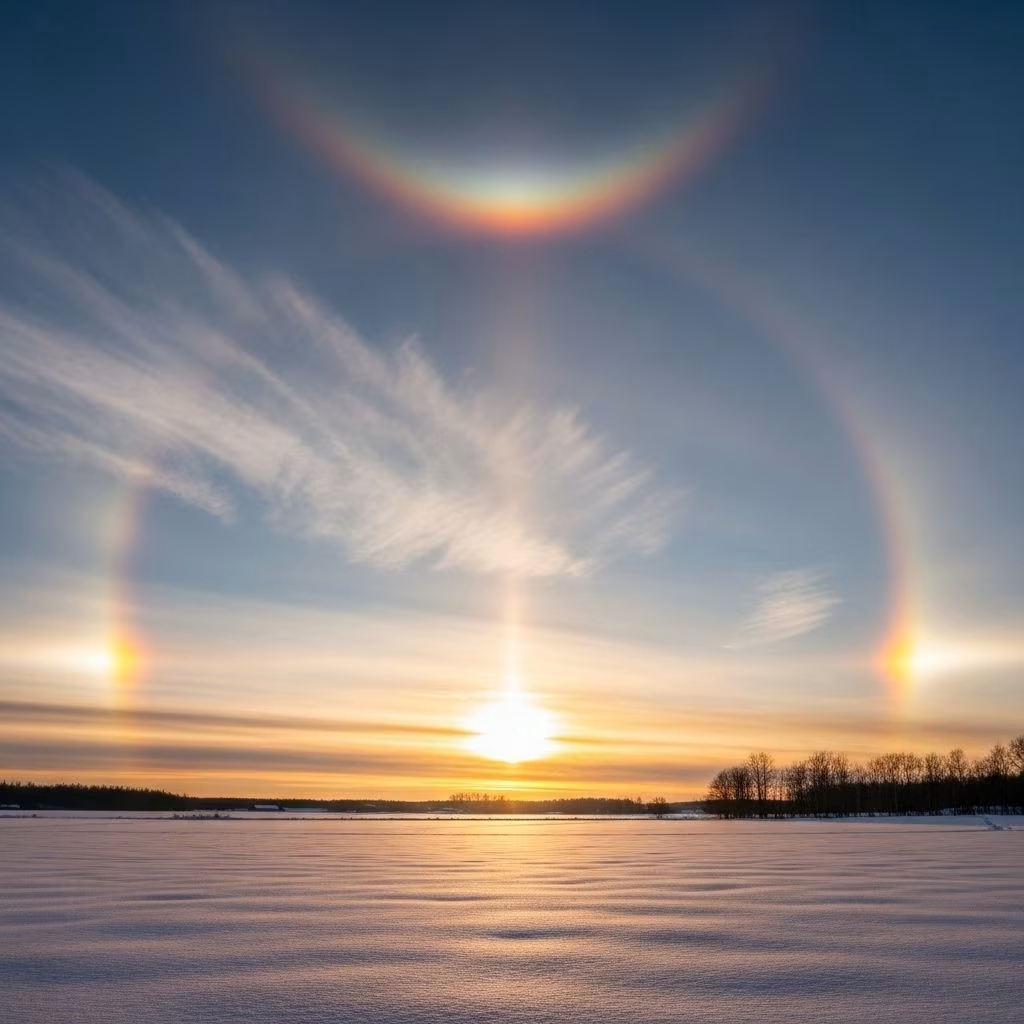
Sundogs are concentrated patches of sunlight that appear to the right and left of the sun, at approximately 22 degrees, and at the same elevation in the sky as the sun itself. Sundogs are members of a broader family of atmospheric optical phenomena called halos. They are typically noticed when the sun is low on the horizon and may appear as bright spots of white or as patches tinted with colors resembling those found in a rainbow—most notably, reddish tones on the side closest to the sun and bluish hues further out.
- Scientific name: parhelion (plural: parhelia)
- Common nicknames: mock suns, sun dogs
- Phenomenon type: Atmospheric optical effect, subclass of halos
The Science Behind Sundogs: How Do They Form?
At the heart of every sundog lies a story of sunlight and ice, orchestrated by the subtle physics of light refraction and reflection within the Earth’s atmosphere. The visual spectacle of a sundog is produced when the sun’s rays pass through high-altitude cirrus or cirrostratus clouds that are filled with millions of tiny, hexagonal plate-shaped ice crystals.
Mechanism of Formation
- As sunlight passes through these suspended ice crystals, it is refracted (bent) by exactly 22 degrees—this specific angle results from the hexagonal shape of the crystals and their orientation in the sky[11].
- For sundogs to form, the majority of these ice crystals must be aligned horizontally, with their flat faces parallel to the ground, so that light entering through one side of the hexagon exits through another, deflected at this precise angle[11].
- This causes the light to concentrate at specific spots on either side of the sun, thus triggering the bright, nearly symmetrical appearance of sundogs on sunny, cold days.
Why 22 Degrees?
The angle of 22 degrees is not arbitrary. When sunlight travels through a hexagonal crystal, entering one face and exiting another that is not parallel, the minimum deviation for light occurs at 22 degrees. This specific geometry is why sundogs (and related optical effects like halos) always appear at a distance of about 22 degrees from the sun, forming a characteristic halo or patch.
Sundogs vs. Other Atmospheric Phenomena
| Phenomenon | Key Features | Underlying Cause |
|---|---|---|
| Sundogs (Parhelia) | Bright spots at 22 degrees left and right of sun; often colored | Sunlight refracted by horizontally aligned plate-shaped ice crystals |
| 22° Halo | Complete circle at 22 degrees from sun/moon; white or faintly colored | Sunlight refracted by randomly oriented ice crystals |
| Sun Pillar | Vertical column of light above or below the sun | Reflection off flat ice crystals falling with faces horizontally oriented |
| Circumzenithal Arc | Upside-down rainbow near zenith | Refraction through horizontally oriented ice crystals |
When and Where Can You See Sundogs?
Sundogs are not limited to any particular part of the world and can be observed anywhere provided the right atmospheric conditions are met. However, the likelihood of witnessing sundogs increases in places with cold climates or during chilly weather, as these conditions favor the formation of high-altitude ice clouds necessary for sundog creation.
- Best time to see sundogs: Shortly after sunrise and just before sunset, when the sun is low on the horizon.
- Required conditions: Presence of cirrus or cirrostratus clouds filled with ice crystals; cold weather is beneficial but not essential.
- Observation tips: Look to the left and right of the sun when these cloud types are visible—the sundog will be at the same height as the sun, often appearing as bright, rainbow-like spots.
Why Are Sundogs Often Colorful?
While sometimes appearing as white patches, sundogs often show distinct colors akin to a fragment of a rainbow. The closest part to the sun almost always glows reddish, while the outer edge tends to be bluish or even slightly greenish. This color separation happens due to the different wavelengths of visible light bending by varying amounts as they pass through the ice crystals.
- Red light is bent the least and thus appears nearest to the sun.
- Blue and green light are refracted more strongly, showing up farther away from the sun.
The vividness of colors depends on several factors, including the purity, size, and perfect alignment of the crystals.
Historical and Cultural Significance of Sundogs
Throughout history, sundogs have stirred wonder and even apprehension. In ancient times, they were sometimes seen as omens or supernatural signs, particularly when appearing in pairs or with the sun ring (halo). Some accounts report their mention in historical texts and chronicles:
- Ancient Greeks referred to them as “parhelia,” noting their association with solar events.
- Medieval chroniclers sometimes recorded sundogs before important events, which led to superstitions regarding their appearance.
- Today, sundogs continue to inspire art, photography, and literature as symbols of beauty and mystery.
Scientific Studies and Current Research
Modern science has clarified the causes of sundogs, yet researchers continue to study these phenomena for their insights into atmospheric conditions and climate. By analyzing the occurrence and properties of sundogs (and related halo effects), scientists can learn about the microstructure of clouds—information valuable for weather prediction and climate research.
- Sundogs are excellent visual indicators of high-level cirrus clouds—clouds which often precede an approaching weather system.
- Detailed analysis of sundogs can provide information about the size distribution and orientation of ice crystals in the atmosphere.
How to Photograph Sundogs
Capturing the beauty of a sundog can be a breathtaking experience. Here are some practical tips for photographing these rare wonders:
- Use a wide-angle lens: Sundogs appear relatively close to the sun, so a wide field of view helps encompass both sundogs and the solar disc.
- Shield your lens: Sundogs are always near the sun—shield your camera with your hand or another object to avoid lens flare and protect your eyesight.
- Maximize dynamic range: To capture both the bright sun and the delicate colors of the sundogs, use exposure bracketing or shoot in RAW for post-processing flexibility.
- Use filters cautiously: Neutral density filters and graduated filters may help; avoid using anything that obscures the sundog’s clarity.
Common Myths and Misconceptions
- Sundogs are not rainbows: Although both result in colorful displays, sundogs are formed by refraction through ice crystals, not by rain droplets like rainbows.
- Sundogs don’t cause weather changes: While their presence can indicate the approach of a weather front due to cirrus clouds, sundogs themselves have no bearing on the weather.
- They are not always visible: Sundogs require very specific atmospheric conditions and may not appear even on cold, clear days if high ice clouds are absent.
Global Occurrence: Are Sundogs Universal?
Sundogs can form at any location and latitude, but are most frequently observed in regions that regularly experience cold air masses at high altitudes. Some notable regions include:
- Arctic and Antarctic zones
- Northern United States and Canada
- Russia and northern Europe
Nevertheless, sundogs have been photographed across all continents whenever the atmospheric recipe is just right.
Frequently Asked Questions (FAQs)
Q: Are sundogs dangerous to observe?
A: No, sundogs themselves are not hazardous. However, never look directly at the sun without proper eye protection, as direct observation can damage your vision. Always use safe indirect viewing techniques.
Q: Do sundogs only occur in winter?
A: While they are more common in colder weather (when ice crystals are present in the upper atmosphere), sundogs can appear at any time of the year if the atmospheric conditions are suitable.
Q: Can sundogs appear with the moon?
A: Yes. Similar optical phenomena can occur around the moon, called “moon dogs” or parselenae. However, these are much rarer and usually fainter due to the moon’s lower brightness.
Q: What is the difference between a sun halo and a sundog?
A: A 22-degree halo forms a complete ring around the sun due to light refracting through randomly oriented ice crystals. Sundogs, on the other hand, are bright spots on either side of the sun, resulting from horizontally aligned ice crystals.
Q: Are sundogs unique to Earth?
A: While Earth’s atmosphere provides ideal conditions for sundogs thanks to our combination of sunlight and ice-crystal clouds, similar effects could theoretically occur on other planets with sunlight and the right type of atmospheric ice. However, sundogs have not been observed elsewhere in the solar system to date.
Inspiring Moments: Sundogs in Art and Photography
Sundogs have inspired countless artists and photographers to capture their fleeting beauty. From early medieval tapestries to modern landscape photography, the symmetry and color of sundogs continue to fascinate those who lift their eyes skyward. The striking appearance of sundogs can even cause viewers to mistake them for mystical or even supernatural events—a testament to their dramatic effect on the observer.
Quick Facts About Sundogs
- Typical position: 22 degrees to the left and right of the sun
- Appearance: Colored spots—red near sun, blue on the outer edge
- Formation: Sunlight bends through horizontally oriented hexagonal ice crystals
- Frequency: Varies by location and weather; best on cold, crisp mornings and evenings
Summary
Sundogs are among nature’s most enchanting and scientifically intriguing displays—formed by nothing more than the interaction of sunlight and naturally occurring ice crystals far above the Earth’s surface. Whether you’re a curious stargazer, weather enthusiast, or simply enjoy marveling at the sky’s spontaneous artworks, understanding sundogs adds a layer of wonder to every sunrise and sunset. The next time you spot those vivid patches of light flanking the sun, you’ll not only appreciate their fleeting splendor, but also the remarkable science that creates such a sight.
References
- https://www.space.com/sundogs-definition-formation-science
- https://www.space.com/21948-rainbow-sundog-bird-photo.html
- https://www.britannica.com/science/sun-dog
- https://en.wikipedia.org/wiki/Sun_dog
- https://www.space.com/laika-space-dog
- https://www.hko.gov.hk/en/education/earth-science/optical-phenomena/00353-indepth-anatomy-of-the-atmospheric-optical-phenomenon-sun-dog.html
- https://weird-and-wonderfull-space.fandom.com/wiki/Sundog
- https://www.livescience.com/26402-sundogs.html
- https://thehashinsight.com/sundog-on-tron/
- https://www.crypto-news-flash.com/sundogs-ai-growth-or-pepes-9-8-surge-why-investors-are-turning-bullish-on-moonbag-as-the-top-crypto-presale-project-of-2024/
- https://www.howderfamily.com/blog/sundog/
- https://www.aicoin.com/en/article/415504
- https://nationalpost.com/news/canada/whats-a-sun-dog-a-nobel-laureate-explains-the-science-behind-the-cold-snap-light-show
- https://www.sundog-education.com/home/
- https://www.youtube.com/watch?v=Y-GvQSmgJEI
- https://www.bosswallet.com/en/articles/c1735806182015.html
- https://earthobservatory.nasa.gov/blogs/earthmatters/2014/02/03/reader-pics-sundogs/
- https://www.sundog-digital.com
- https://www.bitrue.com/blog/sundog-whitepaper-summary
- https://coinmozo.com/sundog-meme-coin-explodes-to-200m-the-next-big-cryto/
- https://techbullion.com/sundogs-performance-rivals-pepe-within-10-days-of-launch-sunpump-redefines-meme-gameplay/
- https://dyored.com/projects/sundog/research/whitepaper
- https://bitcoinist.com/justin-suns-sundog-explodes-on-tron-network-heres-why-dtx-could-be-next/
- https://atoptics.co.uk/blog/sundog-moondog-gallery/