Lunar Eclipses: Earth’s Shadow on the Moon
Lunar eclipses are among the most captivating celestial events, enchanting observers for millennia. Unlike solar eclipses, which require you to be in a narrow path of totality, lunar eclipses are visible from anywhere on the night side of Earth, making them one of the most accessible astronomical spectacles. But what exactly causes a lunar eclipse, why do they sometimes turn blood red, and how can you make the most of your viewing experience? This comprehensive guide explores the science, types, cultural significance, and observation tips for lunar eclipses.
What Is a Lunar Eclipse?
A lunar eclipse occurs when Earth moves directly between the Sun and the Moon, casting its shadow onto the Moon’s surface. This only happens during a full moon, when the Sun, Earth, and Moon are closely aligned in a straight line (syzygy).
The process involves two types of Earth’s shadow:
- Umbra: The central, darkest part of the shadow where the Sun is completely blocked by Earth.
- Penumbral shadow: The outer, fainter region where part of the Sun is still visible.
Depending on how the Moon travels through these shadow zones, different types of lunar eclipses occur.
Types of Lunar Eclipses
There are three main types of lunar eclipses, each offering a unique visual experience:
Total Lunar Eclipse
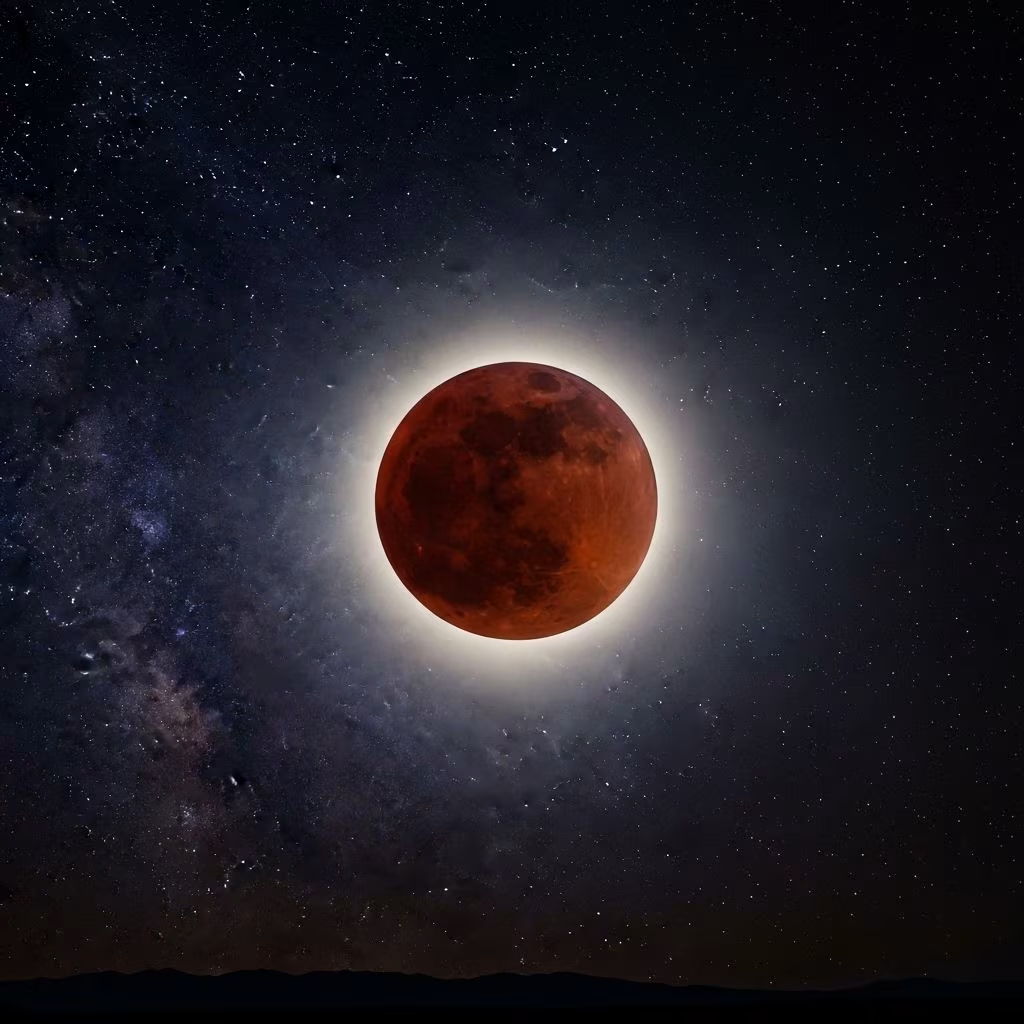
During a total lunar eclipse, the Moon passes completely through Earth’s umbra. For several hours, the Moon gradually darkens before turning a striking shade of red or copper—earning the nickname “blood moon”.
- The reddish tint results from Earth’s atmosphere bending and filtering sunlight. Shorter blue wavelengths are scattered, while longer red wavelengths pass through and reflect off the Moon’s surface.
- Total lunar eclipses are not rare, but do not occur at every full moon; skywatchers may see about one every 2-3 years from a given location.
- The entire total eclipse can last from a few minutes up to over an hour, with the partial phases extending the show to several hours in total[11].
Partial Lunar Eclipse
A partial lunar eclipse happens when only part of the Moon enters Earth’s umbra. The result is a dramatic ‘bite’ taken out of the lunar disc, with part appearing dark while the rest remains illuminated.
- Observers can see Earth’s curved shadow gradually moving across the Moon’s face.
- These eclipses can be nearly as visually compelling as total eclipses, especially when the majority of the Moon is shadowed.
Penumbral Lunar Eclipse
In a penumbral lunar eclipse, the Moon only traverses Earth’s penumbral shadow.
- The subtle dimming can be barely noticeable to the naked eye, though with careful observation (or digital enhancement) the shadow can be seen as a slight shading over parts of the Moon.
- Penumbral eclipses are more common than total or partial ones, but are less visually dramatic[11].
Why Don’t We See an Eclipse Every Month?
One might expect lunar eclipses to occur each full moon, but that’s not the case. This is because the Moon’s orbital plane is tilted by about 5 degrees compared to Earth’s orbit around the Sun (the ecliptic).
- Most months, the full Moon passes above or below Earth’s shadow.
- Eclipses only happen when the Moon is near one of the two points where its orbit crosses the ecliptic—these points are called nodes.
- Lunar eclipses come in predictable cycles, known as the Saros cycle, which repeats every 18 years, 11 days, and 8 hours[10].
The Science Behind the “Blood Moon”
The visually stunning red or copper color during a total lunar eclipse is often called a “blood moon.”
- As sunlight passes through Earth’s atmosphere, molecules and particles scatter shorter blue wavelengths and allow the longer red wavelengths to pass through—a process known as Rayleigh scattering.
- These reddish rays are refracted and reach the Moon, bathing it in a coppery hue.
- The precise color during each eclipse can vary based on atmospheric conditions—volcanic eruptions, dust or major storms can all impact the shade and brightness.
How Often Do Lunar Eclipses Occur?
Lunar eclipses occur at least twice a year somewhere on Earth, but the frequency and type observed from any single location vary:
- Total lunar eclipses: Once every 2-3 years at a given spot.
- Partial or penumbral eclipses: More frequent, often several times a year globally.
- The Saros cycle tracks recurrence of similar eclipses, allowing predictions centuries in advance[10].
Solar Eclipses on the Moon: The Reverse Perspective
Interestingly, what we see as a lunar eclipse on Earth would appear as a solar eclipse for astronauts standing on the surface of the Moon: Earth would completely block the Sun, casting a shadow and darkening the lunar “sky” for several hours.
- These “solar eclipses” on the Moon generally last longer, up to five and a half hours, compared to two and a half hours for solar eclipses on Earth.
- The event would be observable mostly from the Moon’s near side during lunar sunrise and sunset.
Historic and Cultural Significance
Lunar eclipses have inspired awe and curiosity across centuries, giving rise to myths, omens, and scientific inquiry:
- Ancient cultures sometimes interpreted the blood-red Moon as a supernatural omen, while others saw it as proof of celestial mechanics.
- Lunar eclipses aided early astronomers in understanding Earth’s shape (by observing the circular shadow) and dimensions of the solar system.
- Stories, rituals, and records from thousands of years ago describe the spectacle and mystery of lunar eclipses[10][11].
How to Observe a Lunar Eclipse
One of the great advantages of lunar eclipses is their accessibility—no special equipment is required, and there is no danger to your eyes from watching them directly (unlike solar eclipses).
- Naked Eye: The changing brightness and color are easily visible.
- Binoculars: Enhance contrast and highlight lunar features in the shadow.
- Telescope: Offers close-up views of craters and terminator (shadow boundary) details.
- Photography: Use a tripod and telephoto lens for clear shots; longer exposures reveal the Moon’s subtle coloring during totality.
- Timing: Check local times for the different eclipse phases. The whole event can last several hours, so patience rewards you with a full sequence.
Phases of a Lunar Eclipse
| Phase | Description |
|---|---|
| Penumbral begins | Moon enters Earth’s penumbral shadow—slight dimming, hard to notice at first. |
| Partial begins | Moon starts to enter Earth’s umbra—noticeable ‘bite’ in shadow. |
| Totality begins | Entire Moon within Earth’s umbra—deep red/copper color appears. |
| Maximum eclipse | Midpoint of totality—often the deepest, brightest red. |
| Totality ends | Portion of Moon leaves umbra—color fades. |
| Partial ends | Moon exits umbra—bright lunar surface returns. |
| Penumbral ends | Moon fully outside Earth’s shadow—eclipse concludes. |
Prime Destinations for Viewing Lunar Eclipses
Lunar eclipses can be enjoyed from anywhere the Moon is above the horizon. However, some places offer particularly memorable experiences:
- Desert locations: Clear, dark skies and minimal light pollution make for stunning views.
- High-altitude areas: Reduced atmospheric interference enhances sharpness.
- Cultural landmarks: Observing an eclipse near historic sites or natural wonders can add significance.
- Global cities: Major cities often host public viewing parties, boosting communal appreciation.
Frequently Asked Questions (FAQs)
Q: How is a lunar eclipse different from a solar eclipse?
A lunar eclipse occurs when Earth’s shadow falls on the Moon, visible to anyone on the night side of Earth. A solar eclipse happens when the Moon passes between Earth and the Sun, casting a shadow on Earth and only visible from a small area.
Q: Is it safe to look at a lunar eclipse with the naked eye?
Yes. Unlike solar eclipses, lunar eclipses are completely safe to watch without any eye protection or special equipment.
Q: Why does the Moon turn red during a total lunar eclipse?
The red color appears because Earth’s atmosphere bends (refracts) sunlight and filters out shorter blue wavelengths, leaving longer red wavelengths to cast on the Moon’s surface—a phenomenon called Rayleigh scattering.
Q: How long does a typical lunar eclipse last?
A complete lunar eclipse, including all phases, may last up to several hours. The totality phase alone can range from a few minutes to over an hour.
Q: When is the next lunar eclipse?
There are several lunar eclipses each year. Consult astronomical calendars or observatory websites for exact upcoming dates visible in your region.
Fascinating Lunar Eclipse Facts
- Every lunar eclipse is visible from over half the planet—wherever the Moon is above the horizon.
- Christopher Columbus famously used a predicted lunar eclipse to scare local populations in the Americas during his explorations.
- Lunar eclipses helped prove Earth is round—the shadow cast on the Moon is always circular, regardless of where the eclipse occurs in the sky.
- The longest total lunar eclipse in the 21st century occurred on July 27, 2018, lasting 1 hour and 43 minutes.
The Enduring Allure of Lunar Eclipses
Lunar eclipses offer a vivid, awe-inspiring demonstration of celestial mechanics, easily accessible to skywatchers worldwide. Whether you are a seasoned astronomer, a photographer, or a casual observer, few astronomical events rival the serene beauty and communal excitement of watching Earth’s shadow slowly sweep across the face of the Moon.
References
- https://www.space.com/stargazing/lunar-eclipses/blood-moon-1st-pictures-september-7-2025-total-lunar-eclipse
- https://www.space.com/stargazing/lunar-eclipses/one-week-until-blood-moon-total-lunar-eclipse-sept-7-2025
- https://en.wikipedia.org/wiki/Lunar_eclipse
- https://science.nasa.gov/moon/eclipses/
- https://www.timeanddate.com/eclipse/total-lunar-eclipse.html
- https://spaceplace.nasa.gov/eclipses/en/
- https://en.wikipedia.org/wiki/Solar_eclipses_on_the_Moon
- https://libguides.lindahall.org/eclipses/lunar
- https://www.britannica.com/science/lunar-eclipse
- https://www.turito.com/learn/earth-and-science-space/lunar-eclipse
- https://newspaceeconomy.ca/2024/10/24/lunar-eclipses-a-guide-for-space-enthusiasts/
- https://www.thesuntoday.org/eclipses/lunar/
- https://www.sciencealert.com/a-spacecraft-has-just-given-us-the-best-view-of-the-recent-lunar-eclipse
- https://www.scribd.com/document/644215922/Lunar-Eclipses-and-Solar-Eclipses-NASA-Space-Pl
- https://www.britannica.com/science/eclipse/Lunar-research
- https://www.universetoday.com/articles/the-lunar-eclipse-seen-from-the-international-space-station
- https://space.rice.edu/eclipse/lunar_eclipse_faq.html
- https://study.com/learn/lesson/what-is-a-lunar-eclipse.html
- https://www.planetary.org/night-sky/lunar-eclipse
- https://www.livescience.com/space/the-sun/nasa-spacecraft-snaps-images-of-lunar-transit-and-earth-eclipse-on-the-same-day-see-the-photos