


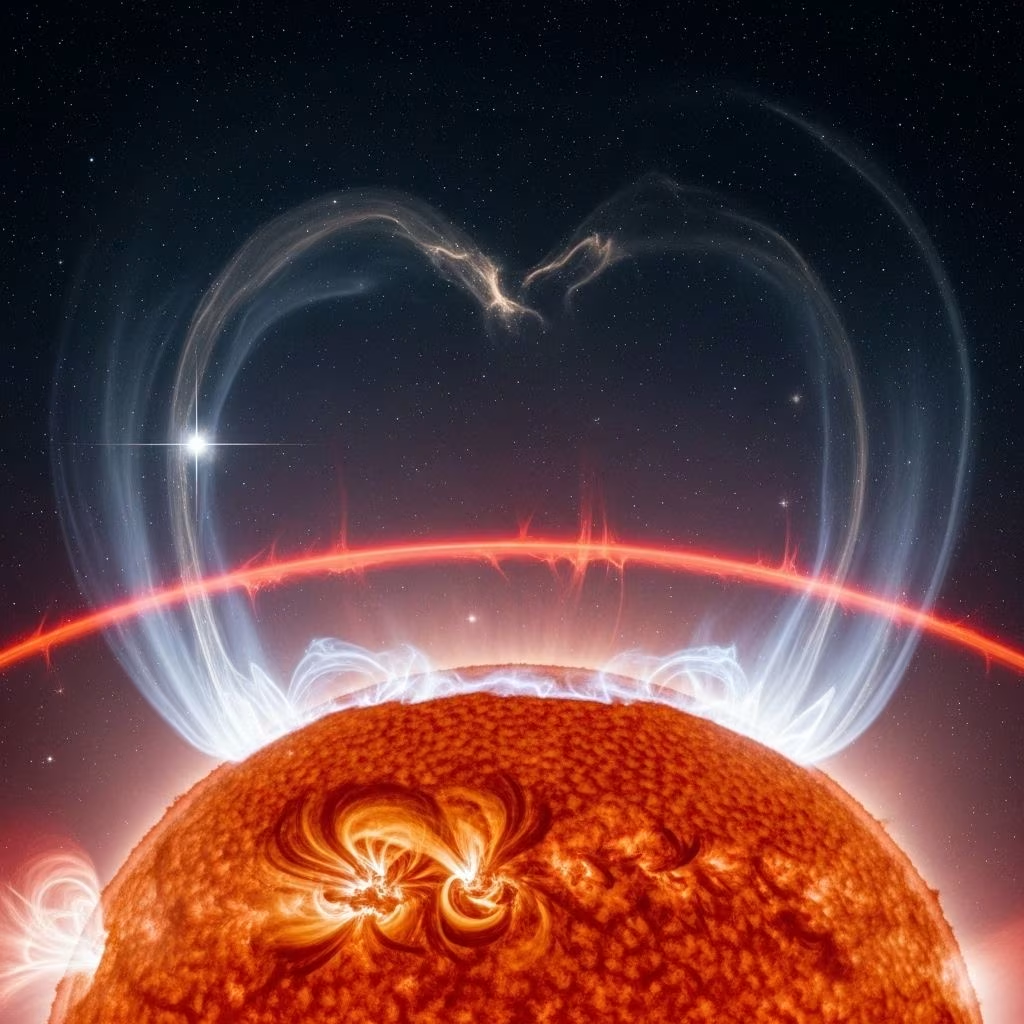
Atmosphere of the Sun: Photosphere, Chromosphere & Corona
The Sun is not just a ball of incandescent gas, but a complex object made up of multiple layers, each exhibiting unique characteristics and playing crucial roles in solar phenomena. Its atmosphere is much more than what we see; it extends from the recognizable surface (known as the photosphere) out through the chromosphere and the corona, generating the light and heat essential for life and driving space weather throughout the solar system.
What Is the Sun’s Atmosphere?
The atmosphere of the Sun refers to the collection of gaseous layers found above the Sun’s interior. Although the Sun lacks a solid surface, its outermost regions gradually transition from dense, visible gas to the extremely tenuous whisps of plasma that make up the extended corona. Understanding the Sun’s atmosphere offers profound insights into how solar energy is generated, transported, and released into the solar system.
- Photosphere: The Sun’s visible “surface” and the lowest, densest atmospheric layer.
- Chromosphere: The turbulent, reddish layer above the photosphere.
- Corona: The Sun’s outermost, ultra-hot atmosphere, visible during total solar eclipses.
The Sun’s Internal Structure: A Foundation for the Atmosphere
Before examining the atmospheric layers, it is important to briefly contextualize them against the Sun’s internal zones, which supply energy to the outer solar environment:
- Core: The innermost, densest region where nuclear fusion occurs, reaching temperatures of 15 million °C (27 million °F).
- Radiative Zone: Surrounds the core; energy from the core travels outward via radiation and may take up to 170,000 years to move through this region.
- Convection Zone: The outermost layer of the interior where hot plasma rises, cools, and sinks in dynamic convection currents.
This energy is ultimately released through the atmospheric layers listed below, shaping everything from sunspots to solar flares and influencing planets far beyond the Sun itself.
Photosphere: The Sun’s Visible Surface
The photosphere constitutes the Sun’s apparent surface, radiating most of the sunlight we see on Earth. Contrary to the impression that it is a distinct, solid shell, the photosphere is a relatively thin layer—only about 500 kilometers (310 miles) thick—where the plasma becomes transparent to visible light. Its properties include:
- Temperature: Roughly 5,500–6,000 degrees Celsius (9,932–10,832 degrees Fahrenheit).
- Density: Considerably low compared to Earth’s atmosphere, but much denser than the outer layers above.
- Composition: Roughly 74% hydrogen, 25% helium, with traces of heavier elements like oxygen, carbon, and iron.
This is the region where solar light escapes and thus marks the boundary beyond which the Sun becomes ‘see-through.’ High-resolution images reveal a granulated appearance called granulation, a result of the underlying convection currents:
- Granules: Convection cells, about 1,000 km (620 mi) wide, lasting 8–20 minutes.
- Sunspots: Darker, cooler areas caused by strong magnetic activity.
- Limb Darkening: The edges (‘limbs’) of the Sun appear darker because we view cooler, shallower layers at an angle.
Important Phenomena in the Photosphere
- Sunspots: Appear as dark patches due to intense localized magnetic fields inhibiting convection, resulting in lower temperatures.
- Faculae: Bright regions associated with magnetic fields, often found near sunspots.
- Solar Flares: Sudden, powerful bursts of radiation originating from magnetic disturbances, often near sunspots.
Chromosphere: The Sun’s Turbulent Middle Layer
The chromosphere lies just above the photosphere, extending upward for about 2,000–3,000 kilometers (1,200–1,900 miles). It is considerably less dense than the photosphere and is largely invisible to the naked eye except during solar eclipses, when it glows faint red due to hydrogen emissions.
- Temperature: Surprising for its increase with height, from about 4,000 °C (7,200 °F) at the base to more than 25,000 °C (45,000 °F) at the top.
- Composition: Similar to the photosphere — predominantly hydrogen and helium.
- Features: Characterized by spicules (jet-like plasma eruptions) and bright regions called plages.
Key observations reveal the chromosphere as a region of high activity and complexity, bridging cooler lower layers with the super-heated outer corona. Its name derives from the Greek ‘chroma’, meaning ‘color’, as it displays a vivid reddish glow in certain wavelengths.
- Spicules: Columns of rising gas lasting minutes, reaching up to 10,000 km (6,200 mi) in height.
- Filaments and Prominences: Massive, looping structures of cooler, denser plasma held aloft by magnetic fields. Seen as dark ‘filaments’ on the solar disk and bright ‘prominences’ at the limb.
- Plages: Bright patches often associated with sunspot regions, marking zones of steeply increased temperature due to magnetic fields.
Corona: The Sun’s Outer Halo
Above the chromosphere lies the corona, a wispy, faint outer atmosphere that can stretch millions of kilometers into space and is best seen during a total solar eclipse as a ghostly white halo. The corona is puzzling to scientists because its temperature soars to 1–3 million kelvin (or even higher), far hotter than the layers beneath it—an unsolved problem known as the coronal heating paradox.
- Temperature: 1 to 3 million kelvin (1.8–5.4 million °F), with some regions reaching up to 10 million kelvin during flares.
- Density: Extremely low (less than a billionth the density of air at Earth’s surface).
- Composition: Ionized hydrogen, helium, and traces of highly ionized heavier elements, emitting in X-rays and ultraviolet light.
The corona’s brightness in X-rays and UV light indicates the presence of very energetic particles. Its structure is shaped by the Sun’s magnetic field, resulting in features such as:
- Coronal Loops: Brilliant arches of plasma following magnetic field lines above sunspots and active regions.
- Coronal Holes: Regions of lower density and temperature, often sources of fast solar wind streams.
- Solar Wind: The continuous outflow of charged particles from the corona into the solar system. The solar wind shapes the heliosphere and plays a critical role in space weather.
Composition of the Sun’s Atmosphere
The Sun’s atmosphere, like its interior, consists mainly of hydrogen (74%) and helium (around 25%), with minor contributions from oxygen, carbon, neon, iron, and other heavier elements. The relative abundance of elements can be determined using spectroscopy—measuring the absorption and emission lines found in sunlight.
- Hydrogen: Most abundant, responsible for many photometric and spectral features, especially in the chromosphere.
- Helium: Second most abundant, revealed spectroscopically in the chromosphere and corona during eclipses.
- Trace elements: Oxygen, carbon, iron, neon, magnesium, silicon, sulfur, and nickel, mainly responsible for various spectral lines in both the photosphere and corona.
Energy Transfer and Dynamics in the Sun’s Atmosphere
Energy generated in the core travels through all internal layers before reaching and escaping from the photosphere. This journey is critical:
- Radiation in the radiative zone takes tens to hundreds of thousands of years before emerging at the photosphere.
- Convection in the convective zone forms granules and supergranulation, observable as visible patterns on the photosphere.
- Magnetic fields permeate the solar atmosphere, guiding everything from sunspot formation to massive ejections of plasma into space (e.g., solar flares and coronal mass ejections).
Key Phenomena Shaping the Solar Atmosphere
- Solar Flares: Explosive releases of energy due to magnetic field realignment, emitting X-rays and charged particle bursts.
- Coronal Mass Ejections (CMEs): Gigantic eruptions hurling billions of tons of solar plasma into space, sometimes impacting Earth’s magnetosphere.
- Solar Wind: The persistent flow of charged particles (mainly electrons and protons) from the Sun’s corona, filling the entire solar system within the heliosphere.
- Sunspots and Active Regions: Indicators of magnetic instabilities, correlated with enhanced solar activity.
Comparison of Atmospheric Layers
| Layer | Thickness | Temperature Range | Main Features |
|---|---|---|---|
| Photosphere | ~500 km | 5,500–6,000 °C | Granules, Sunspots, Faculae |
| Chromosphere | 2,000–3,000 km | 4,000–25,000 °C | Spicules, Plages, Prominences |
| Corona | Several million km | 1–3 million K (can reach 10 million K) | Coronal Loops, Holes, Solar Wind |
Observing the Sun’s Atmospheric Layers
- Photosphere: Seen in visible light; sunspots and granulation can be observed with solar telescopes fitted with special filters.
- Chromosphere: Best observed with hydrogen-alpha filters or during the brief moments of a solar eclipse, visible as a reddish rim.
- Corona: Most apparent during total solar eclipses or with specialized instruments called coronagraphs; emits strongly in X-ray and extreme ultraviolet wavelengths.
Solar Activity and Its Impact on Earth
Dynamic processes in the Sun’s atmosphere, especially in the corona and chromosphere, influence not only our understanding of stellar astrophysics, but also have direct practical consequences:
- Geomagnetic Storms: High-energy solar particles interact with Earth’s magnetic field, disrupting satellites, GPS, power grids, and radio communications.
- Auroras: Northern and Southern Lights, resulting from solar wind particles exciting atmospheric molecules near the poles.
- Space Weather Forecasting: Monitoring solar activity enables predictions to protect technology and astronauts from solar radiation.
Frequently Asked Questions (FAQs)
Q: Why is the Sun’s corona so much hotter than the layers below it?
A: The mechanism that heats the corona to millions of degrees—far hotter than the underlying photosphere—remains a key scientific question. It is suspected that magnetic reconnection and the constant motion of plasma driven by magnetic fields deposit energy into the corona, but the details are still being researched.
Q: Can we see the chromosphere under normal conditions?
A: The chromosphere is normally invisible to the naked eye due to the overpowering brightness of the photosphere below it, except during total solar eclipses when it appears as a thin, vivid red rim.
Q: What is solar wind and how does it affect us?
A: Solar wind is a continuous stream of charged particles (primarily electrons and protons) escaping from the corona into the solar system. When intense, such as during solar storms, it can interfere with technology on Earth and pose radiation hazards to astronauts.
Q: How do telescopes observe different layers of the Sun?
A: Specialized solar telescopes use filters to isolate specific wavelengths: visible light for the photosphere, hydrogen-alpha or calcium-K filters for the chromosphere, and X-ray or ultraviolet imagers for the corona.
Q: What are prominences and filaments?
A: Prominences are huge, arched clouds of cooler, denser plasma suspended in the corona by magnetic fields; when seen against the dark solar limb, they appear bright. The same structures, if viewed against the Sun’s disk, are called filaments and appear darker.
References
- https://en.wikipedia.org/wiki/Sun
- https://byjus.com/physics/layers-of-sun/
- https://www.space.com/17160-sun-atmosphere.html
- https://science.nasa.gov/sun/facts/
- https://study.com/academy/lesson/the-suns-atmosphere.html
- https://courses.lumenlearning.com/suny-astronomy/chapter/the-structure-and-composition-of-the-sun/
- https://science.nasa.gov/blogs/the-sun-spot/2023/09/26/layers-of-the-sun/
- https://www.mpg.de/18652392/new-calculations-of-solar-spectrum-resolve-decade-long-controversy-about-the-sun-s-chemical-composition
- https://en.wikipedia.org/wiki/Stellar_corona
- https://www.pmfias.com/sun-internal-structure-atmosphere/
- https://www2.mps.mpg.de/solar-system-school/lectures/intro_solar_physics/Intro_solar_physics_part2.pdf
- https://www.thesuntoday.org/sun/solar-structure/
- https://www.youtube.com/watch?v=pw1O40v0AP0
- https://spaceweather.ssl.berkeley.edu/the-suns-structure/
- https://study.com/learn/lesson/structure-sun-anatomy-diagram.html
- https://phys.libretexts.org/Bookshelves/AstronomyCosmology/Astronomy_2e_(OpenStax)/15:_The_Sun-_A_Garden-Variety_Star/15.02:_The_Structure_and_Composition_of_the_Sun
- https://courses.lumenlearning.com/towson-astronomy/chapter/the-structure-and-composition-of-the-sun/
- https://www.thesuntoday.org/sun/parts-of-the-suns-atmosphere/
- https://openstax.org/books/astronomy/pages/15-1-the-structure-and-composition-of-the-sun


