


Sunspots: What Are They and Why Do They Occur?
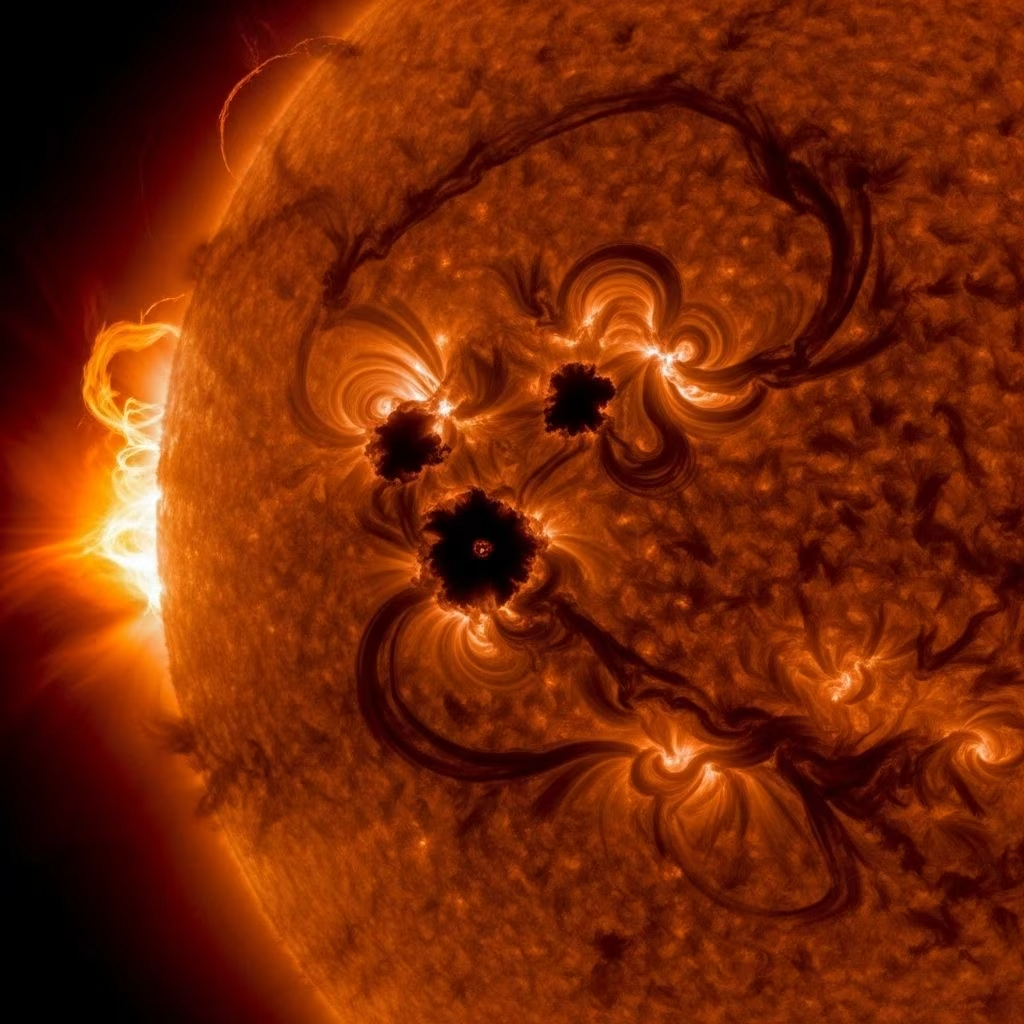
Sunspots are large, dark regions on the Sun’s surface where intense magnetic forces suppress the flow of hot gases. These intriguing blemishes have fascinated astronomers for centuries, offering a window into the dynamic magnetic interior of our star. Sunspots are not randomly distributed; their frequency and structure reflect the Sun’s underlying magnetic activity.
- Size: Sunspots can be as large as Earth or even larger, often appearing in pairs or groups.
- Appearance: They look darker because they are cooler than the surrounding solar surface, but still extremely hot by any terrestrial standard.
- Associated phenomena: Sunspots are closely tied to eruptive solar events like solar flares and coronal mass ejections (CMEs), which can impact Earth’s space environment.
Historical Observations and Discovery of Sunspots
Sunspots have been observed and recorded for over two millennia, with the earliest written records dating back to Chinese astronomers in the first millennium BCE.
- Early telescopic studies: Galileo Galilei and other astronomers in the 17th century used telescopes to observe and systematically document sunspots, laying the groundwork for solar physics.
- Long-term records: Ongoing observation has revealed cycles in sunspot activity, contributing to our understanding of solar behavior over centuries.
The Structure of a Sunspot
Each sunspot consists of two key regions:
- Umbra: The dark central core of the sunspot, where magnetic fields are strongest and temperatures are lowest—about 6,300°F (3,500°C).
- Penumbra: The lighter, surrounding area with filament-like structures radiating outwards, where temperatures are somewhat higher but still below the normal solar surface.
For comparison, the surrounding photosphere of the Sun averages around 10,000°F (5,500°C)—making sunspots noticeable yet extremely hot regions by Earthly standards.
How Do Sunspots Form?
Sunspots form through the dynamic interplay of the Sun’s magnetic field and the convection processes deep within its interior. While the precise details remain an area of active research, several key steps have been identified:
- Differential Rotation: The Sun’s equator rotates faster than its poles, stretching and twisting magnetic field lines much like rubber bands.
- Magnetic Flux Emergence: Concentrated magnetic fields rise through the Sun’s convective outer layer, forming magnetic loops that can break through the surface.
- Inhibiting Convection: Where strong magnetic fields emerge, they inhibit the normal upward flow of hot plasma, reducing surface temperature locally—creating a sunspot.
Recent research has suggested that the formation of molecular hydrogen may play a role in triggering sunspot formation, as cooler regions enable hydrogen atoms to pair up, lowering local pressure and further facilitating magnetic field intensification.
Sunspots and the Solar Cycle
The quantity and distribution of sunspots are closely tied to the solar cycle—a roughly 11-year oscillation in the Sun’s magnetic activity. During the peak of the cycle, or “solar maximum,” sunspots are especially numerous, while during “solar minimum” they become scarce or even absent.
- Sunspot cycles are tracked by counting sunspots over weeks, months, and years.
- The cycle relates to reversals of the Sun’s magnetic poles and the winding up of its field lines.
Unraveling the Mysteries: Competing Theories of Sunspot Formation
Though scientists agree that magnetism lies at the heart of sunspot formation, several theories have emerged to explain their exact origins:
| Theory | Main Idea | Status |
|---|---|---|
| Flux Tube Theory | Magnetic fields rise as buoyant tubes, breaking the surface to form sunspot pairs of opposite polarity. | Classic model, widely referenced. |
| Molecular Hydrogen Formation | Formation of hydrogen molecules in cooler spots lowers pressure and allows magnetic buildup. | Newer, supported by observational evidence. |
| Magnetic Pressure Instability | Local magnetic pressure inhibits convection, forming persistent dark spots. | Active research, explains complex spot shapes. |
Modern supercomputer simulations and high-resolution telescopes continue to refine these models, but the interplay of convection, rotation, and magnetism remains a vibrant field of inquiry.
Impact of Sunspots on Solar Activity and Earth
Sunspots are not mere surface details—they are manifestations of intense magnetic disturbances that drive dramatic solar events, with crucial impacts on both the Sun and Earth.
- Solar Flares: Sudden, intense bursts of radiation often originate near sunspots due to magnetic reconnection.
- Coronal Mass Ejections (CMEs): Massive explosions can propel charged particles toward Earth, triggering geomagnetic storms.
- Space weather effects: Increased solar activity around sunspot maxima can interfere with satellites, GPS, communications, and even power grids.
- Aurorae: Charged particles from the Sun, stemming from solar storms, create stunning auroral displays near Earth’s poles.
Notably, the Maunder Minimum—a period during the 17th century with very few sunspots—has been linked to cooler global weather, though the relationship between solar activity and Earth’s climate is still debated.
Sunspots and Modern Solar Research
The detailed study of sunspots has advanced rapidly with modern observational technologies:
- Solar telescopes: Ground- and space-based telescopes such as the Solar Dynamics Observatory (SDO) capture high-resolution images of sunspots in various wavelengths.
- Magnetogram imaging: Instruments measure solar surface magnetic fields, mapping complex sunspot magnetic structures.
- Simulations: Supercomputing models simulate magnetic field behavior and sunspot evolution to test and refine formation theories.
Future missions, such as the European Solar Telescope, are expected to offer even sharper views, potentially unlocking new levels of understanding about these phenomena.
Notable Sunspots and Records
- Largest sunspots: Some sunspots have spanned over 50,000 kilometers, more than four times Earth’s diameter.
- Sunspot groups: Complex groups with numerous spots and tangled magnetic fields often produce the most violent solar eruptions.
- Recent events: Sunspot AR3038 in 2022 drew global attention due to its rapid growth and visible size—larger than the United States.
Key Facts About Sunspots
- Sunspots are not permanent: They typically last from a few days to several weeks before dissipating.
- Polarity: Sunspot pairs almost always appear with opposite magnetic polarities, reflecting the underlying field configuration.
- Solar magnetic cycle: Every 11 years, sunspot numbers peak and then wane, often coupled with a reversal of the Sun’s magnetic field.
Frequently Asked Questions (FAQs) About Sunspots
Q: Why do sunspots appear dark?
A: They are cooler than the surrounding photosphere of the Sun, causing their emission of light to be much less, making them appear dark even though they’re still extremely hot.
Q: How big can sunspots get?
A: Sunspots can reach sizes of tens of thousands of kilometers across—large enough to engulf the entire planet Earth many times over.
Q: How often do sunspots occur?
A: Their numbers wax and wane in an 11-year cycle. During solar maximum, dozens may be visible at once; during minimum, the Sun may be spot-free for days or weeks.
Q: Do sunspots affect Earth’s weather or climate?
A: While some studies suggest links between solar activity (as indicated by sunspots) and Earth’s climate patterns, the connection is complex and remains an active subject of scientific investigation.
Q: Can we see sunspots with the naked eye?
A: Rarely, and only under very specific conditions. Never look directly at the Sun without proper solar filters—a practice that can permanently damage your eyes. Professional and amateur astronomers use special telescopes or solar-safe glasses to observe sunspots safely.
Sunspots: Windows Into the Dynamic Sun
Sunspots offer a unique and vital glimpse into the Sun’s magnetically active and complex outer layers. Through their continuing study and observation, scientists unravel the mysteries of our star—which, in turn, helps us anticipate and prepare for solar events that shape our technological society and, potentially, our climate. As our tools and understanding grow, sunspots remain at the nexus of solar science and space weather.
References
- https://www.space.com/sunspots-formation-discovery-observations
- https://www.space.com/14423-sunspots-sun-mystery-magnetic-theory.html
- https://www.spacedaily.com/reports/Sunspot_Formation_Explained_by_Solar_Physicists_999.html
- https://www.nasa.gov/technology/computing/secrets-of-sunspots-and-solar-magnetic-fields-investigated-in-nasa-supercomputing-simulations/
- https://en.wikipedia.org/wiki/Sunspot
- https://www.youtube.com/watch?v=u3JPnapOjrE
- https://arxiv.org/abs/1704.04062
- https://www.nasa.gov/history/spots-waves-and-wind-a-solar-science-timeline-full-text/
- https://arxiv.org/pdf/1704.04062.pdf
- https://spaceter.hashnode.dev/formation-of-the-sunspots
- https://www.youtube.com/watch?v=nNGFS97tO1k
- https://decodingbiosphere.com/2371-2/what-are-sunspots-how-are-sunspots-formed/
- https://www.matsati.com/index.php/scientists-think-theyve-solved-the-mystery-of-sunspots-a-spiritual-insight/
- https://science.howstuffworks.com/sunspot4.htm
- https://www2.mps.mpg.de/homes/warnecke/proceedings/Losada_etal17.pdf
- https://spacemesmerise.com/en-de/blogs/space-technology/the-fascinating-role-of-telescopes-in-sunspot-research?srsltid=AfmBOopa7dHUidX-r7i0bj4f9ZqlU9kDqNUDqoN2Q1IdoEbBzV4vnW61


