How Far Away Is Venus?
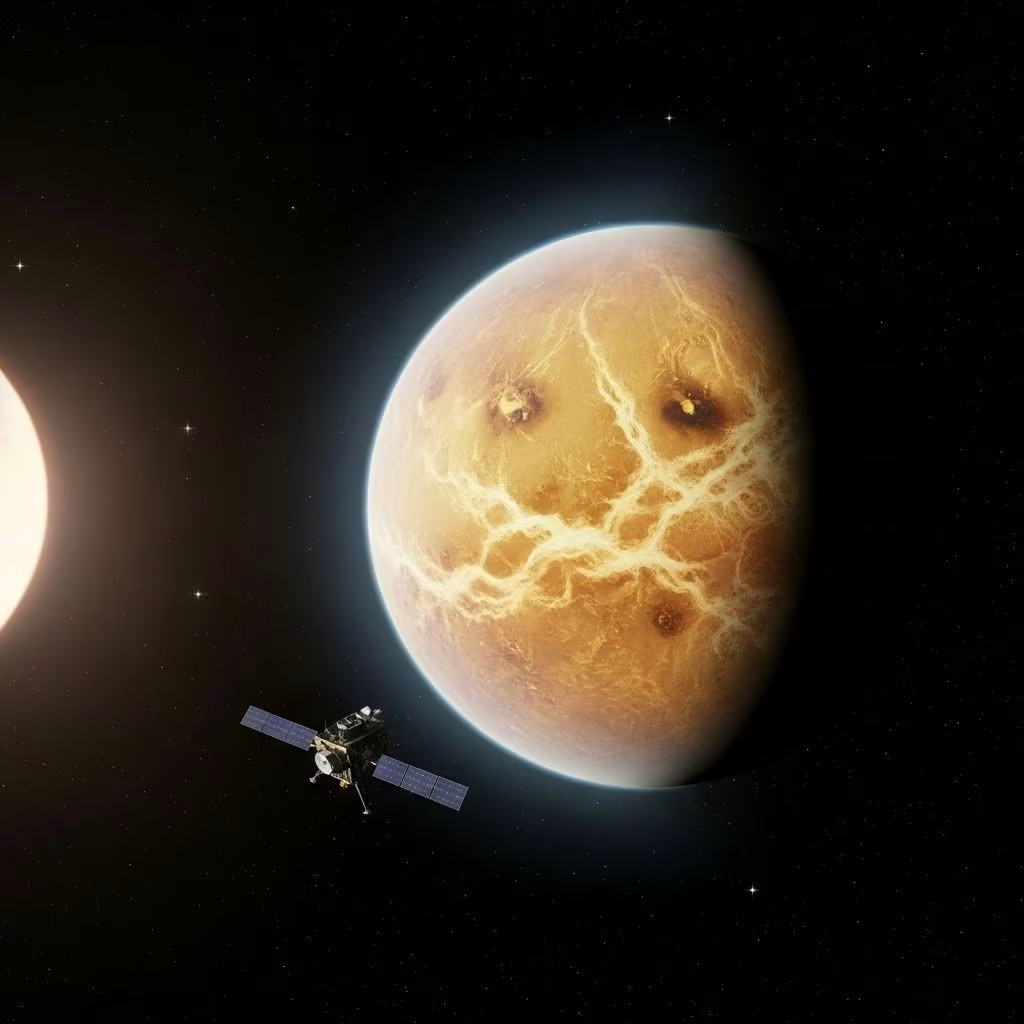
Venus is our closest planetary neighbor and one of the most brilliant objects in the night sky, often called the “morning star” or “evening star” thanks to its dazzling presence near the sun. But just how far is Venus from Earth, and why does this distance change so dramatically over time? This article unfolds the science behind Venus’s shifting position, its place in our solar system, and the implications for observing and exploring our sister planet.
The Ever-Changing Distance: Elliptical Orbits and Their Effects
Both Earth and Venus orbit the sun in elliptical paths—not perfect circles. As a result, the distance separating these two planets fluctuates throughout the year. This variation is substantial, with the gap shrinking and stretching over millions of kilometers depending on their respective locations in their orbits.
- Closest Approach (Inferior Conjunction): Venus can come as close as 38 million kilometers (about 24 million miles) to Earth. This is when Venus is situated between Earth and the Sun, aligning with us in its orbit.
- Farthest Position (Superior Conjunction): At their most distant, the planets can be separated by as much as 261 million kilometers (about 162 million miles). Here, Venus is on the far side of the Sun, opposite Earth in its orbit.
- Average Distance: Averaging these values, Venus typically maintains a gap of approximately 41 million kilometers (25 million miles) from Earth, though the true ‘average’ can shift due to orbital eccentricities.
Details in Numbers: Venus-Earth Distance Table
| Configuration | Distance (kilometers) | Distance (miles) | Distance (AU*) |
|---|---|---|---|
| Closest (Inferior Conjunction) | 38,000,000 | 24,000,000 | ~0.254 |
| Farthest (Superior Conjunction) | 261,000,000 | 162,000,000 | ~1.744 |
| Average | 41,000,000 | 25,000,000 | ~0.65 |
*1 Astronomical Unit (AU) = Mean Earth-Sun distance (~149.6 million km).
Why Does the Distance Change? Understanding Planetary Motions
The root cause lies in both planets’ elliptical orbits and their different orbital speeds. Earth completes a lap around the Sun in about 365 days, while Venus does so in about 225 days. This difference means the two planets periodically align in varying configurations:
- Every 584 days, Venus makes its closest approach to Earth (inferior conjunction).
- The configuration repeats, causing the minimum distance to occur at regular intervals, which is crucial for planning spacecraft launches.
Current Distance: Where Is Venus Now?
The current distance between Venus and Earth depends on the precise date and position in their orbits. For example, in mid-2023, Venus was about 91,800,000 km away from Earth. This value continually changes as both planets move along their respective paths. Tools like The Sky Live provide real-time data on planetary distances.
Venus’s Distance from the Sun
Venus orbits the Sun at a relatively consistent distance due to its nearly circular path—more so than any other planet in our system. Its mean distance from the Sun is about 108 million kilometers (67 million miles), which is just over 72% of the Earth-Sun distance.
| Planet | Average Distance from Sun (km) | Average Distance from Sun (AU) |
|---|---|---|
| Earth | 149,600,000 | 1.00 |
| Venus | 108,000,000 | 0.72 |
Light-Time and Space Perspective
Given the immense scales involved, distances in space are sometimes referenced in terms of light-time—the time it takes for light to travel between the two bodies:
- At its closest (38 million km), light takes just over 2 minutes to reach Venus from Earth.
- At its farthest (261 million km), it takes about 14.5 minutes.
- In light-years, Venus never exceeds about 0.00003 light-years from Earth—making our neighbor very close on the cosmic scale.
Comparing Venus to Other Planets
Venus is typically the closest planet to Earth, but not always. Due to the way planetary orbits work, Mercury is on average the planet that spends the most time closest to Earth, but Venus comes much closer on occasion than any other planet does. This is one reason Venus has long fascinated astronomers and is an important target for spacecraft missions.
Venus at a Glance: Planetary Facts
- Diameter: 12,104 km (7,521 miles) — just slightly smaller than Earth’s.
- Orbital Period: 225 Earth days.
- Atmosphere: Extremely dense, mostly carbon dioxide, with clouds of sulfuric acid.
- Brightness: Often outshone only by the Moon in our night sky.
How Do Scientists Measure the Distance?
Methods employed over the years include:
- Radar Ranging: Sending radio signals from Earth and timing their return after bouncing off Venus.
- Angular Measurement: Observing how Venus appears against background stars from different locations on Earth during special events (like transits).
- Mathematical Calculations: Applying principles of orbital mechanics and Kepler’s laws to predict and calculate distances at any given time.
The Role of Distance in Venus Missions
The shifting distance between Earth and Venus is a critical factor in mission planning. The shortest and most efficient path—a Hohmann transfer orbit—is only possible when the planets’ positions are just right, typically every 19 months or so. This timing allows spacecraft to reach Venus with minimal fuel and energy.
- Typical spacecraft travel time: 3 to 5 months.
- Past missions have taken widely varying durations, adjusting for launch window, speed, and orbital insertions.
Relationship with the Sun: Orbit Characteristics
- Venus orbits the Sun inside Earth’s orbit, making it an inferior planet (closer to the Sun than Earth).
- Orbital eccentricity (how stretched out the orbit is): Venus’s is extremely low, almost a perfect circle.
- This makes its distance from the Sun more consistent compared to planets such as Mercury or Mars.
Astronomical Significance of Venus’s Changing Distance
The ever-changing distance between Venus and Earth has helped astronomers calibrate planetary scales and test celestial mechanics for centuries. During rare events like transits of Venus, scientists have used careful observations and timing to refine our knowledge of the size of the solar system.
- Historic measurements: Transits in 1761, 1769, 1874, and 1882 advanced astronomy dramatically.
- Modern technology: Radar and spacecraft allow much more precise distance tracking.
Future Exploration and the Importance of Distance
The next generation of Venus missions (such as NASA’s VERITAS and ESA’s EnVision) will again depend on optimal distances for efficient spacecraft launches. Measuring these distances precisely ensures safe and timely mission arrivals, critical for both robotic science and, potentially, human exploration in the distant future.
Frequently Asked Questions (FAQs)
Q: How far away is Venus from Earth right now?
A: The distance is constantly changing due to orbital positions, but on average it’s about 41 million kilometers (25 million miles). As of mid-2023, Venus was roughly 92 million kilometers from Earth.
Q: What is the closest Venus ever gets to Earth?
A: The closest approach is about 38 million kilometers (24 million miles), occurring at inferior conjunction when Venus is directly between Earth and the Sun.
Q: Why does Venus’s distance from Earth vary?
A: Both planets have elliptical orbits and move at different speeds. Their relative positions shift over time, causing distances to change from about 38 million to 261 million kilometers.
Q: How long does it take to get to Venus by spacecraft?
A: Most missions take between 3 to 5 months, depending on launch timing and the chosen trajectory.
Q: What is the size of Venus compared to Earth?
A: Venus’s diameter is 12,104 kilometers, only about 638 kilometers less than Earth’s—making it the most Earth-like planet in size and mass in our solar system.
References
- https://www.space.com/18529-distance-to-venus.html
- https://www.space.com/3131-venus-data-sheet.html
- https://science-atlas.com/faq/what-is-venus-s-distance-from-earth/
- https://theskylive.com/venus-info
- https://orbitaltoday.com/2023/07/11/how-far-is-venus-from-the-earth-and-the-sun/
- https://theskylive.com/how-far-is-venus
- https://www.astronomy.com/science/venus/
- https://en.wikipedia.org/wiki/Venus
- https://www.britannica.com/place/Venus-planet
- https://science.nasa.gov/venus/venus-facts/
- https://lovethenightsky.com/how-far-away-is-venus/
- https://en.wikipedia.org/wiki/Orbit_of_Venus
- https://starwalk.space/en/news/discover-the-amazing-planet-venus
- https://profmattstrassler.com/articles-and-posts/relativity-space-astronomy-and-cosmology/transit-of-venus-and-the-distance-to-the-sun/
- https://www.universetoday.com/articles/venus-distance-from-earth
- https://www.worldatlas.com/space/venus.html
- https://starlust.org/how-far-away-is-venus-now/