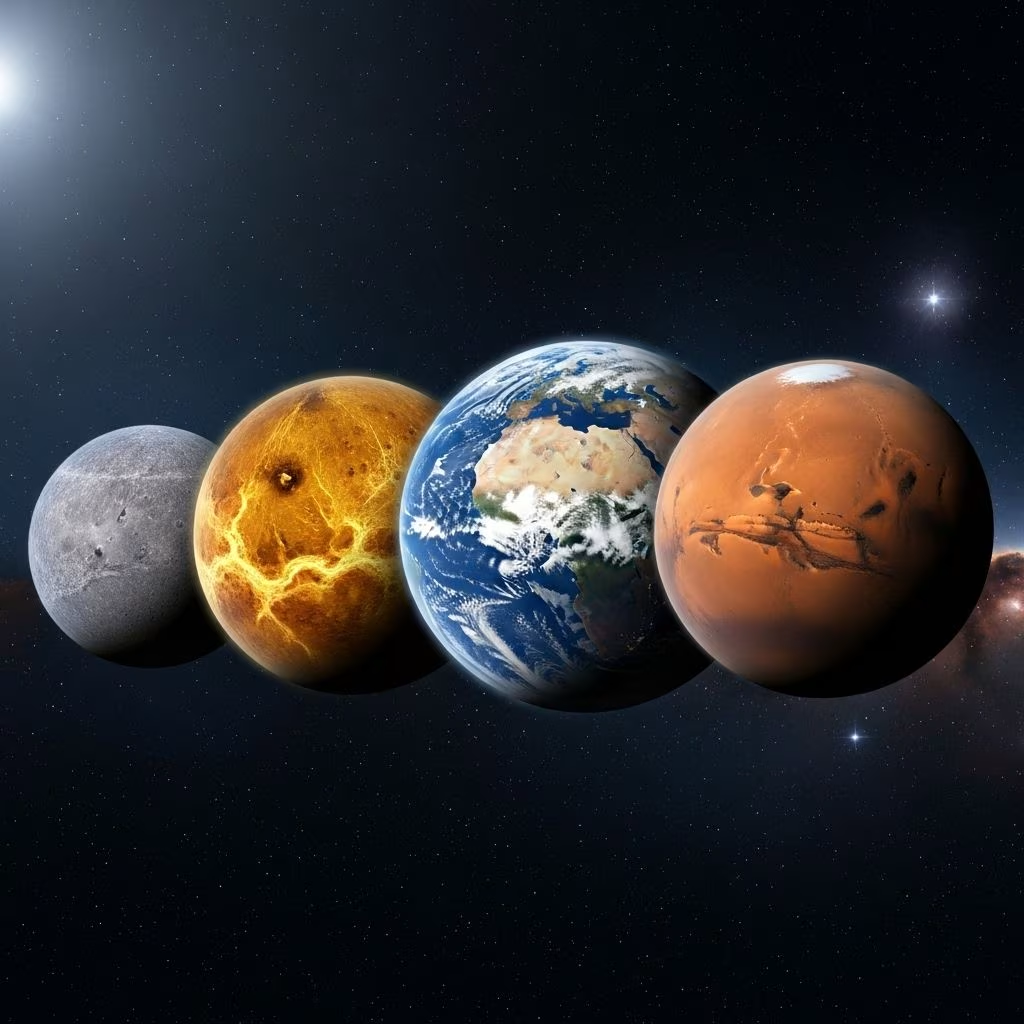
The terrestrial planets are the innermost worlds of our solar system, standing in stark contrast to the large, gaseous giants that orbit farther from the Sun. Composed primarily of rock and metal, these solid-surfaced bodies—Mercury, Venus, Earth, and Mars—are often termed ‘Earth-like planets.’ Their geology, atmospheres, and potential for hosting life have captivated astronomers and planetary scientists for generations.
What Are Terrestrial Planets?
The word terrestrial comes from the Latin Terra or Tellus, meaning ‘Earth.’ Terrestrial planets, also known as rocky planets or telluric planets, are primarily composed of silicate rocks and metallic cores. These planets are distinct from the gas and ice giants—not only in composition, but also in size, density, and appearance.
- All terrestrial planets in the Solar System orbit closer to the Sun.
- Their key feature is a solid, rocky crust unlike the thick gaseous envelopes of the outer planets.
- Examples include: Mercury, Venus, Earth, and Mars.
- Some planetary-mass moons and larger asteroids share similar internal structures.
Criteria for a Planet
According to the International Astronomical Union (IAU), an object must meet specific criteria to be classified as a planet:
- It must orbit the Sun.
- It should have enough mass to become nearly round due to its own gravity (hydrostatic equilibrium).
- It must have cleared its orbital neighborhood of other debris.
The four terrestrial planets meet all these conditions, whereas some bodies, like Pluto, are categorized as dwarf planets because they do not dominate their orbits.
Main Features of Terrestrial Planets
Despite their unique personalities, all terrestrial planets share several distinguishing characteristics:
- Solid Surface: A prominent rocky or metallic crust and mantle dominate, making features like mountains and valleys possible.
- Dense Interiors: Their cores contain heavy elements—primarily iron and nickel—wrapped in silicate mantles.
- Higher Density: Compared to gaseous planets, terrestrials are smaller in size yet denser in composition.
- Thin or Secondary Atmospheres: Due to weaker gravity compared to gas giants, their atmospheres—when present—are usually thin and often shaped by volcanic outgassing or comet impacts, rather than by direct capture from the solar nebula.
- Few or No Moons: Their modest gravitational influence means they retain only a small number of natural satellites, or none at all.
Comparing Terrestrial and Jovian Planets
| Feature | Terrestrial Planets | Jovian (Gas Giant) Planets |
|---|---|---|
| Main Composition | Rocks, metals | Hydrogen, helium, ices |
| Surface | Solid | No definite surface |
| Location | Inner solar system | Outer solar system |
| Density | High | Low |
| Moons | 0–2 | Many (dozens) |
Internal Structure of Terrestrial Planets
Every terrestrial planet, regardless of surface features or atmosphere, is built around a similar internal plan:
- Core: Mostly iron (sometimes nickel), providing a magnetic field for planets like Earth and Mercury.
- Silicate Mantle: Surrounds the core and forms the bulk of the planetary mass.
- Crust: Outermost layer that forms the planet’s surface and hosts geological features.
Some large asteroids, like Vesta, share a differentiated structure (core-mantle-crust), but many smaller objects do not. Moons such as Earth’s Moon and Jupiter’s Io also have internal stratification akin to terrestrial planets, but with unique details—Io is volcanically active, while the Moon’s core is much smaller relative to its mass.
Surface Characteristics of Terrestrial Planets
Terrestrial planets display remarkable landscapes, shaped by internal dynamics and environmental processes. Common features include:
- Craters: Impact structures from asteroids and comets.
- Mountains and Ranges: Formed by tectonic or volcanic activity.
- Canyons: Carved by erosion, tectonics, or both.
- Volcanoes: Both extinct and active, fueled by internal heat.
- Sedimentary Structures: Sand dunes, riverbeds, and other signs of erosive liquids in the past or present.
The presence and scale of these features vary between the planets, influenced by atmosphere, gravity, and historical activity.
Atmospheres of Terrestrial Planets
The atmospheres of the terrestrial planets are diverse and often tenuous. These atmospheres are not primordial (not captured from the solar nebula) but are instead secondary atmospheres:
- Mercury: Exceedingly thin exosphere, essentially airless.
- Venus: Extremely dense, composed mostly of carbon dioxide with thick clouds of sulfuric acid.
- Earth: Nitrogen and oxygen-rich, dynamic and supportive of life.
- Mars: Thin, mostly carbon dioxide with seasonal dust storms.
These secondary atmospheres evolved through volcanic outgassing and comet impacts, and were continually altered by solar wind, impacts, and planetary magnetism.
The Four Terrestrial Planets
Mercury
Mercury is the smallest and closest planet to the Sun. Key facts include:
- No moons or rings.
- Heavily cratered, resembles the Moon in appearance.
- Extremely thin, almost negligible atmosphere (exosphere).
- High density due to large iron core relative to its size.
- Extreme temperature variations between day and night.
Venus
Venus, the second planet, is sometimes called Earth’s sister planet because of its similar size and density. Key highlights:
- No moons or rings.
- Surface hidden by thick, reflective clouds of sulfuric acid.
- The hottest planet in the solar system due to a runaway greenhouse effect.
- Surface pressure over 90 times that of Earth’s.
- Volcanically active, with vast plains and few impact craters.
Earth
Earth is the only known planet to support life. Its distinguishing features:
- One natural satellite—the Moon.
- Surface 71% covered by liquid water.
- Rich atmosphere (mainly nitrogen and oxygen).
- Active geology—plate tectonics, mountains, and volcanic activity.
- Strong magnetic field protecting the surface.
Mars
Mars, the red planet, has intrigued observers for centuries. Notable traits:
- Two tiny moons: Phobos and Deimos.
- Thin, cold atmosphere.
- Lowest surface gravity among the terrestrials.
- Largest volcano in the solar system—Olympus Mons.
- Surface holds signs of ancient water flows (valleys, gullies).
Beyond the Four: Other Rocky Bodies
While Mercury, Venus, Earth, and Mars are the classic terrestrial worlds, a few other objects share some of their rocky, differentiated characteristics:
- Large Asteroids: Vesta and sometimes Pallas display layered structures similar to planets.
- Planetary Moons: The Moon, Io (of Jupiter), and possibly Europa, have rocky mantles and cores, though Europa is covered by a thick ice layer.
Importance of Terrestrial Planets
Why are terrestrial planets so central to scientific investigation?
- They host tectonic, volcanic, and sedimentary processes that shape planetary evolution.
- Earth, as a terrestrial world, is used to compare and contrast planetary development and habitability elsewhere.
- Mars and Venus are prime candidates in the search for past or present extraterrestrial life.
Frequently Asked Questions (FAQs)
What is a terrestrial planet?
A terrestrial planet is a planet made predominantly of rock and metal, featuring a solid surface and a metal-rich core. Mercury, Venus, Earth, and Mars are the prime examples in our solar system.
How are terrestrial planets different from gas giants?
Terrestrial planets have solid surfaces and are composed of rocks and metals, whereas gas giants are mostly made of hydrogen, helium, and various ices and have no true surface.
Why do terrestrial planets have fewer moons compared to gas giants?
Their lower gravity and smaller size make capturing and retaining many natural satellites difficult. For example, Earth has only one moon, while Jupiter has over seventy.
What determines if a planet has a secondary or primary atmosphere?
Primary atmospheres are captured from the solar nebula during planet formation, typical for gas giants. Terrestrial planets feature secondary atmospheres, which evolve from volcanic outgassing or accumulated impact material.
Do terrestrial planets exist around other stars?
Yes, astronomers have detected many rocky, Earth-like exoplanets in other planetary systems using spacecraft and telescopic surveys, indicating that terrestrial worlds may be common throughout the galaxy.
Key Takeaways
- Terrestrial planets formed closest to the Sun are rocky, dense, and have relatively thin atmospheres and few moons.
- Their surface and internal structures make them vibrant geological laboratories for understanding the history and evolution of planets.
- Studying these worlds aids the search for habitable environments both within and beyond our solar system.
References
- https://science.nasa.gov/exoplanets/terrestrial/
- https://en.wikipedia.org/wiki/Terrestrial_planet
- https://science.nasa.gov/learn/basics-of-space-flight/chapter1-2/
- https://revolutionized.com/characteristics-of-terrestrial-planets/
- https://gml.noaa.gov/infodata/info_activities/pdfs/TBI_terrestrial_planets.pdf
- https://www.universetoday.com/articles/terrestrial-planet
- https://study.com/academy/lesson/terrestrial-planets-definition-characteristics-quiz.html
- https://theplanets.org/terrestrial-planets/
- https://www.ebsco.com/research-starters/astronomy-and-astrophysics/terrestrial-planets
- https://www.youtube.com/watch?v=IuoGsea9mPY
- https://space-facts.com/terrestrial-planets/
- https://astro4edu.org/resources/glossary/term/354/
- https://gml.noaa.gov/outreach/info_activities/pdfs/TBI_terrestrial_planets.pdf
- https://en.wikipedia.org/wiki/Planet
- https://study.com/academy/lesson/video/terrestrial-planets-definition-characteristics-quiz.html
- https://science.howstuffworks.com/terrestrial-planets.htm
- https://phys.org/news/2015-07-terrestrial-planet.html
- https://www.britannica.com/science/terrestrial-planet
- https://eartheclipse.com/space/terrestrial-planets-definition-facts.html