The Expanding Universe: From the Big Bang to the Present Day
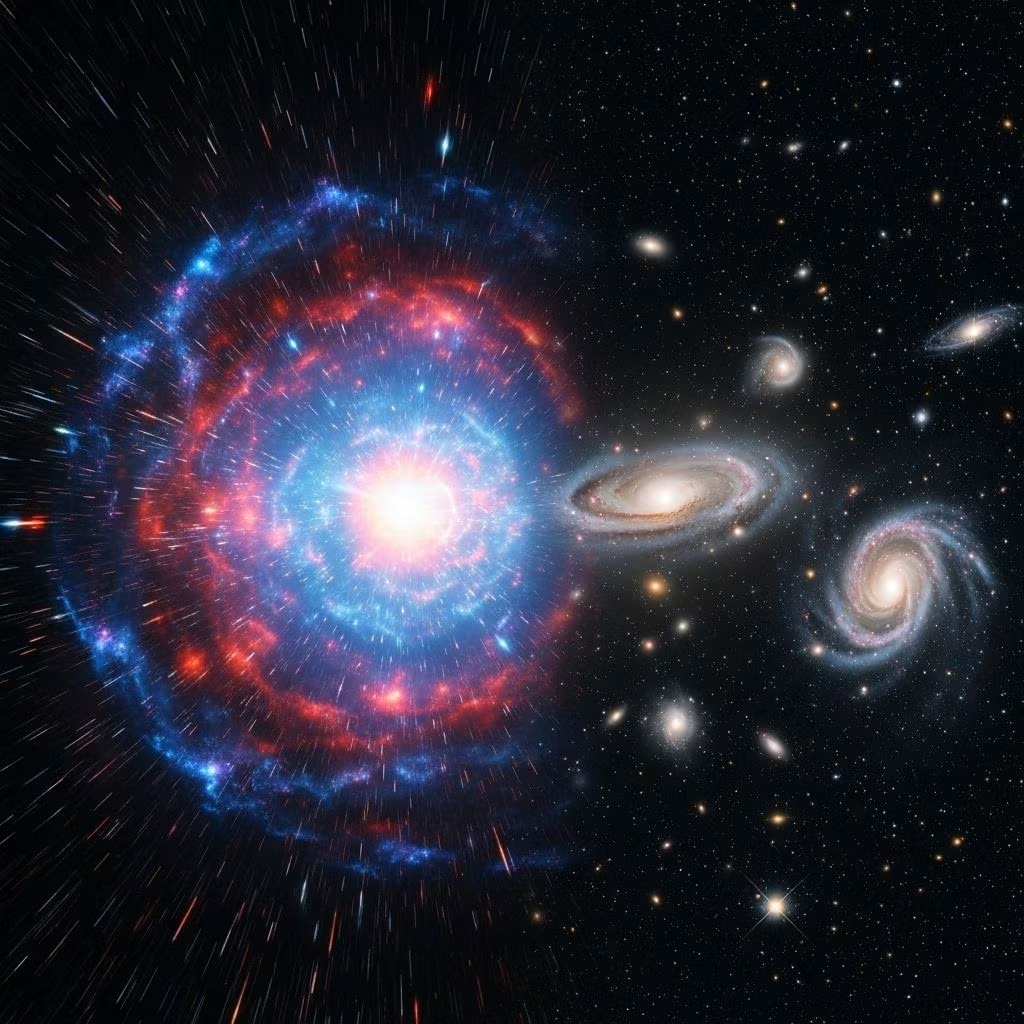
The universe was born out of a cataclysmic event—the Big Bang—around 13.8 billion years ago. Since then, it has been continually expanding, a fact that fundamentally reshaped our understanding of cosmology and our cosmic place. From Edwin Hubble’s observations to the revolutionary concept of dark energy, the story of the expanding universe is both dazzling and humbling, illuminating the grand scale and fate of everything we know.
Origins: What is the Expanding Universe?
When astronomers speak of the universe expanding, they don’t mean that matter is simply flying outward into empty space. Instead, space itself is stretching, causing galaxies to recede from each other with time, a phenomenon observed through the redshift of light from distant galaxies.
- The Expanding Universe refers to the increase in distance between any two given gravitationally-unbound parts of the observable universe with time.
- This concept challenges the earlier steady-state theory and supports the dynamic cosmic model introduced by the Big Bang theory.
- Distances between galaxy clusters increase, while within clusters, gravity can still bind galaxies together.
Edwin Hubble and the Birth of Modern Cosmology
In the 1920s, Edwin Hubble made a landmark discovery: nearly all observed galaxies appear to be moving away from us. Plotting recession velocities against their distances, Hubble revealed a linear relation—now called the Hubble Law:
- Galaxies further away are receding faster.
- This relationship is not due to our special position, but is a feature of space itself expanding.
- The proportionality constant is Hubble’s Constant (H₀).
Table: Key Details of Hubble’s Discovery
| Concept | Description |
|---|---|
| Hubble Law | Velocity of recession ∝ distance from observer |
| Supporting Evidence | Redshifted light from distant galaxies |
| Implication | Universe is dynamic, not static |
The Big Bang: Explosive Origins
Tracing the expansion backward leads to a singular moment of extraordinary density and temperature—the Big Bang. This theory posits that:
- All matter and energy, as well as space and time, were once compressed into a singular, infinitesimally small point.
- The ‘primordial fireball’ began to cool and expand rapidly, creating the conditions for matter to form and, eventually, for galaxies and stars to emerge.
- The Cosmic Microwave Background (CMB) is a relic of this hot, dense phase.
Key Evidence for the Big Bang:
- Universal expansion observed via redshift.
- Cosmic Microwave Background radiation pervading space.
- Abundances of light elements like hydrogen and helium.
Cosmic Inflation: The Early Growth Spurt
Shortly after the Big Bang, the universe experienced a brief but stupendous phase of inflation, where its size multiplied by an enormous factor in a fraction of a second.
- This inflationary era explains why the observable universe is so homogeneous and isotropic on large scales.
- Quantum fluctuations during inflation seeded the cosmic structures—galaxies and clusters—that later evolved under gravity.
Measuring Expansion: Redshift and Standard Candles
Astronomers gauge the universe’s expansion rate by observing redshift—the stretching of light waves as space expands. More distant galaxies display higher redshifts, signifying a greater recession velocity.
- Standard candles such as Type Ia supernovae serve as cosmic mileposts because their intrinsic brightness is known.
- By comparing their apparent brightness to expected values, astronomers deduce how much the universe has stretched since their light was emitted.
An Accelerating Expansion: The Discovery of Dark Energy
In the late 1990s, two independent teams measuring distant supernovae made a startling discovery: the expansion of the universe is not slowing down, but rather accelerating.
- This acceleration implies the presence of a mysterious force or energy—dubbed dark energy—which permeates all of space.
- Dark energy counteracts gravity, driving galaxies apart ever more quickly.
- Current estimates suggest that dark energy makes up roughly 68% of the total energy content of the universe.
The Nature of Space, Time, and the Universe’s Shape
The expansion of the universe raises fundamental questions about the nature of space and time:
- Space itself is dynamic, capable of stretching—or potentially, in some models, contracting.
- The universe could be finite or infinite; current observations favor a flat geometry, but the totality might extend beyond what we can observe.
- Space is not expanding into anything; rather, the metric describing the distances between points in space changes with time.
Observable Universe: Our Cosmic Horizon
Because the universe is about 13.8 billion years old, and light travels at a finite speed, we can only see objects whose light has had time to reach us—defining the limits of our observable universe.
- Everything beyond this horizon remains unseen, though it may exist and be forever inaccessible.
- At the edge of the observable universe, galaxies recede from us at the speed of light due to expansion.
Consequences of Expansion: Fate of the Universe
What does the accelerating expansion mean for the cosmos’ ultimate fate?
- If dark energy continues to dominate, the universe will expand forever, cooling and thinning out until galaxies and stars become isolated—sometimes called the “Big Freeze” scenario.
- If dark energy’s properties change, alternate endings (such as the “Big Rip” where expansion eventually tears apart all structure) are theoretically possible.
Cosmic Expansion in Everyday Terms
To visualize cosmic expansion, scientists often use analogies:
- Balloon Analogy: Imagine dots on a balloon’s surface. As the balloon inflates, the dots grow farther apart—but there’s no center of expansion on the surface itself.
- The universe is like the whole balloon: its surface is all there is, and expansion occurs everywhere simultaneously.
- Light from distant galaxies is stretched alongside the expansion, causing wavelengths to shift ‘redward.’
Key Milestones in the Universe’s Expansion
| Time After Big Bang | Notable Event |
|---|---|
| <10^-32 seconds | Inflation rapidly expands the universe |
| ~380,000 years | Cosmic Microwave Background released |
| ~1 billion years | First galaxies form |
| 13.8 billion years | Today: Accelerating expansion dominates |
Frequently Asked Questions (FAQs)
What is causing the universe to expand?
The expansion is a fundamental property of space set in motion by initial conditions from the Big Bang. Dark energy is now driving the current acceleration.
Is the universe expanding into something?
No. The universe isn’t expanding into existing space; rather, the fabric of space itself stretches and carries matter with it.
How fast is the universe expanding?
Expansion is quantified by the Hubble constant. Current values are around 67 to 74 kilometers per second per megaparsec, but this is an area of active research.
What will happen to the universe in the distant future?
If current trends continue, the universe will expand forever, galaxies will drift apart, stars will die, and the cosmos will become vast and cold—a “heat death.” Alternative outcomes are possible if the nature of dark energy changes.
Can we observe beyond the observable universe?
No. The observable universe is bounded by how far light has traveled since the Big Bang. Anything beyond that is inaccessible to current or future observation.
Summary: The Unfolding Cosmic Saga
From the fiery origins in the Big Bang to the mysterious tug of dark energy, the expanding universe remains one of science’s profound revelations. Every increment in understanding brings fresh mysteries—from the fate of all matter to the very structure of space and time. As our instruments and theories improve, so too will our comprehension of the magnificent, ever-unfolding cosmos that surrounds—and includes—us all.
References
- https://www.space.com/25126-big-bang-theory.html
- https://www.space.com/13320-big-bang-universe-10-steps-explainer.html
- https://en.wikipedia.org/wiki/Expansion_of_the_universe
- https://en.wikipedia.org/wiki/Big_Bang
- https://www.skyatnightmagazine.com/space-science/expansion-universe
- https://science.nasa.gov/dark-energy/
- https://bigthink.com/starts-with-a-bang/universe-expand-stretching-creating-space/
- https://bigthink.com/starts-with-a-bang/what-universe-expanding-into/
- https://www.britannica.com/science/cosmology-astronomy/The-cosmological-expansion
- https://www.youtube.com/watch?v=7GC8XOKwRpM
- https://www.youtube.com/watch?v=qS7tt_9P1k8
- https://space-chatter.com/the-expanding-universe-observations-and-implications/
- https://www.britannica.com/video/Your-Daily-Equation-28-Einstein-The-Big-Bang-and-the-Expansion-of-the-Universe/-254991
- https://www.jpl.nasa.gov/edu/resources/teachable-moment/exploring-the-mystery-of-our-expanding-universe/
- https://www.encyclopedia.com/science/encyclopedias-almanacs-transcripts-and-maps/expanding-universe-big-bang