Introduction: What Is the Triangulum Galaxy?
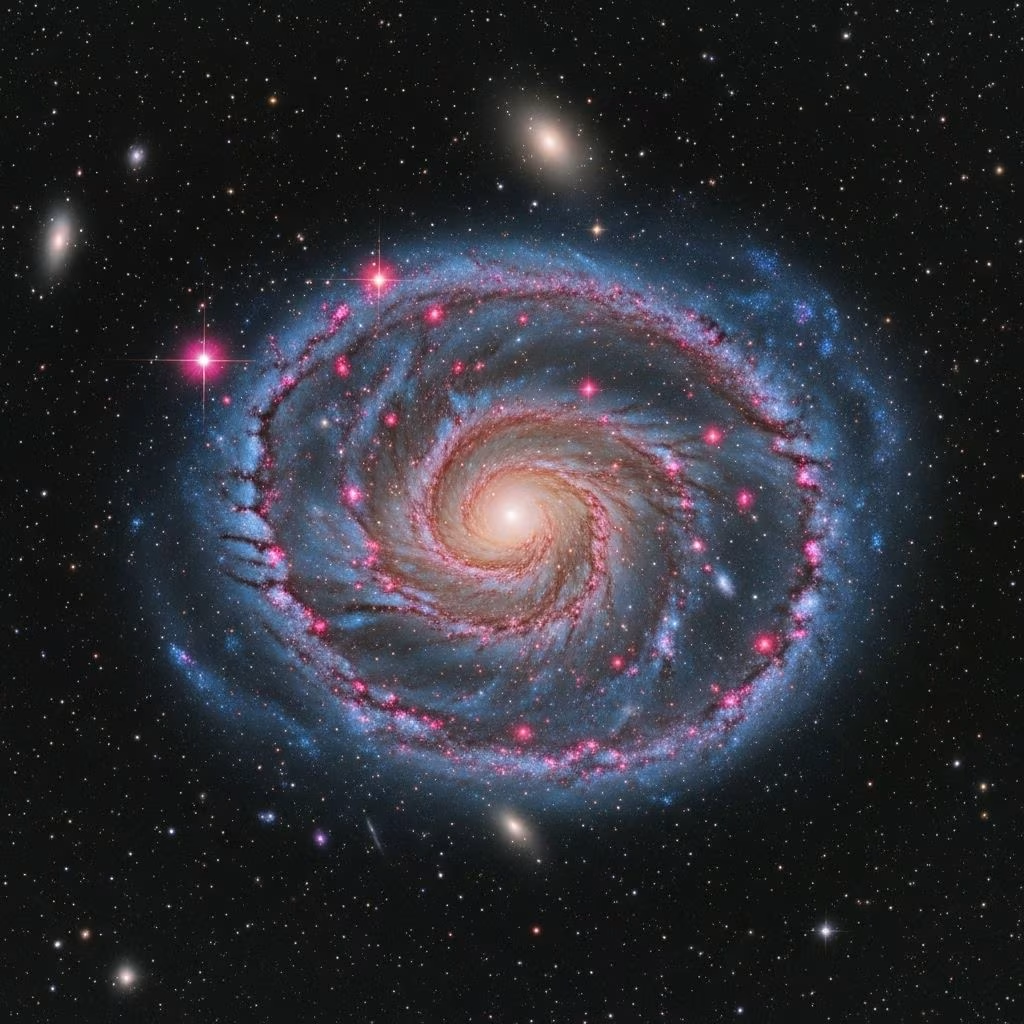
The Triangulum Galaxy, cataloged as Messier 33 (M33) or NGC 598, stands out as one of the most remarkable spiral galaxies near the Milky Way. Located in the northern constellation Triangulum, it sits about 2.7–3 million light-years from Earth, making it a significant member of our Local Group of galaxies, alongside the more massive Milky Way and Andromeda galaxies .
- Third-largest galaxy in the Local Group
- Striking spiral arms and intense regions of star formation
- Easily visible to dedicated amateur astronomers under dark skies
Names, Location, and Etymology
The Triangulum Galaxy’s official designations include M33 and NGC 598. Its common name derives from its position in the small constellation Triangulum. While occasionally referenced informally as the “Pinwheel Galaxy,” this nickname more accurately refers to Messier 101, located in Ursa Major .
- Coordinates: RA 01h 33m 50.9s, Dec +30° 39′ 37″
- Distance from Earth: About 2.7–3 million light-years
- Neighboring constellations: Aries, Perseus, Andromeda, Pisces
Physical Characteristics and Structure
The Triangulum Galaxy is classified as a spiral galaxy (type Sc or SA(s)cd), displaying beautiful, well-defined spiral arms. Its disk spans an estimated 60,000–61,100 light-years across—about 70% the diameter of the Milky Way, but much smaller than the vast Andromeda Galaxy .
Key characteristics include:
- Contains an estimated 40 billion stars
- Disk mass: (3–6) billion solar masses; total baryonic (normal) matter ~10 billion solar masses
- Gas mass: Approximately 3.2 billion solar masses
- Dark matter component: Adds ~50 billion solar masses up to a radius of 17 kpc (55,000 light-years)
- Distinct blue spiral arms indicating active star-forming regions
Comparison Table: Local Group Galaxies
| Galaxy | Diameter (light-years) | Number of Stars (estimate) | Distance from Earth (ly) |
|---|---|---|---|
| Andromeda (M31) | 200,000 | 1 trillion | 2.5 million |
| Milky Way | 100,000 | 400 billion | N/A (Home galaxy) |
| Triangulum (M33) | 60,000–61,100 | 40 billion | 2.7–3 million |
The Triangulum Galaxy’s Place in the Local Group
The Local Group is a gravitationally bound collection of more than 50 galaxies, with the Milky Way, Andromeda, and Triangulum as its most substantial members. Triangulum may be a satellite or former satellite of Andromeda, given their relative proximity and measured velocities .
- Location: Resides roughly equidistant from the Milky Way and Andromeda
- Gravitational dynamics allow astronomers to study galaxy interactions
- Potentially on a collision or interaction course with the Andromeda-Milky Way merger in billions of years
Star Formation and Stellar Populations
Triangulum is renowned for its intense star formation. Its spiral arms, highlighted by a blue glow, reveal prominent clusters of hot, young stars. Compared to Andromeda, Triangulum’s star-forming activity is an order of magnitude greater, with roughly one solar-mass worth of new stars formed every two years .
Notable features:
- H II regions—clouds of ionized hydrogen where stars are born
- The largest known H II region in any Local Group galaxy: NGC 604, a vast stellar nursery containing hundreds of massive, young stars
- A total star population of 25–40 billion observed and inferred
Images, Observations, and the Hubble Space Telescope
Recent imagery, especially from the Hubble Space Telescope, has revealed the detailed structure and stellar composition of the Triangulum Galaxy as never before. In one famous survey, Hubble’s wide-field camera captured the galaxy in 54 overlapping segments, assembling a panoramic image covering 19,000 light-years and showing nearly 25 million resolved stars .
- The Hubble mosaic showcases grand spiral arms filled with star clusters, nebulae, and dust lanes
- Observed with high resolution, revealing spiral symmetry and contrasting regions of star birth and older stars
- Images help astronomers study the history of stellar and chemical evolution in spiral galaxies
Scientific Significance and Research
The Triangulum Galaxy plays a key role in astronomy owing to its proximity, orientation, and relatively unperturbed nature. Its distinct spiral arms enable researchers to study star formation, chemical enrichment, galaxy dynamics, and the impact of gravitational interactions.
- Triangulum’s well-ordered spiral structure suggests it has experienced few major collisions or mergers in recent times compared to more chaotic galaxies
- The galaxy is an important laboratory for studying star formation rates and interstellar medium physics
- Comparative studies with Andromeda and the Milky Way help clarify the Local Group’s evolution
Dark Matter and Dynamics
Like most galaxies, Triangulum is dominated by an unseen dark matter halo, influencing its rotation and overall mass. Measurements indicate the galaxy’s dark matter outweighs visible matter by a factor of five out to its visible edge .
- Dark matter shapes spiral arms, stabilizes disk
- Gravity from dark matter dominates at large radii, helping calculate the galaxy’s total mass
Observing the Triangulum Galaxy
The Triangulum Galaxy is among the most accessible spiral galaxies for amateur observation. Although barely visible to the naked eye under ideal conditions, it can be spotted with binoculars or a small telescope. It appears as a faint, diffuse patch in the autumn sky from the Northern Hemisphere .
- Best time to observe: Northern Hemisphere autumn and early winter (September–January)
- Location: Find constellation Triangulum, which sits between Perseus and Aries
- Urban skywatchers will need dark, clear skies to glimpse the galaxy
Astrophotographers prize Triangulum for its fine spiral structure and star-forming regions, producing some of the most beautiful extragalactic images accessible from Earth.
Relationship with Neighboring Galaxies
Triangulum may be gravitationally influenced by nearby Andromeda (M31), evidenced by its motion and past interaction signatures. Some models propose Triangulum has orbited Andromeda and may even be falling back toward it now, complicating the dynamics of the Local Group .
- Proximity may eventually make Triangulum part of the massive Andromeda–Milky Way merger expected in some 4 billion years
Studying these interactions sheds light on how galaxies merge, grow, and assemble into larger structures.
Notable Features and Facts
- Contains NGC 604, one of the largest and most active star-forming regions in the Local Group
- Its spiral arms are brighter in blue light due to hefty populations of hot, young stars
- The galaxy is less massive than the Milky Way or Andromeda but sustains a rapid rate of new stellar births
- Orientation: Nearly face-on, offering a clear view of spiral structure
The Future of the Triangulum Galaxy
Triangulum’s isolation from major collisions in its recent history may change gradually. Its proximity to Andromeda and the Milky Way places it on a possible future collision course, where all three galaxies might eventually merge as the Local Group evolves over the next several billion years .
- Astrometric surveys will refine predictions about interactions and eventual fate
Frequently Asked Questions (FAQs)
Q: Why is the Triangulum Galaxy important to astronomers?
A: Triangulum’s proximity, spiral structure, and active star formation offer a unique laboratory for studying galaxy dynamics, star birth, and cosmic evolution.
Q: Can the Triangulum Galaxy be seen without a telescope?
A: Under exceptionally dark and clear skies, it can be spotted as a faint smudge with the naked eye. Binoculars or a small telescope greatly enhance visibility.
Q: How does Triangulum compare to the Milky Way?
A: The Triangulum Galaxy is smaller—roughly 60,000 light-years across and housing about 40 billion stars compared to the Milky Way’s 100,000 light-year diameter and 400 billion stars.
Q: What makes the Triangulum Galaxy’s spiral structure special?
A: Its spiral arms are well-defined and largely undisturbed, likely due to a peaceful history free of major galactic collisions in recent epochs.
Q: What is the brightest feature in the Triangulum Galaxy?
A: The H II region NGC 604 is the most luminous feature, a huge area of glowing gas and young, massive stars.
Conclusion
The Triangulum Galaxy enchants astronomers and stargazers alike as a beautiful nearby spiral in our cosmic neighborhood. Its ongoing star formation, history of relative isolation, and impending role in galactic mergers render it a vital target for both visual observers and advanced research. As technologies improve, Triangulum will remain at the forefront of extragalactic astronomy, illuminating much about the history and future of galaxies like our own.
References
- https://en.wikipedia.org/wiki/Triangulum_Galaxy
- https://www.space.com/star-packed-triangulum-galaxy-hubble-telescope-photo
- https://www.space.com/43105-triangulum-galaxy-hubble-telescope-photos.html
- https://science.nasa.gov/mission/hubble/science/explore-the-night-sky/hubble-messier-catalog/messier-33/
- https://space.fandom.com/wiki/Triangulum_Galaxy
- https://www.skyatnightmagazine.com/astrophotography/galaxies/triangulum-galaxy
- https://www.youtube.com/watch?v=K4MzYXqeOCM
- https://space-facts.com/galaxies/triangulum/
- https://www.nasa.gov/image-article/triangulum-galaxy/
- https://en.wikipedia.org/wiki/Triangulum
- https://theplanets.org/triangulum/
- https://www.youtube.com/watch?v=uMpOOpBaeKU
- https://www.astronomy.com/science/101-must-see-cosmic-objects-the-triangulum-galaxy/
- https://www.britannica.com/place/Triangulum
- https://esahubble.org/images/heic1901a/
- https://www.jameswebbdiscovery.com/astronomy-news/unlocking-the-mysteries-of-the-triangulum-galaxy-through-webb-telescope
- https://www.galactic-hunter.com/post/m33-the-triangulum-galaxy