The Four Fundamental Forces: The Blueprint of the Universe
Physics seeks to explain how everything in the universe interacts. At the heart of this quest lie the four fundamental forces: gravity, electromagnetism, the strong nuclear force, and the weak nuclear force. These forces govern every process in the cosmos, from the movement of galaxies and the orbiting of planets to the structure of atoms and the transformation of particles. Understanding these core interactions is crucial for comprehending the universe at every scale, from the vastest clusters of galaxies to the smallest subatomic particles.
What Are the Four Fundamental Forces?
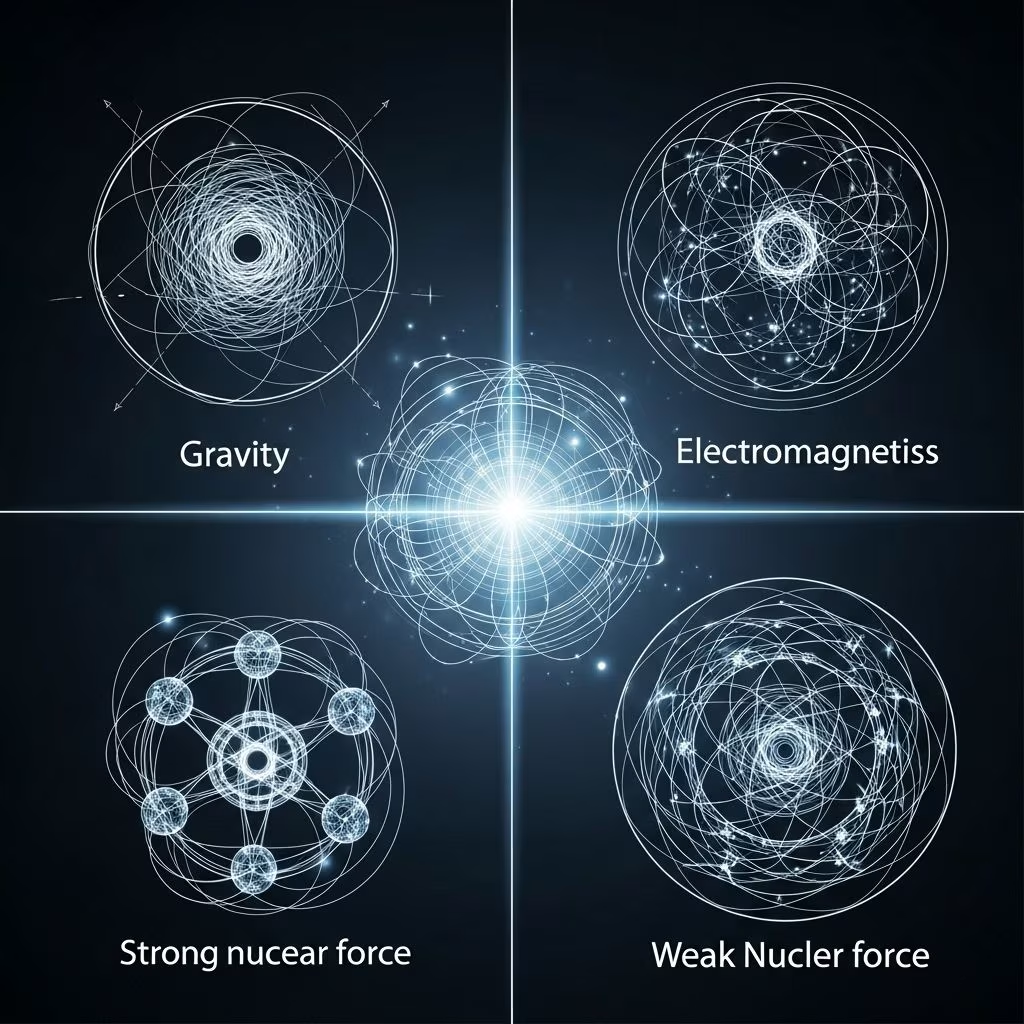
Scientists have discovered that all interactions in the universe can be explained by one or more of the following four forces:
- Gravitational Force
- Electromagnetic Force
- Strong Nuclear Force
- Weak Nuclear Force
Each of these forces operates across different ranges and strengths, and each plays a unique role in shaping matter and energy as we know it.
Gravity: The Oldest and Weakest, Yet Most Far-Reaching Force
Gravity is perhaps the most familiar force. It is the universal attraction between objects with mass—it keeps our feet on the ground, causes planets and stars to form, and binds galaxies together across cosmic distances. Gravity was the first force to be mathematically described, most famously in Isaac Newton’s law of universal gravitation, which states that the attractive force between two masses is proportional to the product of their masses and inversely proportional to the square of the distance between them.
- Nature: Always attractive, affects anything with mass.
- Range: Infinite, never becomes zero, but weakens with the square of distance.
- Strength: Weakest of all four forces—but dominates at astronomical scales where large masses are involved.
Einstein’s general theory of relativity advanced our view of gravity, showing it as the curvature of spacetime itself. Massive objects warp space and time, causing other objects to move along curved paths, thus appearing to attract each other.
Examples of gravity in action include:
- Planets orbiting the sun
- The fall of an apple from a tree
- The tides on Earth caused by the moon
- Galaxies clustering under mutual attraction
Electromagnetism: The Force Behind Light, Electricity and Magnetism
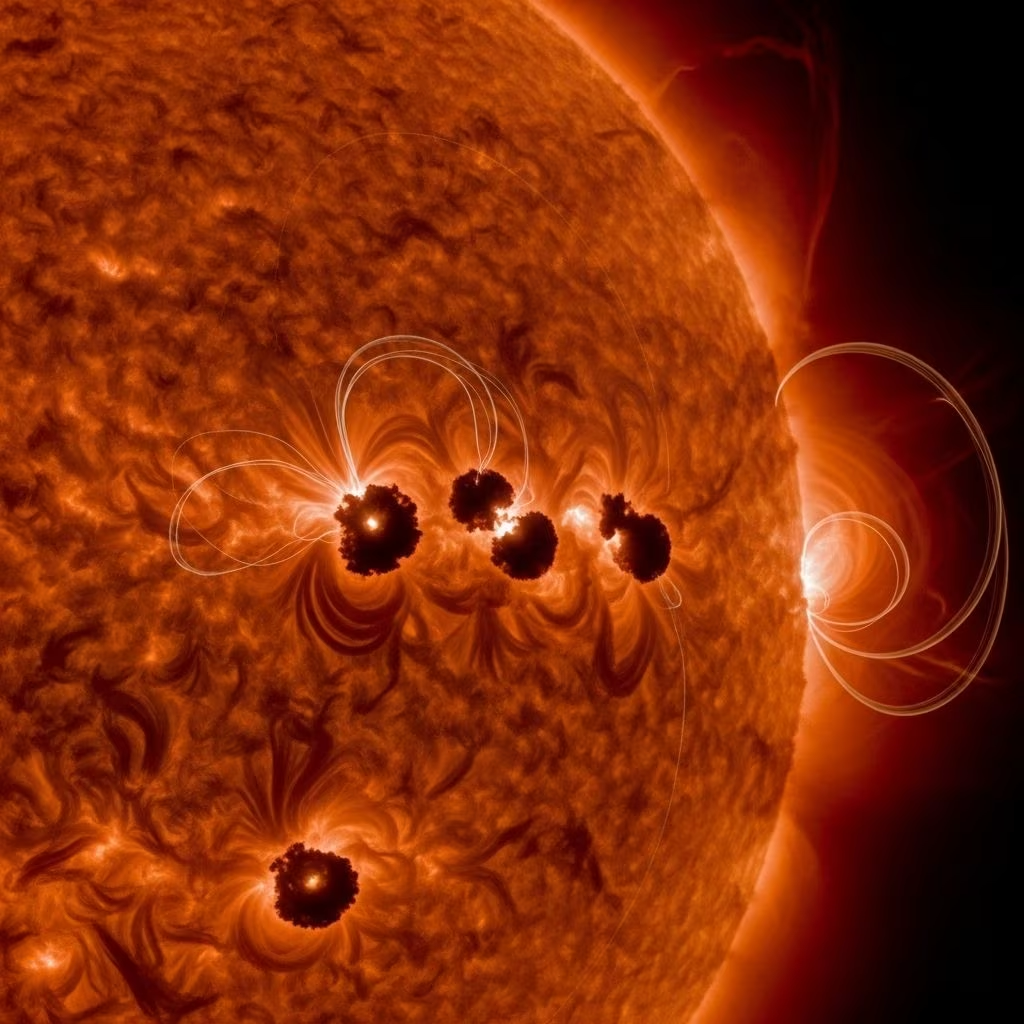
The electromagnetic force causes interactions between charged particles. It is responsible for light, the behavior of electric and magnetic fields, and the vast diversity of chemistry. This force holds electrons in orbit around atomic nuclei, binds atoms into molecules, and governs the phenomena of electricity and magnetism that we harness in daily life.
- Nature: Can be attractive or repulsive (like charges repel, unlike charges attract).
- Range: Infinite—weakening with the square of distance—but far stronger than gravity at atomic and macroscopic scales.
- Carrier Particle: Photon, the quantum of electromagnetic radiation.
- Effects: Responsible for all chemical bonds, the transmission of light, radio waves, and electric power.
The unification of electric and magnetic phenomena into a single force was one of the biggest triumphs in physics, achieved by James Clerk Maxwell in the 19th century. The electromagnetic force—in its many manifestations—shapes the world as we see, touch, and experience it every day.
Examples of electromagnetic force include:
- Atoms forming molecules (chemical bonds)
- Light shining from the sun and stars
- Electric currents in wires
- The Earth’s magnetic field
The Strong Nuclear Force: Holding the Heart of Atoms Together
The strong nuclear force (or just “strong force”) is the most powerful of the four forces, but it only acts over extremely short distances, on the order of one femtometer (about 10-15 meters). This force binds protons and neutrons inside atomic nuclei, overcoming the strong electromagnetic repulsion between positively charged protons.
- Nature: Always attractive, but only significant within atomic nuclei.
- Range: Extremely short (about 1 femtometer), beyond which its influence drops to zero.
- Strength: Strongest force—about 100 times stronger than electromagnetism, a million times stronger than weak force, and 1038 times stronger than gravity.
- Carrier Particle: Gluon (mediates the strong interaction between quarks).
The strong force is central to formation and stability of atomic nuclei. It’s also responsible, via its residual effects, for the powerful fusion and fission reactions inside stars and nuclear reactors.
Examples of the strong force’s role:
- Binds quarks into protons and neutrons
- Holds protons and neutrons together in nuclei
- Enables energy release in nuclear fusion (stars) and nuclear fission (reactors/weapons)
The Weak Nuclear Force: Master of Particle Transformation
The weak nuclear force (or “weak interaction”) is crucial for processes that change the type—or flavor—of elementary particles. It is responsible for certain forms of radioactive decay, most notably beta decay, and is key to how the sun and other stars produce energy.
- Nature: Can change one flavor of quark into another (e.g., a neutron to proton).
- Range: Extremely short, less than 0.1% of the diameter of a proton.
- Strength: Much weaker than both electromagnetism and strong force, but stronger than gravity at the subatomic scale.
- Carrier Particles: W and Z bosons.
The weak force is essential for the fusion reactions in stars that produce light and heat. It is also responsible for the generation of neutrinos in nuclear processes, some of the most elusive and abundant particles in the universe.
Examples of the weak force include:
- Radioactive beta decay (conversion of a neutron to a proton, with emission of an electron and antineutrino)
- The fusion of hydrogen into helium inside stars (including the sun)
Comparing the Forces: Strengths, Ranges, and Roles
| Force | Relative Strength* | Range | Carrier Particle | Main Role in Universe |
|---|---|---|---|---|
| Strong Nuclear | 1 (strongest) | ~1 femtometer | Gluon | Binds quarks and holds nuclei together |
| Electromagnetic | 1/137 of strong force | Infinite | Photon | Electricity, magnetism, light, chemical bonds |
| Weak Nuclear | 1/10,000 of strong force | <1 femtometer | W and Z bosons | Nuclear decay; particle transformations |
| Gravitational | 10-38 of strong force | Infinite | (Graviton*) | Orbits, structure and motion of planets, stars, galaxies |
*Relative to the strong nuclear force. The gravitational force’s carrier, the graviton, is hypothetical and not yet observed.
Mediators: Force Carrier Particles
According to the Standard Model of particle physics, every fundamental force (except gravity) is mediated by an exchange of force-carrying particles called bosons:
- Photon: Carries the electromagnetic force.
- Gluon: Carries the strong force.
- W and Z bosons: Mediate the weak force.
- Graviton: (hypothetical)—would mediate gravity if discovered.
The interaction of these carrier particles with matter particles is what gives rise to the various force phenomena we observe.
The Search for Unity: Toward a Theory of Everything
While the Standard Model elegantly unifies three of the four forces—electromagnetism, strong, and weak interaction—gravity continues to stand apart, resisting full incorporation into quantum theories. Physicists continue to seek a Grand Unified Theory (GUT) that would describe all four forces under a single theoretical framework, sometimes referred to as a Theory of Everything. Approaches like string theory and loop quantum gravity are active areas of research.
- Electroweak theory already unifies electromagnetic and weak forces.
- The strong force and gravity remain to be unified with the electroweak force at a deeper level.
If achieved, such a theory may shed light on some of the universe’s greatest mysteries, like the true nature of dark matter and energy, and the quantum underpinnings of spacetime itself.
Extraordinary Forces? The Search for a Fifth Force
Despite the immense success of the four-force model, some physicists speculate about the existence of a fifth force. Experimental searches continue around the world, but so far, results remain inconclusive. The search for new forces is driven by unexplained phenomena such as dark matter, cosmic acceleration, and anomalies in standard models of particle physics.
Frequently Asked Questions (FAQs) About the Four Fundamental Forces
Q: Why are there only four fundamental forces?
A: Current evidence supports only four independent, irreducible interactions governing all phenomena in the universe. However, new forces may be discovered in the future, especially if anomalies appear in experiments or observations.
Q: Why does gravity seem so weak compared to the other forces?
A: Gravity is inherently far weaker than the other forces at subatomic scales, but because it cannot be canceled or shielded, it dominates at large, astronomical scales where masses are huge.
Q: How do scientists study the fundamental forces?
A: Experiments in particle accelerators, astronomical observations, and sensitive measurements of radioactive decay help probe the action of the four forces. Theoretical physics also plays a key role, using mathematics to predict and interpret behaviors.
Q: What would happen if one of the fundamental forces changed?
A: Even a small change in any fundamental force could have dramatic consequences—for example, if the strong force were weaker, heavier elements might not exist; if gravity were stronger, stars might burn much faster or never form at all.
Q: Are the carriers for all forces discovered?
A: All except for the graviton (the hypothetical carrier of gravity) have been detected experimentally. The graviton remains a prediction of some quantum gravity theories, but has not yet been observed.
Conclusion: The Tapestry of Forces
The four fundamental forces weave together the fabric of reality. Whether binding stars and galaxies or enabling atoms and life itself, these interactions provide the structure and strength for a universe of breathtaking complexity. As research advances, physicists continue to search for deeper unity among these forces, striving to answer the oldest questions: why does our universe exist, and could it exist in any other way?
References
- https://science.nasa.gov/universe/overview/forces/
- https://en.wikipedia.org/wiki/Fundamental_interaction
- https://openstax.org/books/physics/pages/23-1-the-four-fundamental-forces
- https://byjus.com/physics/what-are-the-fundamental-forces-in-nature/
- https://home.cern/science/physics/standard-model
- https://www.youtube.com/watch?v=a-6skWBuHaE
- https://www.britannica.com/science/fundamental-interaction
- https://texasgateway.org/resource/231-four-fundamental-forces
- https://www.youtube.com/watch?v=669QUJrF4u0
- https://www.khanacademy.org/science/cosmology-and-astronomy/universe-scale-topic/light-fundamental-forces/v/four-fundamental-forces
- https://phys.libretexts.org/Courses/Georgia_State_University/GSU-TM-Physics_I_(2211)/04:_Forces/4.12:_The_Four_Fundamental_Basic_Forces_in_Nature
- https://www.snexplores.org/article/explainer-fundamental-forces-physics-gravity-electricity-magnetism-weak-strong
- https://en.wikipedia.org/wiki/Fundamental_force
- https://www.nobelprize.org/prizes/themes/forces/
- https://study.com/learn/lesson/four-fundamental-forces-of-nature.html
- https://www.sciencealert.com/four-forces
- https://www.khanacademy.org/science/telangana-class-11-physics/xce8021dd18b5ec4d:in-in-11th-physics-physical-world/xce8021dd18b5ec4d:in-in-physics-and-its-laws/v/four-fundamental-forces
- https://scholarworks.utep.edu/cgi/viewcontent.cgi?article=2424&context=cs_techrep