


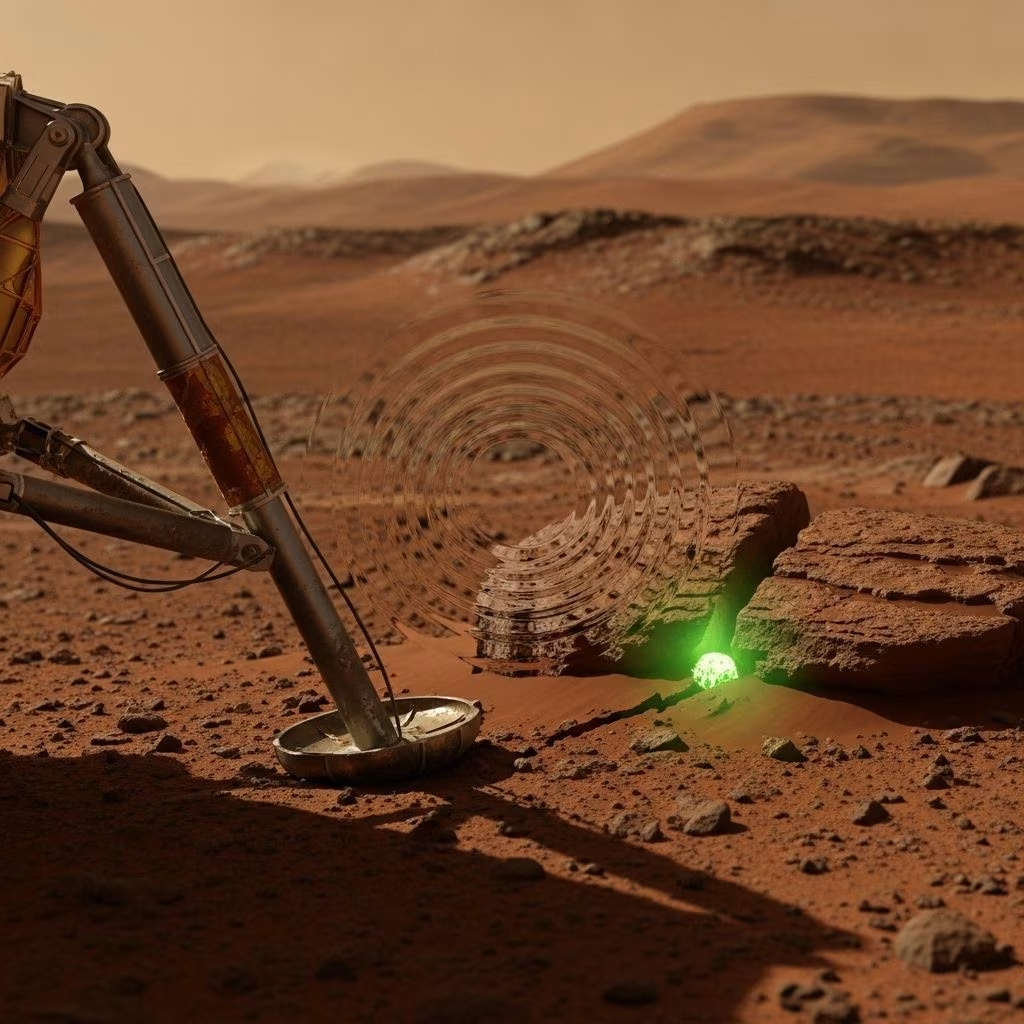
Did NASA Find and Kill Martian Life in the Viking Era?
In the summer of 1976, NASA’s Viking 1 and Viking 2 landers became the first American spacecraft to successfully operate on the surface of Mars. These twin missions sought to answer one profound question: did Mars ever host life? Decades later, a debate endures about whether the Viking experiments may have actually killed Martian microbes that were present in the soil, missing a historic discovery in the process.
This article examines the details of the Viking missions, the science behind the controversial claim, reactions from the scientific community, and how modern Mars exploration continues to seek answers about possible life on the Red Planet.
The Viking Missions: A Search for Alien Life
NASA’s Viking project was designed as a daring leap in planetary exploration. Each spacecraft consisted of an orbiter, which mapped the planet from above, and a lander that would analyze the surface up close. Launching in 1975, they arrived at Mars in 1976, with Viking 1’s lander touching down on July 20—the first time the U.S. had ever landed a craft on another planet.
The landers carried a suite of instruments designed to probe the Martian environment, including soil analyzers, weather sensors, imaging systems, and, most notably, biology experiments intended to detect life.
- Viking 1: Landed in Chryse Planitia, operated well beyond its 90-day primary mission.
- Viking 2: Landed in Utopia Planitia, providing additional data points from a different region.
Together, Viking 1 and 2 revolutionized our view of Mars, returning more than 50,000 photos and reams of scientific data. Their findings shaped planetary science and laid the foundation for subsequent missions.
The Biology Experiments: Hopes for a Breakthrough
The centerpiece of the Viking life-detection package was a trio of biology experiments:
- Labeled Release (LR) Experiment: Designed by Dr. Gilbert Levin, this experiment sought to identify metabolic processes by adding a nutrient solution containing radioactive carbon to a soil sample and monitoring for gases that could indicate biological activity.
- Gas Exchange Experiment: Measured changes in the atmosphere above a soil sample for evidence of gas production or consumption resulting from metabolism.
- Pyrolytic Release Experiment: Looked for the incorporation of carbon from a gas mixture into organic compounds by potentially living organisms in heated soil samples.
Of these, the Labeled Release test produced especially curious results: after adding nutrient broth to Martian soil, the instrument detected the release of radioactive gas—behavior reminiscent of metabolic activity by microbes on Earth.
Initial Results and Early Interpretations
When the data from the LR experiment began streaming back, Dr. Levin and his team were amazed. The measurements from both Viking landers, spaced thousands of miles apart, returned positive responses in four separate trials, with five control samples included for scientific rigor. The gas-release curves resembled those seen when Earth soil teeming with bacteria was tested using the same method.
These results raised extraordinary questions: Had NASA found evidence for Martian microorganisms? Or, were there nonbiological processes unique to Mars at play?
| Experiment | Primary Result | Interpretation |
|---|---|---|
| Labeled Release (LR) | Positive: release of radioactive CO2 | Microbial metabolism or unknown chemistry |
| Gas Exchange | No definitive evidence | Unclear: responses not conclusive for life |
| Pyrolytic Release | No significant result | Unclear: no signs of carbon assimilation |
Given the ambiguous and conflicting nature of the results, NASA scientists ultimately concluded that the evidence was not strong enough to claim the detection of life on Mars. Instead, they attributed the LR results to chemical reactions involving the harsh Martian soil and its oxidizing agents.
Did NASA Accidentally Kill Martian Life?
Decades after the Viking missions, some scientists began to revisit the data—and to ask whether the experiments themselves might have inadvertently destroyed the very microbial life they sought to find. The theory, now gaining renewed attention, hinges on the possibility that Martian life, if it existed, could have been far more fragile or different than anticipated—perhaps dependent on Martian-salty water called perchlorates, or susceptible to drying and heating.
A Question of Water
Dr. Dirk Schulze-Makuch, an astrobiologist at Technical University Berlin, argues that the Viking landers’ experiments assumed that Martian microbes—if present—would react similarly to Earth organisms when exposed to water. But modern understanding of Mars’ chemistry points to the presence of perchlorates in Martian soil, substances that absorb water and lower its freezing point, creating briny conditions hostile to conventional life.
By adding large amounts of pure water to their Martian soil samples, Schulze-Makuch and others speculate that the experiments might have “drowned” potential Martian microbes living in dry, salty microenvironments. If these organisms were adapted to thrive in tiny films of highly concentrated brine, a deluge of sterile Earth-like water could have been toxic, destroying any native biology before it had a chance to reveal itself in the tests.
Additionally, the Viking procedures involved heating the soil, which could have damaged or killed sensitive microbial life before any life-detection could occur.
The Perchlorate Puzzle
Further complicating the science, Martian soil is now known to contain significant amounts of perchlorate salts—a finding made nearly three decades after the Viking experiments by the Phoenix lander in 2008. Earth microbes are generally destroyed by high concentrations of perchlorates, but on Mars, hypothetical native microbes might have adapted to exploit these compounds. This adaptation would mean that the direct addition of liquid water in the Viking experiments may have disrupted, rather than nurtured, Martian life.
- Perchlorates lower the freezing point of water; Mars’ surface may support liquid brines for brief periods.
- Many Earth microbes can’t survive in such environments, but certain “extremophiles” can thrive in high-salt environments—offering a clue for Martian possibilities.
- If Martian life exists, it may be fundamentally different from Earth-based biology, requiring much more tailored detection strategies.
Dissent and Scientific Debate
Not all scientists are convinced by the arguments that Viking found and killed Martian microbes. Mainstream opinion, as of 2025, still holds that the evidence for life detected during Viking’s experiments remains unconvincing:
- Alternative Explanations: Chemistry alone—specifically, reactive compounds in Martian soil like superoxides and perchlorates—may have produced the observed results in the LR experiment without any biological processes.
- Lack of Organics: The Viking landers’ gas chromatograph-mass spectrometer, intended to detect organic molecules, did not find conclusive traces of carbon-based molecules typically associated with life.
- Replication Problems: No subsequent mission has clearly replicated Viking’s ambiguous findings, further complicating the claim that Viking discovered life.
However, the persistent disagreement and ongoing reinterpretation of the Viking data underscores how little is truly known about the potential for life on other worlds—and how vital it is to design experiments that do not rely solely on Earth-based assumptions.
Impacts on Modern Mars Research
The mystery of the Viking results continues to influence Mars exploration. Newer missions, such as the Curiosity rover and Perseverance rover, carry more sophisticated tools for searching for life, including drills to reach below irradiated surface soils, sensors for complex organics, and experiments designed to recognize a wider spectrum of possible biology.
Future astrobiology experiments aim to avoid replicating Viking’s possible mistake: the application of too much water, heat, or other Earth-centric procedures to alien soil. Instead, they are guided by what has been learned about extreme environments on Earth—life that survives in dry deserts, deep sea brines, and frozen Antarctic soils provides analogs that inform how we look for life on Mars today.
Lessons from the Viking Missions
- Viking 1 and 2 remain among the most important probes in planetary exploration history.
- Their ambiguous results taught scientists the importance of planetary protection: carefully avoiding contamination of alien worlds with Earth microbes.
- Mars is a far harsher and more chemically complex environment than anticipated in the 1970s.
- Detecting life beyond Earth may require rethinking our biases and expanding our definitions of habitability.
Frequently Asked Questions (FAQs)
Q: What did the Viking biology experiments actually find?
A: The Labeled Release experiment detected gas production consistent with metabolic activity, but the absence of organic molecules and alternative chemical explanations led NASA to conclude these results were likely not due to life.
Q: Why do some scientists think Viking may have killed Martian life?
A: Some researchers argue that adding pure water and heating the soil may have destroyed microbes adapted for dry, salty Mars conditions—preventing detection before the experiments could succeed.
Q: Has any later Mars mission confirmed Viking’s results?
A: No subsequent mission has confirmed the ambiguous Viking results. More advanced rovers have found complex organics and brines, but not unambiguous evidence of current or past life.
Q: What will future missions do differently?
A: Future missions are developing gentler, less Earth-biased tests, drilling deeper below the harsh surface and searching for a broader range of biosignatures—including molecules and patterns not identical to Earth’s life.
Conclusion: The Search for Martian Life Continues
The Viking missions remain an enduring milestone in space history and the ongoing saga of the search for life beyond Earth. Whether NASA inadvertently killed Martian microbes—or simply ran into a wall of planetary strangeness—may never be fully answered. Yet, in the wake of the Viking data, scientists are rethinking what “life” might mean across the universe, and designing ever-more sophisticated experiments to find it. The lingering question of whether we found, and then lost, life on Mars serves as both a cautionary tale and a powerful motivator for the explorers of tomorrow.
References
- https://science.nasa.gov/mission/viking/
- https://en.wikipedia.org/wiki/Viking_program
- https://www.space.com/nasa-may-have-unknowingly-found-and-killed-alien-life-on-mars-50-years-ago-scientist-claims
- https://www.nasa.gov/history/45-years-ago-viking-1-touches-down-on-mars/
- https://www.livescience.com/space/mars/nasa-may-have-unknowingly-found-and-killed-alien-life-on-mars-50-years-ago-scientist-claims
- https://en.wikipedia.org/wiki/Viking_lander_biological_experiments
- https://www.spaceflighthistories.com/post/nasa-viking-lander
- https://phys.org/news/2016-10-year-old-viking-life-mars.html
- https://thedebrief.org/did-we-find-and-then-accidentally-kill-alien-life-on-mars-rethinking-the-viking-missions/
- https://www.foxnews.com/science/mars-alien-life-nasa
- https://www.planetary.org/space-missions/viking
- https://www.acs.org/pressroom/tiny-matters/1970s-mars-mission.html
- https://www.the-independent.com/tech/nasa-alien-life-proof-mars-space-viking-lr-a9156001.html
- https://phys.org/news/2025-09-years-nasa-spacecraft-life-mars.html
- https://blog.sciandnature.com/2024/03/nasa-knew-there-was-alien-life-on-mars.html
- https://www.space.com/space-exploration/search-for-life/did-nasas-viking-landers-accidentally-kill-life-on-mars-why-one-scientist-thinks-so


