Total Lunar Eclipse September 2025: Live Updates, Maps, and Insights
The total lunar eclipse of September 7–8, 2025, will create a spectacular global event for skywatchers across Europe, Asia, Australia, Africa, and beyond. This in-depth guide delivers all the critical details, visual highlights, scientific explanations, and real-time coverage for enthusiasts and curious observers alike.
Live Coverage: Tracking the Eclipse in Real Time
- Timeanddate.com streamed the eclipse with expert commentary, global timing references, and images as the Moon traversed Earth’s shadow.
- Key moments included planes passing in front of the Moon, the shifting colors from penumbral gray to deep red, and live updates from astronomers in Cyprus and other locations.
- Full duration of the eclipse: 5 hours and 27 minutes, with approximately 1 hour and 22 minutes of totality—when the Moon was completely enveloped in Earth’s umbra (inner shadow).
- Global views captured the Moon behind famous landmarks, like the Burj Khalifa, and showcased guest appearances by Saturn in the night sky.
What Is a Total Lunar Eclipse?
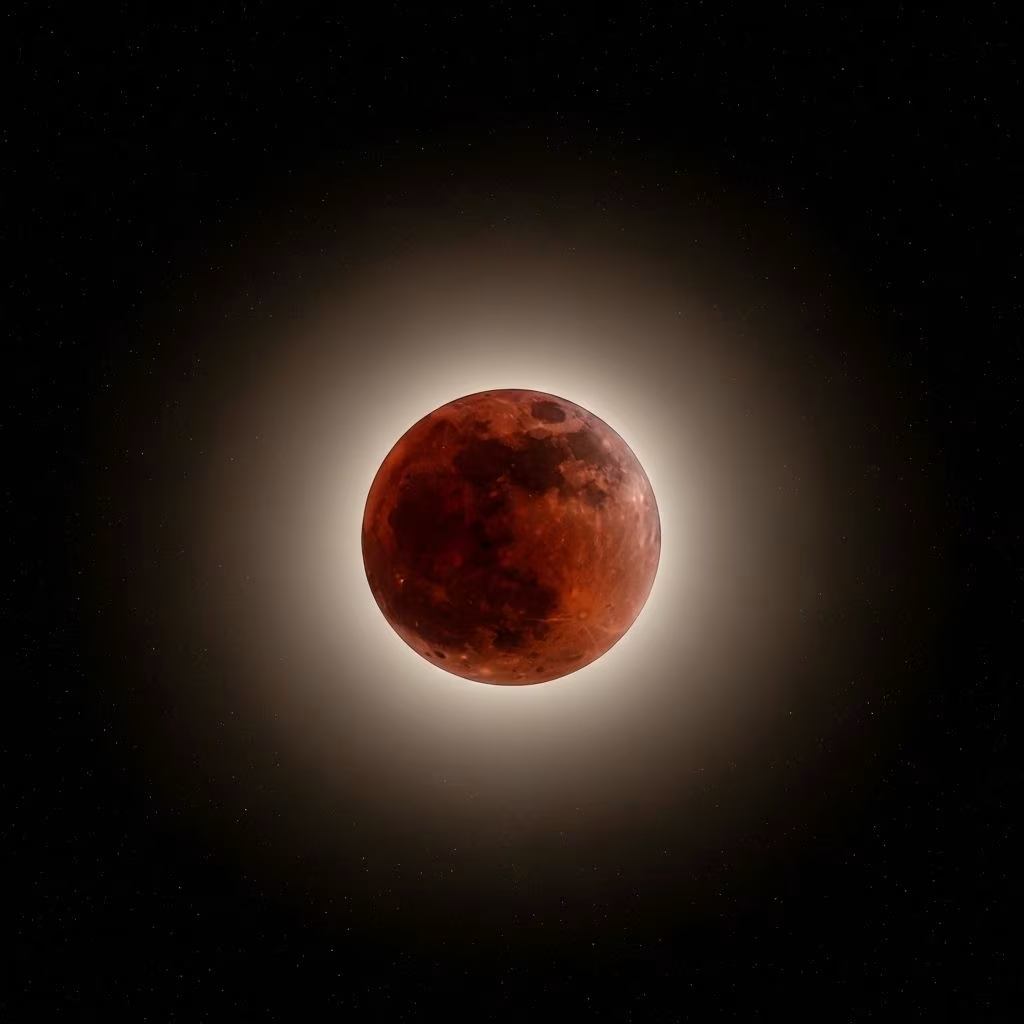
A total lunar eclipse occurs when the Earth positions itself precisely between the Sun and the Moon, causing the Earth’s shadow to cover the entire lunar surface. During this central phase, direct sunlight is blocked, and the Moon often turns a reddish hue—commonly known as a blood moon.
Key Phases of a Total Lunar Eclipse
| Contact | Description |
|---|---|
| P1 | First penumbral contact—the eclipse begins as the Moon enters Earth’s penumbral (outer) shadow. |
| U1 | First umbral contact—the partial eclipse starts as the Moon enters Earth’s umbra (inner shadow). |
| U2 | Second umbral contact—the Moon is completely within the umbra; this marks the start of totality. |
| GE | Greatest eclipse—the moment the Moon is closest to the center of Earth’s shadow. |
| U3 | Third umbral contact—the end of totality; the Moon begins to exit the umbra. |
| U4 | Fourth umbral contact—the end of the partial eclipse as the Moon exits the umbra. |
| P4 | Last penumbral contact—the eclipse concludes as the Moon leaves the penumbra. |
Blood Moon: Scientific Explanation of the Red Hue
During totality, the Moon can take on striking red or copper tones. This is a result of Earth’s atmosphere filtering and bending sunlight, allowing only red wavelengths to reach the lunar surface—a phenomenon known as Rayleigh scattering.
- Rayleigh scattering is also responsible for red sunsets and sunrises on Earth.
- Many observers report seeing subtle blue hues at the edges of the Moon, caused by Earth’s ozone filtering some sunlight.
Who Can See the Eclipse?
The total lunar eclipse of September 2025 was visible to millions across large parts of the globe:
- Europe, Asia, Australia, and Africa experienced the eclipse during prime nighttime hours.
- Regions in Greenwich, UK saw the Moon as it rose after the eclipse had begun, letting viewers catch the later phases (from the end of totality onward).
- Visibility maps illustrated which segments of the eclipse were viewable in different locations by the position of the Moon above the horizon throughout each phase.
Global Visibility Map
An interactive visibility map highlighted where and when the Moon was visible above the horizon during each eclipse phase.
- Shaded regions indicated visibility for penumbral, partial, and total phases, with precise local timings for every contact.
- Selecting map phases let users isolate details about visibility and progression from their exact location.
Diagram: Path of the Moon Through Earth’s Shadow
A detailed eclipse diagram visually tracked the Moon during its journey through Earth’s shadow:
- Red circles depicted the umbra (core shadow), while lighter circles showed the penumbra (outer shadow).
- Annotated contact points marked the transition from one phase to another, crucial for eclipse timing predictions.
- Visibility indicators (green/red circles) signaled which phases were accessible from specific locations.
Timeline: The September 2025 Lunar Eclipse Step-by-Step
- Pre-Eclipse: The event began with the Moon entering Earth’s penumbral shadow (P1), a subtle shading hard to detect outside of time-lapse photography.
- Partial Eclipse: The distinct partial phase began (U1), as a bite was taken out of the lunar disk by Earth’s umbra.
- Totality: The Moon was fully immersed in the umbra (U2), reaching peak eclipse (GE). During this phase, deep red and orange hues became prominent, leading to breathtaking skywatching moments.
- Post-Totality: The Moon began to exit the shadow (U3), transitioning back through partial (U4), until all traces of Earth’s shadow disappeared (P4).
Visual Highlights and Spectacular Photos
The September 2025 eclipse offered unforgettable visuals:
- The blood moon was photographed rising over city skylines, mountains, and historical landmarks.
- Airplanes crossing the Moon during the eclipse provided dramatic silhouetted images for viewers and photographers.
- Saturn made a cameo in the sky near the eclipsed Moon, allowing simultaneous planetary and lunar observations and photographs.
- Live streams captured the shifting colors and gradual transitions, delivering real-time cosmic drama to millions.
Expert Commentary and Interviews
- Astronomers like Matt Woods explained why the Moon turns red at totality, breaking down the atmospheric science for viewers.
- Live interviews from Cyprus and other locations (e.g., Renate Mauland-Hus, Steffen Thorsen) offered personal observations and local perspectives, highlighting regional viewing experiences.
Why Are There More Total Lunar Eclipses Now?
Recent years have seen a higher frequency of total lunar eclipses, often called “blood moons.” Astronomers attribute this to the cycles of lunar nodes and the relative geometry of the Moon’s orbit around Earth.
- Lunar eclipses repeat according to saros cycles, periods of about 18 years that predict eclipse recurrences.
- Clustering of total eclipses can occur based on the orbital mechanics of the Sun, Earth, and Moon.
Watching the Eclipse: Preparation and Viewing Tips
- No special equipment is required to view a lunar eclipse safely—it’s a naked-eye event.
- Telescopes and binoculars can enhance views of the red lunar disk and capture details in surface shading.
- Photography tips include using tripods, long exposures for totality, and adjusting settings for color and brightness changes.
- Monitoring precise timing (local time and UTC) helps optimize viewing and capturing moments from each phase.
Frequently Asked Questions (FAQs)
Q: What causes the Moon to look red during a total lunar eclipse?
A: Earth’s atmosphere filters sunlight, bending red wavelengths toward the Moon and giving the lunar surface a reddish hue at totality (Rayleigh scattering).
Q: Is it safe to look at a lunar eclipse?
A: Yes, lunar eclipses are completely safe to observe with the naked eye, binoculars, or telescopes, with no risk of damage to eyesight.
Q: Which regions saw the September 2025 lunar eclipse?
A: The eclipse was visible across Europe, Asia, Australia, Africa, and some parts of the Americas, with totality timed for prime viewing in many of these areas.
Q: Why do some years have more lunar eclipses?
A: Eclipse frequency depends on the Moon’s orbit and its intersection points (nodes) with Earth’s orbital plane, in cycles known as saros periods.
Q: Can I photograph a lunar eclipse with a smartphone?
A: Yes, smartphones can capture lunar eclipses, especially when paired with tripods or telescopic aids. Adjust exposure settings for red color highlights during totality.
Looking Forward: Upcoming Eclipses and Events
- Keep track of upcoming lunar and solar eclipses through reliable sites like timeanddate.com, which provide live streams and interactive event schedules.
- Next major lunar eclipse events are scheduled within the next two years, with precise timings and visibility details published closer to each event.
Key Takeaways
- The September 2025 total lunar eclipse delivered a long, vivid, red-hued spectacle for millions.
- Global coverage via live streams, scientific analysis, and photography brought the event to viewers worldwide.
- Understanding eclipse mechanics—shadow phases, atmospheric science, orbital geometry—enhances appreciation for these celestial events.
References
- https://www.space.com/stargazing/lunar-eclipses/blood-moon-1st-pictures-september-7-2025-total-lunar-eclipse
- https://www.youtube.com/watch?v=l1Sx0FG8EYE
- https://www.timeanddate.com/eclipse/lunar/2025-september-7
- https://www.space.com/news/live/lunar-eclipse-live-updates
- https://www.timeanddate.com/live/
- https://www.youtube.com/watch?v=0AITXP4DBz8
- https://theskylive.com/lunar-eclipses/2025-09-07
- https://en.wikipedia.org/wiki/March_2025_lunar_eclipse
- https://en.wikipedia.org/wiki/September_2025_lunar_eclipse
- https://www.eclipsewise.com/oh/ec2025.html
- https://science.nasa.gov/eclipses/future-eclipses/
- https://www.eclipsewise.com/lunar/LEprime/2001-2100/LE2025Sep07Tprime.html
- https://www.drikpanchang.com/eclipse/lunar-eclipse-date-time-duration.html
- https://www.universetoday.com/articles/catch-the-final-total-lunar-eclipse-of-2025-sunday-night
- https://science.nasa.gov/eclipses/future-eclipses/mar-29-2025-eclipse/
- https://lovethenightsky.com/lunar-eclipses-this-year/