


What Is Mars Made Of?
Mars, often called the Red Planet, is a world of scientific intrigue and discovery. Its distinctive hue, complex geology, and thin atmosphere continue to captivate scientists and enthusiasts alike. Understanding what Mars is made of offers insight into planetary formation, evolution, and the prospects for life beyond Earth.
The Layers of Mars: Crust, Mantle, and Core
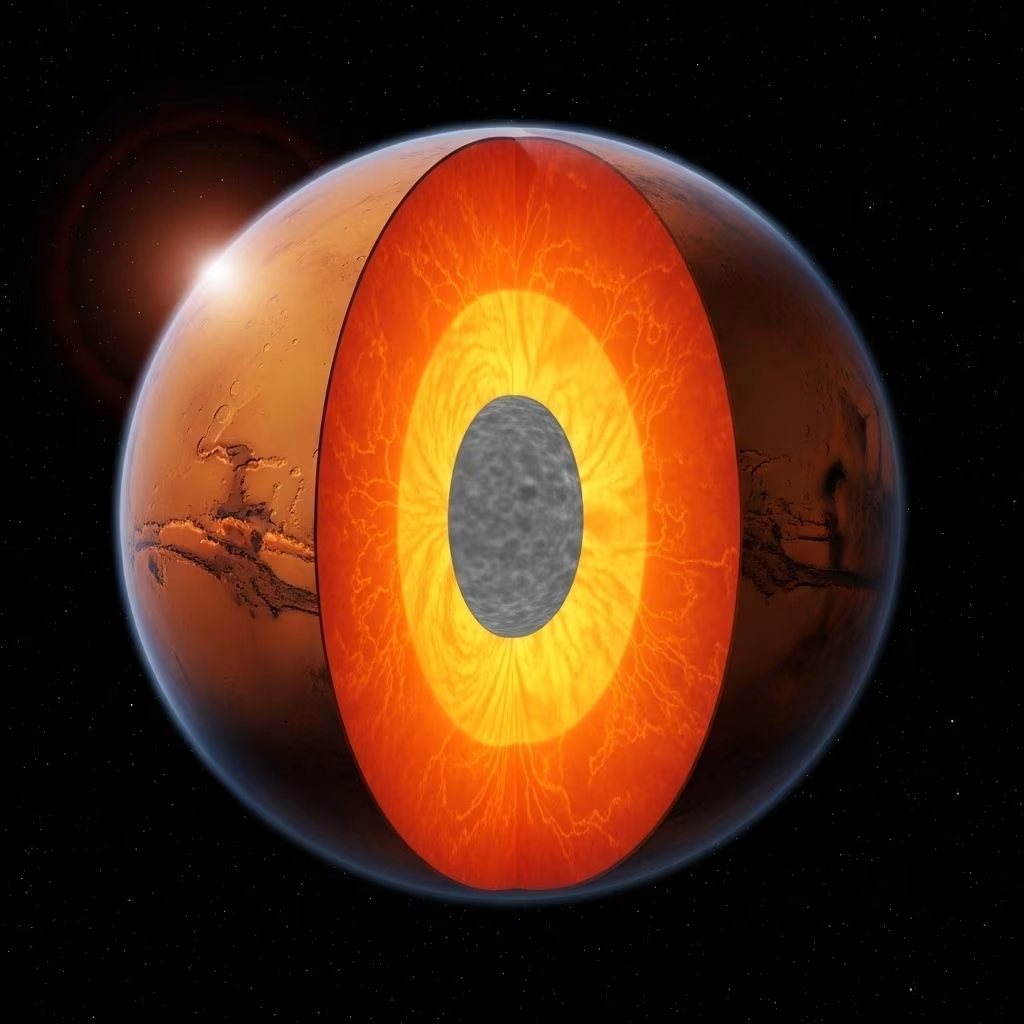
Like Earth, Mars is a differentiated planet: it has distinct internal layers—crust, mantle, and core—each with unique compositions and physical properties.
- Crust: The outermost layer, averaging about 30-50 kilometers thick, is primarily composed of basaltic rock, volcanic minerals, and is enriched with iron oxides that give Mars its reddish color.
- Mantle: Beneath the crust, Mars’ mantle is rich in silicates and has a higher percentage of iron, potassium, and phosphorus when compared to Earth’s mantle.[11]
- Core: The core is believed to be made up of iron, nickel, and sulfur, possibly containing less sulfur than previously thought due to recent research.[11]
Elemental Composition of Mars
Scientists analyze Mars’ elemental composition using data from orbiters, landers, and meteorite samples. These investigations reveal several key distinctions from Earth:
- High Iron Content: The red coloration of Mars comes from iron oxides on its surface, and the mantle contains twice as much iron as Earth’s.
- Sulfur-Rich Core: Mars’ core contains significant sulfur, though recent evidence suggests levels may be lower than previous models predicted.[11]
- Silicates: Silicate minerals are abundant in both the crust and mantle.
- Potassium and Phosphorus: Higher concentrations of these elements compared to Earth, especially in the mantle.[11]
- Volatile Elements: Mars’ crust includes more volatiles such as sulfur and chlorine than Earth’s crust.
What Makes Mars Red?
The famous Martian red color is due to the presence of iron oxides—mainly rust—covering its surface. Iron-rich dust is distributed by wind, blanketing the planet and further accentuating its distinctive appearance.
Mars Meteorites: Clues From Space
Meteorites that originated from Mars have made their way to Earth, providing essential data on the planet’s chemical makeup. These are chiefly grouped into:
- Shergottites
- Nakhlites
- Chassignites
Analysis of these meteorites confirms Mars’ high iron content and offers insight into its interior structure.[11]
Mars’ Surface: Mineralogy and Texture
- Basaltic Rocks: The Martian surface consists largely of basalt, a volcanic rock that forms from quickly cooling lava.
- Olivine and Pyroxene: These minerals are common in Martian rocks and contribute to the planet’s color and magnetic properties.[13]
- Regolith: Martian ‘soil’ is fine, iron-rich dust mixed with grains and rocks, shaped by billions of years of wind erosion and impacts.[12]
Remote sensing by missions such as Pathfinder, Opportunity, Spirit, and Curiosity has identified various rock types, salts, and hydrated minerals, supporting these findings.
Crustal Structure and Complexity
While once thought to be relatively uniform, Mars’ crust shows evidence of complex origins. Recent studies reveal varied rock types and a dynamic geologic past with volcanic, tectonic, and impact-driven processes.
- Volcanic Activity: The massive Tharsis region is home to giant volcanoes like Olympus Mons.
- Impact Basins: Features like the Hellas Basin and Valles Marineris indicate large ancient impacts and subsequent geological activity.
- Crustal Dichotomy: Mars displays a stark contrast between its heavily cratered southern highlands and the smoother northern lowlands.
Atmospheric Composition
Mars’ atmosphere is both thin and dusty, playing a minor but important role in shaping its surface:
- Carbon Dioxide: About 95% of Mars’ atmosphere is CO2. The remainder consists of nitrogen (2.7%), argon (1.6%), and trace amounts of oxygen, carbon monoxide, and water vapor.
- Pressure: Surface pressure averages only 0.6% of Earth’s, but can fluctuate during dust storms.
- Weather: Features thin clouds, dust storms, and seasonal changes. Water vapor is rare but present, and the planet can support frost formation at night.
Unlike Earth, the Martian atmosphere lacks a thick ozone layer and strong greenhouse effect, contributing to wide temperature swings and harsh conditions.
Core, Mantle & Interior Structure Revealed
NASA’s InSight mission has probed Mars’ interior and confirmed the basic structure hypothesized by planetary scientists:
- Core: About 1,800 kilometers in radius, consisting primarily of iron, some nickel, and lower sulfur concentrations than earlier models.[11]
- Molten State: There is evidence Mars has at least a partially molten outer core, though little mantle convection occurs today.
- Seismic Activity: InSight detected ‘marsquakes,’ offering clues to the core’s state and the planet’s tectonic history.
Comparing Mars and Earth
| Feature | Mars | Earth |
|---|---|---|
| Surface Color | Red (Iron Oxide) | Varied (Water, Vegetation, Soil) |
| Main Rock Type | Basalt | Granite, Basalt |
| Core Elements | Iron-Nickel-Sulfur | Iron-Nickel |
| Atmosphere Thickness | Thin | Thick |
| Dominant Atmospheric Gas | CO2 | N2, O2 |
| Surface Pressure | 0.6% of Earth’s | Standard Earth Pressure |
How Do We Know What Mars Is Made Of?
- Remote Sensing: Orbiters use spectrometers to analyze surface minerals and atmospheric gases.[11]
- Landers and Rovers: In-situ instruments on missions like Curiosity analyze soil and rocks directly.
- Meteorite Study: Laboratory analysis of Martian meteorites offers insights into both surface and interior compositions.[11]
- Seismology: NASA’s InSight and similar missions measure seismic waves to infer interior structure.
Water and Ices: Hydrated Minerals on Mars
Despite a thin atmosphere, Mars hosts ample evidence of water in various forms. These include:
- Permafrost: Ice-rich soil lies near the polar regions and at mid-latitudes.
- Hydrated Salts: Minerals containing bound water appear in surface rocks and regolith, especially near ancient lakebeds.
- Polar Ice Caps: Seasonal and permanent ice exists at both poles, mainly as frozen water and dry ice (CO2 ice).
Volcanism and the Martian Surface
Volcanic activity has shaped Mars’ landscape for billions of years, with enormous shield volcanoes like Olympus Mons and Elysium Mons dominating the surface.
- Volcanic Plains: Vast regions covered in flood basalts, formed from repeated lava flows.
- Tectonic Features: Massive fissures like Valles Marineris indicate crustal stretching and faults.
While present-day volcanism is dormant, ancient eruptions played a major role in creating the planet’s crustal diversity.
FAQs: Frequently Asked Questions About Mars’ Composition
Q: Why is Mars red?
A: Mars appears red because its surface is coated with fine-grained iron oxide, or rust, which efficiently reflects reddish sunlight.
Q: Is there water below the surface of Mars?
A: Yes, Mars has subsurface ice, especially near the poles and mid-latitudes. Hydrated minerals also suggest the presence of water locked in surface rocks.
Q: How thick is Mars’ atmosphere?
A: Mars’ atmosphere is very thin—just 0.6% that of Earth’s—with surface pressure averaging about 6 millibars.
Q: What minerals have been found on Mars?
A: Basalt, olivine, pyroxene, sulfates, chlorides, and hydrated salts are among the minerals identified by landers and spectrometers.[13]
Q: How do scientists study Mars’ interior?
A: By analyzing seismic waves (marsquakes) detected by missions like InSight, scientists map the planet’s core, mantle, and crust.
Mars Exploration: Technology Unlocking Secrets
Discoveries about Mars’ composition rely on advanced robotic missions. Notable spacecraft and rovers include:
- Mars Global Surveyor
- Mars Reconnaissance Orbiter
- Curiosity Rover
- Perseverance Rover
- Spirit and Opportunity Rovers
- InSight Lander
Each mission’s spectrometers, cameras, drills, and laboratories analyze soils, rocks, and atmospheric gases, building a detailed picture of the planet’s structure and history.
Key Takeaways: Mars’ Unique Identity
- Iron-rich surface imparts the iconic red color.
- Complex crustal geology shaped by volcanism, impacts, and tectonics.
- Sulfur and iron dominate the core, with less sulfur than previously estimated.
- Thin, carbon dioxide-rich atmosphere with extreme temperature variance.
- Evidence of water in ice, hydrated minerals, and polar caps.
Ongoing and future Mars missions promise to further refine our understanding of what the Red Planet is made of—and what that means for the broader story of the solar system.
References
- https://www.space.com/16895-what-is-mars-made-of.html
- https://en.wikipedia.org/wiki/Composition_of_Mars
- https://www.space.com/mars-crust-origins-more-complicated-than-expected
- https://en.wikipedia.org/wiki/Atmosphere_of_Mars
- http://marspedia.org/Surface_composition
- https://www.britannica.com/place/Mars-planet/Composition-and-surface-pressure
- https://www.nasa.gov/centers-and-facilities/jpl/nasas-insight-reveals-the-deep-interior-of-mars/
- https://www.britannica.com/place/Mars-planet/Atmospheric-structure
- https://study.com/learn/lesson/mars-atmosphere-composition-surface.html
- https://spaceref.com/science-and-exploration/what-is-mars-made-of/
- https://astrobiology.com/2019/09/the-composition-of-mars.html
- http://www.vizagchemical.com/blog/chemical-elements-mars-planet-description-chemical-man
- https://spacemesmerise.com/en-us/blogs/planets/unlocking-the-secrets-a-comprehensive-guide-to-understanding-what-mars-is-made-of
- https://marsed.asu.edu/mep/atmosphere
- https://consensus.app/questions/composition-of-mars/
- https://science.nasa.gov/mars/facts/
- https://par.nsf.gov/servlets/purl/10134891
- https://spacemesmerise.com/en-us/blogs/planets/exploring-the-mysteries-of-the-martian-climate-a-close-look-at-the-weather-on-mars
- https://consensus.app/questions/composition-on-mars/


