What Is the Temperature of Mars?
Mars is often called the “Red Planet,” and its distinct appearance in our sky is matched by a climate and temperature regime that is both extreme and fascinating. Unlike Earth, the surface of Mars experiences dramatic temperature swings, influenced by its thin atmosphere, distance from the Sun, and unique planetary features. This article explores the core details about Martian temperatures, the factors shaping them, and what these mean for future missions and possible human settlement.
Martian Temperature: The Big Picture
On average, Mars is much colder than Earth. Its global, long-term average temperatures hover around -80ºF (-60ºC), but conditions vary widely by latitude, altitude, season, and time of day[15]. The extremes are remarkable— at the planet’s equator during rare summer days, the surface can warm to near 70ºF (20ºC), while at the poles during winter, temperatures can plummet below -195ºF (-125ºC)[10][12][15].
- Global Average: Approximately -80ºF (-60ºC)
- Warmest Surface Temperature: Up to 70ºF (20ºC) at equator during mid-day
- Coldest Surface Temperature: As low as -195ºF (-125ºC) at polar caps during winter
Major Factors Influencing Mars’ Temperature
The temperature regime on Mars is dictated by several interrelated planetary characteristics:
- Thin Atmosphere: Mars’ atmosphere is about 1% as thick as Earth’s, composed mainly of carbon dioxide. It offers little insulation, allowing heat to escape quickly[15].
- Distance from the Sun: Mars orbits farther from the Sun than Earth, receives less solar energy, and thus has overall lower temperatures.
- Seasons: Mars’ axial tilt is similar to Earth’s (~25°), leading to comparable seasonal cycles, but these are accentuated by its eccentric orbit, causing stronger regional effects.
- Surface Albedo: Bright, dusty areas reflect more sunlight and stay cooler, while dark areas absorb heat and become warmer[13].
- Thermal Inertia: Soils with high thermal inertia (larger particles, or packed ground) hold heat longer, moderating temperature swings[13][14].
Surface Temperatures: By Location and Season
Equatorial Region
The most moderate temperatures on Mars occur near the equator due to direct sunlight and lower elevation. During the day, surface readings can sometimes approach or slightly exceed 20ºC (68ºF), while nighttime brings a rapid drop, often to -73ºC (-100ºF) or lower[13][15].
Polar Regions
Martian poles experience the harshest cold. Winter at the poles can see temperatures below -125ºC (-195ºF). During summer, the south polar region may briefly warm above 10ºC (50ºF), but night temperatures remain frigid[13][11][15].
Mid-Latitudes
Mid-latitude regions have moderate seasonal variation, with daytime highs possibly reaching 10ºC to 20ºC (50ºF–68ºF) in summer and lows below -70ºC (-94ºF) at night[13][11].
Comparison Table: Mars vs. Earth Surface Temperatures
| Region | Mars: Daytime High | Mars: Nighttime Low | Earth: Typical Range |
|---|---|---|---|
| Equator | +20ºC (68ºF) | -73ºC (-100ºF) | +15ºC to +35ºC (59ºF–95ºF) |
| Poles | +10ºC (50ºF) | -125ºC (-195ºF) | -30ºC (-22ºF) to 0ºC (32ºF) |
| Average | -60ºC (-80ºF) | -60ºC (-80ºF) | +15ºC (59ºF) |
Daily (Diurnal) Variation
Day and night temperature changes are dramatic due to Mars’ thin atmosphere and low thermal inertia in many soils.
- Daytime: Surface can warm to 20ºC (68ºF) or more in some regions
- Nighttime: Temperatures typically drop below -70ºC (-94ºF) throughout most of Mars
- Range: Temperature swings of over 60ºC (110ºF) in a single sol (Martian day) are possible[13][11][15]
Seasonal Variation
Mars’ seasons are shaped both by its axial tilt and its highly elliptical orbit, creating unconventional climate cycles:
- Southern Hemisphere Summer: Occurs when Mars is closest to the Sun (perihelion), causing warmer, shorter summers and colder, longer winters.
- Northern Hemisphere Summer: Happens when Mars is farther from the Sun (aphelion), leading to cooler, lengthened summers and less dramatic temperature swings.
- Polar Cap Melting: Polar ice caps composed mainly of CO₂ sublimate (change from solid to gas) in summer, raising local temperatures briefly above freezing[12].
Special Features: Thermal Inertia and Albedo
Thermal inertia defines how quickly the Martian surface warms and cools. Soils with higher inertia (darker, coarser grains) retain warmth longer, reducing diurnal extremes. On the other hand, lighter, dustier areas heat rapidly by day and lose heat quickly at night[13].
- Deep soil layers (10–20 cm) have more stable temperatures, averaging -55.7ºC (217.5K), with only minor daily and seasonal variations.
- Dark regions, often basaltic, show higher thermal inertia.
- Bright regions, covered by fine dust, have lower thermal inertia and experience more extreme temperature swings.
Atmospheric Effects and Surface Conditions
Mars’ ultra-thin atmosphere and lack of a significant ozone layer mean the planet is vulnerable to intense solar radiation during the day, and cooling to space at night. This air is primarily carbon dioxide (about 95%), with minimal water vapor or insulating gases.[15]
- Atmospheric pressure: About 0.6% of Earth’s sea-level pressure
- Greenhouse effect: Minimal warming; not enough to significantly raise average temperatures
Recent Temperature Measurements: Viking, Spirit, Curiosity Rovers
Robotic missions have provided detailed readings, confirming and refining earlier models:
- Viking Landers (1976): Recorded air temperatures at about 1.5 meters above ground ranging between +1ºF (-17ºC) and -178ºF (-107ºC). Surface at winter polar caps reached as cold as -225ºF (-143ºC)[11].
- Spirit Rover (2004): Registered ground highs of +5ºC and nighttime lows of -15ºC in Gusev Crater[11].
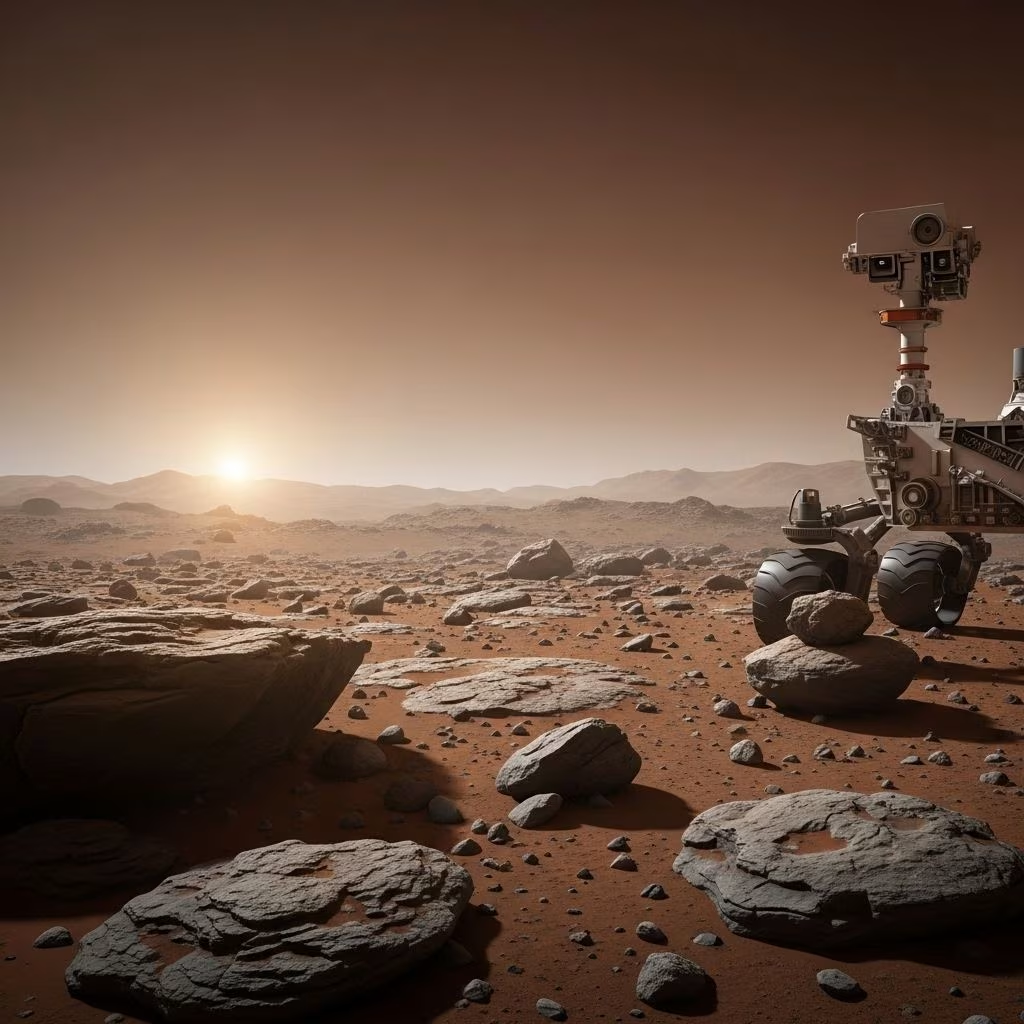
- Curiosity Rover (2012+): Detailed one-fourth of a Martian year’s temperature record in Gale Crater, with surface readings ranging from daytime highs near 20ºC to lows below -70ºC[11].
- Orbiter Data: Instruments like the Mars Global Surveyor Infrared Thermal Mapper have mapped heat profiles across latitudes and seasons.
Temperature Impact on Martian Environment
These extreme temperatures have profound implications for planetary processes:
- Dust Storms: Rapid heating and cooling drive powerful wind cycles and planet-wide dust storms[15].
- Brine Films: Temperature and soil properties may briefly allow thin films of salty water (brine) to form— crucial for astrobiology[13].
- Frost Formation: Carbon dioxide frost routinely forms during cold nights and winter across much of the planet.
Comparing Mars to Other Solar System Planets
| Planet | Average Surface Temp | Atmospheric Composition | Temperature Range |
|---|---|---|---|
| Earth | +15ºC (59ºF) | N2, O2, CO2 | -90ºC to +58ºC |
| Mars | -60ºC (-80ºF) | CO2 | -125ºC to +20ºC |
| Venus | +465ºC (+869ºF) | CO2, N2 | +446ºC to +470ºC |
| Jupiter | -110ºC (-166ºF) | H2, He | -125ºC to -100ºC |
Implications for Future Exploration
Martian temperatures present significant engineering and physiological challenges for future missions. Any spacecraft or habitat must be designed to withstand both scorching day heat and deadly cold at night.
- Thermal Protection: Suits and habitats must insulate against intense cold and unexpected warmth.
- Energy Management: Power systems must operate across extreme temperature swings.
- Life Support: Water in unprotected pipes or equipment could freeze rapidly.
- Seasonal Planning: Missions may optimize landing sites and schedules to coincide with milder seasonal temperatures.
Frequently Asked Questions (FAQs)
Is Mars ever warmer than Earth?
For rare brief periods at the equator in midday summer, Mars’ surface can be as warm as temperate Earth locations, but overall Mars is much colder due to low atmospheric insulation[10].
What causes the large day-night temperature swings on Mars?
Primarily Mars’ thin, almost airless atmosphere— heat from the Sun escapes immediately after sunset, resulting in huge temperature drops each night[15].
Can humans survive the average temperature of Mars?
No. Unprotected exposure would result in rapid heat loss and hypothermia, even during its brief warm periods. Advanced thermal protection is essential for any human activity on Mars.
Do liquid water or brine films form on Mars because of temperature?
Some research suggests brief, thin salty brine films could exist during certain times and at particular locations, assisted by daily temperature cycles and soil characteristics[13]. However, stable surface water remains extremely unlikely.
How do the seasons on Mars affect temperatures?
Mars’ tilt and eccentric orbit combine to produce pronounced seasonal temperature changes, with southern summers being warmer and shorter and winters colder and longer compared to the northern hemisphere.
Key Takeaways
- Mars is a cold planet, with average surface temperatures around -60ºC (-80ºF).
- Equatorial regions see daytime highs up to 20ºC (68ºF) or more, but this warmth is brief and localized.
- Polar winters see temperatures well below -125ºC (-195ºF).
- Daily and seasonal extremes are intensified by the thin atmosphere, variable albedo, and soil properties.
- Understanding Martian temperature is crucial for future robotic and human exploration missions.
References
- https://science.nasa.gov/resource/solar-system-temperatures/
- https://en.wikipedia.org/wiki/Mars
- https://en.wikipedia.org/wiki/Climate_of_Mars
- https://science.nasa.gov/solar-system/temperatures-across-our-solar-system/
- https://www-k12.atmos.washington.edu/k12/resources/mars_data-information/temperature_overview.html
- https://airandspace.si.edu/stories/editorial/today-mars-warmer-earth-see-how-we-compare
- https://www.britannica.com/place/Mars-planet
- https://www.aeronomie.be/en/encyclopedia/mars-climate-important-temperature-difference-between-day-and-night
- https://marspedia.org/Mars
- https://coolcosmos.ipac.caltech.edu/ask/81-What-is-the-temperature-on-Mars-
- https://sten.astronomycafe.net/what-is-the-typical-temperature-on-mars/
- https://www.britannica.com/question/What-is-the-temperature-on-Mars
- https://consensus.app/questions/temperatures-on-mars/
- https://hypertextbook.com/facts/2001/AlbertEydelman.shtml
- https://climatecontroljournal.com/what-is-mars-temperature-and-climate.html
- https://globaldatabase.ecpat.org/files/textbook-solutions/Publication:O4M5/HomePages/mars-average-temperature.pdf
- https://consensus.app/questions/temperature-on-mars/
- https://www.rmets.org/metmatters/martian-meteorology