Why Is Uranus So Cold? Temperatures and Mysteries Explained
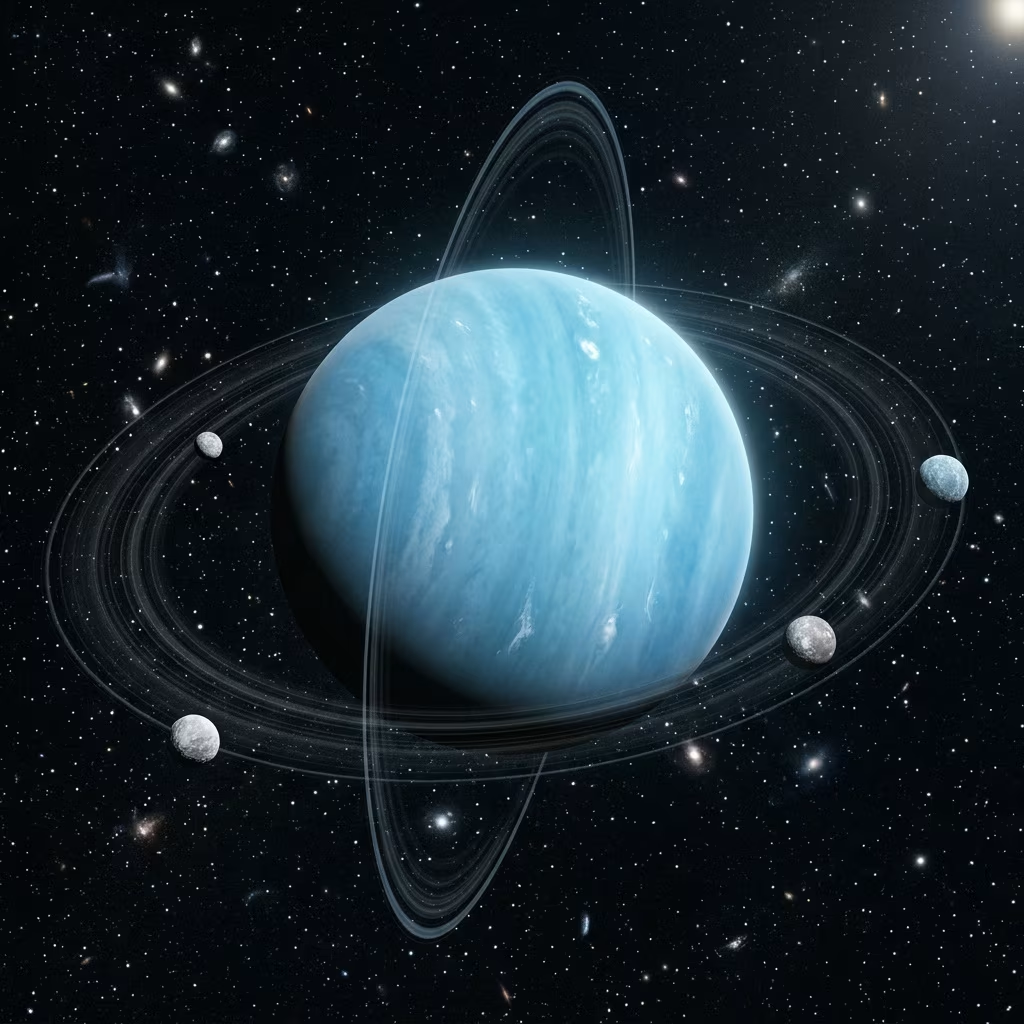
Among all the planets in our solar system, Uranus is an enigmatic ice giant standing out not because it’s farthest from the Sun, but because it is the coldest planet. Its bone-chilling temperatures puzzle scientists even today. What makes this distant, blue-green world so frigid? How does its unique orientation and atmospheric composition contribute to its extraordinary coldness? This article delves into Uranus’ temperatures, climate, and unsolved mysteries, based on current planetary science research and missions.
The Solar System’s Coldest Planet
It may seem intuitive to assume that Neptune, the farthest planet from the Sun, would also be the coldest. However, that title belongs to Uranus, whose minimum recorded temperature is about -224° Celsius (-371° Fahrenheit)—making it the coldest planet in our solar system[12]. Neptune, though farther, is slightly warmer due to its greater internal heat emission.
- Average atmospheric temperature: -224°C (-371°F)
- Coldest recorded temperature: -224°C (-371°F)
- Distance from Sun: About 2.87 billion km (1.78 billion miles)
Understanding Uranus: Context, Composition, and Origins
Uranus is the seventh planet from the Sun and an “ice giant” distinct from the gas giants Jupiter and Saturn. Its coldness isn’t simply a result of distance—but results from its unique formation, chemical composition, and physical orientation. Knowing these factors helps unravel Uranus’s chilling mystery.
Formation and Structure
- Formation: Developed about 4.5 billion years ago in the cold outer reaches of the solar nebula[12].
- Composition: Mostly hydrogen and helium, but also higher proportions of “ices”—water, ammonia, methane—locked in its mantle compared to Jupiter and Saturn[12].
- Axial Tilt: Uranus is unique in that it spins on its side, with an axial tilt of about 98 degrees, possibly caused by a colossal impact long ago[12].
The Impact of Tilt on Seasons and Sunlight
Unlike any other planet, Uranus’ poles face the Sun directly during its 84-year orbit, resulting in day (and night) periods that last for decades. While this could be expected to cause extreme seasonal temperature swings, surprisingly, Uranus’ temperatures are remarkably consistent between equator and poles[10].
- One pole points towards the Sun for 42 years, experiencing continuous daylight, while the other endures the same length of darkness.
- Despite this, temperatures remain uniformly frigid across the globe.
What Drives Uranus’s Extreme Cold?
Solar Energy Intake
Uranus receives only a fraction of solar energy compared to Earth—about 1/400 of what our planet enjoys. While this sets a chilly baseline, Uranus is less able to heat itself internally than other giants, which further amplifies its coldness.
Internal Heat Mystery
| Planet | Internal Heat Output | Relative Temperature |
|---|---|---|
| Jupiter | Emits more than twice the heat it receives from the Sun | Much warmer for its distance |
| Saturn | Emits nearly twice the solar energy it absorbs | Warmer than Uranus |
| Neptune | Emits over twice the heat it gets from the Sun | Colder than Saturn, but warmer than Uranus |
| Uranus | Emits barely more energy than it absorbs from sunlight | Coldest planet |
Scientists suspect that a collision with a massive protoplanet billions of years ago may have “turned off” or redirected much of Uranus’ internal heat, as evidenced by its extreme tilt[12]. Compared to other gas and ice giants, Uranus radiates very little internal heat, making it uniquely cold[10].
Atmosphere and Energy Balance
- Major gases: Hydrogen, helium, with about 2% methane
- Methane’s role: Absorbs red light, giving Uranus its blue-green color and influencing how sunlight is absorbed and re-radiated.
- Minimal sunlight penetration: Most energy is re-radiated as infrared, but little is trapped in the atmosphere.
- Low convection: The lack of strong internal heat means that atmospheric mixing is sluggish, contributing to stable, cold conditions.
Temperature Patterns and Variations on Uranus
Average and Extreme Temperatures
- Tropopause (upper atmosphere): Mean temperature is -224°C (-371°F), the coldest temperature recorded in the solar system[11][12].
- Lower atmosphere and core: Temperatures rise with depth, possibly exceeding 4,700 K (~4,427°C or 8,000°F) near the core.
Surface vs. Atmospheric Temperatures
Uranus has no solid surface; its “surface” is defined at the 1-bar atmospheric pressure level. Temperatures at this level are around -197°C (-323°F), but the coldest observed point—found near the tropopause—drops further.
Temperature Uniformity Explained
Despite seasons that last decades, temperatures at both poles and equator remain almost identical year-round[10]. This consistency is astounding and still not fully understood.
- Even when one pole faces continuous sunlight for 42 years, temperatures barely rise.
- This hints at efficient planetary heat distribution by Uranus’ winds and atmosphere, though the mechanisms remain mysterious.
Atmospheric Phenomena: Winds, Weather, and Storms
Uranus may be cold, but it isn’t without weather. Observations by the Voyager 2 flyby (1986) and later Hubble images have revealed some dynamic systems:
- Winds: Zonal (east-west) winds can exceed 900 km/h (560 mph) at cloud tops.
- Storms: Uranus occasionally shows bright storms and cloud activity, more prominent during equinoxes when sunlight strikes its equator directly.
- Seasons: Season-driven changes in weather are mild relative to the planet’s dramatic tilt—likely because of internal coldness and slow atmospheric dynamics.
Why Uranus, Not Neptune, Is the Coldest Planet
Both Uranus and Neptune are ice giants rich in volatile “ices” and similar in atmospheric makeup. Yet, Uranus is inexplicably colder—even though Neptune is farther from the Sun. Why?
- Internal heat: Neptune emits much more heat from its interior.
- Collision hypothesis: Uranus may have lost or redistributed primordial heat due to a giant impact, leaving it with little internal energy.
- Lack of intrinsic activity: Uranus’s near-featureless blue disc reflects a calmer, less energetic weather system than Neptune’s frequently stormy atmosphere.
Uranus vs Neptune: Key Differences Table
| Factor | Uranus | Neptune |
|---|---|---|
| Distance from Sun | 2.87 billion km | 4.5 billion km |
| Average Temperature | -224°C | -214°C |
| Internal Heat Output | Minimal | Significant |
| Axial Tilt | ~98° | ~28° |
| Weather | Prevailing winds, sparse storms | Frequent, powerful storms |
Current Research and Future Exploration
The persistent coldness and many mysteries of Uranus make it a key target for future deep-space missions. Understanding Uranus will shed light not just on one planet, but on the processes that shape ice giants in other solar systems as well.
- Voyager 2: Only spacecraft to fly by Uranus (1986), revealing its atmosphere, rings, and moons.
- Future missions: NASA and ESA are considering orbiters, probes, and flybys to uncover Uranus’s structure, atmosphere, and interior heat mysteries.
- Ground-based Astronomy: Advances in IR and radio astronomy keep uncovering subtle atmospheric shifts, weather, and equinox phenomena.
Frequently Asked Questions (FAQs)
Q: Why is Uranus so much colder than Jupiter and Saturn?
A: It’s mainly due to Uranus’s lack of significant internal heat output. Jupiter and Saturn both generate considerable energy from slow contraction and early formation heat, warming their atmospheres. Uranus emits barely more energy than it gets from the Sun, making it the coldest major planet.
Q: Do Uranus’s extreme seasons cause dramatic temperature swings?
A: Surprisingly, no. Even when poles experience decades of darkness or sunlight, average atmospheric temperatures remain relatively steady. The reasons are the planet’s minimal internal heat and uniform atmospheric mixing.
Q: Can storms occur on such a cold planet?
A: Yes. Despite frigid temperatures, Uranus can host large, bright storms—mainly as a result of seasonal solar heating variations and complex atmospheric chemistry. These events are typically far milder than those seen on Jupiter or Neptune.
Q: What evidence supports a giant impact in Uranus’s history?
A: Uranus’s unusual 98-degree axial tilt and theoretical loss of primordial heat strongly suggest that a massive collision early in its history could have tipped the planet and “reset” its internal heat mechanisms.
Q: Is Uranus’s coldness unique among known exoplanets?
A: Not necessarily. Dozens of exoplanets are likely similar “ice giants,” but Uranus’s combination of low internal heat and extreme tilt may be unusual even among these distant worlds.
Further Exploration: The Case for a Uranus Orbiter
- Uranus’s temperatures and mysteries have made it a high-interest destination in planetary science priorities.
- Proposed Uranus missions would send atmospheric probes, powerful orbiters, and remote sensing instruments to measure its heat flux, storms, and moons in detail.
- Such missions may answer whether Uranus’s coldness is a primordial remnant, a result of titanic impacts, or both.
Unlocking Uranus’s secrets will help us understand not just our solar system, but ice giant planets orbiting distant stars—and the mechanisms that make worlds so cold and mysterious.
References
- https://www.space.com/astronomy/uranus/scientists-find-uranus-is-surprisingly-warm-heating-up-the-case-for-a-new-planetary-mission
- https://www.space.com/what-is-the-coldest-planet
- https://en.wikipedia.org/wiki/Uranus
- https://www.skyatnightmagazine.com/space-science/why-uranus-coldest-planet-solar-system
- https://science.nasa.gov/resource/solar-system-temperatures/
- https://en.wikipedia.org/wiki/Climate_of_Uranus
- https://science.nasa.gov/solar-system/temperatures-across-our-solar-system/
- https://www.sciencealert.com/uranus-is-getting-mysteriously-colder-and-we-finally-know-why
- https://study.com/academy/lesson/planet-uranus-facts-moons-temperature.html
- https://myspacemuseum.com/uranus-climate
- https://spacem12.com/uranus-temperature-celsius/
- https://spacenessie.com/371-cold-uranus
- https://griffithobservatory.org/exhibits/gunther-depths-of-space/the-planets/uranus/
- https://universemagazine.com/en/the-coldest-planet-in-the-solar-system-what-is-the-temperature-on-uranus/
- https://www.sciencenews.org/article/uranus-energy-planet-sun
- https://lco.global/spacebook/solar-system/uranus/
- https://spacemesmerise.com/en-gb/blogs/planets/unveiling-uranus-secrets-exploring-the-thermal-and-pressure-profile