For generations, Mars has stood out among the planets as the “Red Planet,” captivating astronomers and the public alike. The vivid, rusty color has become central to our cultural and scientific imagination. But why is Mars red? And is the planet truly the color we claim it to be, or is its hue more a matter of perception and context? In this comprehensive article, we’ll explore the physical origins of Mars’s coloration, how different types of telescopes and sensors reveal vastly different views of its surface, and what these insights reveal about Mars’s past.
The Origins of Mars’ Red Color
Mars’s distinctive reddish tone is primarily due to the minerals in its surface dust and rocks—particularly iron oxides. For many years, scientists believed the chief culprit was hematite, an anhydrous, rust-like iron mineral that gives a reddish tint to its environment. However, recent scientific advances have led to a significant revision of this view: new research identifies ferrihydrite, a water-rich iron oxide, as the most plausible source of Mars’s ubiquitous red dust.
- Hematite Theory: Traditional explanations credited Mars’ color to the slow oxidation (‘rusting’) of iron in surface rocks, producing hematite.
- Ferrihydrite Hypothesis: Recent laboratory simulations and spacecraft data suggest the fine iron oxide ferrihydrite, formed in the presence of water, is more consistent with the spectral characteristics of Martian dust.
What Is Ferrihydrite—and Why Does It Matter?
Ferrihydrite is a nanocrystalline, water-containing iron oxide mineral. On Earth, it often forms wherever volcanic ash or basalt interacts with water, resulting in reddish or yellowish deposits familiar from the soils of Iceland or Hawaii. In laboratory settings, Martian-like ferrihydrite produces spectral ‘fingerprints’—patterns of light absorption and reflection—that match those detected by Mars orbiters and landers.
Unlike hematite, ferrihydrite contains water in its structure. Its presence on Mars suggests the surface and dust may have interacted extensively with water in the planet’s past, supporting the hypothesis of a cooler, wetter, and potentially habitable ancient Mars.
The Science of Color: Why Things Look Red
Before delving further, it’s essential to consider what it means for something to be “red”. In physics, the color we see depends on how an object reflects and absorbs visible light. A red object appears red because it preferentially reflects wavelengths in the red region of the spectrum while absorbing most blue and green light.
- Visible Light Spectrum: Human eyes are sensitive to wavelengths from about 400 (violet) to 700 (red) nanometers.
- Reflected Light: Mars’ iron oxide dust mainly reflects longer-wavelength light (red/yellow) and absorbs more of the blue/green part of the spectrum.
- Absorption Features: The specific mineral structures of hematite and ferrihydrite produce diagnostic absorption features—key for remote-sensing studies that analyze color and composition from afar.
Is Mars Always Red? A Matter of Perspective
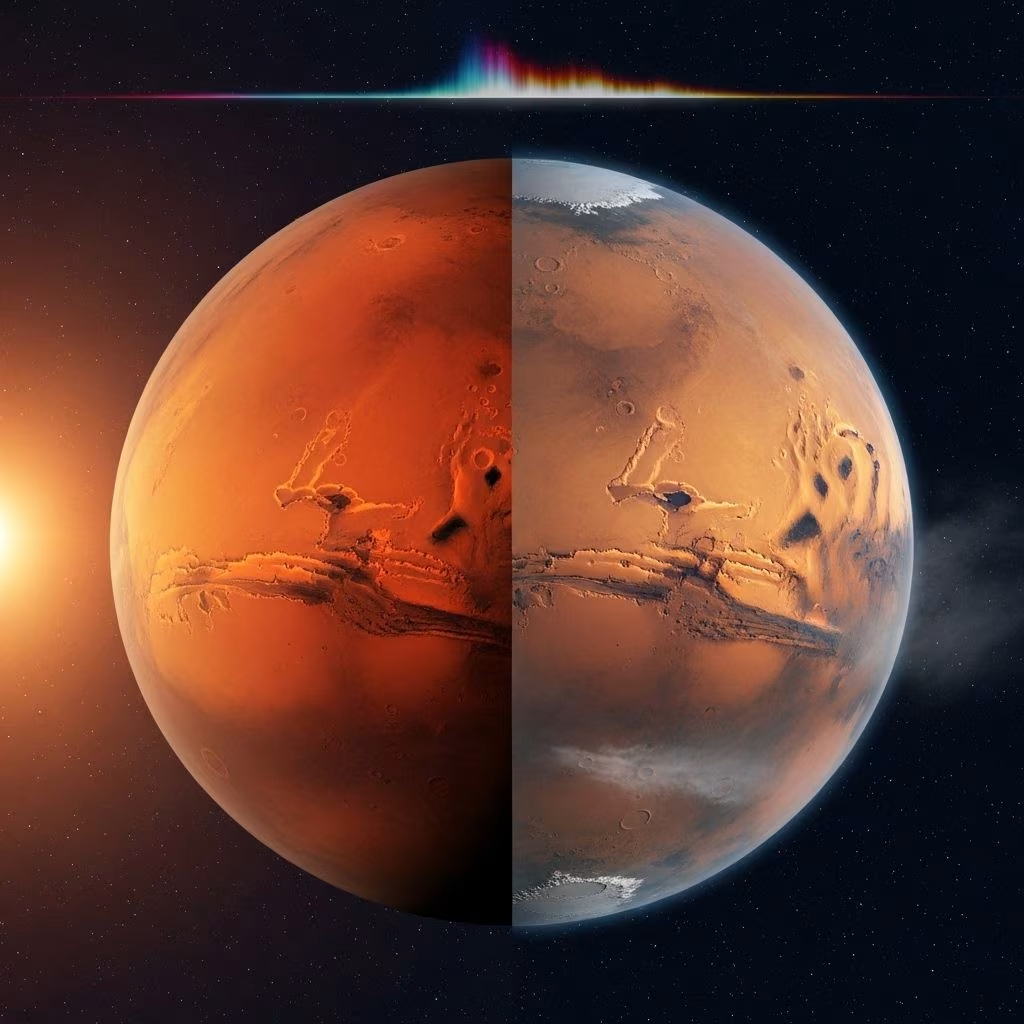
Despite its nickname, Mars does not always appear purely red—as anyone who has observed it through different telescopes, cameras, or even the naked eye during opposition can attest. The apparent color of Mars can change with:
- Viewing Wavelength: Observations using infrared, ultraviolet, or filters that isolate specific colors can make Mars look yellow, brown, tan, or even pale gray.
- Atmospheric Conditions: Both Earth’s and Mars’s atmospheres affect how much light (and which colors) reach our eyes or instruments.
- Surface Texture: Variations in dust cover, rock types, and regional weather (like Martian dust storms) also influence the planet’s apparent color.
For example, spacecraft imagery from Mars orbiters and landers, such as NASA’s Perseverance, uses color filters and calibration targets to record and correct for these differences. As a result, some Mars images appear far more orange, gold, or beige than the deep red of classic telescopic views.
Table: How Mars Appears in Different Light
| Wavelength/Filter | Mars’s Appearance | Scientific Insights |
|---|---|---|
| Visible (~400–700 nm) | Brick-red, orange, or tan | General mineral and dust detection; what human eyes would see |
| Infrared (>700 nm) | Features enhanced contrast; sometimes appears brown or gray | Reveals subsurface minerals and temperature variations |
| Ultraviolet (<400 nm) | Pale, blue-tinted | Highlights atmospheric clouds, surface frost, and high-altitude dust |
| Telescopic (Earth-based) | Usually reddish, but color shifts as Mars rises/sets or during dust storms | Atmospheric effects influence perceived color |
The Historical Puzzle: How Scientists Have Studied Mars’s Color
The mystery of Mars’s hue has been a central question for centuries. Early astronomers speculated about swamps and vegetation based on the changing colors and markings visible through small telescopes. Only with the advent of spacecraft and sophisticated remote-sensing tools in the 20th and 21st centuries have scientists been able to analyze Martian minerals and surface properties directly.
- Spacecraft Missions: Orbiters and rovers (e.g., Mars Global Surveyor, Mars Reconnaissance Orbiter, Spirit, Opportunity, Curiosity, Perseverance) carry spectrometers that measure light at different wavelengths, revealing the signature of iron-rich minerals in the dust and rock.
- Laboratory Simulations: By recreating Martian conditions and mixing volcanic rocks with water, researchers produced ferrihydrite-rich dust that closely matched what is observed on Mars.
Key Finding: The match between lab-created samples and Mars’s observed light spectrum offers persuasive evidence for ferrihydrite dominating the surface dust, especially in regions where water once flowed.
Implications for Mars’s Geological and Climatic History
Understanding the origins of Mars’s red dust is far more than an academic exercise; it directly informs our theories about the planet’s history and potential for ancient life. The newer hypothesis linking ferrihydrite to Mars’s hue points to the following implications:
- Ancient Water: Because ferrihydrite forms in the presence of cool water, widespread deposits suggest Mars was once richer in liquid water than today.
- Evolution to Aridity: If Mars shifted from a wet to a dry environment, the ferrihydrite would have been left as a residue, slowly oxidizing and evolving.
- Potential for Past Habitability: These water-mineral interactions imply there may have been habitats suitable for life during certain periods of Mars’s past.
Why Does the Perceived Color Matter?
Color is a first, powerful clue to composition, but it isn’t just about aesthetics or curiosity. On Mars, color has practical importance for:
- Landing Site Selection: Identifying areas with certain hues can help pinpoint regions most likely to preserve evidence of water—and potentially, life.
- Mineral Mapping: Color datasets help scientists build detailed geologic maps, revealing the distribution of past lakes, riverbeds, and volcanic regions.
- Planning Future Missions: Understanding surface composition aids in developing hardware suited for Mars’s unique conditions.
Why Does Mars’s Color Change in Images?
One of the biggest sources of public confusion is the wide variation in Mars’s appearance across different photos, both from space missions and telescopic views from Earth. This happens due to:
- Instrument Calibration: Cameras are calibrated with special color targets to refine colors, but sometimes this process is skipped in raw data for quick science returns.
- Atmospheric Effects: Dust storms, clouds, and atmospheric haze on both Mars and Earth can scatter or filter sunlight, shifting the apparent color.
- Image Processing: Public-facing images are sometimes deliberately color-enhanced or “balanced” for clarity, scientific analysis, or visual impact, further altering their appearance.
Comparison Table: Mars Image Variations
| Source | Common Color Tones | Reason for Variation |
|---|---|---|
| Human eye (Earth, opposition) | Deep red to orange | Atmospheric scattering, distance |
| Orbiter camera | Reddish-brown, tan | Filter selection and sensor sensitivity |
| Rover camera | Orange, yellow, gold | Calibration targets and local atmospheric haze |
| Raw/unprocessed image | Pale, muted, or grayish tones | Lack of color correction |
Mars Beyond Red: A Dynamic, Changing Planet
To the casual observer, Mars may simply be the “red planet.” But as we’ve discovered, its real colors are a function of both its mineral composition and the ways we observe it. Martian color also changes with seasons, weather, and even episodic dust storms, which can temporarily lighten or darken the planet’s visible surface.
- Changing Hues: When global dust storms occur, particles suspended high in the atmosphere scatter sunlight, giving Mars a muted or yellowish appearance.
- Surface Diversity: Not all Martian regions are equally red: ancient lava plains can appear darker, while dust-covered highlands tend to be lighter and more orange-red.
FAQs: Frequently Asked Questions
Why is Mars called the ‘Red Planet’?
Mars has been known as the “Red Planet” since ancient times because, even to the naked eye, it stands out in the night sky with a distinctly reddish hue. This is due to the vast amounts of iron-rich dust and rock on its surface, most of which reflect red wavelengths of sunlight.
What minerals make Mars red?
The color is primarily due to iron oxides, particularly ferrihydrite (a water-bearing form) and some contribution from anhydrous rust-like hematite. Ferrihydrite’s presence implicates a history of water interaction and supports the idea of an ancient watery Mars.
Does Mars look red to astronauts or probes?
Mars’s actual appearance can vary significantly. To the human eye in daylight on Mars, the ground would look tan, light brown, or ochre rather than a pure, vibrant red. This is because the sky and dust interact with sunlight differently on Mars than on Earth, and direct exposure reduces atmospheric filtering.
Why do photos of Mars look different?
Photos can vary based on camera calibration, color correction, atmospheric conditions, and the filters used. Public-facing NASA images may enhance colors for contrast and scientific clarity, leading to the wide range of hues seen in different sources.
What does Mars’s color reveal about its past?
The abundance of ferrihydrite, which requires water to form, suggests that Mars once had significant and persistent liquid water at its surface. This supports the idea that Mars could have once hosted environments suitable for life.
Key Takeaways
- Mars appears red due to the reflection of sunlight by iron-oxide minerals, especially ferrihydrite, in its surface dust.
- Recent research supports ferrihydrite—formed in the presence of water—as the key to Mars’s signature color, replacing older ideas focused on hematite.
- The way Mars appears depends greatly on observational method, viewing conditions, and even atmospheric events on both Mars and Earth.
- The mineralogy of Mars reveals a history of water, potentially habitable conditions, and a transition from a wetter to a drier planet.
References
- Brown University. “Why is Mars red? Scientists may finally have the answer.”
- NASA Goddard. “New Study on Why Mars is Red Supports Potentially Habitable Past.”
- SETI Institute. “Why Is Mars Red? New Research Uncovers the Real Reason Behind the Red Planet’s Color.”
References
- https://www.brown.edu/news/2025-02-25/why-mars-red
- https://www.space.com/astronomy/mars/is-mars-really-red-a-physicist-explains-the-planets-reddish-hue-and-why-it-looks-different-to-some-telescopes
- https://www.nasa.gov/centers-and-facilities/goddard/nasa-new-study-on-why-mars-is-red-supports-potentially-habitable-past/
- https://en.wikipedia.org/wiki/Mars_surface_color
- https://science.nasa.gov/mars/facts/
- https://www.marssociety.ca/2024/09/27/why-is-mars-red-the-science-behind-its-surface-colour/
- https://www.planetary.org/planetary-radio/2025-why-is-mars-red
- https://www.skyatnightmagazine.com/space-science/why-is-mars-red
- https://www.seti.org/news/why-is-mars-red-new-research-uncovers-the-real-reason-behind-the-red-planet-s-color/
- https://www.youtube.com/watch?v=4_DsX-1-q1E
- https://www.skyatnightmagazine.com/news/mars-red-ferrihydrite
- https://www.livescience.com/space/mars/scientists-made-fake-martian-dust-and-found-a-big-surprise-about-what-makes-mars-red
- https://www.space.com/the-universe/mars/what-makes-mars-the-red-planet-scientists-have-some-new-ideas
- https://www.chemistryworld.com/news/ferrihydrite-in-martian-dust-may-explain-red-planets-colour-and-hint-at-water-rich-past/4021095.article
- https://www.livescience.com/space/mars/is-mars-really-red-a-physicist-explains-the-truth