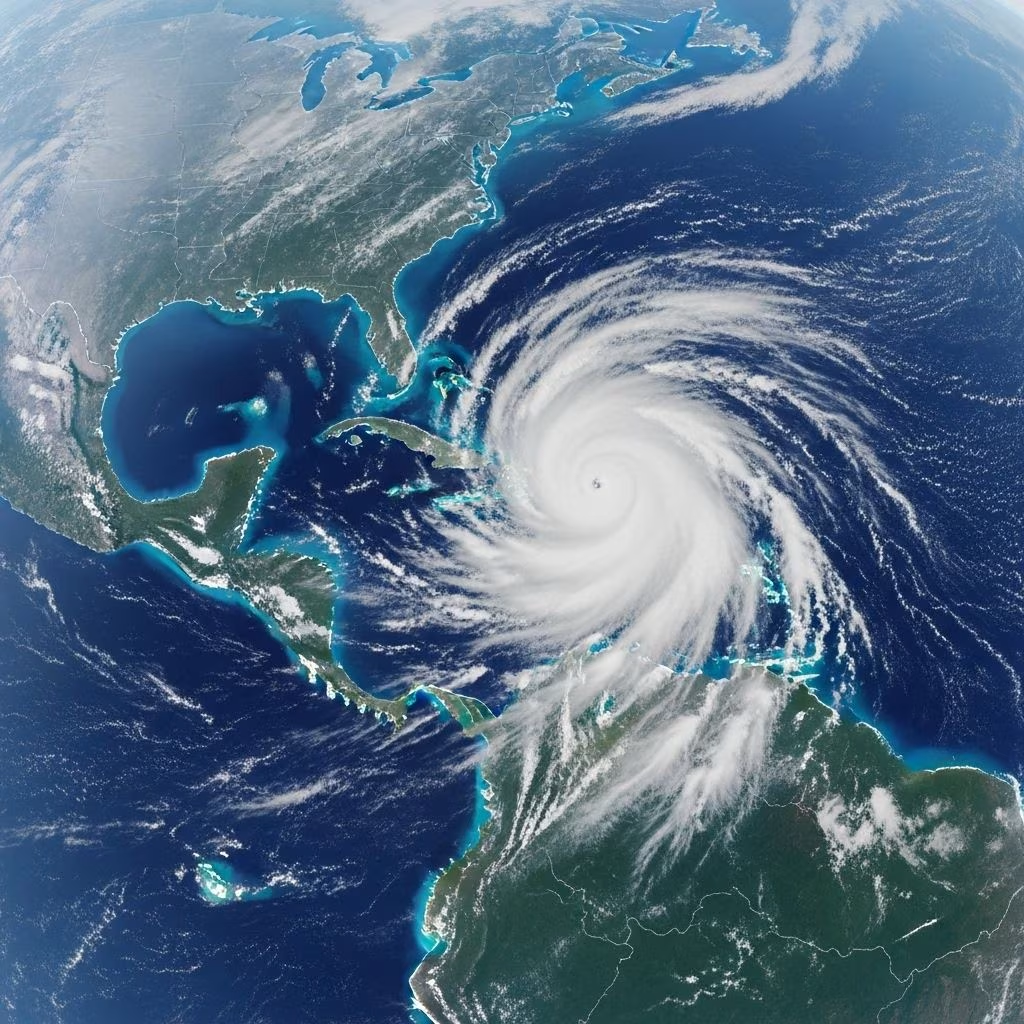
Atlantic Hurricane Season 2019: Forecast, Storm Names, and Essential Preparedness
The Atlantic hurricane season is a crucial annual event for millions living along the United States and Caribbean coasts. The 2019 hurricane season, running from June 1 through November 30, sparked extensive forecasting efforts and community preparation discussions. This guide delivers a thorough analysis of forecasts, storm naming conventions, climate influences, and essential preparedness strategies to help you understand and anticipate the 2019 season.
When Does the Atlantic Hurricane Season Start and End?
The Atlantic hurricane season officially begins on June 1 and ends on November 30. This annual period marks the highest likelihood of tropical cyclones developing in the Atlantic basin. Yet, in recent years, storms have occasionally formed outside these traditional dates, as was the case in 2019 when Subtropical Storm Andrea appeared even before June, making it the fifth consecutive year that a named storm emerged ahead of the official season.
- June 1: Official season start
- November 30: Official season end
- Early storms: Subtropical Storm Andrea formed in May 2019.
What Are the 2019 Atlantic Hurricane Season Forecasts?
Forecasting agencies used several climate indicators to estimate the number and intensity of expected storms in 2019. The most prominent predictions came from Colorado State University (CSU), National Oceanic and Atmospheric Administration (NOAA), and Tropical Storm Risk (TSR):
- Colorado State University (CSU):
- Predicted a slightly below-average season.
- Used both statistical techniques and European long-range model output for improved accuracy.
- Expected a near-average number of named storms but fewer hurricanes and lower ACE (Accumulated Cyclone Energy).
- National Oceanic and Atmospheric Administration (NOAA):
- Forecasted a “near normal” season.
- Expected nine to fifteen named storms, with four to eight hurricanes, and two to four major hurricanes (Category 3 or higher).
- Emphasized the unpredictability of landfall even in average seasons—2018 saw only two major hurricanes, both striking the U.S..
- Tropical Storm Risk (TSR):
- Called for “slightly below-average” activity, estimating 12 named storms, five hurricanes, and two intense hurricanes.
- Rated April forecasts’ predictive skill as “low”—just 2–7% better than non-skill/climatology
- Projected the ACE index (a measure of storm energy) at 81 versus a long-term average of 104.
| Agency | Named Storms | Hurricanes | Major Hurricanes | ACE Index |
|---|---|---|---|---|
| NOAA | 9–15 | 4–8 | 2–4 | N/A |
| CSU | 13 | 5 | 2 | N/A |
| TSR | 12 | 5 | 2 | 81 |
| Long-term Avg | 11 | 6 | 3 | 104 |
Climate Factors Influencing the 2019 Hurricane Forecasts
Several atmospheric and oceanic phenomena impact hurricane formation and strength in the Atlantic:
- El Niño: The presence of a weak El Niño in 2019 was expected to suppress hurricane activity in the Atlantic, as this phase typically increases wind shear, making it harder for storms to develop.
- Sea Surface Temperatures (SST): Slightly below-normal SSTs in the Main Development Region between Africa and Central America suggested fewer major hurricanes.
- West African Monsoon: A stronger than average monsoon was predicted to slightly increase hurricane odds.
- Atlantic Multi-decadal Oscillation: Below its long-term average in 2019, further reinforcing expectations of reduced activity.
The dependency on multiple competing climate signals led to cautious and “near-normal” or slightly below-average predictions overall.
Understanding Key Hurricane Terms
- Named Storm: Any tropical cyclone with maximum sustained winds of at least 39 mph (63 km/h).
- Hurricane: Tropical cyclone with winds of at least 74 mph (119 km/h).
- Major Hurricane: Cyclone reaching Category 3 or higher (winds above 111 mph or 179 km/h).
- ACE (Accumulated Cyclone Energy): A metric integrating both the number and strength of storms in a season.
How Are Hurricanes Named?
The World Meteorological Organization (WMO) maintains a rotating list of names for Atlantic tropical storms and hurricanes, reused every six years. But names are retired when a storm causes significant loss or damage, for clarity and sensitivity. The naming process ensures that each storm has an easily remembered and communicated identifier, avoiding confusion in disaster response.
- 2019 Storm Names: Andrea, Barry, Chantal, Dorian, Erin, Fernand, Gabrielle, Humberto, Imelda, Jerry, Karen, Lorenzo, Melissa, Nestor, Olga, Pablo, Rebekah, Sebastien, Tanya, Van, Wendy.
- Retired Names: Names such as Katrina (2005), Florence (2018), and Michael (2018) retired after devastating impacts.
How Accurate Are Hurricane Forecasts?
Seasonal hurricane forecasts rely on complex climate models and long-term ocean and atmospheric data. Agencies such as NOAA cite approximately 70% accuracy for their hurricane forecasts, though skill rates vary (TSR rates April forecasts only 2–7% above a basic climatology guess). Nevertheless, even an “average” forecast can include highly impactful storms making landfall.
Recent Hurricane Seasons: Lessons Learned
While the 2018 season was considered average in total storm numbers, both Florence and Michael made direct landfalls on the U.S., causing billions in damage and illustrating that landfall likelihood is hard to predict. Climate experts emphasize that even years forecasted to be “quiet” demand vigilance, as any one storm can be devastating.
- Florence (2018): Widespread flooding in the Carolinas
- Michael (2018): Category 5 hurricane, devastating impacts in Florida
Climate Change and Hurricanes
Though climate change was not directly implicating the 2019 hurricane forecast, many scientists acknowledge that global warming is increasing hurricane danger. Warmer air holds more moisture, potentially fueling stronger and wetter storms. However, the primary short-term factors affecting annual hurricane predictions include El Niño/La Niña cycles and Atlantic Ocean temperature changes. Longer-term, continued warming trends pose increased risks for coastal communities.
What Should You Do to Prepare for Hurricane Season?
“We’re expecting a near-normal season but regardless, that’s a lot of activity, and we need to get ready now,” urged Gerry Bell, NOAA’s lead hurricane forecaster. Proactive preparation is essential each year.
- Review evacuation routes and local emergency plans.
- Update insurance documentation and coverage.
- Prepare an emergency kit: Water, non-perishable food, medications, flashlights, batteries, and vital documents.
- Keep communication devices charged and accessible.
- Secure your property: Reinforce windows and remove outdoor objects that can become projectiles.
- Monitor official meteorological sources for real-time updates.
Remember, even a single tropical cyclone making landfall can define an “active” season for any community.
Atlantic Hurricane Season 2019 Forecast Recap
- The season was forecasted as “near normal” to “slightly below average,” with competing climate factors at play.
- Name lists are predefined unless retired post-impact.
- Climate influences included a weak El Niño, cooler-than-average Atlantic SSTs, and a robust West African monsoon.
- Preparedness remains crucial irrespective of predicted storm numbers.
| Storm Category | Description | Wind Speed |
|---|---|---|
| Tropical Storm | Named storm, not yet hurricane strength | 39–73 mph |
| Hurricane | Strong tropical cyclone, named and tracked | 74–110 mph |
| Major Hurricane | Category 3 and above, severe risk | 111+ mph |
Frequently Asked Questions (FAQs)
Q: When is the peak of Atlantic hurricane season?
A: The peak typically runs from mid-August to late October, with September as the statistical high point for hurricane activity.
Q: Why do some hurricane names get retired?
A: If a storm is particularly deadly or destructive—like Katrina (2005), Florence (2018), or Michael (2018)—its name is retired to avoid confusion and respect those impacted.
Q: What is the ACE Index and why is it important?
A: The Accumulated Cyclone Energy (ACE) index measures a season’s total storm energy, integrating both number and strength of tropical storms and hurricanes, giving a broader picture than simple counts.
Q: How does El Niño affect hurricanes in the Atlantic?
A: El Niño years tend to suppress Atlantic hurricane activity via increased wind shear, making it harder for storms to develop and intensify.
Q: Should I prepare differently in years of a below-average forecast?
A: No. Experts emphasize that preparation should be equally thorough every year. Even if only one hurricane hits, it could cause significant disruption and danger for affected communities.
Conclusion: Staying Ready for the Atlantic Hurricane Season
While 2019’s forecasts pointed toward a “near-normal” to slightly below-average activity for the Atlantic hurricane season, the unpredictable nature of tropical systems means every resident and traveler in potential impact zones must stay vigilant. By understanding climate influences, monitoring official forecasts, and periodically reviewing preparedness plans, communities can reduce the risks associated with even a single strike. The annual hurricane season is not only a test for meteorologists and emergency planners but a reminder for all of the vital importance of readiness.
References
- https://www.wunderground.com/cat6/CSU-2019-Atlantic-Hurricane-Season-Forecast-Slightly-Below-Average
- https://time.com/5594685/2019-hurricane-season/
- https://www.weather.gov.ky/hurricanes/hurricane-season-2019
- https://engr.source.colostate.edu/researchers-continue-to-forecast-near-average-2019-atlantic-hurricane-season/
- https://www.accuweather.com/en/hurricane/taking-stock-of-the-2019-atlantic-hurricane-season/635758
- https://www.nhc.noaa.gov/data/tcr/index.php?season=2019&basin=atl
- https://www.usgs.gov/news/featured-story/2019-atlantic-hurricane-season-here-usgs-ready