Understanding Yugoslavia: From Unity to Fragmentation
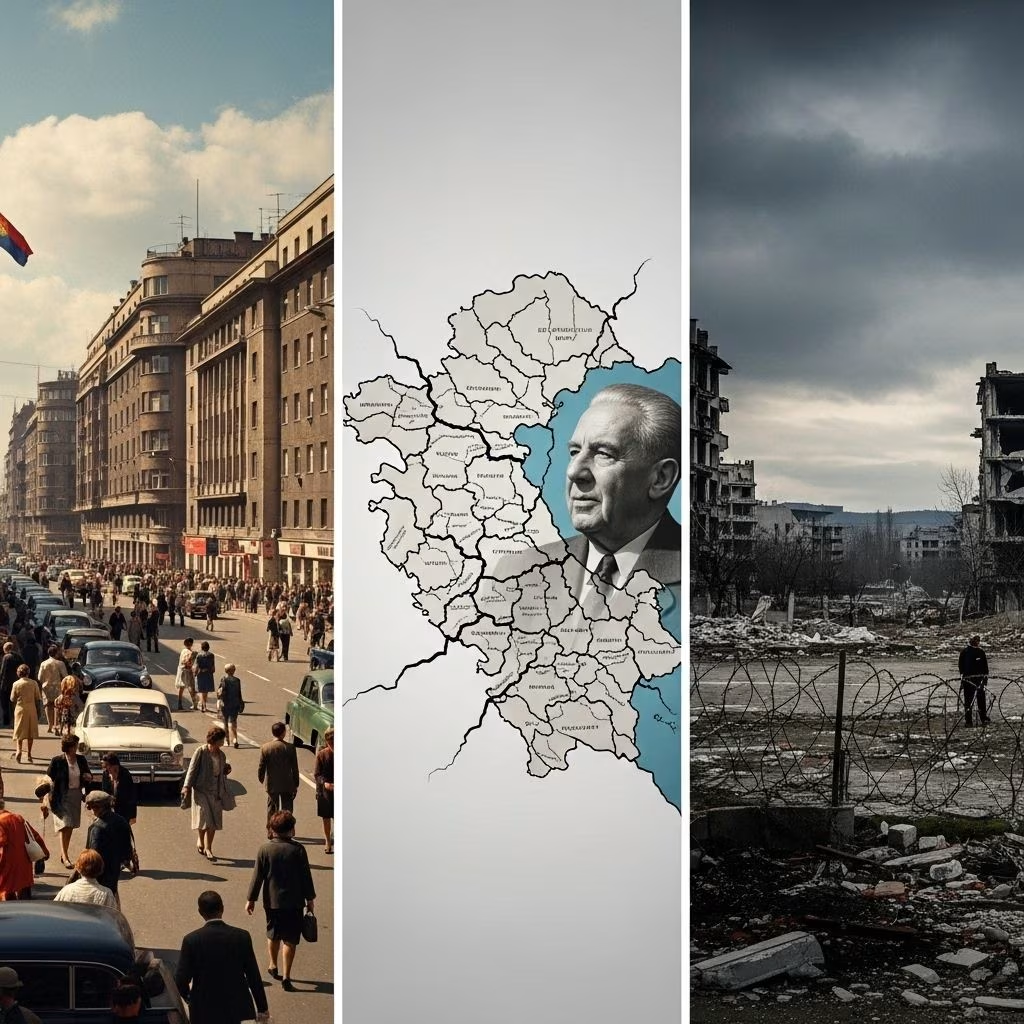
For much of the 20th century, the name Yugoslavia evoked an image of unity amid diversity—a single country pieced together from multiple ethnic groups, languages, religions, and historical trajectories in Southeast Europe. However, the story of Yugoslavia is one of both ambitious federation and tragic fragmentation, shaping the destiny of the Western Balkans well into the 21st century.
The Land of the South Slavs: Yugoslavia’s Inception
Yugoslavia—literally the “land of the South Slavs”—emerged in the aftermath of World War I. Amid the collapse of long-standing empires—Austro-Hungarian and Ottoman—various Slavic and non-Slavic peoples inhabiting the region came together to forge a new political unit.
- 1918: The Kingdom of Serbs, Croats, and Slovenes is established, uniting the former Kingdom of Serbia and territories formerly under Austro-Hungarian and Ottoman rule.
- 1929: Renamed the Kingdom of Yugoslavia, seeking to forge a single Yugoslav identity across Serbs (Orthodox), Croats (Catholic), Slovenes (Catholic), Bosniaks (Muslim), Macedonians, Montenegrins, and others.
However, unity proved fragile amid deep-rooted ethnic, religious, and historical divisions. Tensions simmered throughout the interwar years, with some communities feeling dominated or marginalized by the central government in Belgrade.
World War II: Occupation, Resistance, and Atrocity
The outbreak of World War II shattered Yugoslavia. Nazi Germany and its allies swiftly invaded in 1941, dividing the country between themselves and local collaborators. The Nazi puppet state of Croatia, governed by the fascist Ustaše, engaged in genocidal violence against Serbs, Jews, and Roma.
- Ustaše: Catholic Croat ultra-nationalists committing widespread massacres and persecution, particularly of Orthodox Serbs.
- Četniks: A resistance—and at times collaborationist—force of mainly Serb royalists, aiming to reestablish a Serb-dominated monarchy, infamously brutalizing Croats and Muslims in their territories.
- Partisans: Communist-led irregulars under Josip Broz Tito, advocating both liberation and revolutionary transformation. The Partisans fought Germans, Ustaše, and Četniks, ultimately seeking the creation of a new, united, and socialist Yugoslavia.
The Partisan movement gained international legitimacy and, remarkably, Yugoslavia was the only Eastern European country to liberate itself largely without advancing Soviet armies dictating postwar settlement. By the end of the war, Tito’s Partisans had both military control and popular standing.
Forging a New State: Tito’s Yugoslavia
Josip Broz Tito emerged from the war as the charismatic, iron-willed leader capable of holding Yugoslavia together when all signs pointed to division. His background epitomized Yugoslav diversity: father a Croat, mother a Slovene, wife a Serb, and residence in multiethnic Belgrade.
- 1945: The Federal People’s Republic of Yugoslavia is proclaimed, later renamed the Socialist Federal Republic of Yugoslavia.
- The State Structure: Composed of six socialist republics—Slovenia, Croatia, Serbia, Bosnia-Herzegovina, Montenegro, and Macedonia.
- Within Serbia, two autonomous provinces: Kosovo (ethnic Albanian majority) and Vojvodina (primarily ethnic Hungarian minority).
Each republic had its own parliament and president, but central authority resided in Tito’s dictatorial yet deft hands. Tito’s motto became “Brotherhood and unity”, seeking to suppress nationalism under a shared Yugoslav identity, with lines between republics supposed to be “like white lines in a marble column”—visible, but not divisive.
The Demographics of Yugoslavia
| Republic | Majority Ethnicity | Religion | Key Minorities |
|---|---|---|---|
| Slovenia | Slovene | Catholic | Small Italian & Hungarian |
| Croatia | Croat | Catholic | Serb, Bosniak |
| Serbia | Serb | Orthodox | Albanians (Kosovo), Hungarians (Vojvodina) |
| Bosnia-Herzegovina | Bosniak, Croat, Serb | Islam, Catholic, Orthodox | – |
| Montenegro | Montenegrin | Orthodox | Serb, Albanian |
| Macedonia | Macedonian | Orthodox | Albanian (25%) |
Yugoslavia was remarkable for its diversity:
- Six republics, two autonomous provinces.
- Eight major ethnic groups; dozens of minorities.
- Five languages.
- Three religions: Orthodox Christianity, Catholicism, Islam.
- Two alphabets: the Roman and Cyrillic scripts.
Yugoslavia’s “Third Way”: A Unique Path in the Cold War
Though Communist, Yugoslavia distinguished itself from Soviet-controlled Eastern Europe in both policy and attitude.
- Tito rejected Stalin’s direct control, leading to a dramatic split with the USSR in 1948. Yugoslavia thus became nonaligned—neither fully East nor West.
- Tito’s system allowed private small businesses, in contrast to total state monopoly seen in the USSR. Large industries were nationalized, but a degree of economic freedom gave Yugoslavia the most market-oriented economy in the Eastern Bloc.
- Yugoslavia received significant Western aid, especially from the US, eager to see an independent Communist state outside Moscow’s orbit.
- Tourism flourished, especially along the Adriatic coast, creating ties to Western Europe and boosting living standards.
The Limits of Brotherhood: Underlying Tensions
Despite outward unity, ethnic and nationalist divisions remained just beneath the surface. Tito’s solution was to actively discourage nationalism and force ethnic mixing in key institutions, including the Army.
- National narratives were downplayed or suppressed.
- Military and government units were always mixed to prevent regional separatism.
- Tito’s tight control stifled dissent, including violent crackdowns and Stalinist show trials in the early years.
Tito’s charisma and authority held the patchwork country together, but as he aged and his power faded, underlying tensions began to re-emerge.
The Death of Tito and the Path to Fragmentation
On Tito’s death in 1980, the unifying force of his personality was gone. A weak collective presidency struggled to manage the delicate balance Tito had so carefully constructed.
- Increased autonomy was granted to the republics and provinces, yet no single leader or vision replaced Tito’s authority.
- Economic decline and rising unemployment exacerbated ethnic antagonism.
The Rise of Nationalism
- In Serbia, Slobodan Milošević emerged in the late 1980s, exploiting Serb nationalist sentiment and seeking to centralize power in Belgrade—alarming other republics.
- Republics like Slovenia and Croatia feared subjugation to a “Greater Serbia.” Leaders such as Milan Kučan advocated a decentralized, Swiss-style confederation, but this was rejected by those demanding full autonomy or independence.
The Breakup and Wars of the 1990s
The 1990s were defined by ethnic conflict and the shattering of Yugoslavia into its constituent parts. Local grievances reemerged, fanned by nationalist politics and economic distress. The peaceful “Brotherhood and unity” ethos unravelled into brutal wars.
- 1991: Slovenia and Croatia declared independence—with Slovenia experiencing a brief conflict, while Croatia’s war was bloodier and protracted.
- 1992: Bosnia-Herzegovina declared independence, plunging into a devastating multi-sided war involving Bosniaks, Croats, and Serbs.
- 1991-1995: The wars were marked by ethnic cleansing, sieges (notably Sarajevo), and atrocities such as the Srebrenica massacre.
- 1999: Following years of tension, the Kosovo region erupted in war between Serb forces and ethnic Albanian separatists, halting after NATO intervention.
- 2006-2008: Montenegro (2006) and Kosovo (2008) declared independence, finalizing the breakup of Yugoslavia.
Breakaway States: Timeline of Independence
| Country | Declared Independence |
|---|---|
| Slovenia | 1991 |
| Croatia | 1991 |
| Bosnia-Herzegovina | 1992 |
| Macedonia (North Macedonia) | 1991 |
| Montenegro | 2006 |
| Kosovo | 2008 |
Yugoslavia’s Legacy: What Remains?
Though the country itself has disappeared, the effects of Yugoslav unity and conflict linger powerfully across the Balkans today.
- National borders remain contested, particularly regarding Kosovo, which Serbia and a handful of other states do not recognize.
- Cultural and economic ties forged during the Yugoslav era persist, with former ‘Yugos’ sharing linguistic similarities, cuisine, sports rivalries, and a sense of bittersweet nostalgia among some generations.
- The traumas of the 1990s wars—including war crimes trials, unresolved grievances, and demographic shifts—still shape regional politics.
- EU accession has become a new rallying point for most of the region, but historical tensions and unresolved disputes continue to challenge true reconciliation.
For travelers and students of history alike, understanding Yugoslavia means recognizing the persistent power of identity, memory, and the human drive for both unity and autonomy.
Frequently Asked Questions (FAQs)
What does “Yugoslavia” mean?
Yugoslavia means “Land of the South Slavs,” referring to the union of several South Slavic peoples into one country after World War I.
Which countries were part of Yugoslavia?
Yugoslavia consisted of six republics: Slovenia, Croatia, Bosnia-Herzegovina, Serbia, Montenegro, and Macedonia, plus the autonomous provinces of Kosovo and Vojvodina within Serbia.
Why did Yugoslavia break up?
Yugoslavia’s breakup stemmed primarily from resurgent nationalism after Tito’s death, competing claims to territory, ethnic and religious rivalry, and the inability to find a power-sharing solution to replace the central authority.
Who was Tito, and how did he keep Yugoslavia together?
Josip Broz Tito was a Communist Partisan leader who became president-for-life of Yugoslavia after WWII. His personality, careful regulation of ethnic power-sharing, and suppression of nationalism kept the country united for more than three decades.
What is the Yugoslav Wars?
The Yugoslav Wars refer to the series of violent conflicts in the 1990s as Yugoslavia dissolved, resulting in the independence of several states. The wars were notable for ethnic violence, displacement, and some of the worst atrocities in post-WWII Europe.
Is Tito remembered positively today?
While Tito’s methods were oppressive, many former Yugoslavs remember him more as a unifying hero than a villain, crediting him with holding the diverse country together and providing stability and relative prosperity.
In Retrospect: Lessons from Yugoslavia
Yugoslavia’s history is a warning and a lesson: unity imposed from above may mask, but not resolve, deep divisions. Sustainable peace in a diverse region requires not just tolerance, but active reconciliation, power-sharing, and commitment to pluralism. The legacy of Yugoslavia continues to be written in the lives and aspirations of those living in its former republics.
References
- https://www.ricksteves.com/watch-read-listen/read/understanding-yugoslavia
- https://allthingscruise.com/understanding-yugoslavia-why-did-it-break-up-in-the-1990s/
- https://guesthollow.com/guest-hollows-geography-cultures-online-textbook/former-yugoslavia/
- https://classroom.ricksteves.com/playlists/ZO2W6
- https://www.ricksteves.com/europe/books-movies-croatia-slovenia
- https://www.coursehero.com/file/250641058/Essay-1-place-essaydocx/
- https://www.transitionsabroad.com/publications/magazine/0609/rick_steves_eastern_adriatic_101.shtml
- https://www.heraldnet.com/life/rick-steves-on-walking-the-city-walls-of-dubrovnik-croatia/
- https://community.ricksteves.com/travel-forum/czech/understanding-communism-fascism